Builder Bookkeeping: What to Record, Keep and Claim

Builder bookkeeping is the day-to-day recording of every pound that comes into and goes out of your business: invoices you issue, receipts you hold, CIS deductions taken from your pay, and the costs that belong to each job. Do it weekly and your Self Assessment, your CIS paperwork and your quotes for the next job all get easier. Leave it for months and you are guessing at what you earned.
This guide is for UK sole trader builders and tradespeople. It covers what bookkeeping involves, which records to keep per job, how to handle invoices and receipts, what CIS adds to the picture, and how long to hold on to everything.
TL;DR
- Bookkeeping is recording; accounting is interpreting and filing. As a sole trader you can do the recording yourself if you keep it up weekly.
- Give every job its own reference and attach every invoice, receipt, hire charge and subcontractor bill to it.
- Keep self-employment records for at least five years after the 31 January submission deadline. Contractors under CIS keep deduction records for at least three years after the tax year they relate to.
- Capture receipts the day you buy, not at the end of the month. That one habit prevents most of the missing-paperwork problems.
- Check each job’s real profit against the quote, so the next price you give is based on numbers rather than memory.
Table of Contents
- What bookkeeping means for a builder
- The records to keep for every job
- Invoices: get them right the first time
- Receipts and expenses without the shoebox
- How CIS changes your bookkeeping
- How long to keep your records
- Making Tax Digital and your records
- A weekly bookkeeping routine that takes 30 minutes
- Common bookkeeping mistakes builders make
- Our view on builder bookkeeping
- Put your builder bookkeeping in one place
- FAQ
- Sources
What bookkeeping means for a builder
Bookkeeping is the routine side of your finances. You record sales (invoices), purchases (materials, tools, fuel, hire), payments received, payments made, and any tax deducted at source. Nothing more clever than that.
Accounting sits on top. An accountant takes those records and turns them into a tax return, advises on structure, VAT and tax planning, and deals with HMRC on your behalf if you want. The quality of that work depends on the quality of your records. An accountant handed a carrier bag of receipts will either charge you more to sort it or work with gaps, and gaps cost you in missed expenses.
For a sole trader the split is practical:
| Task | Bookkeeping | Accounting |
|---|---|---|
| Issuing invoices and chasing payment | Yes | No |
| Logging receipts and mileage | Yes | No |
| Recording CIS deducted from your pay | Yes | Checked at year end |
| Working out tax due | No | Yes |
| Advice on VAT registration, tax planning | No | Yes |
| Filing the Self Assessment return | Supplies the figures | Often does it |
Many sole traders do the bookkeeping themselves with an app and pay an accountant only for the return, or file it themselves from tidy records. Both are workable. What does not work is having no records at all.
The records to keep for every job
The single most useful bookkeeping habit for a builder is job-based records. Your tax return only needs totals, but you need to know whether the kitchen extension made money or the loft conversion lost it.
For each job, keep:
- A job reference. A simple code such as a surname plus street or a number. Use the same one on everything.
- The quote and any agreed variations. Written down, dated and signed off where possible. Scope creep is the biggest cause of unpaid extras.
- Invoices you issue, including stage payments, deposits and the final invoice.
- Materials receipts, from merchants, online orders and cash purchases.
- Subcontractor bills and any labour you paid for.
- Plant and tool hire charges.
- Your own time and mileage for the job, even if you never invoice for them separately.
- Payments received, with dates, so you can see what is outstanding.
The method is simple: tag every invoice, materials receipt, subcontractor bill and hire charge to the job, then compare what you quoted against what it cost. After a few months, patterns show up. Perhaps bathrooms always come in near your quote while rewires keep running over. That tells you where to add contingency, and where your pricing is fine.
Pro tip: put the job reference in the filename or notes field of every photo of a receipt. Sorting it later takes seconds instead of an evening.
If you want a quick check on whether a job paid its way, the profit margin calculator for trades turns quoted price and costs into a margin figure.
Invoices: get them right the first time
Invoices are your income record and your route to getting paid. A sloppy one slows payment and causes disputes.
A builder’s invoice should normally carry:
- Your name or trading name and address
- A unique invoice number and the issue date
- The client’s name and the job address
- A clear description of the work done and the dates it covers
- The amount, split into labour and materials where CIS applies
- VAT registration number and VAT amount, if you are VAT registered
- Any CIS deduction shown separately
- Payment terms and how to pay
Stage payments need extra care. Say what each stage covers, what has been paid already and what is due now, so nobody argues later about what a figure refers to.
VAT adds a wrinkle for many builders. If you are VAT registered, some construction services between VAT-registered businesses fall under the domestic reverse charge, which changes the wording and how you show VAT. Our guide to VAT domestic reverse charge invoice wording shows what goes in which box. For layout and ready-to-use wording, see the builder invoicing guide, and if you are a joiner, the carpenter invoice templates.
Keeping invoices in order
- Number them in sequence and never reuse a number.
- Send the invoice the same day the work or stage is finished.
- Record the payment date against the invoice as soon as the money lands, so your list of unpaid work is always current.
- Keep supplier bills in the same place as your own invoices, tagged to the same job.
Receipts and expenses without the shoebox
Receipts are where builders lose the most money, because a cost you cannot evidence is a cost you may not be able to claim. The fix is timing: photograph the receipt when you buy, in the van or at the counter, and tag it to a job or to overheads.
Sort expenses into a few buckets and stay consistent:
- Materials for specific jobs
- Tools and equipment
- Hire and plant
- Vehicle costs and mileage
- Insurance, subscriptions and phone
- Protective clothing and workwear
- Subcontractor payments
Sole traders must keep proof of what they earn and spend. According to the Low Incomes Tax Reform Group, that means invoices for work done, receipts for expenses, bank statements and records of private use of business assets such as mileage logs. If you use your own vehicle for work, a mileage log kept as you go is far more reliable than reconstructing trips at year end. Our receipt retention guide covers what to do with paper and digital copies.
Keep business and personal money apart where you can. A separate business bank account makes reconciling far quicker, because every line on the statement is a business transaction.
How CIS changes your bookkeeping
The Construction Industry Scheme affects almost every builder, either because contractors deduct tax from your payments or because you deduct from subcontractors you pay. Often it is both.
If you are a subcontractor
The contractor deducts a percentage from your labour and passes it to HMRC on your behalf. That deduction counts towards your tax bill. For your books it means:
- Show the labour and materials split on your invoice, because the deduction applies to labour, not materials.
- Record the gross invoice, the deduction and the net amount you actually received.
- Keep the payment and deduction statements the contractor gives you, and match them to your invoices.
- At year end, total the deductions so they are credited against your Self Assessment.
The deduction rate depends on your registration status with HMRC. Our guides to CIS deduction rates and the three rates tradespeople must know explain how each applies, and the CIS deduction calculator shows what lands in your account on a given invoice.
If you are a contractor
If you pay subcontractors, you have record-keeping duties of your own. GOV.UK says contractors must keep the gross amount of each payment invoiced by subcontractors (excluding VAT), any deductions made, and material costs if deductions were made, for at least three years after the end of the tax year they relate to. The same page says a fine of up to £3,000 can apply if you cannot produce them when HMRC asks.

Contractors also file a monthly CIS return and pay over what they deducted. The details and deadlines are on GOV.UK, so check the official CIS pages for the current dates rather than relying on a memory of last year’s.
One point that trips people up: being paid under CIS does not by itself prove you are self-employed for tax purposes. Our article on subcontractor versus sole trader status explains the difference. If your invoicing needs to handle deductions cleanly, see CIS invoice software for UK contractors.
How long to keep your records
Two timeframes matter, and they are different.
| Who | Minimum retention | Source |
|---|---|---|
| Self-employed sole trader | At least 5 years from the 31 January submission deadline after the tax year | LITRG |
| CIS contractor (payments to subcontractors) | At least 3 years after the end of the tax year the records relate to | GOV.UK |
In practice, a sole trader who is also a CIS contractor should work to the longer period for everything. The LITRG gives an example: records for the 2025/26 tax year should be kept until 31 January 2032.
Six or seven years of paperwork is a lot of paper, which is a good reason to store digital copies. Our Self Assessment records checklist lists what to hold on to and in what form.
Making Tax Digital and your records
Making Tax Digital for Income Tax changes how some self-employed people keep records. The LITRG says digital records are required from April 2026 if your qualifying income in 2024/25 was above £50,000, unless you are exempt. If your income was below that, the requirement is not yet triggered for you, but the direction is clear: records kept in software that can send data to HMRC are becoming the norm, and the income threshold for who is covered is staged. Check GOV.UK for where you stand and for the thresholds that apply from later years.
The practical point for a builder is that the records you keep now are the ones MTD software will need. A habit of weekly, job-tagged entries means that moving to digital reporting is a change of tool, not a change of how you work.
A weekly bookkeeping routine that takes 30 minutes
Bookkeeping goes wrong when it becomes a monthly or yearly panic. Do a short session on the same day each week, such as Friday afternoon or Sunday evening.
- Log the week’s receipts. Photograph anything still in the van or your wallet and tag it to a job.
- Issue outstanding invoices. Anything finished but not billed gets billed now.
- Match payments in. Mark invoices paid and note any CIS deductions.
- Chase late payers. Send a polite reminder referencing the invoice number and agreed terms.
- Log mileage and time. Fill in any gaps while you still remember the trips.
- Glance at job profit. Is any job drifting over its costs? Better to spot it in week three than at the final invoice.
- Back up. Make sure digital records are stored somewhere other than your phone alone.
Once a quarter, add a ten-minute review: which jobs made the best margin, which suppliers you spend most with, and whether your day rate still covers your costs.
Common bookkeeping mistakes builders make
- Mixing personal and business spending. It muddies your records and makes expenses harder to evidence.
- No job references. You can total your costs but cannot say which job they belong to.
- Cash purchases with no receipt. Always ask for one, or photograph the till display and note what it was for.
- Not recording CIS deductions. If you miss them, you risk overpaying tax at year end.
- Invoicing late. Late invoices mean late cash, and you carry the cost of materials in the meantime.
- Treating the gross invoice as income you can spend. Tax and any deductions need setting aside.
- Leaving everything to the last week before 31 January. Rushed returns contain errors.
Our view on builder bookkeeping
We built TradeTally because the admin that follows a day on site is the part most builders dread, and it is usually done at the worst time: tired, in the van, with a pile of receipts.
Our approach is to make that admin happen at the point it arises. You raise a branded invoice from your phone, snap a receipt before it goes in the glovebox, and see the profit on each job as the costs come in, rather than discovering it in January.
The CIS side is where we think a tool earns its keep. Our platform is designed to handle CIS deductions for you, so you are not working out percentages on the back of a quote, and it produces tax-ready records, including an SA103F export, that you or your accountant can use directly for Self Assessment.
Good bookkeeping is not about becoming an accountant. It is about having the right information when you price the next job, chase a payment or fill in a return.
Simon
Put your builder bookkeeping in one place
If you want invoicing, receipts, CIS deductions, mileage and per-job profit together, TradeTally is a UK web and mobile app for sole tradespeople. The Starter plan is free at £0 per month, with limited invoicing. Professional is £12 per month, or £120 per year, for full access including unlimited invoices, receipts and tax exports.
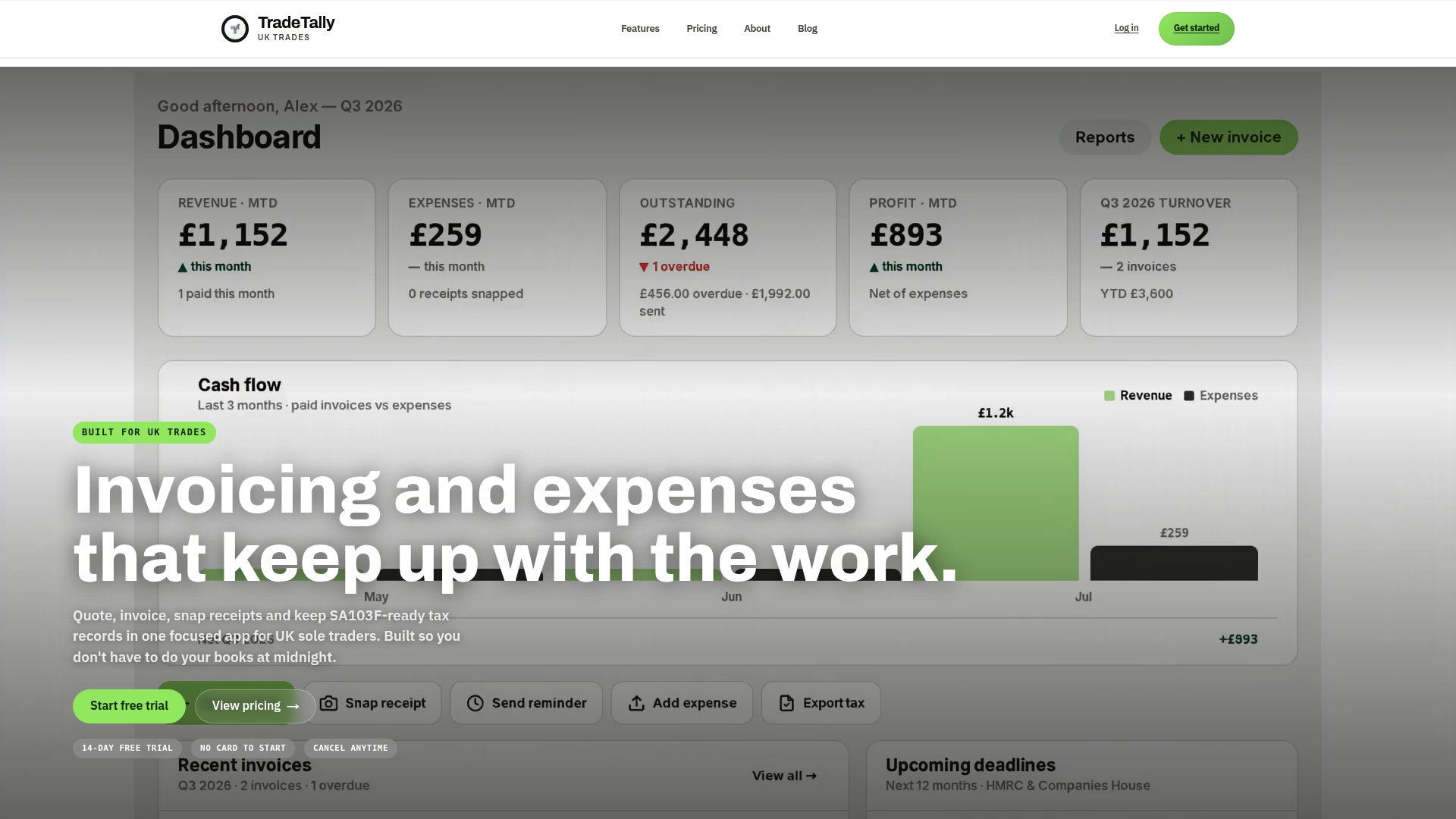
You can see both plans on the TradeTally home page or go straight to the pricing page.
FAQ
Do I need a bookkeeper if I am a sole trader builder?
Not necessarily. Many sole traders keep their own records weekly and use an accountant only for the tax return, or file it themselves. What matters is that your records are complete, tagged to jobs and kept for the required time. If your work involves VAT, employees or a lot of subcontractors, professional help becomes more worthwhile.
What is the difference between bookkeeping and accounting for a builder?
Bookkeeping is the ongoing recording of invoices, receipts, payments and deductions. Accounting uses those records to work out tax, prepare returns and advise on decisions such as VAT registration. Good bookkeeping makes the accounting quicker and often cheaper.
How long should a builder keep business records?
Self-employed people should keep records for at least five years from the 31 January submission deadline for the relevant tax year, according to the Low Incomes Tax Reform Group. CIS contractors must keep subcontractor payment and deduction records for at least three years after the end of the tax year, as GOV.UK sets out. If both apply to you, follow the longer period.
How do I record CIS deductions as a subcontractor?
Show labour and materials separately on each invoice, then record the gross amount, the deduction and the net payment received. Keep the deduction statements from your contractor and total them at year end so they are credited against your tax bill. Our CIS deductions guide explains the rates.
What is the easiest way to track whether a job made money?
Give the job a reference and tag every invoice, receipt, hire charge and subcontractor bill to it. Then compare the total cost with what you quoted and invoiced. Doing this as you go shows overruns while you can still do something about them.
Sources
- Tax: keeping records, Low Incomes Tax Reform Group
- What you must do as a CIS contractor: record keeping, GOV.UK
Recommended
Related articles

Mobile Bookkeeping for Trades: A Practical UK Guide
How UK sole traders can keep invoices, receipts, mileage and Self Assessment records up to date from the van, with a simple routine and a checklist.

Builder Invoicing: VAT, CIS and MTD
A UK builders' guide to legally valid, on‑site invoices. Show the VAT reverse charge and CIS deductions, use copy ready templates, and be MTD ready from 6...

How to Track Business Expenses as a UK Sole Trader
A practical UK guide to tracking business expenses as a sole trader: what to record, which categories are allowable, how long to keep receipts, and a simple routine.

Contractor vs Subcontractor under CIS: What Each Must Do
Contractor or subcontractor under CIS? See who is which, what each must do, how the 20%, 30% and 0% deductions work, and when you can be both.