How to Track Business Expenses as a UK Sole Trader

The simplest way to track business expenses in the UK is to record every cost the day it happens: photograph the receipt, note what it was for, put it in an expense category and keep it all in one place. Do that weekly at the very least. You will then have the records HMRC expects, a clear view of your real profit, and no scramble when Self Assessment comes round.
This guide covers what to record, which categories you can claim, what you cannot, how long to keep records, how to handle mixed business and personal costs, and a routine that fits around a working day on site.
TL;DR
- Record each expense when it happens: date, supplier, what it was for, amount and category. Photograph the receipt straight away.
- Claim only costs that are wholly and exclusively for the business, and split anything that is part personal use.
- Keep your records for five years after the 31 January submission deadline for that tax year.
- Sole traders above the Making Tax Digital income thresholds need software that keeps digital records and sends quarterly updates.
- A weekly 15-minute check against your bank statement catches most of what gets missed.
Table of Contents
- Why tracking expenses properly matters
- What to record for every expense
- Expense categories a sole trader can claim
- Mixed business and personal costs
- How long to keep your records
- A simple system you can set up this week
- Spreadsheet, shoebox or app?
- Making Tax Digital changes the stakes
- Our perspective
- Keeping expenses and invoices in one place
- Common mistakes to avoid
- FAQ
- Sources
Why tracking expenses properly matters
Allowable expenses reduce your taxable profit. GOV.UK gives the example of a sole trader with £40,000 turnover and £10,000 of allowable expenses, who pays Income Tax on the remaining £30,000. Every legitimate cost you forget to record is profit you pay tax on for no reason.
There is a second reason, and it is the one that causes disputes: proof. GOV.UK says you must keep records of all business expenses as proof of your costs. You do not send the proof in with your return, but you need it if HMRC asks. A claim you cannot back up is a claim you may lose.
The third reason is practical. If you know what you spent on materials, fuel and tools this month, you can price the next job properly instead of guessing.

What to record for every expense
Keep the same fields every time, so nothing depends on memory:
- Date of the purchase.
- Supplier, such as the merchant, fuel station or software provider.
- What it was for, ideally with the job or customer if it was bought for one.
- Amount, including VAT if you are VAT registered, shown separately.
- Category, chosen from a fixed list (more on that below).
- Business-use portion, if the cost is shared with personal use.
- The receipt or invoice, as a photo or PDF.
The Federation of Small Businesses publishes a free expense log spreadsheet built on much the same fields: date, description, supplier, category, amount and business-use portion, with a category summary and a reminder if you are using the trading allowance. A spreadsheet works if you are disciplined. An app that captures the receipt on the spot removes the typing.
Expense categories a sole trader can claim
GOV.UK lists the main groups of allowable expenses for the self-employed. Here is how they look for a tradesperson.
| Category | Typical trade examples |
|---|---|
| Stock or raw materials | Pipe, cable, timber, fixings, paint, consumables bought for jobs |
| Travel | Fuel, parking, tolls, public transport to site, vehicle running costs |
| Clothing | Workwear with a logo, PPE, protective gear (not everyday clothes) |
| Office costs | Stationery, phone and internet for business, software |
| Premises | Rent or running costs of a workshop or unit |
| Staff | Subcontractor or employee costs |
| Financial | Bank charges, business loan interest, insurance |
| Advertising and marketing | Van signage, website, business cards, online ads |
| Subscriptions | Trade body membership, trade publications |
| Training | Courses that maintain or update skills you already use in the business |
Tools get their own question from many tradespeople. Small hand tools are often claimed as expenses, while larger equipment may be treated differently, so it is worth reading our guide to allowable tools expenses for UK sole traders before you decide where a purchase belongs.
Legal and financial costs
GOV.UK’s page on legal and financial costs is specific. You can claim accountant, solicitor, surveyor and architect fees when they are for business reasons, and professional indemnity insurance premiums. You can also claim business bank, overdraft and credit card charges, interest on business loans, hire purchase interest and leasing payments.
You cannot claim the repayment of the loan itself, fines for breaking the law, the legal costs of buying property or machinery, or the cost of preparing and submitting your own Self Assessment return.
What you cannot claim
Money you take out of the business for personal use is not an expense. Neither is anything that is not for the business. If you choose the £1,000 tax-free trading allowance instead, GOV.UK is clear that you cannot also claim expenses. The allowance generally suits people whose costs are very low. If you buy materials, run a van and pay for tools, you will almost certainly be better off recording real expenses, which is the point of tracking them in the first place.
Mixed business and personal costs
Vans, phones and the home office are where most mistakes happen. LITRG says that if you use your car or van for both business and private purposes, you need a record of business use including running costs and fuel, unless you use simplified expenses for motor costs. If you work from home, you need to allocate running costs between private and business use, unless you use the simplified flat rate.
A workable approach:
- Phone and broadband: work out a reasonable business percentage from your usage, write down how you reached it, and apply it consistently.
- Van used privately too: log business journeys, or keep a mileage record if you choose the simplified method. Our mileage log template and HMRC rules guide explains what a log needs to show.
- Home office: decide between a flat rate and a proportion of actual costs, and stick with the method you choose.
Pro tip: record the business-use percentage at the time you log the expense, not at year end. It is much harder to reconstruct twelve months later. If you want a worked approach for splitting costs on the go, see how to split personal and business expenses with snap receipts.
How long to keep your records
LITRG explains that a self-employed person must keep adequate records for five years from 31 January following the tax year of the return. For the 2025/26 tax return, that means keeping records until 31 January 2032.
The records to keep include:
- Sales and income records
- Purchase and expense invoices and receipts
- Purchases and sales of assets
- Personal withdrawals and personal money paid into the business
- Journey details, if you claim mileage under simplified expenses
LITRG also points out that digital habits create new risks. If you change email address, bank or card provider, or an online account closes, you may lose access to the history. Download copies regularly rather than assuming the platform will keep them for you. Our Self Assessment records checklist turns the five-year rule into a checklist you can work through.
A simple system you can set up this week
HMRC’s Tax Confident campaign says good record-keeping is about doing it little and often: keep everything in one place, update records weekly or monthly, photograph receipts as soon as you get them, and check your records against bank statements. Here is that advice turned into a routine for someone working on site all day.
Step 1: Separate the money
Open a business current account, or at minimum a dedicated card, and use it for business costs only. It will not make an expense allowable, but it makes the bank-statement check in step 5 far quicker and reduces mixed transactions.
Step 2: Fix your category list
Use the categories in the table above and add nothing new unless you really need it. A short, stable list makes year-end totals meaningful. This also answers the common question of which expense categories a sole trader needs: the ones that match the boxes on your return.
Step 3: Capture the receipt on the spot
The moment you leave the merchant, photograph the receipt. Paper fades, gets wet in a van door pocket, and disappears. For online purchases, forward the confirmation email to a single folder or into your records app.
Step 4: Link costs to jobs
When materials are bought for a particular job, note it. That tells you what the job really cost, and it helps when you invoice. Tax Confident also advises recording date, customer, amount, what it was for and how they paid on the income side, so your invoices and your expenses sit side by side.
Step 5: Do a weekly check
Pick a fixed slot, such as Friday afternoon. Spend 15 minutes going through the bank statement and tick each line against a recorded expense or sale. Anything unmatched is either a missing receipt or a personal cost to leave out. Weekly is the point at which you can still remember what a £37.40 card payment was.
Step 6: Review monthly
Once a month, look at the category totals. Is fuel creeping up? Have you bought the same consumables three times? You are not just filing for tax, you are learning where the money goes.
For a longer walkthrough, our expense tracking guide for UK sole traders and our article on how to track business expenses as a sole trader go into the detail. If you want ideas for tools and workflows that keep expenses organised throughout the tax year, this page on organising expenses throughout the tax year is a place to start.
Spreadsheet, shoebox or app?
All three can work, but they fail in different ways.
| Method | Strength | Where it breaks |
|---|---|---|
| Shoebox or envelope | Costs nothing | Faded receipts, lost paper, a long evening of sorting before January |
| Spreadsheet | Flexible, familiar | Needs typing, easy to skip, no receipt images attached |
| Dedicated app | Receipt photo, category and amount captured together | Only works if you use it on the day |
Whichever you choose, the test is the same: can you find the receipt for any claimed expense in under a minute? If not, tighten the system before the year ends, not after.
Making Tax Digital changes the stakes
Record-keeping is becoming a digital requirement for larger sole traders. GOV.UK states that from 6 April 2026, sole traders and landlords with £50,000 or more in qualifying income from self-employment and property in 2024/25 must use recognised software to keep digital records and send HMRC quarterly updates. The threshold falls to £30,000 (based on 2025/26 income) from April 2027, and £20,000 (based on 2026/27 income) from April 2028. ICAEW’s guidance on the Finance Act 2026 confirms the phased approach.
The same HMRC announcement says those joining in April 2026 still file their 2025/26 return by 31 January 2027 in the usual way. Quarterly updates fall due on 7 August, 7 November, 7 February and 7 May each year, and the first MTD tax return, covering 2026/27, is due by 31 January 2028.

If you earn under the first threshold today, it is still sensible to get your habits right now, because the threshold is coming down. Our six steps to be ready for MTD for ITSA and our page on Making Tax Digital software for sole traders explain what to prepare.
Our perspective
Most tradespeople we speak to do not have a problem understanding expenses. The problem is timing. The receipt is in your pocket at 2pm, the invoice needs sending at 6pm, and by 9pm the last thing you want is to type up a week of fuel and materials.
That is why we built TradeTally around the van, not the office. Snap the receipt when you buy, create the invoice before you leave the driveway, and let the records build themselves as you work. The aim is a set of tax-ready records at the end of the year that you did not have to stay up late to create.
Our view is simple: if capturing an expense takes more than 20 seconds, it will not happen consistently. Design your system, whether it is ours or not, around that number.
Simon
Keeping expenses and invoices in one place
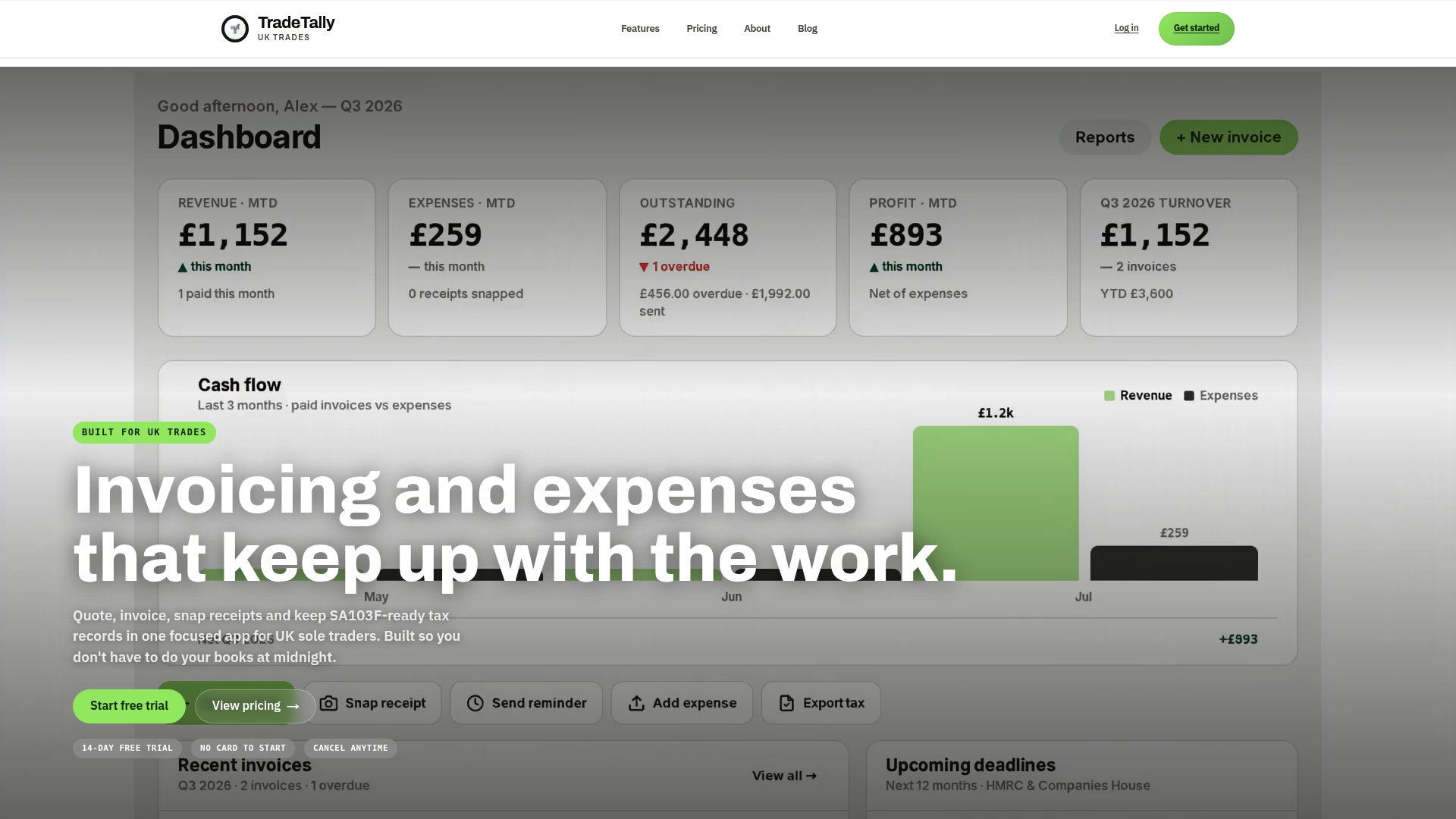
Expenses make more sense next to income. When your invoices and costs live in the same tool, you can see profit by the week rather than discovering it in January. TradeTally is a UK app for sole tradespeople that combines branded invoicing and quotes, receipt and expense tracking, mileage and time tracking, CIS deduction handling and a live profit dashboard, with SA103F-formatted export for Self Assessment and straightforward handoff to an accountant.
There is a free Starter plan at £0 per month. Professional is £12 per month, or £120 per year, and covers unlimited invoices, receipts and tax exports. You can start on the TradeTally home page, compare plans on the pricing page, or see how the SA103F export works for sole traders.
If you are still deciding how much tax your expenses will save, the Self Assessment tax calculator for sole traders gives you a quick estimate to plan against.
Common mistakes to avoid
- Claiming personal costs. If a purchase is not for the business, leave it out. Mixed-use items need a sensible, documented split.
- Mixing up claims. Using the trading allowance and claiming expenses in the same year is not allowed.
- Treating loan repayments as expenses. Interest and charges are claimable, the capital repayment is not.
- Claiming the cost of your own tax return. GOV.UK says preparing and submitting Self Assessment is not allowable.
- Waiting until January. The longer you leave it, the more receipts go missing and the more guesswork creeps in.
- Changing method mid-way. For vehicles and home costs, choose one method and apply it consistently.
If you are unsure whether a specific cost is allowable, check the relevant GOV.UK page or ask an accountant before you claim it. That is cheaper than correcting a return later.
FAQ
What is the easiest way to track business expenses as a sole trader?
Record each cost on the day with a photo of the receipt, a category and a short note of what it was for. Keep everything in one place, and check it against your bank statement once a week. An app that captures the receipt and the category together makes this quicker than a spreadsheet.
Do I need to keep every receipt?
You must keep records of all business expenses as proof of your costs. You do not send them to HMRC with your return, but you must produce them if asked. A clear photo or PDF kept safely is generally how people store them now, but check the current HMRC guidance if a particular record is unusual.
How long do I need to keep expense records?
Five years from 31 January following the tax year of the return. For the 2025/26 return, that is until 31 January 2032. Download copies from online accounts regularly in case you lose access later.
Can I claim expenses if I use the trading allowance?
No. The £1,000 trading allowance is an alternative to claiming actual expenses, and you cannot do both. If your genuine business costs are above £1,000, recording them is usually the more useful route.
Do I need software to track expenses for Making Tax Digital?
If you fall within the income thresholds, yes: you need recognised software to keep digital records and send quarterly updates. The thresholds start at £50,000 from April 2026 and fall in later years, so check the GOV.UK pages for your own position.
Sources
- Expenses if you’re self-employed: Overview, GOV.UK
- Expenses if you’re self-employed: How to claim, GOV.UK
- Expenses if you’re self-employed: Legal and financial costs, GOV.UK
- Business record keeping, Low Incomes Tax Reform Group
- How to Keep Records as a Small Business, Tax Confident
- Act now: sole traders and landlords face new tax rules, GOV.UK
- TAXguide 05/25: Finance Act 2026, ICAEW
- Free downloadable expense log, FSB