UK builders: VAT domestic reverse charge, invoice wording & box 1/4
The VAT domestic reverse charge applies when one VAT-registered construction business supplies specified building services to another VAT-registered business, and that payment gets reported under the Construction Industry Scheme. Where it applies, the supplier does not charge VAT. Instead, the customer accounts for that VAT themselves on their own return. If you’re the supplier, invoice without VAT and add the reverse-charge wording. If you’re the customer, put the VAT in box 1 and reclaim it in box 4 where you’re entitled to, and check whether your customer has given you an end user notification first.
TL;DR:
- The reverse charge only applies to VAT-registered businesses providing specified construction services reported under CIS; it does not apply to non-registered or end-user clients.
- The scheme covers on-site trade work like building, repairing, installing systems, site clearance, and scaffolding, but excludes standalone architectural or manufacturing services unless included in a broader supply.
- To comply, suppliers must invoice without VAT and include clear reverse charge wording, while recipients must record VAT in boxes 1 and 4, and cannot use cash accounting for these transactions.
- Proper setup involves updating invoice templates, training staff on CIS rules, and automating invoicing processes to avoid errors and cashflow issues.
- Reviewing HMRC guidance and correcting past mistakes helps ensure compliance and prevents penalties, especially for complex mixed supplies or disputes over notifications.
Table of Contents
- What is the VAT domestic reverse charge and why does it exist?
- Which construction services fall within the domestic reverse charge?
- Who actually has to apply the reverse charge?
- How to word invoices and record the transaction correctly
- Setting up your systems for reverse charge compliance
- A worked example: invoice through to VAT return
- Where compliance breaks down: common mistakes and red flags
- Cutting the admin load with the right tools
- Getting your priorities straight
- Let Tradetally handle the reverse charge for you
- Where to check the rules yourself
- Sources
- FAQ
What is the VAT domestic reverse charge and why does it exist?
HMRC didn’t introduce this to make your invoicing more complicated for the sake of it. The domestic reverse charge for building and construction services exists to close down a specific type of fraud that was costing the Treasury substantial sums.
The scheme it targets is called missing trader fraud. A subcontractor charges VAT on a supply, the contractor pays it, reclaims it as input tax, and then the subcontractor disappears before handing that VAT to HMRC. This fraud was notably prevalent in a fragmented, subcontractor-heavy industry like construction, which made it a priority to address. The fix is simple in concept: remove the cash from the chain entirely. If the supplier never charges VAT, there’s nothing for them to pocket and vanish with.
That’s the mechanical difference worth understanding. Under the reverse charge, the customer accounts for the VAT as output tax in box 1 and can reclaim it as input tax in box 4, subject to the normal recovery rules. No money changes hands for VAT at any point between the two businesses. It’s often described as a nil-net effect for the recipient, and that’s broadly accurate, though it still has real cashflow consequences we’ll come back to.
Don’t confuse this with the cross-border reverse charge you might have seen on services bought from overseas suppliers. That’s a different mechanism dealing with cross-border VAT treatment. This one is entirely domestic. It applies only:
- Between two UK VAT-registered businesses
- Where the supply is a specified construction service
- Where the payment for that supply is required to be reported under CIS
- Where the customer is not an end user or intermediary supplier who has opted out
The legislative and guidance backbone for all of this sits in VAT Notice 735, which is the document HMRC expects you to be working from if a dispute ever arises. Everything in this article follows that framework.
Which construction services fall within the domestic reverse charge?
The scope test largely mirrors CIS. If a service counts as a “construction operation” for CIS purposes, it’s very likely to be within scope for the reverse charge too, provided it’s supplied between VAT-registered businesses and reported under CIS.
The core list of specified services covers the vast bulk of on-site trade work:
- Constructing, altering, repairing, extending, or demolishing buildings or civil engineering works
- Installing heating, lighting, power, water, drainage, and ventilation systems
- Internal cleaning of buildings carried out during construction, alteration, or repair
- Painting and decorating the internal or external surfaces of a building, where linked to other construction work
- Site clearance, earth-moving, excavation, and landscaping tied to a construction project
- Erecting scaffolding for a construction project
But the exclusion list matters just as much, because it’s where businesses trip up. When supplied on their own, the following are outside the reverse charge:
- Architectural, surveying, and consultancy services
- Manufacturing components, plant, or materials and simply delivering them to site
- Manufacturing or installing seating, blinds, and shutters
- Signwriting and erecting signboards
- Installing security systems, including CCTV and burglar alarms
- Making, installing, and repairing art works
Here’s where it gets genuinely tricky. If any of those excluded services form part of a wider single supply that includes reverse-charge work, the whole thing can fall inside scope. A subcontractor installing a security system as part of a broader fit-out contract, for instance, may find that supply swept into the reverse charge because it isn’t standing alone. HMRC allows a practical 5% disregard: if the reverse-charge element of a supply is worth 5% or less of the total, you can treat the whole thing as outside the reverse charge. Above that threshold, you generally need to apply it to the entire supply.
Pro Tip: When a quote mixes services from both lists, don’t guess. Work out the value split first. If the reverse-charge portion is comfortably under 5% of the total invoice value, you’re on safe ground treating the whole supply as normal-rated. Anywhere near that line, get it in writing from your accountant before you invoice, not after.
Who actually has to apply the reverse charge?
Four conditions need to be true simultaneously for the reverse charge to bite. Miss any one of them and you’re back to standard VAT rules.
- Both parties are VAT-registered. If your customer isn’t VAT-registered, this scheme doesn’t apply, full stop. Standard VAT rules take over.
- The supply is a specified construction service. Check it against the CIS-aligned list above.
- The payment is reportable under CIS. This is a genuinely separate test from VAT registration, and it catches people out. A subcontractor paid gross under CIS can still supply services subject to the reverse charge if the customer is a VAT-registered CIS contractor. Gross payment status affects income tax deductions, not whether the reverse charge applies to VAT.
- The customer isn’t an end user or intermediary who has opted out. More on this below.
An end user is a business or group that receives specified construction services but doesn’t sell those services on as part of a construction supply chain, typically because they’re the final consumer of the building work, such as a landowner commissioning a new office fit-out for their own use. An intermediary supplier is a connected or linked business (think a group company or a landlord and tenant relationship) that on-sells to an end user without adding further construction work.
Both end users and intermediary suppliers can opt out of the reverse charge by giving their supplier written notification. Once you’ve had that notice, you charge VAT under the normal rules and don’t need to keep checking their CIS or VAT status on every job. Usefully, the notification doesn’t need to be a standalone letter. A clause buried in your standard contract terms and conditions can count as written notification, provided it clearly states the customer’s end user or intermediary status. HMRC introduced this route specifically to reduce the administrative burden on organisations like housing associations and local authorities that buy construction services occasionally rather than as their core business.
One more edge case worth flagging: staff supply. A business supplying construction workers under a labour-only arrangement, where it’s genuinely an employment business providing staff rather than a construction service, sits outside the reverse charge entirely, because it isn’t a specified construction service in the first place.
How to word invoices and record the transaction correctly
Get the invoice wording wrong and you create a paper trail that contradicts what actually happened on your VAT return. That mismatch is exactly what draws HMRC’s attention.
If you’re the supplier issuing a reverse-charge invoice, you must:
- Show your normal invoice details (date, VAT number, description of work, net amount)
- Not charge VAT on the invoice
- Include a clear statement that the reverse charge applies
HMRC doesn’t mandate one exact sentence, but a wording along these lines satisfies the requirement: “Reverse charge: customer to account for VAT to HMRC at [rate]% on the VAT-exclusive price shown.” If you don’t state the actual VAT amount, you must at least state the rate that would otherwise have applied, so your customer knows exactly what to account for.
If you’re the recipient, your bookkeeping needs three things to line up: the invoice, your purchase ledger, and your VAT return. On that return:
- Box 1 (output tax): add the VAT you’d have paid had the reverse charge not applied
- Box 4 (input tax): reclaim that same amount, subject to your normal recovery position
- Box 6 (net sales): unaffected by supplies you receive
- Box 7 (net purchases): include the net value of the reverse-charge purchase, as usual
Box 6 and box 7 don’t move because of the reverse charge itself; the effect is confined to boxes 1 and 4. That’s the mechanic that makes the whole scheme cashflow-neutral for most fully taxable businesses, since the same figure is added and reclaimed in the same period.
One restriction catches businesses off guard: you cannot use the VAT Cash Accounting Scheme for supplies subject to the reverse charge. If your business currently runs cash accounting and you both buy and sell specified construction services, you’ll need standard VAT accounting for those particular transactions, which means reconciling two different accounting bases within the same return unless you move off cash accounting entirely.
Pro Tip: Keep a dedicated tag or nominal code for reverse-charge sales and purchases in your accounting software from day one. Trying to untangle which invoices were reverse-charge six months after the fact, working from memory and a pile of paper, is a genuinely miserable job.
Setting up your systems for reverse charge compliance
Getting the reverse charge right isn’t a one-off task you tick off and forget. It’s a process change that touches your invoice templates, your software, your contracts, and your cashflow forecasting all at once.
Start with the invoice template itself. Whatever system you use, whether that’s dedicated trade software, a spreadsheet, or a generic invoicing tool, it needs a way to flag a line item as reverse-charge and automatically suppress the VAT charge while inserting the correct wording. Doing this manually on every invoice is where errors creep in, particularly on busy weeks. Auto-tagging invoices and mapping the amounts straight through to VAT return boxes is consistently the single highest-impact change a construction business can make, because it removes the point where human error usually happens.
Cashflow modelling deserves proper attention too, and it’s often overlooked. Under the old rules, a subcontractor collected VAT from the contractor and held onto that cash until their VAT return was due, weeks or months later, giving useful working capital in the meantime. Under the reverse charge, that cash never arrives. If your business relied on that VAT float, even informally, you need to model the gap now rather than discover it at quarter end.
For contracts and terms and conditions, build the end user and intermediary notification clause into your standard paperwork rather than chasing it project by project. A signed contract that includes the right clause counts as written notification, which saves both sides from re-confirming status on every job.
Practical implementation checklist:
- Update invoice templates with reverse-charge wording and a software flag
- Add an end user/intermediary notification clause to standard contract terms
- Model VAT cashflow assuming reverse-charge sales bring in no VAT float
- Retain written notifications and reverse-charge invoices for at least six years
- Nominate one staff member to reconcile reverse-charge entries each VAT period
- Cross-check that box 1 and box 4 entries match before submitting each return
Training matters more than it sounds like it should. One person on your team needs to genuinely understand the mechanics, not just follow a checklist, because edge cases (mixed supplies, notification disputes, gross-paid subcontractors) come up more often than you’d expect once you’re actually working with this day to day.
A worked example: invoice through to VAT return
Numbers make this far easier to grasp than rules alone. Take a subcontractor carrying out electrical installation work worth £10,000 net for a VAT-registered main contractor, reported under CIS, with no end user notification in place.
The subcontractor’s invoice shows the £10,000 net amount, no VAT charged, and the statement: “Reverse charge: customer to account for VAT to HMRC at 20% on the VAT-exclusive price shown.” No cash for VAT changes hands between the two businesses at any point.
On the contractor’s VAT return for that period, the entries look like this:
Assuming the contractor is fully taxable with no partial exemption restriction, the £2,000 added in box 1 is fully offset by the £2,000 reclaimed in box 4, exactly as the nil-net mechanic predicts.
Now vary the scenario. Suppose the contractor is actually the end user, commissioning the work for their own head office, and they’d given the subcontractor written notification of that status before the job started. In that case, the reverse charge never applies. The subcontractor charges VAT normally, invoicing £10,000 plus £2,000 VAT, and the contractor pays the full £12,000. The contractor then reclaims the £2,000 through box 4 in the usual way, and box 1 doesn’t feature this transaction at all. Same underlying job, genuinely different cash movement.
Where compliance breaks down: common mistakes and red flags
A handful of errors account for most of the reverse-charge problems HMRC encounters, and nearly all of them are avoidable with a bit of process discipline.
The most common by far is charging VAT when the reverse charge should have applied, usually because someone didn’t check whether the payment was reportable under CIS before invoicing. Remember, that CIS reporting test is separate from simply checking VAT registration; skip it and you’ll invoice incorrectly even when both businesses are VAT-registered.
Close behind is missing or vague reverse-charge wording on invoices. A blank VAT field with no explanatory statement leaves the customer unsure whether VAT was forgotten, charged incorrectly, or deliberately reverse-charged. That ambiguity is exactly what invites a compliance check.
Poor records around written end user or intermediary notifications cause disputes too. If a customer claims they notified you of end user status but you can’t produce that notification, HMRC will expect you to apply the reverse charge and treat any VAT you charged as potentially incorrect.
Watch for these red flags in your own processes:
- Invoices with a VAT amount but no reverse-charge statement
- No record of which customers have given written end user notifications
- Reverse-charge purchases still being run through a cash accounting VAT scheme
- Mixed supplies (construction plus excluded services) treated as automatically outside scope without checking the 5% disregard properly
If you find historic errors, correct them promptly rather than hoping they go unnoticed. HMRC generally expects businesses to keep clear evidence of CIS and VAT status checks and to amend past returns where a genuine mistake has occurred, rather than waiting to be caught. For anything beyond a straightforward invoice correction, particularly disputes over end user status or significant historic under or overcharging, get proper advice from an accountant familiar with CIS and construction VAT before you act.
Cutting the admin load with the right tools
None of this needs to eat your evenings. The businesses that find the reverse charge genuinely painless are, almost without exception, the ones who’ve automated the repetitive parts rather than tracking them on paper or in memory.
A trades-focused invoicing app removes most of the manual risk. Instead of remembering to add reverse-charge wording on every applicable invoice, the software applies it automatically once you’ve flagged a customer or job as reverse-charge eligible. It also keeps the VAT calculation itself consistent, since a VAT and CIS calculator built for tradespeople handles the arithmetic the same way every single time, rather than leaving it to whoever happens to be doing invoices that week.
Some invoicing apps are built specifically around this kind of trade-sector admin. They can generate branded invoices with the correct reverse-charge treatment applied where relevant, track CIS deductions, and produce SA103F-ready exports so your Self Assessment records line up with what actually happened on each job across the year.
For rollout, the priorities differ slightly by business size:
- Sole traders: get your invoice template right first, then set up one clear rule for flagging reverse-charge jobs before you touch anything else.
- Small contractors with subcontractors: prioritise a written notification clause in your standard terms and a reconciliation process for box 1 and box 4 each quarter.
- Larger or growing outfits: invest time training whoever handles invoicing on the CIS reporting test specifically, since that’s where most misapplications originate.
Getting your priorities straight
Most construction businesses overcomplicate this. The reverse charge is genuinely just a process change, not a tax increase, and treating it like an existential threat to your margins wastes energy you could spend fixing the actual mechanics.
If you’re catching up, do these four things in order: fix your invoice templates so reverse-charge wording is built in, not bolted on. Tag your accounting software so reverse-charge sales and purchases are flagged automatically. Train one person properly on the CIS reporting test, because that’s where nearly every mistake starts. Then go back through your last six VAT returns and reconcile them against your invoices to catch anything you’ve missed.
That last step is the one people skip, usually because it feels like admitting a mistake. It isn’t. It’s just good practice, and HMRC would rather see you correct it than ignore it.
— Simon
Let Tradetally handle the reverse charge for you
Tradetally is the practical alternative to wrestling with spreadsheets and manual invoice edits every time a reverse-charge job comes in. Rather than remembering which customers need which wording, a job can be flagged once and the correct invoice treatment can follow automatically from that point on, job after job, without manual intervention.
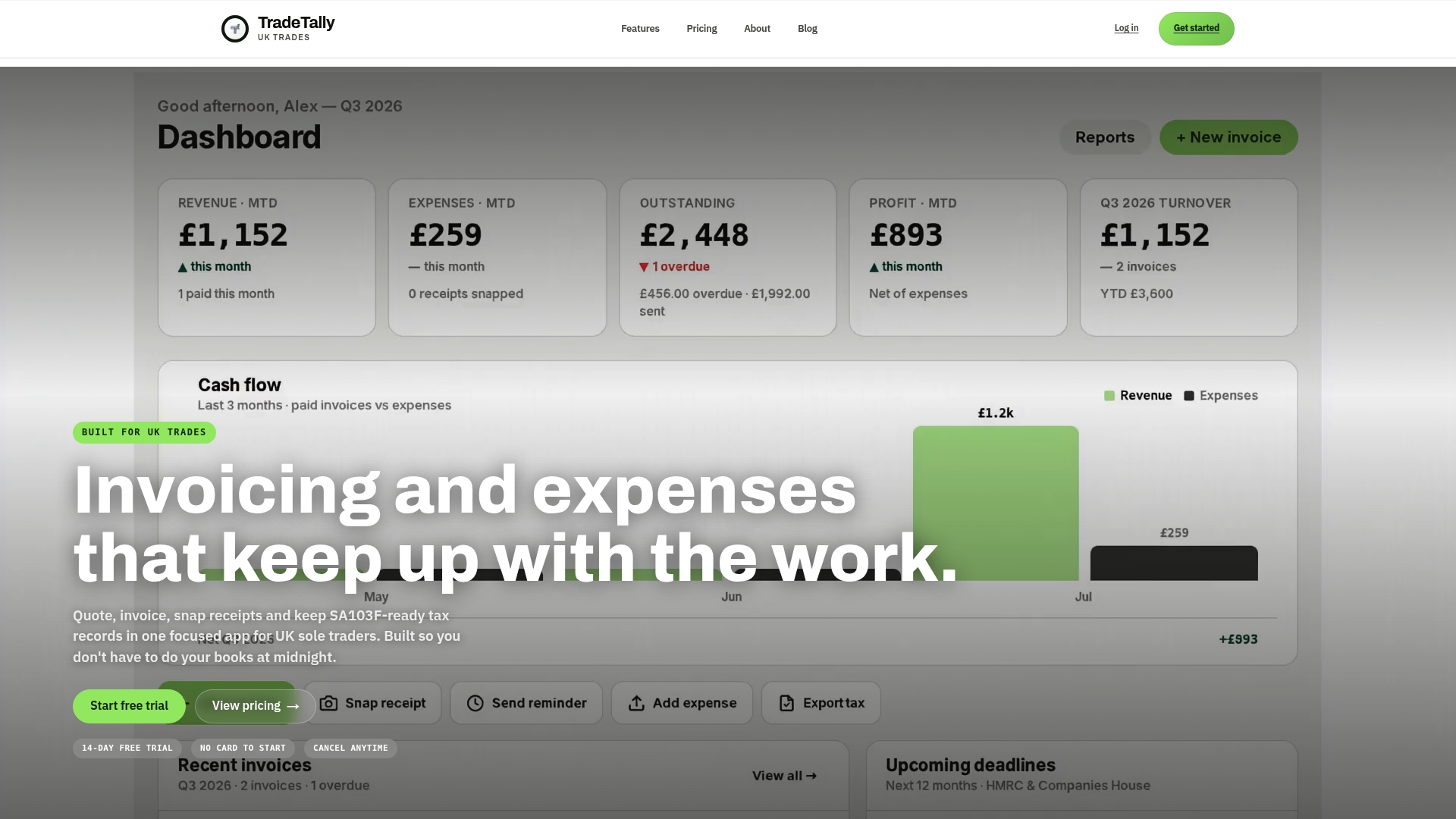
That matters most if you’re a sole trader or small subcontractor issuing several invoices a week across a mix of CIS and non-CIS work, where manually tracking who’s an end user, who’s given written notification, and which jobs need reverse-charge wording becomes its own part-time job. Such invoicing tools can apply the right treatment automatically, keep VAT and CIS figures consistent, and export everything in a format ready for SA103F submission, helping to prevent paperwork from piling up.
If your trade involves frequent CIS-reported work, from fencing to flooring to window fitting, it’s worth seeing how the invoicing built for tradespeople handles this specific compliance headache before your next invoicing run. Start a job in specialized invoicing software and see the reverse-charge wording applied without having to think about it.
Where to check the rules yourself
HMRC’s own guidance is the final word here, and it’s worth bookmarking rather than relying on secondary summaries, however careful.
- VAT Notice 735 sets out the full legal notice, including definitions and the complete list of specified services.
- When you must use the reverse charge gives the practical scope checklist, including the exclusions and the 5% disregard test.
- The technical guide covers operational detail like the cash accounting restriction and edge-case scenarios.
- Tradetally’s free CIS and tax checklist turns that guidance into a working document you can run through job by job.
Sources
FAQ
What is domestic reverse charge VAT in the UK?
It’s a rule requiring the customer, rather than the supplier, to account for VAT on specified construction services, applied only between VAT-registered businesses where the payment is reported under CIS.
What is a reverse charge in the UK VAT system generally?
A reverse charge shifts the responsibility for declaring VAT from the seller to the buyer; the domestic construction version is one specific application, distinct from the cross-border reverse charge used for overseas services.
How do you account for the domestic reverse charge on a VAT return?
The customer adds the VAT due as output tax in box 1 and reclaims it as input tax in box 4, subject to normal recovery rules, while boxes 6 and 7 remain unaffected by which box the VAT sits in.
Can you give an example of how the domestic reverse charge VAT works?
On a £10,000 electrical installation invoiced without VAT under the reverse charge, the contractor enters £2,000 in box 1 and reclaims the same £2,000 in box 4, leaving no net VAT cost for that transaction.
Do I need special software to manage reverse charge invoicing?
You don’t strictly need it, but tools like Tradetally’s VAT calculator and invoicing templates significantly cut the risk of manual errors on wording and box entries compared with tracking it by hand.
Recommended
Ready to sort your trade admin?
TradeTally gives UK sole traders invoicing, expenses, and SA103F-ready tax exports in one mobile-first app.
Start 14-day Pro trial →No card required