0%, 20% or 30%: CIS Deduction Rates UK Contractors Must Get Right
Under the Construction Industry Scheme, deductions run at 0%, 20% or 30%, and HMRC decides which one applies, not you. The rate depends entirely on the subcontractor’s status when you verify them. Deductions only ever touch the labour element of an invoice; materials and VAT stay out of the calculation completely.
TL;DR:
- The CIS deduction rate is set by HMRC during verification and depends on the subcontractor’s compliance status; it ranges from 0%, 20%, to 30%.
- Verification must occur before the first payment and can be done online, by phone, or through payroll software to avoid mistakes.
- Calculations should exclude VAT, subtract materials, and then apply the verified rate solely to the labor portion to avoid common errors.
- Maintaining correct records, verifying status regularly, and itemising materials are crucial to avoid penalties and disputes.
- Using tools like CIS calculators and invoicing templates can streamline compliance and provide clear audit trails.
Table of Contents
- The three CIS deduction rates: what each one means in practice
- Who decides the rate, and how CIS verification works
- How to calculate a CIS deduction step by step
- Gross payment status: the tests, thresholds and how to apply
- Contractor obligations, recordkeeping and who’s liable for mistakes
- Practical tools and workflow: reducing CIS errors day to day
- What actually protects contractors from CIS trouble
- TradeTally: built to keep CIS deductions accurate and evidenced
- Sources
- FAQ
The three CIS deduction rates: what each one means in practice
Every CIS payment falls into one of three brackets, and getting the wrong one can cost you real money, either through HMRC penalties or through a subcontractor chasing you for money you should never have withheld.
- 0%, gross payment status. The subcontractor gets paid in full, with no deduction at source. They settle their own tax through Self Assessment or, for a limited company, through Corporation Tax. This isn’t a tax exemption, it’s a cashflow arrangement, and one HMRC only grants to businesses that meet strict compliance tests.
- 20%, the standard registered rate. This applies to the vast majority of subcontractors working under CIS. It’s deducted from the labour portion of the invoice after materials have been stripped out.
- 30%, the higher rate. This kicks in when HMRC cannot verify the subcontractor, or when the subcontractor isn’t registered for CIS at all. It’s designed as a deterrent against unregistered working, and it hits cashflow hard.
These figures are the current rates used for CIS calculations, and they haven’t shifted in recent years. The most common confusion here is treating the deduction as the subcontractor’s final tax bill. It isn’t. A 20% deduction is simply money held back on account, reconciled later against what the subcontractor actually owes through their own tax return. Many end up reclaiming part of it once expenses and allowances are factored in.
Who decides the rate, and how CIS verification works
You don’t get to choose the deduction rate, and neither does the subcontractor. HMRC assigns it during a formal verification step, and skipping that step is where most contractor errors start.
- Verify before the first payment. Before paying any subcontractor for the first time, you must verify them with HMRC, which will confirm the correct deduction rate for that individual or business.
- Check whether verification is even needed. If the subcontractor has already appeared on one of your monthly returns within the current tax year or the previous two, you don’t need to re-verify them. Doing so anyway just adds admin and risks a mismatch flag on HMRC’s system.
- Use the right channel. Verification can be done through HMRC’s online CIS service, by phone, or through commercial payroll software that connects to HMRC directly.
- Watch for status changes. HMRC issues CIS316A and CIS316B notices when a subcontractor’s payment status changes, so keep an eye on correspondence rather than assuming last year’s rate still applies.
- Record the outcome. Note the date, the rate confirmed and the reference HMRC gives you. If a dispute arises later, that record is your evidence you did things properly.
Treat verification as a five-minute administrative task, not an afterthought squeezed in after the invoice’s already been raised.
How to calculate a CIS deduction step by step
The maths itself is straightforward once you know the order of operations, and getting that order wrong is the single most common calculation error contractors make.
- Start with the invoice total, excluding VAT. VAT never enters the deduction calculation.
- Subtract the materials cost. This must be a reasonable, evidenced figure for materials the subcontractor actually incurred, excluding VAT. Only the labour element is subject to deduction.
- Apply the verified rate to what’s left. Whatever HMRC confirmed during verification, whether that’s 20% or 30%, gets applied only to the remaining labour figure.
Pro Tip: Plant hire charged separately on an invoice is treated as part of the labour cost for CIS purposes, not as a material, so don’t strip it out alongside materials by mistake.
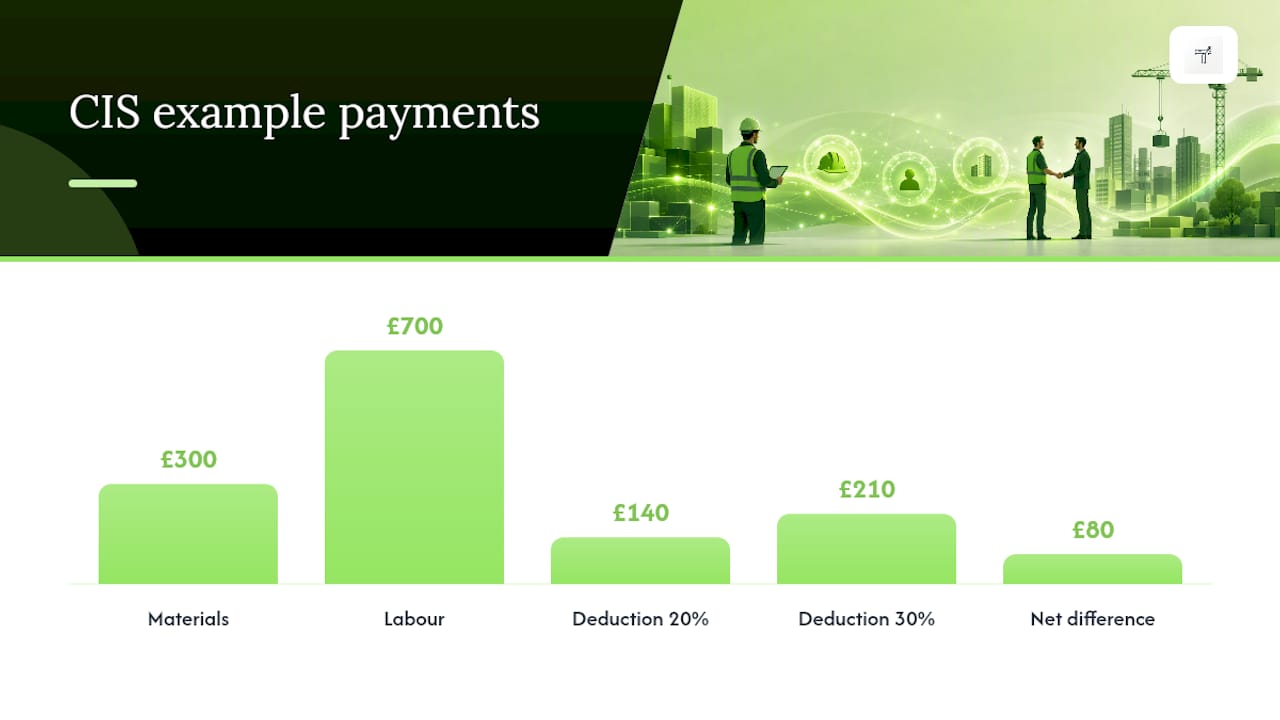
Worked example at 20%: Invoice total is £1,000 excluding VAT. Materials cost £300. Labour is £700. Deduction is 20% of £700, which is £140. The subcontractor receives £860 plus VAT on the full £1,000.
Worked example at 30%: Same invoice, £1,000 excluding VAT, £300 materials, £700 labour. Deduction is £210. Net payment is £790 plus VAT on the £1,000.
That £80 difference between the two examples on an identical invoice shows exactly why verification matters before you pay anyone. A CIS deduction calculator removes the guesswork from separating labour and materials, which is where most manual errors creep in.
Gross payment status: the tests, thresholds and how to apply
Gross payment status is the prize every subcontractor wants, because it means invoices get paid in full with no deduction at all. Getting there means clearing three separate tests, and staying there means passing them repeatedly.
- The turnover test. Sole traders and directors typically need to demonstrate turnover of at least £30,000 from construction work, with aggregation rules applying for partnerships and companies with multiple partners or directors.
- The business test. HMRC checks the business genuinely operates in construction, with a bank account and proper business records.
- The compliance test. Tax returns, payments and, since April 2024, VAT returns all need to be up to date and correctly filed.
Every new applicant starts with net status, meaning deductions apply until gross payment status is confirmed and never automatically. From April 2024, VAT compliance was folded into the compliance test, and late or missing VAT returns are now a frequent reason HMRC refuses or revokes status.
Pro Tip: If you’re applying for gross payment status, sort out any outstanding VAT returns first. HMRC’s own reform guidance flags VAT filing punctuality as a common trip point since the April 2024 changes.
HMRC reviews gross payment status periodically, so maintaining it is more about ongoing administrative discipline than about business size.
Contractor obligations, recordkeeping and who’s liable for mistakes
Running CIS correctly as a contractor means more than deducting the right percentage. HMRC expects you to register for the scheme, verify every subcontractor properly, and file monthly returns on time, every time.
- Register and file monthly. Contractors must register for CIS and submit a return each month showing every payment made and every deduction taken.
- Own the verification decision. If you fail to verify correctly and under-deduct, HMRC can hold you liable for the shortfall, not the subcontractor.
- Itemise materials clearly. Nominee payments and materials figures need to be documented, not estimated, especially if HMRC ever queries a deduction.
- Keep records for at least three years. Verification references, payment records and materials evidence should all be retained well beyond the tax year they relate to.
The liability point catches contractors out more than anything else in the scheme.
Practical tools and workflow: reducing CIS errors day to day
A calculator that splits labour from materials before applying the rate takes the guesswork out of every invoice, and it gives you a clean audit trail if HMRC ever asks questions later.
- Preview the deduction before you pay. A CIS deduction calculator validates the labour and materials split and shows the net figure instantly.
- Invoice with labour and materials separated. Mobile invoicing that itemises this from the outset creates evidence you can point to, rather than reconstructing figures after the fact.
- Keep verification responses on file. Store HMRC’s confirmed rate alongside the invoice it applies to, digitally, so nothing gets lost between the office and the site van.
The CIS calculator and invoice templates are built around exactly this workflow, alongside SA103F export for when Self Assessment season arrives.
What actually protects contractors from CIS trouble
Most CIS disputes I’ve seen traced back to sound the same: someone skipped verification, or materials weren’t itemised clearly enough to survive scrutiny. Verify before that first payment, split labour and materials on every invoice as a habit rather than a chore, and reconcile properly at year-end. None of that is complicated, it’s just easy to let slide when you’re trying to get paid quickly. And if too much has been deducted over the year, that money isn’t gone. It comes back through Self Assessment.
— Simon
TradeTally: built to keep CIS deductions accurate and evidenced
This app is a practical alternative to reconstructing CIS figures from memory at 11pm the night before a return is due. Where a spreadsheet leaves you guessing whether materials were split out correctly three months ago, its CIS calculator does the maths at the point of invoicing, and keeps the record attached to the job.
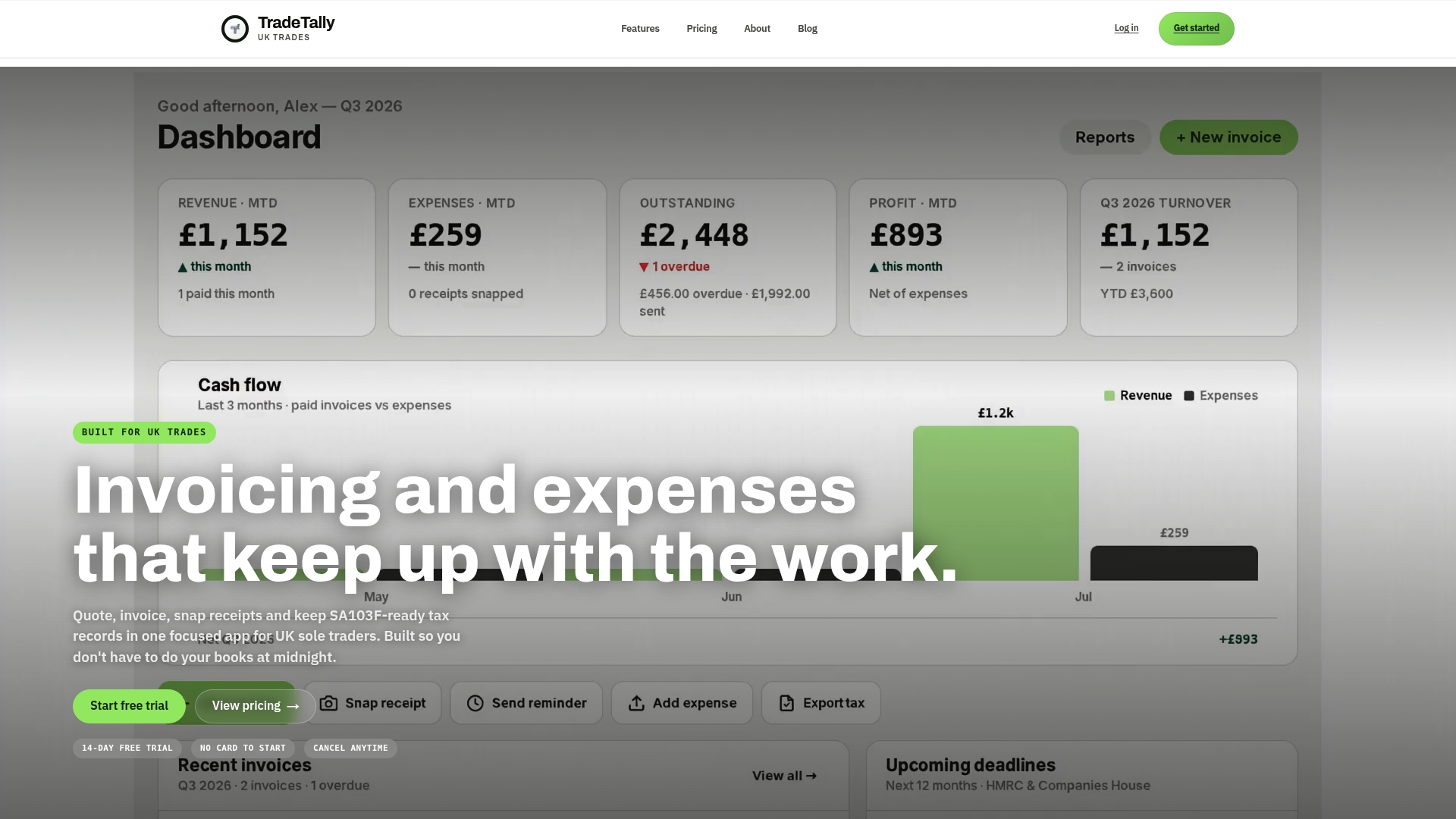
The app generates CIS-compliant invoices that separate labour from materials automatically, which matters if HMRC ever queries a deduction or a subcontractor disputes their net pay. Every invoice, receipt and deduction feeds straight into tax-ready records, with SA103F export ready for Self Assessment rather than a scramble through paper receipts in January. For anyone working across multiple trades, TradeTally also has sector-specific tools, from carpenters to scaffolders, built around how each trade actually invoices.
If you want to see the numbers before committing to anything, try the free CIS deduction calculator on a real invoice today.
Sources
FAQ
Is CIS tax always 20%?
No.
How much tax do you pay through CIS?
CIS deductions aren’t your final tax bill, they’re payments on account. The actual amount owed is settled through Self Assessment or Corporation Tax, and over-deductions are often reclaimed once expenses are factored in.
Do I need to verify a subcontractor every time I pay them?
No. If they’ve appeared on one of your monthly returns within the current tax year or the previous two, re-verification isn’t required.
Recommended
Ready to sort your trade admin?
TradeTally gives UK sole traders invoicing, expenses, and SA103F-ready tax exports in one mobile-first app.
Start 14-day free trial →