Subcontractor vs Sole Trader: CIS Does Not Prove UK Self Employment
A subcontractor and a sole trader are not the same thing: “subcontractor” describes the job you do for a contractor, while “sole trader” is the business structure you trade under. HMRC decides your tax position through Self Assessment and, in construction, the Construction Industry Scheme (CIS). Check your employment status first, and register as self-employed if you are.
TL;DR:
- HMRC judges the working relationship, so use CEST and document substitution rights, client variety, financial risk, and control; CIS registration does not settle status.
- Contractors deduct 20% from verified payments, or 30% if they cannot verify you; gross payment status removes deductions but leaves you responsible for tax.
- Report gross invoiced income on Self Assessment, claim CIS deductions as tax already paid, and keep invoices, statements, receipts, and expense logs for three years.
- For 2026/27, Class 4 National Insurance is 6% on profits from £12,570 to £50,270 and 2% above £50,270.
Table of Contents
- What are the quick differences between a subcontractor and a sole trader?
- How does HMRC decide whether you are really self-employed?
- What tax and National Insurance do you pay?
- What must subcontractors know about the Construction Industry Scheme?
- Which records should you keep, and how do you report the income?
- What should you do first if you are starting out?
- How do you report gross pay and claim CIS deductions back?
- Where do liability and responsibility really differ?
- What do typical work situations look like for each?
- How does insurance change with each status?
- How do you move from sole trader to subcontractor, or back?
- What are the financial advantages and disadvantages of each?
- What should contracts say for each arrangement?
- Why do accurate status and tidy records matter so much?
- How can we help you stay on top of invoicing, CIS records and SA103F?
- FAQ
- Sources
What are the quick differences between a subcontractor and a sole trader?
Most subcontractors in the trades are also sole traders, which is why the terms get mixed up. The practical differences sit in how you are engaged and how the tax gets collected.
- Legal form: a sole trader is a business structure with unlimited personal liability. A subcontractor is a role, and the person filling it may be self-employed, a limited company director or, in some cases, an employee in all but name.
- Tax route: sole traders report profits through Self Assessment. Subcontractors usually do the same, but must show their pay before any CIS deductions.
- National Insurance: a self-employed subcontractor pays their own National Insurance. An employee has it taken through payroll by the employer.
- CIS: many construction subcontractors have 20% or 30% deducted from payments, while a sole trader working directly for customers has nothing deducted.
- First check: read your contract for substitution rights, how many clients you can take, and who controls the work.
Pro tip: if you cannot send someone else in your place and you work for one firm only, pause before assuming you are self-employed.
How does HMRC decide whether you are really self-employed?
HMRC looks at how the working relationship operates in reality, not at the label in your contract. Its Check employment status for tax tool, known as CEST, is the starting point when you are unsure, and HMRC’s internal manual BIM66205 sets out the indicators it applies to subcontractors.
The indicators that point towards self-employment include:
- You are not under direct supervision and decide how the work gets done.
- You can send a substitute to do the job.
- You carry financial risk, meaning you quote prices, can make a loss and fix your own mistakes at your own cost.
- You work for more than one client.
- You supply your own tools and equipment.
GOV.UK says you are probably self-employed if you submit quotes, send invoices, pay your own tax and National Insurance, and get no holiday or sick pay. Being on the CIS register does not settle it either way: both CEST guidance and BIM66205 warn that CIS registration is not proof of self-employment.
If you are uncertain, run CEST and keep a copy of the result. Save your quotes, invoices, evidence of other clients and anything showing you can send a substitute. That paper trail is your protection if status is ever questioned.
What tax and National Insurance do you pay?
Self Assessment is the usual reporting route for sole traders and for most self-employed subcontractors. Register with HMRC when you start trading, and tell them you are self-employed so your National Insurance is set up correctly. Most people pay Class 2 and Class 4 through Self Assessment.
For 2026/27, Class 4 National Insurance is 6% on profits between £12,570 and £50,270 and 2% on profits above £50,270. Class 2 is treated as paid if your annual profits are £7,105 or more, and voluntary Class 2 contributions cost £3.65 per week.
For subcontractors, the key reporting rule is that you declare your total pay before CIS deductions, then enter the deductions made in the designated boxes, such as box 81 for total CIS deductions. The SA103F notes say so explicitly. Your tax is calculated on profit, so your allowable expenses come off the gross figure, and the CIS already taken counts as tax you have paid in advance.
If you want to estimate what you will owe before you file, our Self Assessment tax calculator gives a quick figure from your income and expenses.
What must subcontractors know about the Construction Industry Scheme?
CIS applies to construction work, and if you are a sole trader working for a contractor you should register as a subcontractor. Under the scheme, contractors normally deduct 20% from a registered subcontractor’s payments, and 30% if they cannot verify you. Those deductions are advance payments towards your tax bill, not an extra charge.
- Verification: the contractor checks you with HMRC before paying you. Give them your UTR and your legal or trading name, as Gov, or you risk the higher rate.
- Gross payment status: this removes deductions entirely, but you take full responsibility for paying your own tax. HMRC considers your past compliance, whether you do construction work in the UK, whether the business runs through a bank account, and a turnover test. For sole traders the turnover requirement is £30,000.
- Statements: contractors must give you a monthly payment and deduction statement within 14 days of the end of the tax month. Keep every one.
For a plain-English walkthrough, our guide to CIS for subcontractors goes through it step by step, and our explainer on CIS deduction rates covers 0%, 20% and 30% in detail.
Pro Tip: check each monthly statement against your own invoices the day it arrives, because a wrong deduction is far easier to fix in the month it happens.
Which records should you keep, and how do you report the income?
Good records are what turn a stressful tax return into a routine one. Keep:
- Invoices showing the gross amount you charged
- Every CIS monthly statement
- Receipts for materials, tools and fuel
- Bank statements for the account you trade through
- Mileage and expense logs
On retention, the CIS record-keeping guidance says contractors must keep records of gross amounts invoiced and deductions for at least three years, and that HMRC can ask to see them at any time. Sensible subcontractors hold their own records for at least as long.
The most common error is entering the net amount that landed in your bank account instead of the gross figure on the invoice. That understates your income and can leave deductions unclaimed. The SA103F notes and the HS222 helpsheet are the primary references for calculating taxable profit and where deductions go. Our guide to self-employed invoice records shows a simple way to keep them tidy.
What should you do first if you are starting out?
Work through these in order:
- Register as self-employed for Self Assessment and get your Unique Taxpayer Reference (UTR).
- If you work in construction, register for CIS as a subcontractor and give each contractor your UTR and trading name so they can verify you.
- Run CEST if your status is unclear, and keep your contracts and evidence of independence.
- Start your records on day one: invoices, receipts and statements.
- Consider applying for gross payment status once your turnover meets the test.
Our guide on how to do Self Assessment as a self-employed tradesman covers the return itself once you are registered.
How do you report gross pay and claim CIS deductions back?
Think of it as two separate lines. First, your income: the full invoiced amount, before the contractor took anything off. Second, your credit: the CIS deducted across the year, which you claim against your tax bill. GOV.UK describes misreporting net income as a common error that can distort your tax calculation and cost you a refund.
Here is an illustrative example, with made-up figures. Say you invoice £2,000 for a job and the contractor deducts 20%. You receive £1,600, and the £400 deduction is recorded on your statement. On your return, you enter £2,000 as income and add the £400 to your total CIS deductions. If your overall tax bill for the year comes to less than the total deductions, HMRC repays the difference. If it comes to more, you pay the balance.

That is why the monthly statements matter. Add them up across the year and match the total to the deductions on your return. Where a contractor has missed a statement, ask for a replacement before you file, not after.
Tracking all this by hand across multiple contractors is where mistakes creep in. Keep one running record of gross invoiced, deducted and received for each job, and the return largely fills itself.
Where do liability and responsibility really differ?
As a sole trader, you and the business are legally the same person, so liability is unlimited. If a job goes wrong or a debt goes unpaid, your personal assets are exposed. A limited company is a separate legal entity with limited liability, though it also brings Companies House filing and different tax obligations.
A subcontractor’s responsibilities depend on the contract as much as the structure. In practice:
- Quality of work: you are answerable for your own workmanship, including putting defects right at your own cost.
- Tax: a self-employed subcontractor is responsible for their own tax and National Insurance, and with gross payment status nobody deducts it for you.
- Site and contract terms: GOV.UK notes that self-employed people generally control their own working patterns, but subcontractors can still be bound by site conditions and contractual terms.
- Status risk: if HMRC decides you are an employee in all but name, the contractor has the PAYE and National Insurance problem, and you may have to unpick your own returns.
The distinction to hold on to is that structure decides who is legally on the hook, while the contract decides what you have promised to deliver and by when.
What do typical work situations look like for each?
The same person can sit in either camp depending on who they are working for.
A sole trader working directly for customers. A plumber who quotes homeowners for bathroom refits, sets their own prices, buys their own materials and invoices each customer is trading as a sole trader. No contractor is involved, so there is no CIS deduction. They take on the risk and keep the profit.
A subcontractor under CIS. A bricklayer laying for a building firm on a housing site is a subcontractor. They may still be a sole trader, but the firm is a contractor under the scheme, so deductions apply unless the bricklayer has gross payment status.
A mixed pattern. An electrician might do domestic rewires for customers directly, and also take second-fix work through a contractor. The CIS treatment can depend on the work and who engages you, so check the scheme rules and keep records that distinguish the different jobs.
The warning case. Someone who works set hours, for one firm, using the firm’s tools, with no right to send a substitute, is probably not genuinely self-employed regardless of the paperwork. That is the pattern CEST is built to catch.
How does insurance change with each status?
Insurance needs follow what you do and who you work for, not the label. Still, status shapes what is expected of you.
- Public liability: if you work on customers’ homes or on site, it is sensible for any self-employed trader to carry it, and many contractors will ask to see proof before you start.
- Employer’s liability: this is a different matter, because it relates to people you employ. Whether you need employer’s liability insurance depends on your circumstances, so check the legal position for your situation.
- Tools and equipment: a self-employed subcontractor who supplies their own kit carries that risk themselves, and tool cover protects against theft or damage.
- Professional indemnity: worth considering where you give design advice or specify work, rather than only carrying it out.
If your status is questioned, your insurance can matter too. A contractor who treats you as an employee may cover you under their own policies, whereas a genuinely self-employed subcontractor is expected to arrange their own. Ask the contractor what they require in writing, and confirm exclusions with your insurer rather than assuming.
How do you move from sole trader to subcontractor, or back?
Because the two are not opposites, the move is usually less dramatic than it sounds. A sole trader who starts taking work from a contractor does not set up anything new: they stay self-employed, then register for CIS as a subcontractor, give the contractor their UTR and trading name, and keep their Self Assessment going.
Going the other way, a subcontractor who wants to work direct for customers simply stops relying on one contractor and starts quoting and invoicing customers themselves. They remain a sole trader, and the work outside CIS is reported on the same return.
Some practical points when you shift:
- Update your records so CIS income is clearly separate from direct customer income.
- Review whether you still meet the gross payment status tests if your turnover changes.
- Check your status again if one contractor starts to dominate your work, since that is a CEST warning sign.
- If you later move to a limited company, you enter a different structure with its own filing duties.
Business of structures is a useful read if growth makes you think about incorporating.
What are the financial advantages and disadvantages of each?
Neither route is better across the board. What matters is how each affects your cash flow and admin.
Sole trader working direct. You keep all profits and the structure is simple, with a lighter administrative burden than a limited company. The downside is irregular income, chasing your own payments and unlimited liability.
Subcontractor under CIS. Work can be steadier because a contractor keeps you busy. If your costs are high, you may be overpaying until the return is filed and the refund arrives.
Subcontractor with gross payment status. You receive the full amount, which helps cash flow, but you must set money aside for your tax bill and any payments on account. Those who spend the lot and then face a January bill find this out the hard way.
A sensible habit under any status is to hold a portion of every payment back for tax and National Insurance. Our expense tracking guide for sole traders shows how to keep allowable costs organised so your taxable profit is not overstated.
What should contracts say for each arrangement?
A sole trader dealing with customers needs a contract that is clear on scope, price, payment terms and what happens if the job changes. A subcontract is tighter, because it has to hold up against the status tests as well as define the work.
Look for these in a subcontractor agreement:
- Scope and price: a defined job or package, not open-ended hours.
- Substitution: a clause confirming you can send a suitable replacement, in line with self-employed indicators.
- Payment and CIS: how and when you are paid, the deduction rate that applies and a commitment to issue monthly statements.
- Tools and materials: who supplies what, and who carries the cost of defects.
- Insurance: what cover each side must hold.
- Termination and variations: how changes are priced and how either side can end the arrangement.
Contractors have their own duty here. Before paying a subcontractor, HMRC’s CISR11030 manual says a contractor should be satisfied the contract is one for self-employment and verify the subcontractor where required. The engager checklist adds that status cannot be decided by fiat and should be reviewed as arrangements change. Have anything you sign read by an adviser if the money is significant.
Why do accurate status and tidy records matter so much?
I would put it bluntly: the paperwork you keep in a quiet month is what protects you in a stressful one. Most of the trouble I see described around subcontracting is not cleverness gone wrong. It is gross and net getting mixed up, statements going missing and nobody being able to show how the arrangement really worked. A few small habits remove most of the risk: log every invoice at the gross figure, file every CIS statement the day it lands, and note down who decided how and when the work was done. If your status ever comes under question, that evidence speaks louder than the wording of any contract.
— Simon
How can we help you stay on top of invoicing, CIS records and SA103F?
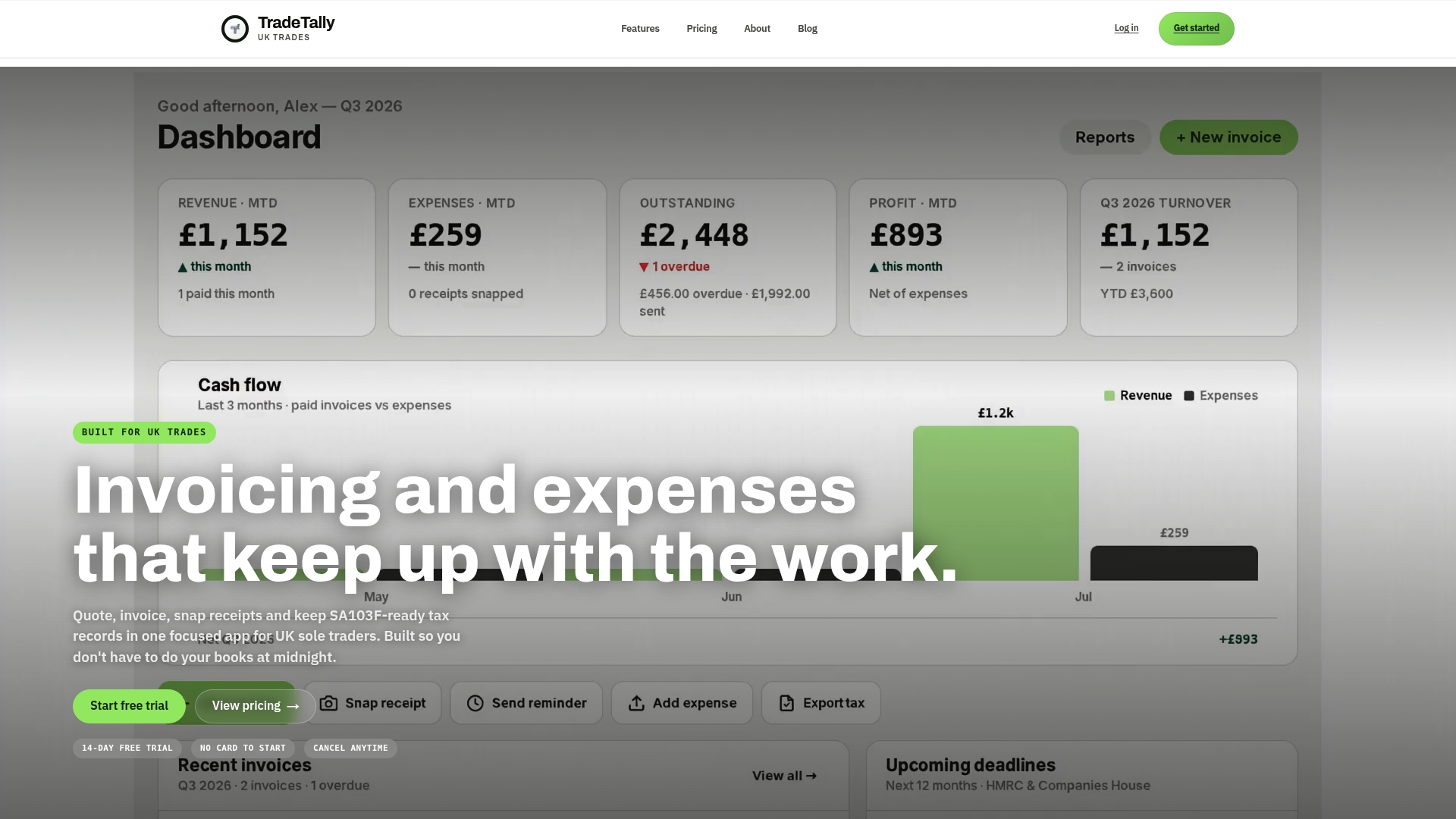
We built TradeTally for UK tradespeople who would rather be on site than doing paperwork at night. You can send branded invoices from your phone, snap receipts the moment you get them and keep CIS-friendly records in one place, then export your figures in SA103F format when the return is due. Our app was built by a working tradesperson, so it fits the way the job actually runs. Start on our Starter plan at £0 per month, or take Professional at £12 per month, and see the full details on our pricing page. You can try TradeTally today and get started with invoicing.
This article is general information, not a substitute for advice from a qualified financial advisor. Consult a qualified financial professional about your own circumstances before acting on anything here.
FAQ
How many hours can a self-employed person work?
There is no set weekly limit for a self-employed person, because they are not subject to working-time rules in the way employees are, as GOV.UK explains. Site conditions and contract terms may still shape your hours. If a contractor fixes your hours for you, that can point to employee status.
Is it better to be a company or a sole trader?
It depends on your income, risk and appetite for admin. A sole trader keeps things simple, while a limited company has limited liability but separate filing duties. Many tradespeople start as sole traders and consider incorporating as profits grow.
How does a sole trader pay a subcontractor?
A sole trader who engages a subcontractor pays against their invoices, agreeing the price and payment terms in advance. If the work is construction work, the CIS rules may make you a contractor, which means verifying the subcontractor and making deductions. Check the CIS contractor guidance before your first payment.
What are the key differences between an independent contractor and an employee in the UK?
An independent contractor controls how and when they work, can usually send a substitute, carries financial risk and pays their own tax and National Insurance. An employee works under direction and gets holiday and sick pay. HMRC judges this on the reality of the relationship, not the label.
Sources
Recommended
Ready to sort your trade admin?
TradeTally gives UK sole traders invoicing, expenses, and SA103F-ready tax exports in one mobile-first app.
Start 14-day Pro trial →No card required