3 UK Carpenter Invoice Templates With Exact CIS and VAT Wording
Use a compliant invoice that includes HMRC’s required fields, and when you are subcontracting, separate labour from materials and add the correct reverse charge wording where it applies. We’ve set out ready-to-edit templates below, alongside the exact HMRC phrasing for CIS and VAT, so you can issue a correct invoice today. We provide a straightforward way to build these invoices and export tax-ready records without the evening paperwork.
TL;DR:
- Invoices for supplies of £250 or less may use HMRC’s simplified format; otherwise include supply and issue dates and send VAT invoices within 30 days.
- CIS subcontractors must separate labor and materials because deductions apply only to labor, then reconcile invoices with statements due within 14 days after each tax month.
- Use the reverse charge only when both parties are VAT and CIS registered and the customer is not the end user; include approved wording and the VAT rate.
- Without agreed terms, invoices become overdue after 30 days; business terms often run 60 days, and late payments can incur statutory interest and fixed compensation.
Table of Contents
- Ready-to-use templates and short editable examples for carpenters
- HMRC requirements: what must appear on a UK invoice
- Subcontractor invoicing: CIS and the VAT domestic reverse charge
- Exact invoice lines and wording you can copy
- Payment terms, late payments and chasing what you’re owed
- We built our software around the admin that follows a day on site, so creating a compliant invoice takes minutes rather than an evening at the kitchen table. Features include:
- Why simple, compliant invoicing saves cashflow and stress
- Try TradeTally for compliant carpenter invoicing
- FAQ
- Sources
Ready-to-use templates and short editable examples for carpenters
Most invoicing problems come down to missing a field or guessing at wording. Below are three short examples you can adapt directly, each built around what HMRC requires.
- Private customer invoice: your business name and address, customer name and address, invoice number, date of supply, description of the carpentry work, and total due. No VAT lines needed if you are not VAT registered.
- VAT invoice: everything above, plus your VAT registration number, the VAT rate applied, net and VAT amounts shown separately, and the gross total.
- Subcontractor (CIS) invoice: labour and materials listed as separate lines, with any CIS deduction shown clearly and reconciled against the contractor’s payment and deduction statement.
Keep invoice numbers sequential (INV-0001, INV-0002, and so on) rather than dated or randomised. This makes gaps obvious to you and to HMRC during a check.
Electronic invoices are accepted by HMRC and most contractors, so a PDF sent by email is just as valid as a paper copy, provided you keep a copy for your own records.
HMRC requirements: what must appear on a UK invoice
Every invoice you issue, VAT registered or not, needs a core set of details to be valid. HMRC’s guidance sets these out clearly, and missing one is the most common reason a contractor’s accounts team bounces an invoice back to you.
- A unique invoice number that doesn’t repeat.
- Your business name, address and contact details, plus the customer’s.
- The date of supply and the date the invoice is issued.
- A clear description of the carpentry work carried out.
- The amount charged, and where you’re VAT registered, the VAT rate, VAT amount and your VAT registration number.
You can issue a simplified invoice, without the full VAT breakdown, for supplies of £250 or less, which saves time on smaller jobs like a single repair or fitting. HMRC’s VAT record-keeping notice confirms this threshold and requires VAT invoices to be issued within 30 days of supply in most cases. Keep copies of everything you send, since these are the records HMRC will ask to see if your return is queried.
Subcontractor invoicing: CIS and the VAT domestic reverse charge
If you work as a subcontractor under the Construction Industry Scheme, your invoices carry extra weight. CIS deductions apply only to the labour element of a job, so your invoice needs to show labour and materials as separate lines. According to CIS guidance (CIS 340), contractors must send you a payment and deduction statement within 14 days of the end of the tax month, and you should check this against your own invoice records.
The VAT domestic reverse charge sits alongside CIS and catches a lot of carpenters out. It applies when you and your customer are both VAT and CIS registered, and your customer is not the end user of the building work. In that case you don’t charge VAT on the invoice at all. Instead, HMRC’s reverse charge technical guide requires a note such as “Reverse charge: Customer to pay the VAT to HMRC”, along with the VAT rate or amount your customer needs to account for.
Before you invoice a contractor for the first time, work through this short sequence:
- Verify the contractor’s CIS status through HMRC’s verification service, or get written confirmation of their registration.
- Confirm in writing whether your customer is the end user; if they are, the reverse charge doesn’t apply and you charge VAT as normal.
- Issue separate invoices for reverse charge and standard supplies where you can, rather than mixing both on one document.
- Send the payment and deduction statement reference alongside any invoice where a CIS deduction has been made.
Our CIS invoice software for UK contractors is built around this exact sequence, so the labour/materials split and reverse charge notes are part of the invoice template rather than something you add manually each time. For a fuller walkthrough of CIS registration and verification, our guide to the Construction Industry Scheme covers the detail.
Pro Tip: Keep a simple log of which customers are end users and which aren’t, so you’re not re-checking reverse charge status on every job.
Exact invoice lines and wording you can copy
Getting the wording wrong on a reverse charge invoice is one of the fastest ways to get it rejected by a contractor’s accounts team, who then sends it back and delays your payment. HMRC’s internal manual on reverse charge wording gives two accepted phrases you can use directly:
- “Reverse charge: VAT Act 1994 Section 55A applies.”
- “Reverse charge: Customer to pay the VAT to HMRC.”
A short worked line might read: Labour, 3 days fitting, £450.00. Materials, timber and fixings, £180.00. Subtotal £630.00. Reverse charge: Customer to pay the VAT to HMRC (VAT at 20% = £126.00, not charged on this invoice).
If you spot a VAT or reverse charge error after sending an invoice, don’t just edit the original. Issue a credit note for the wrong invoice and reissue a corrected one, which keeps your records clean and matches what contractors expect to see. Our guide to reverse charge invoicing shows how this looks on a finished template.
Payment terms, late payments and chasing what you’re owed

Without an agreed date, an invoice becomes overdue 30 days after the customer receives the goods or service, and the same 30-day limit applies to payments from public sector bodies, while typical B2B terms often run to 60 days. If a payment is late, government guidance on late payments confirms you can claim statutory interest plus the Bank of England base rate, plus fixed compensation for small debts, and you may need to be aware of risks such as misclassification of contractors in Garden Grove.
When a payment runs late, work through it in stages rather than letting it drift:
- Send a polite reminder referencing the invoice number and due date.
- Follow up with a formal demand that states the interest and compensation you’re entitled to claim.
- If that doesn’t work, consider a late payment claim or small claims action as a final step.
Our breakdown of claiming late payment interest walks through the maths on a real invoice.
We built our software around the admin that follows a day on site, so creating a compliant invoice takes minutes rather than an evening at the kitchen table. Features include:
- Branded invoices with sequential numbering built in, helping avoid duplicate or skipped numbers.
- CIS fields to separate labour and materials as needed.
- Reverse charge wording added where applicable.
- Receipt snapping from your phone to log expenses as they happen.
- Export functionality to produce tax-ready records for Self Assessment.
Why simple, compliant invoicing saves cashflow and stress
The carpenters who get paid fastest aren’t the ones doing the best work, they’re the ones sending the cleanest invoices. Most late payments we hear about trace back to a missing field or a vague description, not a difficult customer. A compliant template and a digital system that keeps your numbers in order will do more for your cashflow than chasing harder ever will.
— Simon
Try TradeTally for compliant carpenter invoicing
We give you a way to create branded invoices on site, complete with CIS fields and reverse charge wording built in, then export the lot straight into SA103F format when Self Assessment comes round.
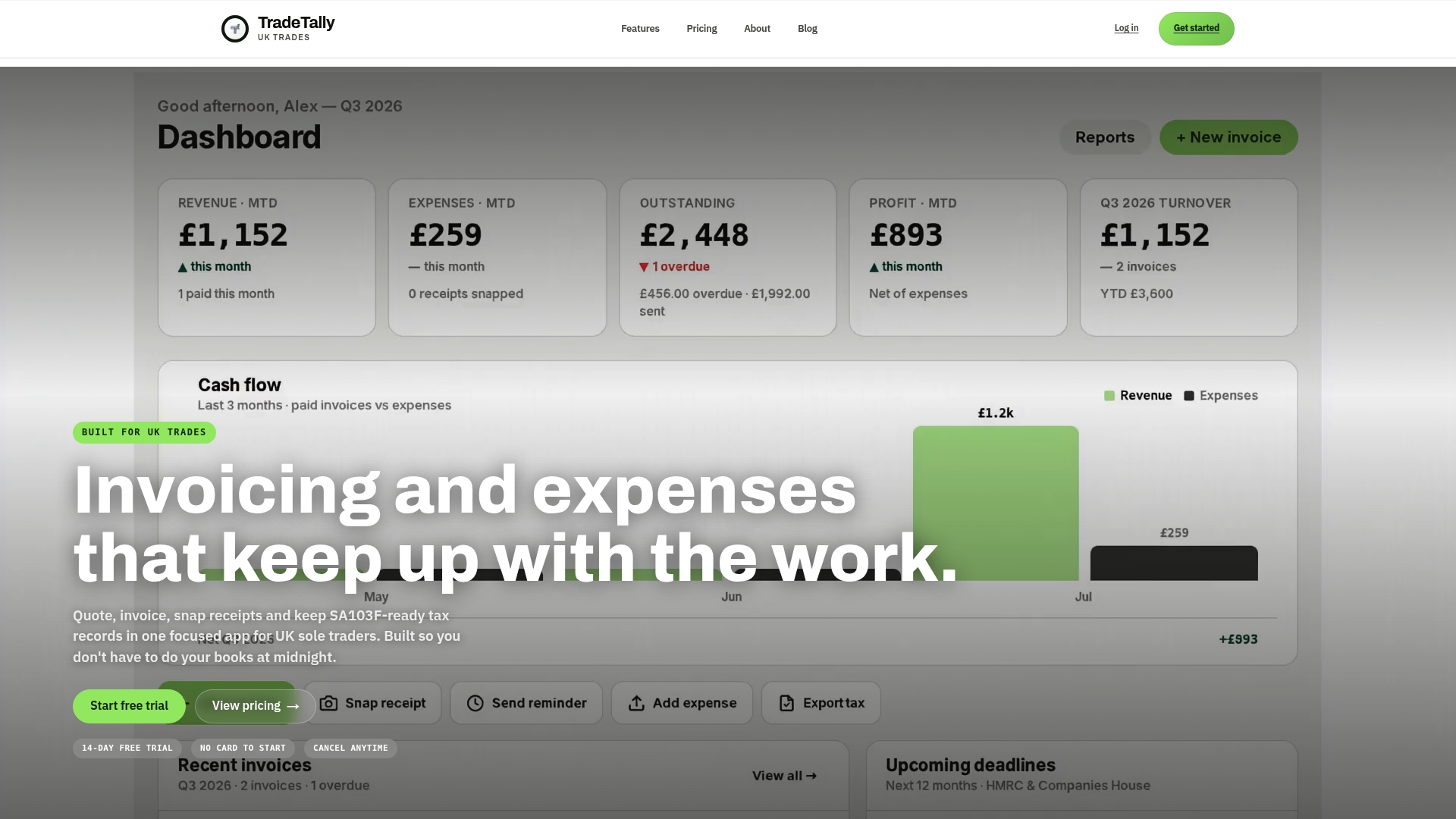
Plans run from the free Starter tier through to Professional at £12 per month or £120 per year. Visit TradeTally to see how it fits your own invoicing routine.
This article is general information, not a substitute for advice from a qualified financial advisor. Consult a qualified financial professional about your own circumstances before acting on anything here.
FAQ
How much do carpenters get paid in the UK?
Carpenter pay varies widely by region, experience and whether you’re employed or self-employed, so there’s no single figure that applies across the trade. Your invoicing and pricing should reflect your own local market rate and job complexity rather than a national average.
What is legally required on an invoice in the UK?
A valid invoice needs a unique number, your details and the customer’s, the date of supply, a description of the work, the amount charged, and VAT details if you’re VAT registered, as set out in HMRC’s invoicing guidance. Supplies of £250 or less can use a simplified invoice without the full VAT breakdown.
How do I invoice as a freelancer?
As a self-employed carpenter, you invoice the same way as any sole trader: include your name or business name, address, invoice number, date, description of work and total due. If you’re not VAT registered, you simply leave out the VAT fields entirely.
Is it illegal to not pay a subcontractor?
Failing to pay a subcontractor within agreed terms isn’t automatically illegal, but it does trigger statutory rights to interest and fixed compensation under late payment law. Government guidance on late payments sets out these entitlements and the escalation routes available if a contractor refuses to pay.
Recommended
Ready to sort your trade admin?
TradeTally gives UK sole traders invoicing, expenses, and SA103F-ready tax exports in one mobile-first app.
Start 14-day Pro trial →No card required