CIS Deductions: Three Rates UK Tradespeople Must Know to Protect Cash

CIS deductions come in three rates: 0%, 20% and 30%. Which one applies depends entirely on the subcontractor’s status with HMRC. Zero percent applies if the subcontractor holds gross payment status. Twenty percent applies to subcontractors registered with the Construction Industry Scheme. Thirty percent applies when a subcontractor is unregistered or cannot be verified. None of this is a tax in itself; it’s an advance payment towards the subcontractor’s eventual tax and National Insurance bill.
TL;DR:
- Only the labour portion of a subcontractor’s invoice is subject to CIS deductions, excluding materials with receipts and VAT from the calculation.
- Subcontractors claiming gross payment status must pass a turnover test and meet specific compliance requirements, including providing evidence of materials.
- Accurate invoice splitting and timely verification are crucial to avoid over- or under-deduction, which can impact cash flow and tax records.
- Contractors must submit monthly HMRC returns, pay deductions on time, and issue statements within 14 days to maintain compliance and avoid penalties.
- Proper CIS management ensures correct tax payments, prevents cash flow issues, and simplifies Self Assessment and refund claims for subcontractors.
Table of Contents
- What counts as a CIS deduction: labour, exclusions and VAT treatment
- How to calculate CIS deductions: step-by-step process and worked example
- Contractor obligations: verification, monthly returns, payment deadlines and statements
- How subcontractors record deductions on Self Assessment and claim refunds
- Gross payment status and the turnover test: how to qualify and what evidence you need
- Common mistakes and a practical compliance checklist
- Why getting CIS deductions right protects your cash flow
- Sort your CIS deductions without the spreadsheet headache
- Sources
- FAQ
What counts as a CIS deduction: labour, exclusions and VAT treatment
Deductions apply only to the labour element of a payment. Materials that the subcontractor has genuinely bought and paid for are excluded from the calculation, and this trips up more people than any other part of the scheme.
The CIS340 guide is blunt about it: contractors must not deduct from the cost of materials, only from what’s left. That means every invoice needs to separate labour from materials clearly, or the contractor ends up guessing, and guessing wrong costs someone money either way.
VAT treatment adds another layer. If the subcontractor is VAT registered, the deduction is calculated on the amount before VAT, not after. Charge VAT on top of the whole invoice as normal, but strip it out before working out the CIS percentage. Get this order wrong and you’ll either overdeduct or underdeduct, and both create paperwork headaches later.
Here’s how a typical invoice breaks down for CIS purposes:
- Labour charges — always subject to the deduction
- Materials genuinely purchased and evidenced by the subcontractor — excluded from the deduction base
- Travel and subsistence charged as part of the job — generally included and subject to deduction
- Plant hire without an operator — usually excluded, but check the specifics
- VAT — excluded from the calculation entirely, regardless of registration status
The tricky part is evidence. If a subcontractor claims £300 of materials but can’t produce a receipt or invoice, the contractor doesn’t have to take their word for it. HMRC allows contractors to make a reasonable estimate of the materials cost when no evidence exists, though that’s a fallback position, not a green light to skip asking. A subcontractor who wants their materials excluded needs to keep receipts and hand over an itemised breakdown before payment, not after a query lands.
Pro Tip: Push for itemised invoices from day one with every subcontractor. It protects you from overdeducting and protects them from losing a legitimate materials claim, and it saves both sides an awkward conversation later.
How to calculate CIS deductions: step-by-step process and worked example
The calculation itself is straightforward once you strip it back to four steps:
- Start with the gross invoice total (excluding VAT).
- Subtract the cost of materials the subcontractor has evidenced.
- What’s left is the labour figure the deduction applies to.
- Apply the relevant rate (0%, 20% or 30%) to that labour figure.
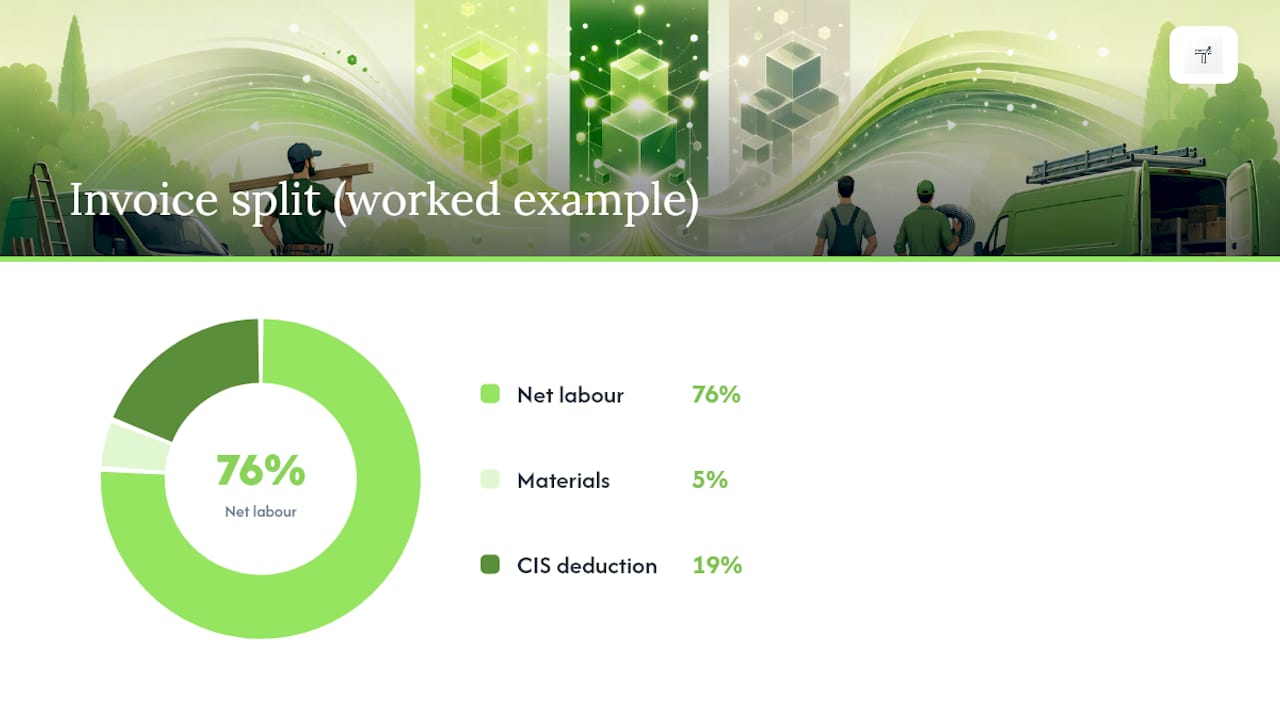
Here’s a worked example that shows the mechanics clearly. A subcontractor invoices a contractor £4,000 for a job, excluding VAT. Of that, £200 covers materials they bought and can prove with receipts. The subcontractor is registered under CIS, so the 20% rate applies.
Step through it:
- Gross invoice: £4,000
- Materials excluded: £200
- Labour figure subject to deduction: £3,800
- CIS deduction (20% of £3,800): £760
- Net payment to subcontractor: £3,240
The subcontractor receives £3,240 in the bank, but for Self Assessment purposes they must record the full £4,000 as turnover and the £760 as a CIS deduction already paid to HMRC. This is where a lot of subcontractors trip up: they treat the £3,240 as their income figure, which understates turnover and creates a mismatch when HMRC cross checks contractor returns against Self Assessment filings.
Reversing the calculation matters too, particularly if a payment and deduction statement has gone missing. If you know the net figure and the rate applied, gross it back up. At 20%, net pay represents 80% of the labour figure, so divide the net amount by 0.8 to recover the gross labour figure, then add back materials to reach the original invoice total.
Keep figures to two decimal places throughout and round only the final deduction amount. Store every invoice, statement and bank record for at least three years; HMRC can and does ask for them.
Contractor obligations: verification, monthly returns, payment deadlines and statements
Before a contractor pays a new subcontractor for the first time, they must verify that subcontractor with HMRC. Verification confirms whether the subcontractor is registered under CIS and tells the contractor which deduction rate to apply. Skip this step and you’re exposed if the subcontractor later turns out to be unregistered or unverifiable. Paying first and verifying later is one of the most common ways contractors end up owing HMRC money they can’t easily recover.
Once verification and payments are underway, contractors carry several recurring duties:
- Submit a monthly return to HMRC detailing every payment made to subcontractors that tax month, even in months with no activity (a nil return still has to be filed).
- Pay over the deductions taken to HMRC, following the same monthly schedule as PAYE.
- Issue each subcontractor a payment and deduction statement within 14 days of the end of the tax month it relates to.
- Keep detailed records of gross payments, materials costs and deductions taken for every subcontractor, for at least three years.
HMRC’s own internal guidance confirms the mechanics behind the rates: the standard 20% rate applies once a subcontractor is verified and matched on HMRC’s system, while the 30% rate kicks in specifically when that match fails or the subcontractor never registered.
Pro Tip: Set a recurring reminder for the 19th of each month, whether you file by post or online. Missing the monthly return deadline, even with nothing to report, can trigger an automatic penalty from HMRC that’s entirely avoidable with a two minute nil return.
How subcontractors record deductions on Self Assessment and claim refunds
Sole traders and partners report their full gross income, before any CIS deduction, as turnover on their Self Assessment return. Alongside that, they declare the total CIS deductions already taken across the year. HMRC then offsets those deductions against the subcontractor’s overall tax and National Insurance liability, settling up once the return is processed.
For most subcontractors, this produces one of two outcomes:
- If the CIS deductions taken during the year exceed the actual tax and National Insurance owed, HMRC refunds the difference after the return is filed.
- If deductions fall short of the total liability, the subcontractor pays the balance, much like any other Self Assessment taxpayer.
Limited companies work slightly differently. Rather than waiting for an annual refund, a company that has CIS deducted from its own invoices can set that amount off against its PAYE and National Insurance liabilities through its regular payroll returns during the year. If deductions still exceed what’s owed at year end, the company claims a refund of the excess directly from HMRC.
Whichever structure applies, HMRC can ask for payment and deduction statements as evidence if figures on a return look inconsistent with contractor filings. Missing statements slow down refunds considerably, so chasing them at the time beats reconstructing months of records later.
Gross payment status and the turnover test: how to qualify and what evidence you need
Gross payment status (GPS) means a subcontractor gets paid the full invoice amount with no CIS deduction at all, taking on the responsibility to settle tax and National Insurance themselves through Self Assessment. It’s a genuine cash flow advantage, but qualifying takes some groundwork.
The core requirement is the turnover test. HMRC looks at net construction turnover, which means gross payments received (excluding VAT) minus the cost of materials, and measures this against a threshold to decide eligibility. Alongside turnover, HMRC also checks that the business has a clean compliance record and passes tests around how the business is run.
Applying means completing the relevant HMRC forms and providing evidence such as invoices, bank statements and existing CIS records covering the qualifying period. If HMRC later finds compliance has slipped, whether through late returns or unpaid tax, it can withdraw GPS.
Common mistakes and a practical compliance checklist
The same errors crop up across the trades, month after month. Contractors pay before verifying, deduct CIS from materials that should have been excluded, or file monthly returns late (or not at all when there’s nothing to report). Subcontractors, meanwhile, often report their net receipts as turnover instead of the gross invoice figure, which distorts their Self Assessment and can trigger HMRC queries.
A short monthly routine catches most of this before it becomes a problem:
- Verify every new subcontractor with HMRC before the first payment goes out.
- Insist on itemised invoices that separate labour from materials.
- Run the turnover test annually if a subcontractor is chasing or maintaining gross payment status.
- File the monthly return, or nil return, without exception.
- Issue payment and deduction statements within the period required by HMRC, typically within 14 days of the end of the tax month and keep copies.
TradeTally’s CIS invoice software builds the labour and materials split into every invoice, so the deduction calculation is right from the outset rather than reverse engineered later. The CIS deduction calculator handles the worked maths from a gross figure down to net pay in seconds.
Pro Tip: If a payment and deduction statement never arrived, don’t just accept whatever landed in your bank account. Gross the net figure back up using the rate you believe applies, then chase the contractor for written confirmation to back up your Self Assessment entry.
Why getting CIS deductions right protects your cash flow
Cash flow is the real casualty when CIS goes wrong, not just paperwork.
Most tradespeople I’ve seen struggle with CIS aren’t struggling with the concept. They understand the rates fine. What trips them up is the admin: separating materials from labour on an invoice raised at 9pm after a full day on site, or reconstructing three months of missing statements before a Self Assessment deadline. That’s exactly the gap tools like TradeTally are built to close, with CIS handling baked into everyday invoicing rather than bolted on as an afterthought.
Get the verification and the invoice split right at the point of raising the invoice, and everything downstream, the monthly return, the Self Assessment entry, the eventual refund, takes care of itself.
— Simon
Sort your CIS deductions without the spreadsheet headache
Some invoicing services build CIS handling directly into everyday invoicing, automating the labour and materials split, applying the right percentage, and keeping a running record ready for Self Assessment.
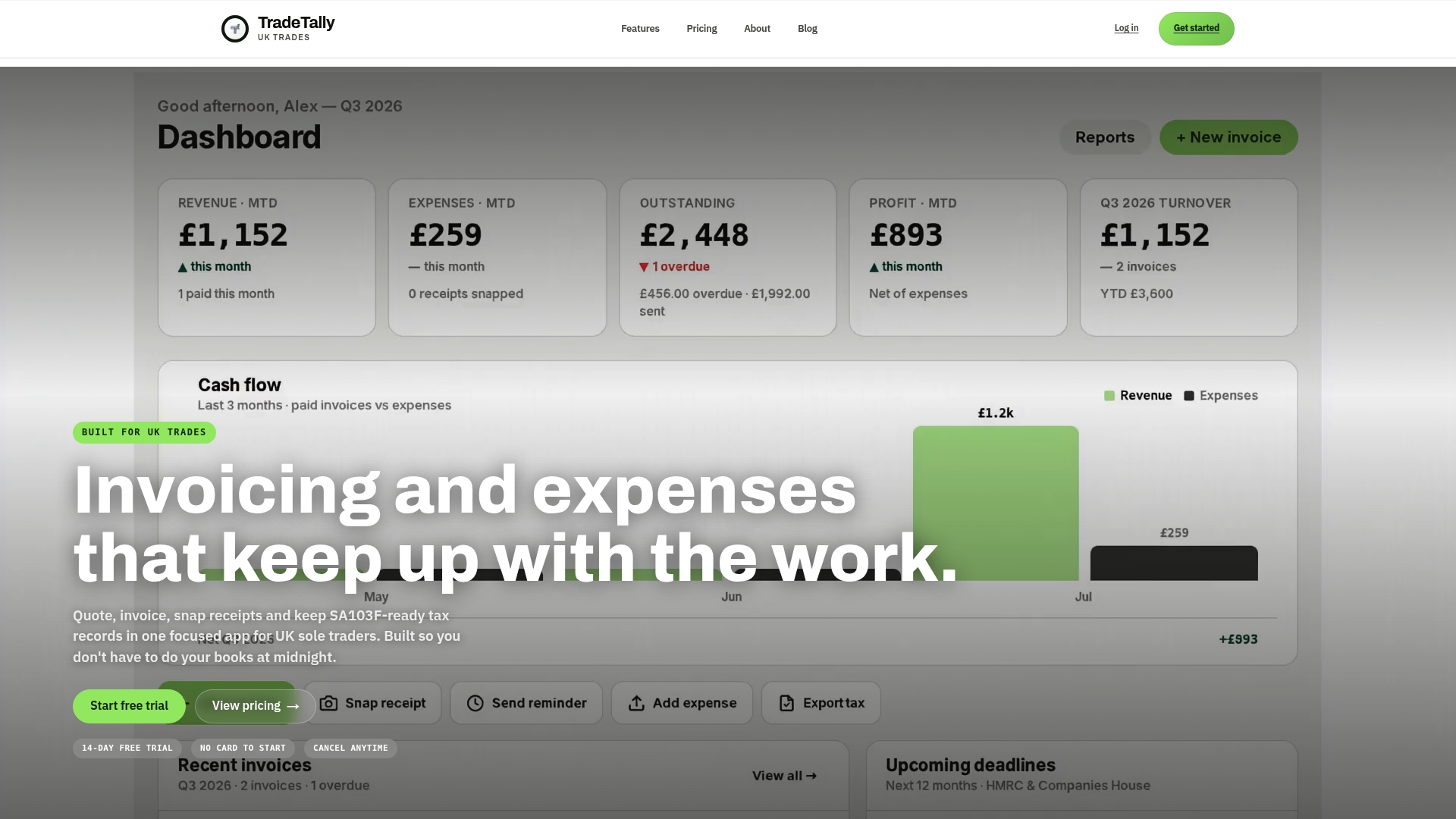
The CIS invoice software creates branded, CIS-ready invoices from your phone or van, while the CIS deduction calculator lets you double check any figure a contractor sends over. Come tax time, the SA103F export pulls your gross income and deductions straight into a Self Assessment ready format, no digging through a year of statements. If you’re a roofer, carpenter, or work in any trade where CIS applies, check out the invoicing software built for roofers or browse Tradetally’s trade specific tools and start your free trial today.
Sources
FAQ
What should CIS be deducted from?
CIS deductions apply only to the labour element of a payment. Materials the subcontractor has genuinely bought and can evidence with receipts are excluded from the calculation, along with VAT.
Is CIS tax always 20%?
No. The rate depends on the subcontractor’s status: 0% for those with gross payment status, 20% for verified registered subcontractors, and 30% for anyone unregistered or unverified.
How do I calculate CIS deductions?
Take the gross invoice figure excluding VAT, subtract any evidenced materials costs, and apply the relevant percentage to what’s left. A tool like the CIS deduction calculator handles this instantly from either a gross or net starting figure.
Is it better to be paid CIS or PAYE?
They’re not really comparable: CIS applies to self-employed subcontractors who handle their own tax through Self Assessment, while PAYE applies to employees. CIS suits those who want the flexibility of self-employment and are comfortable managing invoicing, expenses and an annual tax return, particularly once turnover supports applying for gross payment status.
Recommended
Ready to sort your trade admin?
TradeTally gives UK sole traders invoicing, expenses, and SA103F-ready tax exports in one mobile-first app.
Start 14-day free trial →