Receipt Retention for Sole Traders: How Long to Keep Them
If you are a self-employed tradesperson in the UK, keep your receipts and other business records for at least five years after the 31 January deadline for the tax year they relate to. Paper is not required: a clear digital copy is fine. The detail that catches people out is when the five years actually starts, so this guide gives you worked dates, a list of what to keep, and a simple routine that stops receipts piling up in the van door pocket.
TL;DR
- Keep records for at least 5 years after the 31 January submission deadline of the tax year they cover, according to GOV.UK.
- For the 2025/26 tax year, the deadline is 31 January 2027, so keep those records until at least 31 January 2032.
- You can keep records on paper, digitally or in software. There is no required format, only that the records are complete and readable.
- If a receipt is lost, recreate what you can and flag any estimates on your return. Do not leave the expense out of your records without a note.
- Capture the receipt the same day. A photo taken on site beats a search through glovebox paper in January.
Table of Contents
- How long to keep receipts as a sole trader
- What counts as a record
- Photos and scans instead of paper
- What to do when a receipt is missing
- What happens if you cannot produce records
- VAT, Making Tax Digital and your receipts
- A receipt routine that works from the van
- Our perspective
- Keep your records tax-ready with TradeTally
- FAQ
- Sources
How long to keep receipts as a sole trader
The rule is simple to state. GOV.UK says you must keep your records for at least 5 years after the 31 January submission deadline of the relevant tax year. That is not five years from the date on the receipt, and not five years from the day you filed. It is five years from a fixed date that sits nearly ten months after the tax year ends.
The tax year runs from 6 April to 5 April. The online return for a tax year is due on or before 31 January following the end of that year, as the government’s Tax Confident guidance for small businesses sets out.
Worked examples
Here is how that looks for a plumber or electrician buying materials across several tax years.
| Receipt date | Tax year | Return deadline | Keep until at least |
|---|---|---|---|
| 10 June 2025 | 2025/26 (6 April 2025 to 5 April 2026) | 31 January 2027 | 31 January 2032 |
| 3 March 2026 | 2025/26 | 31 January 2027 | 31 January 2032 |
| 12 April 2026 | 2026/27 (6 April 2026 to 5 April 2027) | 31 January 2028 | 31 January 2033 |
Notice that a receipt from June 2025 and one from March 2026 are kept for the same length of time, because they sit in the same tax year. A receipt dated just after 5 April starts a new clock a full year later.
Pro tip: label each batch by tax year, not by calendar year. In a folder, an app or a spreadsheet, “2025/26” is the only label that tells you when you can safely clear it.
When the five years can run longer
Five years is the minimum, not a promise that you are clear afterwards. HMRC’s compliance handbook says you keep records until the latest of three points: the fifth anniversary of 31 January following the tax year, the completion of any related enquiry, or the closing of the enquiry window. If you file late, the enquiry window is counted differently: it closes on the first anniversary of the next quarter day after you filed. In practice, if you filed a return late, or HMRC has opened a check, hold on to everything until it is fully closed.
Some records are worth keeping well beyond five years. If you buy a van, tools or equipment that you later sell, or you own property used for the business, you may need the original purchase records to work out a gain or loss. ACCA notes that older records, such as those of asset acquisitions, may be needed to calculate a capital gain or loss when you dispose of an asset. Keep purchase paperwork for big-ticket items for as long as you own them, plus the retention period after you sell.
What counts as a record
It is not only receipts. GOV.UK says sole traders must keep records of all business income and expenses, including receipts, bank statements, sales invoices, till rolls and bank slips. For a typical tradesperson, that means:
Money coming in
- Copies of every invoice you issue, with dates and amounts
- Records of payments received, whether by bank transfer, card or cash
- Any CIS deduction statements your contractors give you, if you work under the Construction Industry Scheme
- Quotes that led to the work, which help explain the invoice if a customer disputes it later
Money going out
- Supplier receipts and invoices for materials, tools, workwear and consumables
- Fuel, parking, tolls and van running costs
- Insurance, subscriptions, phone and software bills
- Training and certification fees
Supporting evidence
- Business bank statements (see our guide on which bank statements to keep for Self Assessment)
- Mileage logs, if you claim for vehicle use
- Notes on mixed-use items, such as a phone you use for both work and personal calls
For travel, the Tax Confident guidance says recording where and why you travelled keeps claims straightforward, and for mixed-use items you should record the business portion. A one-line note on the receipt, “Job at 14 Elm Road, boiler parts”, is worth more than it looks if you are ever asked to explain a claim.
If you want a fuller walkthrough of the paperwork, our Self Assessment records checklist covers it item by item.
Photos and scans instead of paper
You do not have to keep the paper. GOV.UK states there are no rules on how you must keep records: paper, digital or part of a software program are all acceptable. The condition is practical, not legal: the record must be complete, accurate and readable when you need it.
For VAT-registered businesses, the guidance is more specific. VAT Notice 700/21 says that if a scanned invoice image contains all the details required for VAT purposes, you do not need to keep the original unless you need it for another purpose. One exception is named: a C79 import VAT certificate must be kept in its original form.
Making a photo that will stand up
A bad photo is the same as no receipt. Check each one against this list:
- The whole receipt is in frame, including the top (supplier name) and the bottom (total).
- The date, amount and what was bought are legible.
- It is taken flat, in good light, not in the shadow of the dashboard.
- The file is stored somewhere other than only your phone’s camera roll.
- It has a note or tag saying which job or category it belongs to.
Thermal till receipts fade, sometimes within months. This is the strongest practical reason to photograph them on the day. Once the print has gone, the paper is useless, while the photo remains.
The government’s guidance suggests two easy habits: take a quick photo of receipts regularly and note down income and expenses each week. It also advises updating your records weekly or monthly. Weekly is better for a tradesperson with lots of small purchases.

For more on this approach, see our guide to digital receipts for sole traders.
What to do when a receipt is missing
It happens: a cash purchase at a merchant counter, a receipt that went through the wash, a supplier’s online account you can no longer log into. Work through these steps.
- Ask the supplier for a duplicate. Merchants and online retailers can usually reissue an invoice or receipt.
- Use other evidence. A bank or card statement showing the payment, plus a note of what it was for and which job, is supporting evidence.
- Write it down now. Record the date, supplier, amount, purpose and job while you still remember.
- Flag estimates. GOV.UK says that if you cannot recreate all your records, you can use provisional or estimated figures, and you must say so in the “Any other information” box on your tax return.
The last point matters. Estimates are allowed in genuine situations, but they must be declared as estimates. Quietly putting a round number on a return and hoping for the best is the version that causes trouble.
There is no safe amount you can claim with no evidence at all. The better approach is to treat every cost as needing a record, however small. A bag of fixings is tiny, but forty of them across a year add up to a real claim.
What happens if you cannot produce records
HMRC can ask to see your records, and failing to keep them has a cost. HMRC’s Enquiry Manual says a penalty of up to £3,000 may be charged for each failure to keep or preserve adequate records for a return or claim.
The same manual is clear about how that is used. HMRC says penalties for failing to keep or preserve records will be sought in more serious cases, such as deliberate destruction to obstruct an enquiry or a history of record-keeping failures. A single lost receipt on an otherwise well-kept set of books is a different matter from a pattern of missing paperwork.
The practical risk is often less dramatic than a penalty. Without a record, an expense may be disallowed, your taxable profit goes up, and you pay more tax than you should have. Good records protect your claims as much as they protect you from a fine.
VAT, Making Tax Digital and your receipts
Two other rule sets sit alongside the Self Assessment five-year rule.
VAT-registered traders
If you are VAT-registered, GOV.UK says you must generally keep all your business records for VAT purposes for at least 6 years. The same notice says VAT-registered businesses must keep and preserve certain records digitally and keep their accounts within functional compatible software. If you are VAT-registered, work to the longer period, six years, for anything that supports a VAT return.
Making Tax Digital for Income Tax
Making Tax Digital changes how records are kept, not how long. The Low Incomes Tax Reform Group explains that, unless exempt, sole traders with qualifying self-employment and property income of more than £50,000 in the 2024/25 tax year must keep digital records for those businesses under Making Tax Digital for Income Tax from April 2026. If you are not in that group yet, check the official GOV.UK pages for the current thresholds and start dates, because the rules have a phased timetable.
Even if you are not in scope yet, working digitally now is sensible preparation. Our guides on MTD for ITSA requirements and Making Tax Digital software for sole traders explain what the change means day to day.
A receipt routine that works from the van
The retention rule is easy. The hard part is the habit. This routine takes a few minutes a day.
- Photograph at the counter. Do it before the receipt goes in your pocket. The photo takes seconds.
- Tag it straight away. Job, category and whether it is business or mixed use. Our guide on splitting personal and business expenses shows how to handle the awkward ones.
- Do a weekly check. Ten minutes on Friday to match receipts against your bank feed and catch anything missing while it can still be replaced.
- Store by tax year. Everything for 2025/26 together, with a “keep until” date of 31 January 2032.
- Back it up. One copy on your phone is not a system. Use cloud storage or software that syncs.
- Clear out on schedule. Once the date has passed and no enquiry is open, you can dispose of the records. Shred paper securely, as receipts can carry card and address details.
Pro tip: put the destruction date in your calendar when you file. It stops you either hoarding everything forever or clearing a year too early.
If you want a fuller approach to expenses, our expense tracking guide for sole traders is a good next step, and the five-year rule guide shows how to capture records on site.
Our perspective
Most of the record-keeping trouble we see is not about not knowing the rule. It is about the evening after a long day, when the receipts are in three pockets and the invoice for Tuesday’s job has not gone out.
We built TradeTally around that moment. The idea is that the receipt is captured when you buy it, the invoice is sent from your phone before you leave the driveway, and the records are already organised by tax year when the return is due. We designed it so the SA103F export comes from records you have been keeping all along, not from a weekend of catching up.
Our advice is the same whatever tool you use: capture early, tag early, and store by tax year. If a tool makes that easier to do every single day, it is worth having.
Simon
Keep your records tax-ready with TradeTally
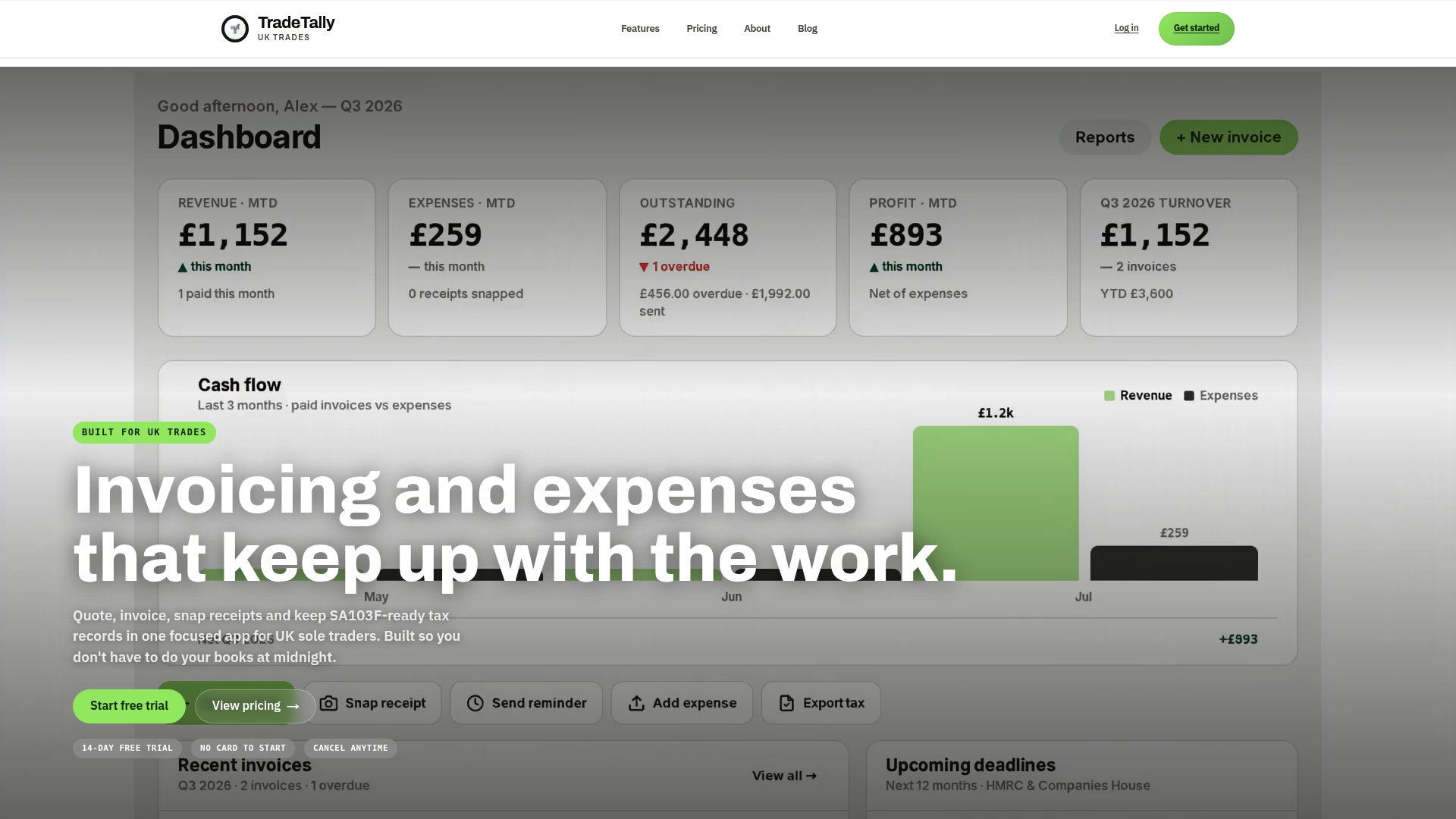
TradeTally is built for UK sole traders in the trades. You can create branded invoices, snap receipts, track expenses, mileage and time, handle CIS deductions and export records formatted for SA103F, all from your phone or the web. Our Starter plan is free at £0 per month, and Professional is £12 per month or £120 per year. You can see what each includes on our pricing page, or start with the free plan.
If you want to compare approaches first, our guide to the best app to keep receipts for tax explains what to look for.
FAQ
How long do I need to keep tax records in the UK as a sole trader?
At least 5 years after the 31 January submission deadline for the tax year concerned. For the 2025/26 tax year, that deadline is 31 January 2027, so you keep records until at least 31 January 2032. Keep them longer if HMRC has opened an enquiry or you filed late.
Can I throw away paper receipts if I have a photo?
Yes, in general. GOV.UK says there is no required format for records, and digital copies are acceptable. Make sure the image is complete and legible, and keep it backed up. Keep the original if you need it for another purpose, and note that a C79 must be kept in its original form.
Do I need to keep receipts for seven years?
For Self Assessment, the minimum is the five-year period described above, not seven. VAT-registered businesses should keep VAT records for at least 6 years. Some records, such as those for assets you later sell, may be useful for longer.
What if I lose a receipt?
Ask the supplier for a copy, then back it up with a bank statement and a note of what the purchase was for. If you still cannot recreate your records, you can use provisional or estimated figures, but you must say so in the “Any other information” box on your return.
Sources
- Business records if you’re self-employed: how long to keep your records, GOV.UK
- Business records if you’re self-employed: what records to keep, GOV.UK
- Keeping your pay and tax records: overview, GOV.UK
- CH14530 Record keeping: how long must records be retained, HMRC Compliance Handbook
- EM4650 Penalties: failure to keep or preserve records, HMRC Enquiry Manual
- Record keeping (VAT Notice 700/21), GOV.UK
- How to keep records as a small business, Tax Confident
- Record keeping, estimates and valuations, ACCA
- Tax: keeping records, Low Incomes Tax Reform Group
Recommended
Ready to sort your trade admin?
TradeTally gives UK sole traders invoicing, expenses, and SA103F-ready tax exports in one mobile-first app.
Start 14-day Pro trial →No card required