Contractor vs Subcontractor under CIS: What Each Must Do

Under the Construction Industry Scheme (CIS), the contractor is the business that pays for construction work and the subcontractor is the business or person who does it. The contractor verifies the subcontractor, deducts tax from their payments and reports it to HMRC every month. The subcontractor registers, gets paid net of those deductions and claims the tax back through their own return. Plenty of tradespeople are both at once, so the labels describe what you do on each job, not what kind of business you are.
TL;DR
- A contractor pays subcontractors for construction work. A subcontractor carries out that work. One business can be both.
- Contractors must register, verify each subcontractor with HMRC, deduct at the right rate, send monthly returns and keep records.
- Subcontractors should register for CIS. The deduction rates are 20% if registered, 30% if not and 0% with gross payment status.
- Deductions are advance payments towards your tax and National Insurance, not an extra tax.
- Private householders are not contractors, so work for a homeowner on their own home sits outside CIS.
Table of Contents
- Who counts as a contractor and who as a subcontractor
- You can be both on the same week
- Contractor vs subcontractor at a glance
- What a contractor must do
- What a subcontractor must do
- How CIS deductions are worked out
- Gross payment status: getting paid without deductions
- When CIS does not apply
- What happens when a contractor gets it wrong
- Our perspective
- A simple way to keep both sides tidy
- FAQ
- Sources
Who counts as a contractor and who as a subcontractor
HMRC’s guide to the scheme defines a contractor as a business or other concern that pays subcontractors for construction work. The subcontractor is whoever carries out that work for the contractor.
The label is wider than most tradespeople expect. In HMRC’s definition a subcontractor can be an individual, a partnership, a company, a public body, a labour agency, a gang leader or a foreign business doing construction work in the UK. A one-man plumber and a limited company with a van fleet are both subcontractors if a contractor is paying them for construction work.
On the contractor side, you may be a sole trader, a partnership or a limited company. If you are paying subcontractors, you must register as a CIS contractor before you take on your first one.
Some businesses are contractors without being builders
A business outside construction can still be a contractor. GOV.UK says a non-construction business must register if it has spent more than £3 million on construction in the 12 months since its first payment. For most of our readers, though, the question is simpler: are you paying someone else to do building work, or are you being paid to do it?
You can be both on the same week
Say you are a self-employed electrician. Monday to Thursday you wire a new-build for a main contractor, so you are their subcontractor. On Friday you bring in a labourer to chase walls on a separate job and pay them. Now you are a contractor too.
GOV.UK is clear that a subcontractor who also pays other businesses for construction work must register as both a CIS subcontractor and a CIS contractor. Your invoices to the main contractor are one stream. The deductions you make on the person you pay are another, with their own returns.
The practical tip: keep the two sides separate in your records from day one. Income that has had CIS taken off is tracked differently from payments you have made and deducted from.
Contractor vs subcontractor at a glance
| Contractor | Subcontractor | |
|---|---|---|
| Who they are | Pays for construction work | Does the construction work |
| Registration | Registers as a CIS contractor before the first subcontractor | Registers as a CIS subcontractor (or applies for gross payment status) |
| Main duty | Verify, deduct, report, keep records | Invoice correctly, keep statements, declare income on the tax return |
| Deductions | Takes them off payments and pays them to HMRC | Has them taken off and counts them as tax already paid |
| Monthly paperwork | CIS return and payment to HMRC | Check the payment and deduction statements |
| Penalty exposure | Late returns, missing deductions | Higher rate if unregistered |
| Can be both? | Yes | Yes |
What a contractor must do
HMRC’s summary is that contractors must verify subcontractors, make deductions when required, file monthly returns and keep full CIS records. In order:
- Register for CIS before taking on the first subcontractor.
- Check employment status. If the person should be on your payroll, PAYE applies, not CIS.
- Verify the subcontractor with HMRC before the first payment. You need their exact registration details. HMRC tells you whether they are registered and which rate applies.
- Re-verify if a past subcontractor has not appeared on one of your returns in the current tax year or either of the previous two.
- Deduct and pay. Take the deduction from the payment and pass it to HMRC.
- Give a statement. The subcontractor needs a payment and deduction statement within 14 days of the end of the tax month. For the month running 6 May to 5 June, that means by 19 June.
- File a monthly return. Contractors generally submit returns by the 19th and pay deductions by the 22nd.
If you pay no subcontractors for a stretch, you can ask HMRC to make your scheme inactive for up to six months, but you must file a return once payments resume.
Where you invoice customers and pay subcontractors from the same system, tools built around contractor payment and invoicing software can help you keep the paper trail tidy between verification and your monthly reporting.
Unmatched subcontractors
If HMRC cannot match the details you gave, the subcontractor must be treated as subject to the higher deduction rate until the identity or registration details are sorted. Typing the name, unique taxpayer reference or company number exactly as registered avoids most of these.
What a subcontractor must do
GOV.UK says an individual, limited-company owner, partnership or trust working as a subcontractor should register for CIS. You do not register if you are an employee, because PAYE applies instead.
If you want no deductions at all, you can apply for gross payment status, which registers you if you are not already. We cover the wider picture in our CIS guide for subcontractors.
As a subcontractor, your day-to-day jobs are:
- Put the labour and materials on your invoice as separate lines, so the contractor can deduct on the right figure.
- Keep every payment and deduction statement.
- Match the statements against your own records before the year ends. Our piece on what subcontractors must verify on statements walks through the checks.
- Declare all your income on your Self Assessment return and claim the deductions as tax already paid.
How CIS deductions are worked out
The contractor starts with the gross invoice, takes off VAT and the qualifying direct costs, then applies the rate to what is left. GOV.UK’s list of direct costs includes materials the subcontractor pays for directly, plant hire and non-travel fuel.
The rates stated there are:
- 20% for registered subcontractors
- 30% for unregistered subcontractors
- 0% for subcontractors with gross payment status
A worked example
This is an illustration, not a real job. You invoice £2,000 before VAT, of which £600 is materials you bought yourself and £1,400 is labour.
| Registered (20%) | Unregistered (30%) | |
|---|---|---|
| Labour charged | £1,400 | £1,400 |
| Deduction | £280 | £420 |
| Paid to you (before materials and VAT) | £1,120 | £980 |
The materials are paid back to you in full. The gap between registered and unregistered on this one job is £140, which is why registering matters for cash flow. For more on the three rates, see our guides to CIS deduction rates and CIS deductions.
Deductions are not an extra tax
CIS deductions are advance payments towards your tax and National Insurance. Tax Confident adds that registering can mean less is deducted and more cash flow, but does not mean paying less tax overall. If more has been deducted than you owe once your return is done, you can get the difference back.
Gross payment status: getting paid without deductions
Gross payment status means the contractor pays you in full and you settle your tax through Self Assessment. HMRC requires you to pass business, turnover and compliance tests. From 6 April 2024, VAT compliance is part of the statutory compliance test for getting and keeping the status.
For an individual, HMRC’s notes say you generally need UK construction activity run through a bank account, net construction turnover of at least £30,000 in the preceding 12 months, and compliance with specified tax obligations. Check the current notes before you apply, as the tests can change.
Pro tip: gross status brings a tax bill you need to plan for. With no tax taken at source, put money aside as you invoice. Our Self Assessment tax calculator gives you a rough figure to work with.

When CIS does not apply
Three situations catch people out.
Private householders. HMRC says private householders are not contractors for CIS, so if you are paid by a homeowner for work on their own home, CIS is not in play.
Employees. If you are really an employee, you are on PAYE. Registering for CIS does not prove you are self-employed. Tax Confident points to signs of employment such as the engager setting your hours, booking your jobs, supplying tools or stopping you sending a substitute. Our article on why CIS does not prove self-employment covers this in more depth, and CIS versus PAYE shows what the difference does to your take-home.
Work outside the UK. HMRC’s manual says CIS applies to construction operations in the UK, including Great Britain, Northern Ireland and UK territorial waters up to 12 miles from the high-water mark. It does not cover the Republic of Ireland, the Isle of Man or the Channel Islands.
What happens when a contractor gets it wrong
GOV.UK warns that penalties may apply if contractors fail to register, file monthly returns or keep full records. The late filing penalties in HMRC’s compliance manual are £100 at first, a further £200 at two months, and at six months the greater of 5% of the liability or £300, with more possible at 12 months.

There is also the deduction risk. Blick Rothenberg warns that HMRC may seek unpaid deductions from the contractor where the contractor failed to deduct them. For a subcontractor, the practical protection is to be registered, supply accurate details and keep your own copy of every invoice and statement.
Our perspective
We built TradeTally because the admin after a day on site is where tradespeople lose evenings. CIS makes it heavier: labour and materials to separate, a deduction to check, a statement to file away and a year-end figure that has to match.
Most disputes we hear about start with an invoice that blurred labour and materials, or a statement nobody kept. Our approach is to get the invoice right the first time. Branded invoices, CIS deduction handling, receipt capture from your phone and an SA103F export are designed so that by January your records are already in the shape your return needs.
Whether you are the subcontractor on one job and the contractor on the next, the habit is the same: record it when it happens, from the van, not from a shoebox in January.
Simon
A simple way to keep both sides tidy
If you are a sole trader subcontractor, TradeTally lets you create invoices with CIS deductions handled, snap receipts, track mileage and time, and export your records for Self Assessment. The Starter plan is £0 per month for limited invoicing. Professional is £12 per month or £120 per year and covers unlimited invoices, receipts and tax exports. You can see both on our pricing page.
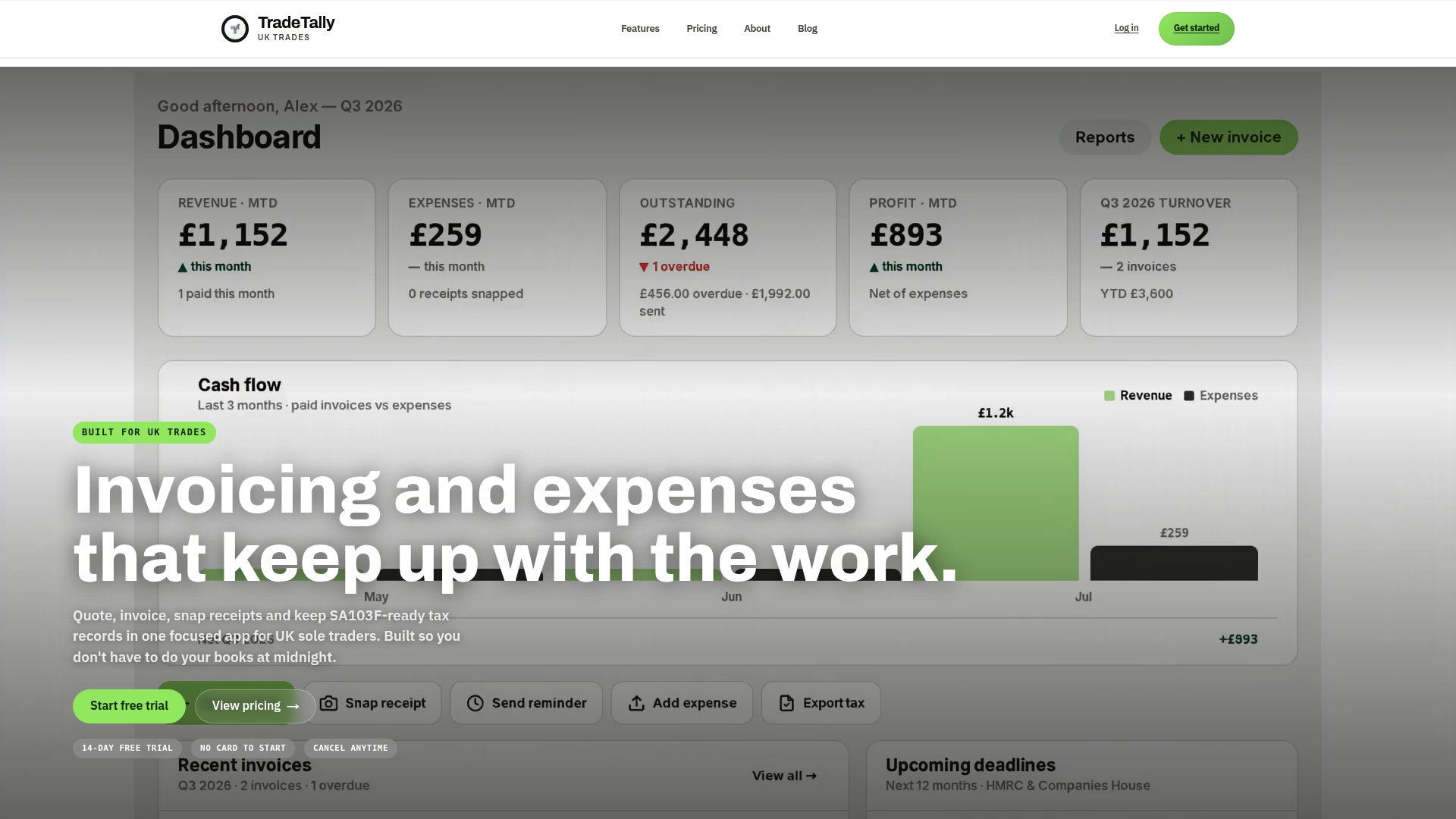
If you want to see how the numbers reach your return, our SA103F software page explains the export, and the CIS invoice software page shows how invoices are set up. You can also start from the TradeTally home page.
FAQ
Do I need to register for CIS if I only work for homeowners?
No. HMRC says private householders are not contractors for CIS purposes, so work for a homeowner on their own home falls outside the scheme. If you also take work from a builder or main contractor, that work is covered and you should register as a subcontractor.
Can I be a contractor and a subcontractor at the same time?
Yes. If you do construction work for another contractor and also pay others for construction work, GOV.UK says you must register as both. You then have deductions taken from you on one side and you take deductions on the other.
What happens if a contractor is not registered for CIS?
A contractor who pays subcontractors must register, file monthly returns and keep records. GOV.UK warns that penalties may apply if they do not. HMRC may also pursue the contractor for deductions that should have been made.
What rate will be taken from me as a subcontractor?
The rates GOV.UK states are 20% if you are registered, 30% if you are not and 0% with gross payment status. The contractor verifies you with HMRC to find out which applies, so give your details exactly as registered.
Sources
- HMRC: Construction Industry Scheme, a guide for contractors and subcontractors (CIS340)
- GOV.UK: What you must do as a CIS contractor
- GOV.UK: Verify subcontractors
- GOV.UK: Make deductions and pay subcontractors
- GOV.UK: What you must do as a CIS subcontractor
- GOV.UK: How to register as a CIS subcontractor
- HMRC: CISR51060, Verify subcontractor
- HMRC: CISR13010, The scheme: subcontractors
- HMRC: Strengthening the tests for gross payment status
- HMRC: CIS302 notes, individual registration for gross payment
- HMRC: CH62320, Penalties for failure to file on time
- Tax Confident: How tax works for construction businesses
- Blick Rothenberg: Contractors and subcontractors and the Construction Industry Scheme
Recommended
Related articles

Subcontractor vs Sole Trader: CIS Explained
See how HMRC tests self employment for UK trades, why CIS registration does not prove status, and how to report deductions through Self Assessment.

CIS Deductions: The Three Rates Explained
A practical UK trades guide to CIS deductions: the three rates, step-by-step calculations, verification duties and a compact compliance checklist.
CIS Deduction Rates: 0%, 20% or 30%?
Practical guide to CIS deduction rates (0%, 20%, 30%) for UK contractors: verification, step-by-step calculations, gross status tests and tools to avoid...
CIS vs PAYE for UK Subcontractors
Practical guide for UK subcontractors: compare CIS and PAYE with a £4,000 example, see 20%/30%/0% deductions, learn CEST use, and which records to save.