How to Write Off a Bad Debt as a UK Sole Trader

You write off a bad debt when you decide, with evidence, that a customer’s unpaid invoice will not be recovered, and you record it as a loss in your books. For most sole traders the practical question is what that does to your tax. If you use the cash basis, nothing needs claiming, because income you never received was never taxed. If you use the accruals basis, the loss is deductible in the year the debt goes bad. If you are VAT registered, you can claim the VAT back once the invoice is six months overdue. Either way, a write-off is a bookkeeping decision: the customer still owes you the money.
This guide takes you through the decision, the evidence to keep, the entries, the tax and VAT, and what to do if the customer turns up and pays.
TL;DR
- A write-off is an accounting decision, not forgiveness. The debt stays enforceable for six years in England, Wales and Northern Ireland, five in Scotland.
- Write off only when you have a paper trail showing you tried to recover the money and it has failed or is not worth the cost.
- Cash basis sole traders do not need bad debt relief. Accruals basis traders deduct the specific bad debt in the year it goes bad.
- VAT bad debt relief needs six months of non-payment, a separate bad debt account, and a claim in box 4 of your VAT return.
- If the customer pays later, put the income back in your records and repay any VAT relief you claimed.
Table of Contents
- What writing off a bad debt actually means
- When is an unpaid invoice a bad debt?
- Before you write off: exhaust the sensible recovery steps
- The evidence file to keep
- Do you even need to write it off? Cash basis versus accruals
- How to record the write-off in your books
- What it does to your tax
- VAT bad debt relief
- If the customer pays after you wrote it off
- Keeping the paper trail without the paperwork
- Keep your invoices and records in one place
- FAQ
- Sources
What writing off a bad debt actually means
A write-off is the accounting recognition that a specific debt will not be collected. It is not a legal act. Business Debt Recovery’s guide explains that the debt still legally exists and remains enforceable for six years from when it fell due. A part payment or a written acknowledgement from the customer can restart that clock. Only a credit note or a written agreement releasing the customer gives up your right to the money.
HMRC draws the same line in its corporate finance manual. Writing a debt off in the books does not extinguish it, whereas formally waiving it releases the debtor. Its business income manual adds that a trade debt becoming statute-barred after six years under the law of England and Wales does not change its original status as an enforceable debt.
The limitation period depends on where you work. According to a 2026 sole trader guide, you have six years from the date the debt fell due to bring a claim in England, Wales and Northern Ireland, and five in Scotland.
So you are not giving the customer a free pass. You are telling your books, and HMRC, that you no longer expect to be paid.
When is an unpaid invoice a bad debt?
An invoice being late is not enough. A bad debt is one you have reasonable evidence you cannot recover, and you have made a clear decision to stop chasing. Sidekick Accounting lists common triggers:
- The customer has gone into administration.
- The invoice is six to twelve months old with no payment plan in place.
- You have taken advice that recovery costs would exceed the debt.
Coface’s UK guide adds a few more: the customer is insolvent with no expected dividend, cannot be traced, the debt is time-barred, or legal enforcement has failed. It also says that for audit and tax purposes, documentation is essential to justify the write-off.
The same logic shows up in government guidance. The official debt recovery guide tells creditors to weigh the commercial reality. If the customer is insolvent or has no funds, further action is unlikely to help, and the cost of any action should be set against the size of the debt before you instruct a solicitor or an agency.
A quick decision test
Ask yourself four questions:
- Have I sent a documented series of reminders, a final demand and, where sensible, a letter before action?
- Is there a clear reason payment will not come: insolvency, a vanished customer, a failed judgment?
- Is the next recovery step likely to cost more than I would get back?
- Am I writing this off because recovery is hopeless, or because I want a tidier year end?
If the honest answer to the last one is the second, wait. Action Accountants makes the point that the write-off date should reflect when recovery actually became hopeless, not when you want to tidy up.
Before you write off: exhaust the sensible recovery steps
The write-off is the last step, not the first. The official guidance is to check your invoice is accurate and that you can prove delivery of the work. Then tell the customer in writing that you will claim statutory interest at 8% over the Bank of England base rate plus compensation under the late payment legislation, as set out in the government’s debt recovery guide. It also suggests stopping further supply, and considering Money Claim Online or a solicitor.

For day-to-day chasing, our guides on chasing overdue invoices and chasing unpaid invoices as a tradesperson set out the reminder sequence. If the customer is disputing the work rather than ignoring you, settle that first: our 72-hour invoice dispute playbook shows how. A disputed invoice that you later concede is a credit note matter, not a bad debt.
Prevention beats any write-off. Stage payments and deposits shrink the amount that can go bad, and a partial payment invoice is a simple way to set that up on a job. For a wider system on how to get invoices paid faster, clear terms and prompt, automatic follow-up do most of the work.
The evidence file to keep
A write-off with a paper trail is straightforward. One with nothing behind it looks like a decision made for tax reasons, as the sole trader guide puts it. Keep these together for each debt:
- The quote, signed contract or written agreement of the work.
- The issued invoice, showing the due date and your payment terms.
- Proof the work was done: photos, a signed job sheet, delivery notes.
- Every reminder, message and call note, in date order.
- The final demand or letter before action.
- Anything showing why recovery failed: an insolvency notice, a liquidator’s letter, a returned letter, an unenforceable judgment.
- The date you decided to write off, and why.
Pro tip: photograph the finished job and get the customer’s sign-off before you leave site. Whatever happens later, that record is hard to argue with. Our invoice requirements guide covers what an invoice must show so that it stands up if it is ever challenged.
Do you even need to write it off? Cash basis versus accruals
This is the question most sole traders skip, and it decides whether you have anything to claim.
Under the cash basis you count income when it is paid, so an invoice that is never paid never becomes taxable income. AccoTax notes that cash basis users do not need bad debt relief for this reason. According to Merranti Accounting, the accruals basis is mandatory for limited companies and for self-employed people with turnover over £150,000 a year, and those businesses are the ones that need relief.
| Your situation | Is the unpaid invoice in your taxable profit? | What you do |
|---|---|---|
| Sole trader, cash basis | No, because you have not been paid | Nothing to claim. Keep the records and close the debt in your books |
| Sole trader, accruals basis | Yes, it was counted when invoiced | Write off the specific debt and deduct it in the year it goes bad |
| VAT registered, standard accounting | You paid VAT on the invoice | Claim VAT bad debt relief once the conditions are met |
| VAT registered, cash accounting scheme | No VAT paid on unpaid sales | No VAT relief needed |
If you are unsure which basis you are on, check your last Self Assessment return or ask your accountant before you claim anything.
How to record the write-off in your books
The core entry is simple. When a specific debt becomes irrecoverable, debit Bad Debts and credit Trade Receivables. Do not post the write-off directly against sales.
Where you keep a sales ledger, Solar Protect’s bookkeeping guide describes the general ledger entry as a debit to irrecoverable debts expense and a credit to the sales ledger control account. The individual customer’s account is credited too. Posting only to the control account without allocating it to the customer is the classic cause of a control account difference.
The same guide makes two practical points:
- Write off the full amount owed, including VAT, because that is the balance in the ledger.
- Show it as a write-off transaction, not a credit note. A credit note understates turnover and muddles your VAT records.
The second point trips up a lot of tradespeople. A credit note is for correcting or cancelling an invoice, for example a job you agreed to reduce. Our guide to VAT-compliant credit notes explains when one is correct. Writing off a debt you simply cannot collect is a different thing.
Keeping the original sale visible as revenue, with the loss in its own bad debts account, also tells you something useful. It shows how many of your customers fail to pay, and so how much credit you can safely give.
A specific write-off, not a guess
Tax relief follows specific debts, not hunches. A specific provision against an identified at-risk debt is deductible once the debt is formally written off. A general provision, such as setting aside 5% of all debtors on the assumption some will go bad, is not deductible and is added back in the tax computation, according to Holloway Davies. Name the customer, the invoice and the amount.
What it does to your tax
For a sole trader on the accruals basis, HMRC allows a deduction only for a bad debt, a doubtful debt to the extent it is estimated to be bad, or a debt released under a statutory insolvency arrangement. The deduction is made in the year the debt becomes bad or doubtful. That is in HMRC’s business income manual. The legal basis is section 35 of the Income Tax (Trading and Other Income) Act 2005, which IAK Accountants sets out alongside the corporation tax equivalent for companies.
For income tax purposes there is no minimum waiting period. AccoTax says a specific bad debt can be written off as soon as it is reasonably clear it will not be paid. The six-month rule applies only to VAT relief. Chasing letters, customer insolvency or an unenforceable court judgment all support the write-off.
It also reduces Class 4 National Insurance, because that is calculated on the same profit. Holloway Davies notes that the deduction arises in the period when the write-off is made, so delaying a genuine write-off delays the relief.
A worked example
Say you are a plumber on the accruals basis and not VAT registered. You fitted a bathroom for £2,400, the customer has gone bankrupt, and the trustee confirms there will be no dividend. You write off £2,400 as a bad debt in that tax year. Your taxable profit falls by £2,400, which reduces both your income tax and your Class 4 NIC. If you were on the cash basis, you would have recorded no income for the job, so there would be nothing to deduct.
VAT bad debt relief
If you charged VAT on the invoice and have already paid it to HMRC, you can usually get it back. The rules are in HMRC’s VAT Notice 700/18, last updated on 18 September 2025. The conditions are:
- You have already accounted for and paid the VAT.
- The debt is written off in your day-to-day VAT accounts and moved to a separate bad debt account.
- The value of the supply is not more than the customary selling price.
- The debt has not been paid, sold or factored under a valid legal assignment.
- It has been unpaid for six months after the later of the payment due date and the date of supply.
You claim in box 4 of the VAT return covering the date the conditions are met. The claim must be made within four years and six months of the later of the due date and the date of supply. Your separate bad debt account must show the amount written off, the VAT claimed and the return it went on, the VAT originally charged, any payments received, and the customer’s name with invoice date and number. Keep the records for four years from the date of the claim.
If you want to check the VAT element of an invoice quickly, our VAT calculator adds or removes 20%.
Business Debt Recovery gives an illustrative example for a company: on an £18,000 invoice including 20% VAT, writing off the £15,000 net sale gives £3,000 VAT relief and £3,750 corporation tax relief at 25%, so £6,750 comes back through the tax system. Sole traders pay income tax rather than corporation tax, but the VAT side works the same way. The point is that the relief is real, and it is no substitute for being paid.
Small traders have another route. HMRC’s manual on irrecoverable VAT says most traders must account for VAT at the time of supply and cannot waive it because the customer has not paid. Those with VAT-exclusive turnover not exceeding £1,350,000 may opt for cash accounting, which avoids paying VAT on invoices that are never settled. Check with your accountant whether that suits you.
Domestic reverse charge
Builders and subcontractors working under the VAT domestic reverse charge do not charge VAT on those supplies, so there is no VAT to reclaim on an unpaid invoice of that kind. Our guide to the domestic reverse charge shows how invoices should be worded.
If the customer pays after you wrote it off
The debt was never extinguished, so a late payment is simply income that arrives after the write-off. Per the sole trader guide, it goes back into your accounts as income for the period you receive it, and any VAT you reclaimed is repaid. HMRC’s Notice 700/18, as summarised by Business Debt Recovery, has you repay VAT relief in box 1 of the VAT return for the period the payment arrives.
You can also still pursue a written-off debt if the customer’s finances recover. RWK Goodman notes that a debt has a six-year life, and a County Court Judgment can in some circumstances be enforced even after six years.
So it is worth recording the write-off date and any later recovery. Business Debt Recovery suggests you stop pursuing only when the debtor has ceased trading with no assets, is dissolved, is insolvent and you are unsecured, the debt is time-barred, or the likely recovery is smaller than the cost of the next step. For tax records, sole traders should keep them for at least five years after the 31 January submission deadline, as TapTax’s guidance, relayed by that same guide, says.
Also be realistic about small sums. The sole trader guide points out that a £400 invoice from a vanished customer is not worth six months of attention. Close it, keep the file and focus on not repeating it.

Keeping the paper trail without the paperwork
The hardest part of a clean write-off is not the journal. It is being able to produce, months later, the invoice, the dates and the chasing history. Tradespeople lose these in phone galleries, glovebox receipts and half-remembered texts.
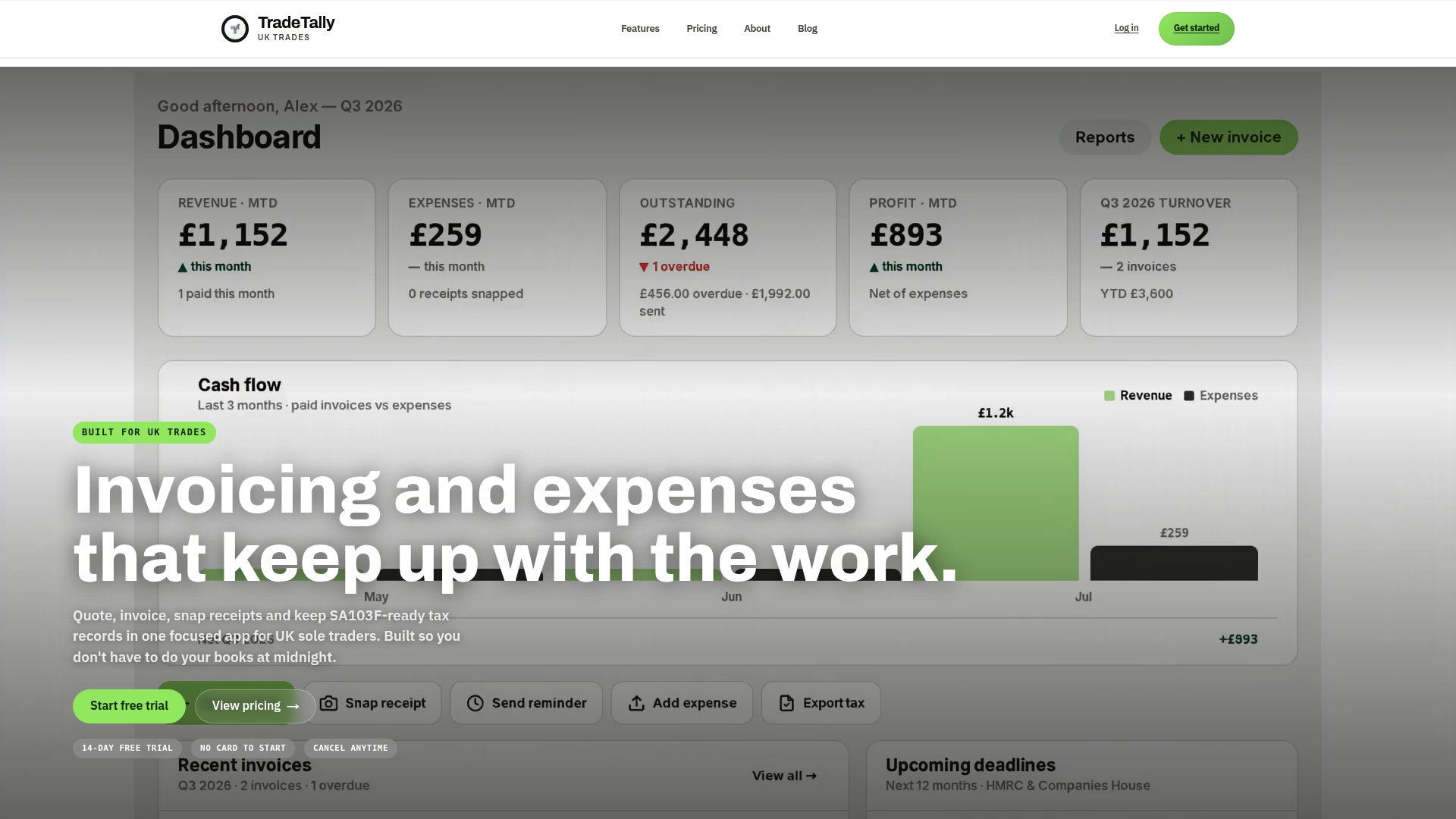
This is where we built TradeTally to help. It handles branded invoicing and quotes, expense and receipt capture from your phone, and tax-ready records with an SA103F export for Self Assessment. It also produces straightforward exports to hand to an accountant. With invoices and receipts in one place, you can see which jobs are unpaid and show what you issued and when.
Our expenses guide for tools and our piece on splitting personal and business expenses cover the other half of a tidy set of records.
Our view
We built TradeTally because the admin after a day on site is where trades businesses lose money and sleep. A bad debt is rarely one bad decision. It is usually a missing deposit, a vague quote, a job finished without sign-off, or an invoice sent three weeks late.
So our advice is to fix the front end. Quote clearly, take stage payments, invoice the day the job ends and keep a dated record of every chase. When all that is in one place, a write-off becomes a calm, documented decision rather than a scramble at year end. We designed TradeTally for sole traders who want exactly that: invoices, receipts and tax-ready records that are there when you need them.
Write off what is genuinely lost, record it honestly and move on to the next job.
Simon
Keep your invoices and records in one place
The Starter plan is free at £0 per month, for limited invoicing. The Professional plan is £12 per month or £120 per year, and gives you unlimited invoices, receipts and tax exports. You can start with TradeTally and see the Professional plan pricing.
If a debt looks unusual, for example a large sum, a company in administration or a claim involving a judgment, speak to your accountant before you claim relief, and to a solicitor before you start a court claim.
FAQ
Can you legally write off a debt in the UK?
Yes, as an accounting entry. You decide you will not recover the money and record it as a loss. Legally, the customer still owes you, and you can pursue the debt for six years in England, Wales and Northern Ireland, or five in Scotland. Only a credit note or a written release gives up your right to the money.
How long before a bad debt can be written off?
For income tax there is no set waiting period: you can write it off once it is reasonably clear the debt will not be paid, per AccoTax. For VAT bad debt relief the invoice must have been unpaid for six months after the later of the due date and the date of supply, under VAT Notice 700/18.
What happens when you write off a bad debt?
The amount moves from your trade receivables to a bad debts expense, and the customer’s account is cleared. If you are on the accruals basis, it reduces your taxable profit for the year. If you are VAT registered and the conditions are met, you can also reclaim the VAT in box 4 of your VAT return.
Do I need to write off unpaid invoices if I use the cash basis?
Not for tax. On the cash basis you only count income when it is paid, so an unpaid invoice never enters your profit. You should still keep the file and close the invoice in your records, in case you recover the money later.
Sources
- Writing off a bad debt, Business Debt Recovery
- CFM31077, HMRC corporate finance manual
- BIM40260, HMRC business income manual
- Writing off an unpaid invoice: tax and VAT for sole traders
- Writing off bad debts: tax relief, Sidekick Accounting
- Irrecoverable debt guide, Coface
- When all else fails, government debt recovery guide
- Writing off bad debts for tax and VAT purposes, AccoTax
- Bad debts and tax relief, Merranti Accounting
- How to write off bad debt in the UK, Action Accountants
- Writing off a debt in the books, Solar Protect
- Bad debts explained, IAK Accountants
- Late payment rules for small businesses, Holloway Davies
- BIM42701, HMRC business income manual
- BIM31575, HMRC business income manual
- Relief from VAT on bad debts (VAT Notice 700/18)
- Debt recovery: enforcing written off bad debts, RWK Goodman
Recommended
Related articles

Chasing Overdue Invoices in the UK: A Step-by-Step Guide for Tradespeople
How to chase overdue invoices in the UK: when an invoice is late, what to say, when to add interest and £40–£100 compensation, and when to go to court.
Claim Late Payment Interest in the UK
Find out what you can charge when a UK client pays late: the statutory 8%+Bank Rate, £40–£100 fixed compensation, plus invoice templates.

Late Fees on an Invoice in the UK: What You Can Charge
What UK tradespeople can legally charge on a late invoice: 8% statutory interest, £40 to £100 fixed fees, worked examples and how to word it.
Invoice Disputes: 72-Hour Resolution Playbook
Resolve invoice disputes within 72 hours. Step by step actions, evidence checklist, OSBC/ADR routes and ready templates. Tradetally: Starter free;...