Credit Control: 10 Steps UK Tradespeople Can Run From Van to Desk

Credit control means deciding who you let pay later, setting clear terms up front, and chasing anything overdue before it becomes a write-off. The single most useful habit is to invoice the moment a job finishes and state the due date on the invoice itself. Small firms lose an average of 86 hours a year chasing payments, and HMRC’s Making Tax Digital rules mean those invoices need to be recorded properly too.
TL;DR:
- Federation of Small Businesses research found that small firms spend 86 hours yearly chasing late payments, with costs reaching £5,200 for some businesses.
- Require new domestic clients to pay upfront or on completion, and offer repeat commercial clients written terms only after trust is established.
- Before filing a debt claim, send a Letter of Claim, allow at least 28 days for a response, and consider alternative dispute resolution.
- Making Tax Digital applies only to some sole traders, who must keep digital records and submit quarterly updates; check your qualifying income threshold on GOV.UK.
Table of Contents
- Why credit control matters for sole traders in the UK
- A step-by-step credit control system you can set up this week
- How to chase overdue invoices without burning the relationship
- Invoicing and payment habits that get you paid faster
- A daily and weekly routine to keep credit under control
- What actually separates sole traders who get paid from those who don’t
- Keeping credit control simple with TradeTally
- FAQ
- Sources
Why credit control matters for sole traders in the UK
Chasing money is not a side task. It is the task that decides whether a sole trader has cash to buy materials for next week’s job or spends evenings on the phone instead of with family.
Federation of Small Businesses research shows small firms spend an average of 86 hours a year chasing late payments, with lost time and resources costing some firms up to £5,200 annually. The same research found that roughly 38 firms close every day because of late payment problems, a reminder that this is not a paperwork annoyance but a continuity risk.
For a sole trader, there is no finance department to absorb the gap between work done and money in the bank. One client paying late can mean a choice between covering fuel, materials or your own mortgage. Credit control exists to stop that gap opening in the first place, and where it does open, UK law gives you tools to close it.
Those tools include:
- The right to charge statutory interest automatically on overdue business-to-business invoices.
- Fixed compensation payments that scale with the size of the debt.
- A formal pre-action process that pushes slow payers towards settling before court becomes necessary.
The detail of those rights matters enough that it gets its own section further down, but knowing they exist changes how you negotiate terms from day one. A client who understands you know your rights tends to pay faster than one who assumes you will not chase it.
A step-by-step credit control system you can set up this week
Most late payment problems start before the invoice is even sent. Building a routine around these ten steps closes the gaps that let invoices slip.
- Decide who gets credit. New domestic clients pay on completion or up front; repeat commercial clients can be offered agreed payment terms once trust is established.
- Ask for a deposit on bigger jobs. A common approach for larger projects is to request a deposit upfront, with the balance due on completion, though the right split depends on materials cost and job length.
- Put terms in writing before you start. State the price, payment due date, accepted payment methods and what happens if payment is late.
- Invoice the day the job finishes, not the following week. British Business Bank guidance notes that clients are more likely to pay promptly when the work is still fresh and clearly itemised.
- Use a consistent invoice number and reference so neither side loses track of which job an invoice relates to.
- Record the invoice digitally the moment it is issued. Under Making Tax Digital for Income Tax, some sole traders must keep digital records and send quarterly updates, and HMRC’s own MTD guidance sets out the practical steps for getting compliant software in place.
- Set an automatic reminder before the due date.
- Flag anything unpaid after the due date, rather than letting it drift for a week.
- Log every contact attempt, including date, method and what was said, in case you need it later.
- Review your aged debt list weekly so overdue invoices do not slip by unnoticed.
For recurring clients, a saved invoice template with your standard terms pre-filled removes the temptation to skip steps when you are tired after a long day on site. Automatic reminders sent by your invoicing software do the chasing for you before a conversation is even needed, which keeps the relationship friendly for longer.
Pro Tip: Set your invoice due date to a fixed number of days rather than a calendar date, so templates stay accurate however late in the month you send the invoice.
How to chase overdue invoices without burning the relationship
Chasing payment well is about escalating fairly and keeping a paper trail, not about getting personal.
A sensible cadence looks like this:
- After the due date: a friendly email reminder referencing the invoice number and amount.
- Day 7: a phone call, followed by a written summary of what was agreed.
- If payment remains outstanding: a firmer written notice stating that statutory interest may apply if payment is not received.
- If the debt remains unresolved: consider sending a formal Letter of Claim.
That Letter of Claim is not optional paperwork. The Pre-Action Protocol for Debt Claims sets out what courts expect before any claim is filed: a Letter of Claim, at least 28 days for the other side to respond using the Annex 1 reply form, and consideration of alternative dispute resolution before proceedings start.
Once that stage is reached, you are entitled to more than just the original invoice amount. Under the Late Payment of Commercial Debts framework, suppliers can automatically charge statutory interest and claim fixed compensation on overdue business payments. Interest starts accruing the day after the due date, and fixed compensation is £40 for debts under £1,000, £70 for debts between £1,000 and £9,999.99, and £100 for debts of £10,000 or more.

If the debt still is not paid after the Pre-Action Protocol stage, Money Claim Online lets you file a claim without a solicitor for straightforward debts. Skipping the pre-action steps first can weaken your claim or your ability to recover costs, so the sequence matters as much as the escalation itself. For larger or disputed debts, weigh the court fee and your time against the likelihood of actually recovering the money. Sometimes a measured conversation gets you paid faster and cheaper than a court form ever will.
Invoicing and payment habits that get you paid faster
Friction in the payment process is often the real reason an invoice sits unpaid, not bad faith on the client’s side.
A clear invoice includes:
- Your name or business name, address and contact details.
- A unique invoice number and date issued.
- A clear description of the work, the amount due and the payment due date.
- Accepted payment methods and your bank details or payment link.
Our free invoice template for sole traders covers all of these fields if you want a starting point rather than building one from scratch.
Payment method matters too. Small Business Commissioner guidance recommends offering several payment methods, such as bank transfer, card and Direct Debit, because reducing friction at the point of payment lowers the risk of the invoice being forgotten or delayed. Asking the client to confirm receipt of the invoice by email also gives you a timestamp to refer back to if a dispute arises later.
When it comes to reminder wording, the tone makes a real difference:
- A warm, assumptive first reminder: “Just checking this has landed safely.”
- A neutral follow-up stating the amount and due date plainly.
- A firmer notice referencing the payment terms agreed at the outset.
- A final notice before formal escalation, stating that interest will apply.
We set out this exact four-step wording in our invoice reminder guide, and our late payment letter templates are ready to copy and adapt for the firmer stages.
A daily and weekly routine to keep credit under control
Credit control stops feeling like a chore once it is broken into small habits rather than one big monthly scramble.
Daily:
- Invoice any job finished that day before you leave the site or get home.
- Snap receipts for materials and expenses as they happen.
- Note any partial payments against the right invoice straight away.
Weekly:
- Run an aged-debt check: overdue invoices get a reminder.
- Call clients whose invoices are approaching the due date rather than waiting until they are overdue.
- Block out time for follow-up calls so chasing does not get pushed aside by site work.
Monthly:
- Reconcile receipts against your bank statement.
- Set aside a portion of income for tax, so a slow-paying month does not eat into money already owed to HMRC.
- Review anyone who paid late and decide whether to adjust their terms or require a deposit next time.
Because some sole traders are required to keep digital records and submit quarterly updates under Making Tax Digital, doing this weekly rather than scrambling before a deadline keeps you compliant with far less stress. HMRC’s guidance on using MTD walks through getting software authorised and sending those updates on time.
Pro Tip: Keep your aged-debt list on your phone, not buried in a spreadsheet on a laptop you only open at month end.
What actually separates sole traders who get paid from those who don’t
The sole traders who struggle least with late payment are rarely the ones with the toughest terms. They are the ones who invoice on the same day, every time, without exception.
The biggest trap is treating credit control as something you do when cash gets tight, rather than a routine you run regardless. Waiting until an invoice is long overdue to start chasing properly makes recovery harder and the conversation more awkward than it needed to be. A better alternative is to escalate the tone promptly rather than letting the delay grow.
If a dispute does become complicated, free guidance is available through the Small Business Commissioner and the British Business Bank before matters reach a solicitor.
— Simon
Keeping credit control simple with TradeTally
We built TradeTally around the admin that follows a day on site, which is exactly where credit control tends to fall apart for busy sole traders. Instead of juggling a notebook, a banking app and a separate invoicing tool, everything sits in one place.
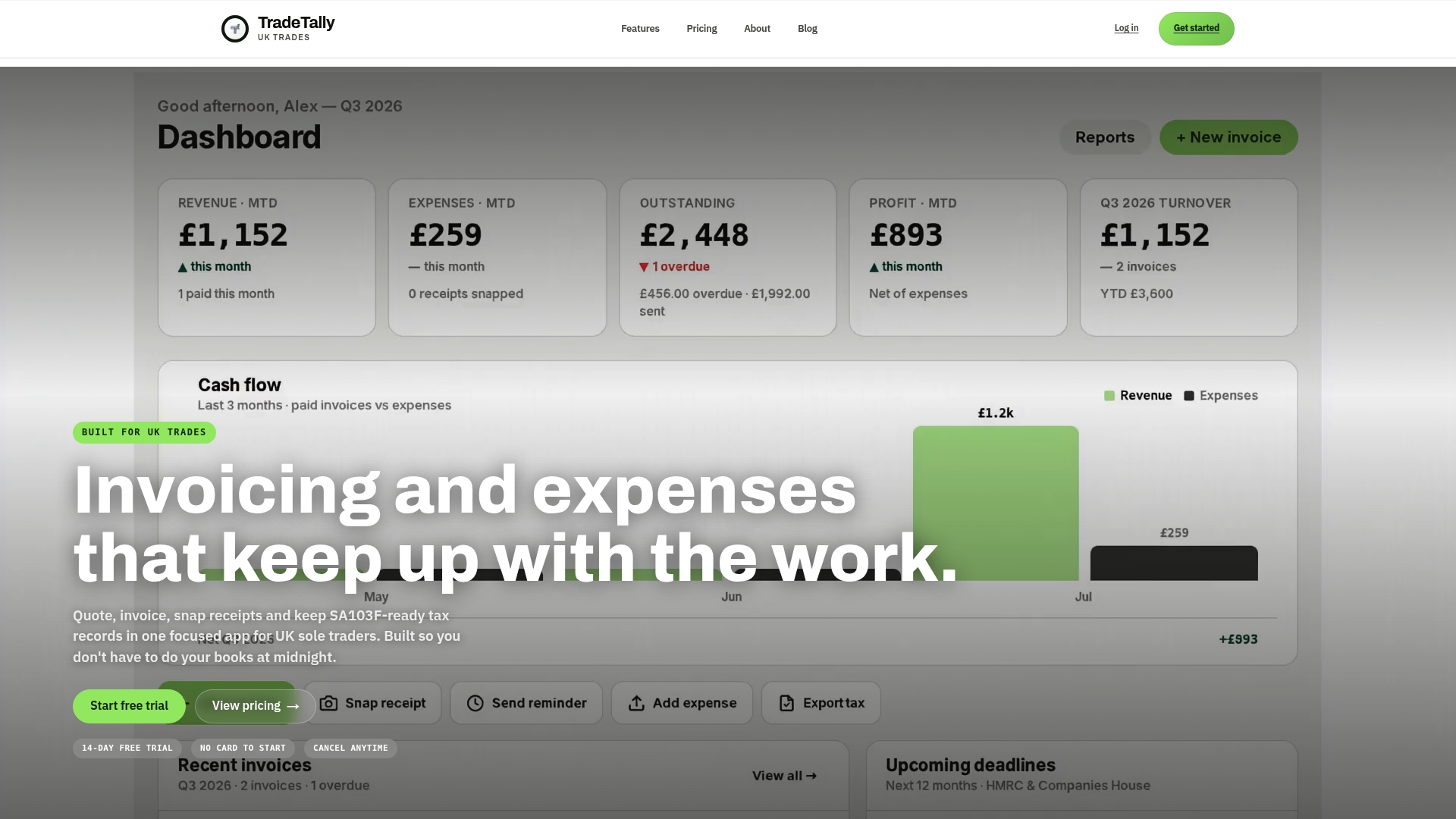
- Create and send branded invoices from your van the moment a job finishes.
- Snap receipts on the spot so expense records stay current without an evening of paperwork.
- Export tax-ready records formatted for SA103F when Self Assessment season arrives.
These features map directly onto the routine above: same-day invoicing, weekly reconciliation and records that are already in shape when HMRC asks for them. You can start on the free Starter plan or move straight to Professional at £12 per month (or £120 per year) by visiting our pricing page.
FAQ
What are the new rules for sole traders in the UK?
The most relevant change for invoicing and record-keeping is Making Tax Digital for Income Tax, which requires some sole traders to keep digital records and send quarterly updates depending on their qualifying income. Checking your own threshold on GOV.UK is the quickest way to know whether you are affected this tax year.
What is credit control in the UK?
Credit control is the process of deciding who you extend payment terms to, setting clear invoice terms, and following up on anything overdue before it becomes a bad debt. In the UK, it also includes legal remedies such as statutory interest and fixed compensation on late business-to-business payments, set out in guidance on payment rights for small businesses.
What is the best bank account for a sole trader in the UK?
There is no single best account; it depends on fees, whether you need a dedicated business account, and how you want to track income separately from personal spending. Many sole traders pair a simple business current account with invoicing software like TradeTally so payments, receipts and tax records stay in one view.
What are the legal requirements for being a sole trader in the UK?
You need to register with HMRC for Self Assessment, keep accurate records of income and expenses, and meet your tax-return obligations, with some sole traders also required to follow Making Tax Digital rules for digital record-keeping and quarterly updates. You are also personally liable for any business debts, which makes clear payment terms and prompt invoicing especially important.
Sources
- Gov
- National News | Time to pay up
- A Guide to Payment Rights for Small Businesses
- How to deal with late payments | British Business Bank
Recommended
Ready to sort your trade admin?
TradeTally gives UK sole traders invoicing, expenses, and SA103F-ready tax exports in one mobile-first app.
Start 14-day Pro trial →No card required