Partial Payment Invoice UK: How to Set One Up and Stay Paid

A partial payment invoice asks the client to pay part of the total price now, or at an agreed stage, and shows what is still owed. To set one up properly, agree the schedule in writing before you start, give each invoice its own number, state the total, the amount due now and the remaining balance, and record every payment you receive against the original job. Do that and you can take deposits and stage payments without arguments over who owes what.
This guide covers the difference between a deposit and a part-payment, when it is reasonable to ask, what to include, how VAT behaves, what the law says if a client pays only some of the bill, and how to keep your records straight.
TL;DR
- A deposit and a part-payment are not the same thing in law: a deposit is a guarantee the client is serious, while part-payments can be recoverable if the job ends early.
- Ask for money up front only when you have real outlay, such as materials or a bespoke order, or on a large job split into stages.
- Put the purpose, amount, due date and trigger for each payment in writing, and make the final instalment payable once the client is happy.
- If you are VAT registered, a deposit can create a tax point straight away, so VAT may be due on the money before the job is done.
- Record every part-payment against the original invoice so the outstanding balance is always clear.
Table of Contents
- What a partial payment invoice actually is
- When it is reasonable to ask for money up front
- Agree the schedule before you quote it as fact
- How to create a partial payment invoice
- VAT on deposits and part-payments
- When a client pays only part of the final bill
- Recording part-payments properly
- Our view on part-payment invoicing
- Keep part-payments tidy with TradeTally
- FAQ
- Sources
What a partial payment invoice actually is
A partial payment is any payment that covers only a portion of what an invoice says is owed. In day-to-day trade work it shows up in three forms:
- Deposit: a sum paid before work starts to secure the booking or cover the first costs.
- Stage (or staged) payment: the price split into instalments tied to points in the job, such as first fix complete or materials delivered.
- Part-payment of a finished invoice: the client pays some of a final bill and promises the rest later.
The first two are planned. The third is often a problem you did not plan for, and it needs a different response.
The legal difference matters. Legal commentary in LexisNexis distinguishes a deposit from part-payments: a deposit counts towards the price if the deal goes ahead and acts as a guarantee the buyer means business, and unless agreed otherwise it can’t be recovered. Part-payments may be recoverable if the contract ends. So if you call something a deposit, say so on the paperwork and say what happens to it if the job is cancelled.
Staged payments are one form of what is sometimes called advance invoicing. American Express describes the common thread as requesting payment before the goods or services are delivered, whether as instalments through delivery or a deposit plus later amounts.
When it is reasonable to ask for money up front
Clients are more comfortable paying early when the reason is obvious. Which? Trusted Traders advises that traders should ask for a deposit only when they need to buy goods or are working on a bespoke design and need to cover initial outlay. It adds that staged payments are entirely reasonable on a big project needing a lot of materials, and that the final instalment should be payable only once the customer is happy with the work.
In practice, a partial payment is easy to justify when:
- You must order made-to-measure or special-order items, such as a kitchen worktop, a bespoke staircase or a specific boiler.
- The materials bill is large compared with your cash buffer.
- The job runs over several weeks and you would otherwise fund it all yourself.
- The client is new to you and you have no payment history.
It is harder to justify on a two-hour call-out. For small jobs, invoice on completion and keep your payment terms short and clear.
Pro tip: tell the client why you are asking. “The deposit covers the tiles and the bathroom suite, which I order in your name this week” gets a better response than “I need 50% up front”.
Agree the schedule before you quote it as fact

Most disputes over instalments come from a vague agreement, not a bad client. The NCC says a payment schedule should explain what each payment is for, when it becomes due and how that point will be established. Agreeing only a percentage and a date can leave both sides unsure if the work changes or a delivery is delayed. It also advises agreeing in writing the purpose, amount, timing and cancellation terms, and, where products are involved, the specification and supplier, who places the order and what happens if the product is wrong, delayed or the business stops trading.
A sound schedule on a bathroom refit might look like this:
| Stage | What triggers it | Share of price | Example on a £4,800 job |
|---|---|---|---|
| Deposit | Quote accepted, materials ordered | 25% | £1,200 |
| Second payment | First fix complete and signed off | 40% | £1,920 |
| Third payment | Tiling complete | 25% | £1,200 |
| Final payment | Snagging done and client happy | 10% | £480 |
The figures are an illustration, not a recommendation. What matters is the middle column: each payment is tied to something both of you can see.
The Small Business Commissioner also warns against assuming terms such as “30 days” without confirming the date you can expect the money in your account. Its guidance on getting invoices right is worth reading before you set your terms.
What to cover in writing
- What the payment is for (deposit, materials, stage completion).
- The amount, and whether it includes VAT.
- The due date, or the event that makes it due.
- What counts as a stage being complete, and who confirms it.
- What happens to money already paid if the client cancels, or if you cannot start.
- How changes to the scope will be priced and invoiced.
If you are unsure how to structure the quote that sits behind all this, our invoice template for builders shows the layout we suggest.
How to create a partial payment invoice
The Small Business Commissioner lists the items an invoice template should carry: invoice date, invoice number, purchase order number if you have one, what the work relates to, the total fee (with VAT details if applicable), the payment due date, the payment terms agreed in the contract and your bank details. A partial payment invoice needs all of those, plus a few extras that make the split obvious.
- Number it uniquely. Each instalment invoice gets its own number, in sequence. Our guide to invoice numbering for tradespeople explains how to keep it automatic.
- Describe the job and the stage. For example: “Bathroom refit, 14 Mill Lane. Invoice 2 of 4: first fix complete.”
- Show the full job price. This is the agreed total, so the client sees the whole picture.
- Show what this invoice asks for. Put the amount due now in a clear line.
- Show payments already received. List earlier deposits or instalments with dates.
- Show the balance still to come. The remaining sum after this invoice is paid.
- Add the due date and how to pay. Give a date, not just “30 days”.
- Add VAT details if you are registered. More on that below.
A simple layout for the second invoice on the £4,800 example above:
| Line | Amount |
|---|---|
| Agreed job price | £4,800.00 |
| Previously paid (deposit, invoice 1) | £1,200.00 |
| This invoice (first fix complete) | £1,920.00 |
| Balance remaining after this invoice | £1,680.00 |
If you want a starting point, there is a free invoice template for sole traders, and our guide to what a sole trader invoice must include covers the required details. For VAT-registered work, invoice requirements for tradespeople goes through what a client needs to reclaim VAT without delay.
VAT on deposits and part-payments
If you are VAT registered, taking money early can bring your VAT forward. GOV.UK explains that an advance payment or deposit is a proportion paid before you supply. The tax point is the earlier of the date you issue a VAT invoice for the advance or the date you receive it, and you include the VAT due on the deposit on the VAT Return for the period in which that tax point falls. When the client pays the balance, a further tax point arises on the same basis, and the VAT on that balance goes on the return for that period.
The same page says that if you keep a deposit because the customer decides not to go ahead, VAT remains due on the money you received.
What this means in practice:
- A £1,200 deposit from a VAT-registered business may carry VAT that you owe on your next return, even if you have not started the job.
- Put the deposit in a separate pot, or keep enough aside, so the VAT is not spent on materials.
- Issue a proper VAT invoice for the deposit, so the dates and the VAT are on paper.
If a VAT bill ever outgrows your cash flow, getting advice early matters. Organisations that explain options such as fast track voluntary arrangements can help you understand where you stand before a debt becomes a bigger problem.
For the detail on how deposits sit in your books, see our guides on client deposits accounting and avoiding VAT and CIS errors on deposit invoices.
CIS and partial payments
If you work as a subcontractor under the Construction Industry Scheme, your contractor deducts tax from payments for labour, so each stage invoice needs the labour and materials split shown clearly. Use our CIS deduction calculator to check the figure before you send the invoice. Our guide for builders invoicing with VAT, CIS and MTD shows worked layouts.
When a client pays only part of the final bill
This is the awkward case: the work is done, the invoice is out, and the client sends a fraction. Take it step by step.
- Accept the money and record it. Taking a part-payment does not mean you agree the rest is not owed. Note it as received against that invoice.
- Reply in writing the same day. State the amount received, the balance outstanding and the date it is due.
- Ask why. The client may dispute one item, be waiting for their own funds, or have misread the invoice. The answer decides your next move.
- Agree a dated plan if they need time. Put it in an email: amount and date for each remaining payment.
- Do not issue a new invoice for the balance. Keep the original invoice open and show the balance on a statement or reminder.
Your rights on late payment
If the client is another business, the Late Payment of Commercial Debts (Interest) Act 1998 applies. Where no payment day was agreed, the relevant day is the last day of a 30-day period beginning with the later of performance and notice of the amount owed, or the applicable day following an acceptance procedure. Statutory interest starts the day after the relevant day.
Once interest runs, the Late Payment of Commercial Debts Regulations 2002 also give a right to a fixed sum: £40 for debts under £1,000, £70 for debts from £1,000 to under £10,000, and £100 for debts of £10,000 or more. Check the legislation pages for the current position on how the rules apply to your situation, because the Act is aimed at business-to-business debts and not at private householders.

If you want to charge late fees or interest on your own terms, put them in your quote and on each invoice before the job starts.
Recording part-payments properly
Good records protect you if a client disputes the amount and make your Self Assessment simpler. Whatever you use, keep these habits:
- One job, one thread. Every payment links back to the original quote and invoice.
- Date and method each time. Bank transfer, card or cash, with the date it landed in your account.
- Issue a receipt for each payment. It should show the amount received, the date, what it was for and the balance remaining.
- Update the outstanding balance straight away. Do not rely on memory at the end of the month.
- Keep the bank reference. It makes matching payments to jobs much quicker.
- Keep cash payments on record too. If a client hands you cash on site, write a receipt and log it the same day.
We built TradeTally to make this routine, so the balance on each job updates as you log what has come in. If you also want to see whether the job is making money after materials and mileage, the profit margin calculator for trades is a quick check.
Our view on part-payment invoicing
We built TradeTally because the admin after a day on site is where trades lose money and patience. Part-payments are a good example: the work is easy to agree on the doorstep, but a month later nobody can say what was paid, what was for materials and what is still outstanding.
Our approach is to treat the deposit, each stage and the final balance as one job with one running total. You create the invoice from your phone, the amount paid and the amount left sit side by side, and your receipts and expenses land in the same place, so the profit on the job is visible while you are still working on it.
We designed TradeTally to hand you records you can use for Self Assessment, including SA103F-formatted exports, and to handle CIS deductions so you are not working them out with a calculator in the van. That is the sort of paperwork that should take minutes, not an evening.
Simon
Keep part-payments tidy with TradeTally
If you take deposits or stage payments regularly, a single place for quotes, branded invoices, receipts and expenses saves a lot of chasing. TradeTally has a Starter plan at £0 per month, and the Professional plan is £12 per month or £120 per year. You can see what each includes on our pricing page.
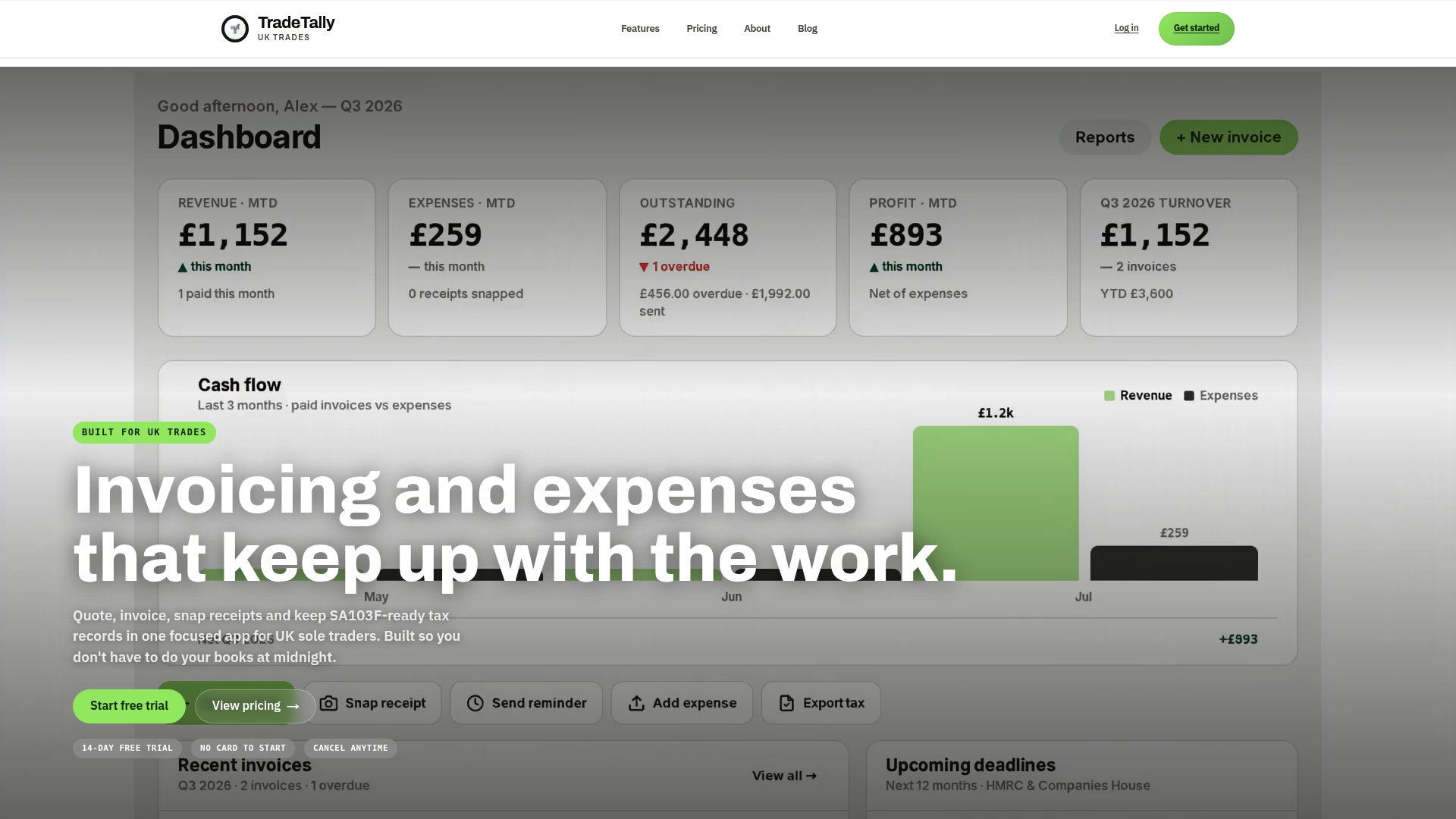
You can also try the plan options from our homepage and set up your first stage-payment invoice in a few minutes. If you invoice mainly for contractors, our CIS invoice software page shows how deductions are handled.
FAQ
Can I ask for a deposit as a sole trader in the UK?
Yes, there is no general rule against it, but it should have a clear purpose. Which? Trusted Traders suggests asking only when you need to buy goods or cover a bespoke order. Put the amount, the reason and the cancellation terms in writing before the client pays.
What is the difference between a deposit and a part-payment?
A deposit goes towards the price and guarantees the client’s commitment, and unless agreed otherwise it generally can’t be recovered. Part-payments may be recoverable if the contract ends. Use the right word on your paperwork and say what happens if the job is cancelled.
Do I charge VAT on a deposit?
If you are VAT registered, usually yes. A deposit can create a tax point on the earlier of the date you issue a VAT invoice for it or the date you receive it, so the VAT goes on the return for that period. Check GOV.UK guidance or ask your accountant about your own case.
Should I issue a new invoice when a client pays only part?
No. Keep the original invoice open, record the part-payment against it and confirm the remaining balance and due date in writing. Only raise a new invoice if you have agreed in advance to bill in stages.
Can I charge interest if a business client pays late?
For business-to-business debts, the Late Payment of Commercial Debts (Interest) Act 1998 gives a right to statutory interest and a fixed sum, from £40 up to £100 depending on the debt. It does not cover private householders, so set out your own terms in your quote.
Sources
- LexisNexis: Deposit and part payment distinguished
- American Express Business: Advance invoicing
- Which? Trusted Traders: How to work with your trader
- NCC: Building work deposits and stage payments
- Small Business Commissioner: Getting invoices right
- GOV.UK: VAT instalments, deposits, credit sales
- Late Payment of Commercial Debts (Interest) Act 1998
- Late Payment Act 1998, section 4
- Late Payment of Commercial Debts Regulations 2002
Recommended
Related articles
Deposit Invoices: Avoid VAT and CIS Errors
Deposit invoice checklist for UK trades: label it a deposit, charge VAT at the tax point, split labour and materials for CIS, use templates.

Late Fees on an Invoice in the UK: What You Can Charge
What UK tradespeople can legally charge on a late invoice: 8% statutory interest, £40 to £100 fixed fees, worked examples and how to word it.

Client Deposits Accounting for UK Tradespeople
How to record client deposits as a UK sole trader: VAT tax point, cash basis or traditional accounting, final invoices, refunds and MTD-ready records.

Chasing Overdue Invoices in the UK: A Step-by-Step Guide for Tradespeople
How to chase overdue invoices in the UK: when an invoice is late, what to say, when to add interest and £40–£100 compensation, and when to go to court.