14 Day Rule: VAT Compliant Credit Notes for UK Tradespeople

A credit note is a document that records a reduction in the price of a supply already made. For VAT purposes, it allows you to adjust the VAT you previously accounted for. It is not an automatic substitute for a cash refund under UK consumer law, and HMRC guidance treats the two as separate matters entirely.
TL;DR:
- Credit notes must be issued within 14 days of an agreed reduction in consideration, such as returns or pricing errors, to ensure VAT compliance.
- They should include specific details like a unique number, issue date, customer and supplier information, original invoice reference, description, and VAT breakdown.
- Credit notes cannot be used to write off bad debts or to replace refunds mandated by consumer law, especially if goods are faulty or not as described.
- Both supplier and customer are responsible for recording the adjustment in the same VAT period to avoid mismatches that could trigger HMRC scrutiny.
- Maintaining organized records, including digital backups and linking credit notes to original invoices, prevents compliance issues and facilitates accurate VAT reporting.
Table of Contents
- What a credit note is in UK practice
- When to issue a credit note and consumer rights on refunds
- How credit notes affect VAT accounting for supplier and customer
- What to include on a credit note
- Record keeping: how long to keep credit notes and how to store them
- Common mistakes and compliance risks
- Step-by-step: correcting a VAT return after a credit note
- Bookkeeping habits that prevent credit note errors
- How TradeTally helps you record credit notes correctly
- Sources
- FAQ
What a credit note is in UK practice
A credit note formally reduces the value of a supply you have already invoiced, whether that is a return, a pricing error, or an agreed discount applied after the job. HMRC guidance sets out the conditions a credit note must meet to be valid for VAT: it must correct a genuine mistake or overcharge, reflect a real reduction in value, give value to the customer, and be issued in good faith.
Issuing a credit note does not change the original tax point of the supply. It sits alongside the original invoice as an adjustment, not a replacement.
Common situations where tradespeople issue one include:
- A customer returns faulty materials after the invoice has gone out.
- You agreed a price reduction after finding less work on site than quoted.
- An invoice was raised with the wrong VAT rate or quantity.
- A discount was promised after the original invoice was sent.
When to issue a credit note and consumer rights on refunds
Consumer rights and VAT rules pull from different directions here, and it pays to know which one governs the situation in front of you.
-
If goods or work are faulty, not as described, or not fit for purpose, the Consumer Rights Act 2015 means you cannot force a credit note on a customer who is entitled to a refund. A refund must be offered where the law requires one.
-
If a customer simply changes their mind and your returns policy allows it, offering a credit note instead of cash is a business choice, not a legal obligation either way, as long as your policy was clear at the point of sale.
-
Once you and the customer agree a reduction in consideration, the VAT Regulations 1995 require the credit note to be issued within 14 days of that decrease taking effect.
The distinction matters because conflating consumer rights with VAT paperwork is where many small businesses get caught out, usually when a customer complains that a credit note was offered when cash was due.
How credit notes affect VAT accounting for supplier and customer
A credit note allows you to reduce the VAT you declared on the original supply, but only when it meets HMRC’s conditions. It must be issued to the actual customer, reflect a genuine change in value, and never be used to disguise a bad debt as a price adjustment. HMRC’s internal manual is explicit that credit notes must not be used for bad debt relief, which has its own separate procedure.
The 14-day rule is written into law. The Value Added Tax Regulations 1995 require a credit note to be issued within 14 days of the decrease in consideration occurring, and it must carry specific particulars, not just a revised total.
Both sides of the transaction need to move together:
- The supplier reduces output tax in the same period the adjustment is recognised.
- The customer reduces input tax claimed on the original invoice to match.
- Both parties keep the credit note on file as evidence of the agreed change.
- Where no actual supply took place at all, different rules on cancelling the tax point may apply.
When supplier and customer record the adjustment in different VAT periods, the figures stop matching and that mismatch is exactly the kind of thing that draws HMRC’s attention. VAT Notice 700/45 sets out how to handle corrections when that happens.
What to include on a credit note
A credit note that is missing the right details is not VAT-effective, which means HMRC may not accept the adjustment even if the underlying reduction was genuine. The HMRC manual on credit note principles lists what a compliant document needs:
- A unique sequential document number.
- The date of issue.
- Your business name, address and VAT registration number.
- The customer’s name and address.
- A reference to the original invoice number and date.
- A description of the goods or services being credited.
- The net amount credited, the VAT rate applied, and the VAT amount in sterling.
- A brief stated reason for the credit.
Electronic credit notes are accepted on the same basis as paper ones, provided the format is legible and retrievable for inspection. For guidance on what else belongs on your paperwork before a credit note is ever needed, see this rundown of what a sole trader invoice must include.
Pro tip: Number credit notes from a separate sequence to your invoices, not the same run, so an auditor can follow the trail without cross-referencing two lists at once.

Record keeping: how long to keep credit notes and how to store them
VAT-registered businesses must keep every credit note issued or received as part of their VAT records for at least six years, counted from the date the document was issued, not from the date the related job finished.
Electronic records carry the same weight as paper ones for HMRC inspection purposes, so there is no need to print and file physical copies if your digital system is reliable.
- Store credit notes against the original invoice they relate to, not as a loose pile.
- Back up digital records somewhere separate from your main device.
- Reconcile weekly rather than letting a quarter’s worth build up unchecked.
- Keep supplier and customer copies aligned so both sides show the same figures.
For a sole trader juggling several jobs a week, the biggest risk is not a missing document. It is a credit note sitting in a notebook or a text message thread that never makes it into the books at all. A sole trader invoicing guide covers the habits that keep this from happening.
Common mistakes and compliance risks
Most credit note problems trace back to timing or intent rather than arithmetic.
- Using a credit note to write off a debt a customer simply never paid. That is bad debt relief, and it has its own separate procedure, not a credit note.
- Issuing the credit note weeks after the price change was agreed, missing the 14-day window set out in the regulations.
- Supplier and customer recording the adjustment in different VAT periods, so the two sets of books never quite match.
- Leaving the reason for the credit blank or vague, which weakens your position if HMRC later queries it.
Pro tip: Write the reason on the credit note in plain terms, such as “materials returned, invoice 0231,” rather than a generic label like “adjustment.” It takes seconds and saves an argument later.
Step-by-step: correcting a VAT return after a credit note
Once a credit note is issued, the VAT adjustment needs to land in the right place, and that depends on timing and the size of the error.
- Decide whether the adjustment belongs in your current VAT return or whether it needs to go back and correct a past one, following the tests in VAT Notice 700/45.
- Issue the credit note with full particulars and update your ledger straight away.
- Adjust the relevant VAT return boxes to reflect the reduced output tax, or input tax if you are the customer.
- Keep the credit note, the original invoice and any correspondence together as evidence.
- If the adjustment is large or you are unsure which period it belongs to, speak to an accountant or use HMRC’s guidance on fixing VAT return errors before filing. TradeTally’s VAT calculator is a quick way to check the sums before you commit them to a return.
Bookkeeping habits that prevent credit note errors
Credit notes usually come up on site, not at a desk. A customer asks for money off after spotting a scratch, or you realise halfway through a job that the quote covered the wrong scope. The habit that prevents a mess later is recording the change the moment it happens, not after the van is packed up. Capturing it on the spot, rather than reconstructing it from memory that evening, is the difference between a clean VAT return and a guessing game.
— Simon
How TradeTally helps you record credit notes correctly
TradeTally is designed to help tradespeople address common credit note challenges. The app lets you raise a credit note against the original invoice quickly from your phone or van, so the reason, the reference number, and the VAT figure are captured while the job is still fresh in your head.
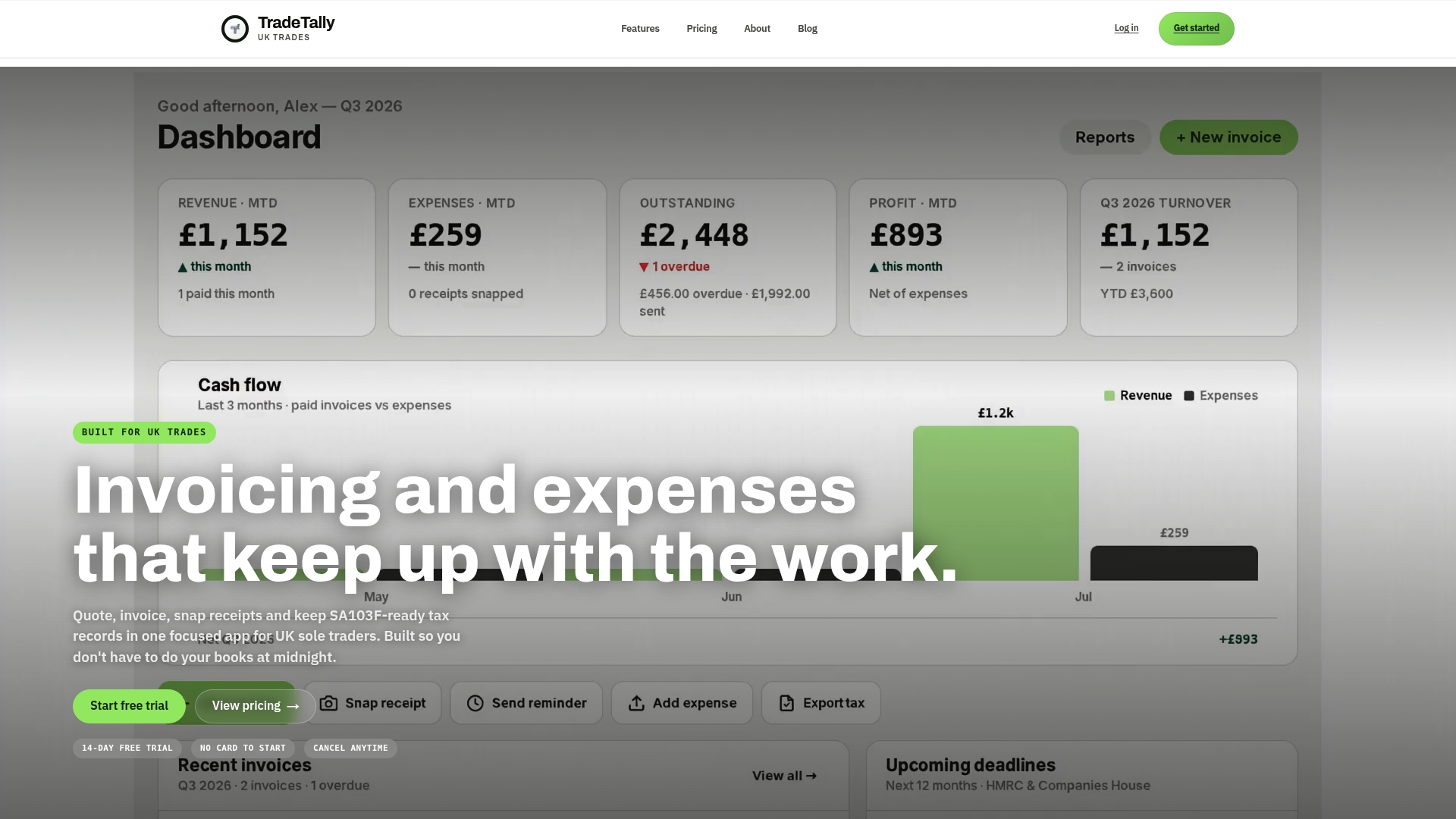
- Branded invoicing and credit notes stored against the original job, not a separate spreadsheet.
- A built-in VAT calculator to check the adjustment before it goes anywhere near a return.
- Tax-ready records that export straight to SA103F format for Self Assessment.
- Mobile-first design for logging details from the cab between jobs.
The Starter plan is free for limited invoicing, while the Professional plan runs £12 per month or £120 per year for unlimited invoices, receipts and tax exports. Have a look at how it fits your trade on the TradeTally site.
This article is general information, not a substitute for advice from a qualified financial advisor. Consult a qualified financial professional about your own circumstances before acting on anything here.
Sources
FAQ
What is a credit note in the UK?
A credit note is a document that reduces the value of a supply already invoiced, used to adjust VAT previously accounted for rather than to cancel the original transaction. HMRC’s credit note guidance sets out the particulars it must include to be valid.
Is it legal to give a credit note instead of a refund?
Where the Consumer Rights Act 2015 entitles a customer to a refund, a business cannot substitute a credit note instead. For a change of mind outside any legal entitlement, offering a credit note is a matter of store policy rather than law.
When should a credit note be issued?
A credit note should be issued as soon as you and the customer agree a reduction in the price of a supply, such as a return, a pricing error or an agreed discount. The VAT Regulations 1995 require it within 14 days of that decrease taking effect.
Does a credit note mean I owe money?
A credit note reduces the amount owed on the original invoice, so it is not a request for payment and does not create a debt in itself. If it leaves a balance in the customer’s favour, that balance can usually be offset against a future invoice or repaid directly.
Recommended
Ready to sort your trade admin?
TradeTally gives UK sole traders invoicing, expenses, and SA103F-ready tax exports in one mobile-first app.
Start 14-day Pro trial →No card required