Chasing Overdue Invoices in the UK: A Step-by-Step Guide for Tradespeople

To chase an overdue invoice in the UK, check your terms and the invoice itself, send a polite written reminder the day after the due date, phone if that gets no reply, then send a formal letter. Add statutory interest and fixed compensation if you want to. Go to court only after the pre-action steps. Most jobs get paid at the first or second step, so start calmly and keep a record of everything.
This guide is for sole traders and small trade businesses. It covers what to check first, the order to chase in, what to say, what you can legally add, and what to do when a customer disputes the bill or says they can’t pay.
TL;DR
- Check your payment terms, the due date and the invoice for errors before you chase. A wrong PO number or missing detail is a common reason for delay.
- Chase in a set order: polite written reminder, phone call, formal demand letter with a deadline, then court.
- For business customers you can claim 8% plus the Bank of England base rate as interest, plus fixed compensation of £40, £70 or £100 depending on the debt. You choose whether to use these rights.
- Write down every call and promised date, and confirm it by email the same day.
- Court claims normally need a letter of claim first, so build that step into your timeline.
Table of Contents
- When is an invoice actually overdue?
- The chasing sequence, step by step
- Interest and compensation you can add
- When the customer disputes the invoice or says they can’t pay
- If reminders don’t work: formal steps
- Perspective: why we think chasing is mostly a records problem
- Make the next chase shorter
- Keeping your invoices and records in one place
- FAQ
- Sources
When is an invoice actually overdue?
An invoice is overdue once the payment date has passed. That date is the one in your contract, quote or invoice terms, which is why those terms matter. If you agreed nothing, the late payment rules apply a default period, so put a clear due date on every invoice and don’t leave it to argument.
Before you send anything, the Small Business Commissioner advises checking the original invoice and contract. Confirm the payment terms, the due date and any late-fee policy you included, and make sure the invoice has no errors that could have held up processing.
A quick pre-chase checklist:
- Terms: what did you agree on payment, in writing? Stage payments, retention and deposits all change what is due when.
- Due date: has it definitely passed, counting from the date the customer received the invoice?
- Invoice details: correct name and address, job description, amount, VAT where relevant, any PO or job reference the customer’s accounts team needs, and your bank details.
- Delivery: did it reach the right person? Many “never got it” cases are an email sent to a site contact rather than the person who pays.
- Job sign-off: is there any snag, variation or complaint outstanding that the customer might hold payment against?
Pro tip: if your invoices are clear and consistent, you give late payers fewer excuses. A branded invoice with a clear due date and bank details is harder to ignore or lose. Our free invoice template covers the fields above.
The chasing sequence, step by step
The official guidance describes a gentle reminder first, then direct contact if there is no response, then a formal demand. It doesn’t give day-by-day timings, so the schedule below is a practical suggestion rather than a rule. Adjust it for the size of the job and how well you know the customer.
| Stage | Suggested timing | What you do |
|---|---|---|
| 1. Polite reminder | 1 to 3 days after the due date | Short email with invoice attached and payment details |
| 2. Second reminder | About 7 days after the due date | Firmer email, ask for a payment date |
| 3. Phone call | 7 to 10 days after the due date | Speak to the person who approves payment, note the promised date |
| 4. Formal demand | 14 days or more after the due date | Letter or email with a deadline, interest and compensation stated |
| 5. Final steps | After the deadline passes | Letter of claim, then a court claim or a collection agency |
Keep a note of the date you did each step. If this ever reaches a court, a tidy timeline helps you.
Step 1: the polite reminder
A first step that often resolves non-payment is a polite reminder in a professional, friendly tone. Include the amount, the due date and how to pay.
Think of it as a nudge. Most late payments are admin: an invoice sitting in someone’s inbox or waiting for approval. Assume that until you learn otherwise.
A short example:
Subject: Invoice 1042, payment now due
Hi Karen, just a quick note that invoice 1042 for the bathroom refit (£2,450) was due on 3 November. I’ve attached a copy and my bank details are at the bottom. Could you let me know when I can expect payment? Thanks, Dave
If the customer says they never received the invoice, resend it. The Commissioner suggests a clear subject line along the lines of “Resending Invoice #[number] – Payment Overdue”. More wording options are in our four-step invoice reminder wording guide and our late payment letter templates. Builders working to stage payments may prefer invoice reminders for builders.
Step 2: the second reminder
If a week passes in silence, send a second email that is a little firmer. Ask for a specific payment date rather than a general “when you can”. Mention that you are happy to resend anything the customer’s accounts team needs.
A reply like “it’s in the system” is useful: you now have a stated position to hold them to. Reply the same day thanking them and noting the date you are expecting funds.
Step 3: the phone call
If emails are being ignored, speak to someone. The Commissioner’s guidance moves from reminders to direct contact, such as a call or meeting. A conversation tells you quickly whether you have an admin problem, a dispute or a cash problem.
How to run the call:
- Ask for the right person. The site contact or homeowner may not be the one who releases payment. In a business, ask for accounts payable.
- Stay level. Open with the invoice number, amount and original due date. Don’t open with blame.
- Ask open questions. “Is there anything holding this up on your side?” tells you more than “Why haven’t you paid?”
- Get a date and a method. “Payment by bank transfer by Friday 14th” is a commitment. “Soon” is not.
- Watch for a dispute. If they raise a problem with the work, ask them to put it in writing and agree what would settle it.
- Write it up straight away. Note the date, time, who you spoke to and what was promised, then email a summary: “Thanks for your time today. As discussed, I’ll expect payment of £2,450 by Friday 14 November.”
That follow-up email matters. It turns a verbal promise into a written one, and if the date passes you can refer back to it in your next message without any argument about what was said.
Pro tip: don’t accept excuses at face value, but don’t challenge them either. Ask for the detail: who approves it, when is the next payment run, and what do they need from you.
Step 4: the formal demand
If the invoice is still unpaid, the Commissioner says you may need to issue a formal demand letter with a deadline and the potential consequences, as official notice before considering legal action.
Your demand should include:
- The invoice number, date, amount and original due date
- A list of the earlier reminders and calls, with dates
- Any interest and compensation you are claiming (see below)
- A firm deadline, such as 7 or 14 days, to pay in full
- What you will do next if they don’t pay
- Your payment details
Send it by email and by post if you have an address. Keep proof of sending.
Interest and compensation you can add
Business customers owe more than the invoice once it is late. GOV.UK says that for business-to-business transactions you can charge statutory interest of 8% plus the Bank of England base rate. You can’t claim it where your contract sets a different interest rate.
To work out the daily amount, GOV.UK’s worked example takes a £1,000 debt where the base rate is 0.5%. The annual interest is £85, and dividing by 365 gives 23p a day, which you multiply by the days late. Use the current base rate for your own sums.
You can also claim fixed compensation. The BIS user guide to the late payment rules sets it at:
| Size of debt | Fixed compensation |
|---|---|
| Up to £999.99 | £40 |
| £1,000 to £9,999.99 | £70 |
| £10,000 or more | £100 |
You can also claim reasonable recovery costs beyond the fixed sum. The same guide says these rights, available since the changes of 16 March 2013, are not compulsory: you decide whether to use them. Plenty of tradespeople keep the relationship sweet by mentioning them only in the formal demand, and some waive them for a customer who pays promptly after that.
The Commissioner also points to an Interest Calculator to help you work out what you can charge. For the full walkthrough, see our guide to claiming late payment interest in the UK.
These rules cover business-to-business work. If your customer is a homeowner, a different position applies, so keep to your written terms and the steps above.

When the customer disputes the invoice or says they can’t pay
Not every delay is a refusal. The Commissioner’s guidance acknowledges legitimate reasons for delay, including administrative errors, and advises contacting the client directly to find out what is happening.
If they dispute the work
- Ask for the complaint in writing, with specifics.
- Separate the disputed part from the undisputed part. Ask for payment of what is not in question.
- Offer a site visit or photos to resolve a snag quickly.
- Keep your original quote, any variation messages and sign-off photos to hand.
Our invoice dispute playbook for UK tradespeople lays out a fast route to settling these.
If they can’t pay in full
If the customer is struggling with cash flow, the Commissioner says you could offer to split the payment into instalments, with the terms clearly outlined and documented in writing and shared by email to avoid future disputes.
A workable instalment agreement states the amounts, the exact dates, the payment method and what happens if one is missed (for example, the full balance becomes due). Get the customer to reply “agreed” by email.

If reminders don’t work: formal steps
Collection agencies and legal action are last resorts, according to the Small Business Commissioner. Before a court claim in England and Wales, the court expects pre-action steps. GOV.UK’s Money Claim Online guide says these usually include sending a letter before the claim, giving enough information for the customer to understand your position and allowing a chance to respond. Failing to follow them can affect or invalidate a claim.
The Pre-Action Protocol for Debt Claims draft sets out what a letter of claim should contain:
- Information about the debt, including interest and charges
- The agreement, or an explanation if there isn’t one
- How to pay
- A full statement of account, the contract or agreement and a reply form
The same draft says the letter should require the reply form back within 28 days and warns that the court could order extra costs if proceedings start because the defendant failed to respond. Shelter’s summary of the debt protocol adds that, for individual debtors, court proceedings should not start sooner than 30 days from the letter of claim, and that a reply or a request for documents can extend the wait. That page is written about debt cases involving individuals, so check which protocol applies to your customer, and ask a solicitor or Citizens Advice if you are unsure before you issue a claim.
Plan on this stage taking weeks, not days. That is why a prompt first reminder is so valuable.
If your customer is a much larger business, the Office of the Small Business Commissioner may help. Its support is aimed at small businesses with fewer than 50 employees chasing late payment from a larger business with more than 50, and offers free advice and a complaint scheme.
Perspective: why we think chasing is mostly a records problem
Most of the trades we speak to don’t struggle with the reminder email. They struggle to find the paperwork when the customer says “I never agreed that.” The chase is quick when you can show the quote, the invoice, the due date and the dates you got in touch.
That is why TradeTally was built by a working tradesperson around the admin that follows a day on site. Branded invoices with clear due dates, quotes, receipt capture and job records all live in one mobile-first place, so you can sort it from the van rather than at the kitchen table at 10pm.
Our view is simple: prevent as much chasing as you can by sending the invoice the same day, making it clear and keeping a tidy record. Then when you do chase, you do it calmly, with the facts in front of you.
Simon
Make the next chase shorter
A few habits cut the number of invoices that go overdue at all. Our guide to the best ways to stop late payers goes further, and our look at software for late invoice chasing covers the tools side.
- Invoice on the day. The sooner it goes out, the sooner the clock starts.
- Put terms on the quote and the invoice. Due date, late-payment position and bank details, every time. Our quote template is a starting point.
- Agree stage payments on bigger jobs so you are never owed the whole sum.
- Send to the person who pays, and ask who that is at the start.
- Keep one record per job. Quote, variations, photos, invoice and messages together.
- Diarise chasing. Set a weekly slot to check what is due and what is late.
If you work under the Construction Industry Scheme, get the deduction right on the invoice, because a wrong figure is another reason for a customer to query it. Our CIS deduction calculator helps.
Keeping your invoices and records in one place
TradeTally is a UK web and mobile app for sole traders, with branded invoicing, quotes, expense and receipt tracking, CIS deduction handling and a live profit view for each job. The Starter plan is £0 per month. The Professional plan is £12 per month or £120 per year. See the pricing page for what each includes.
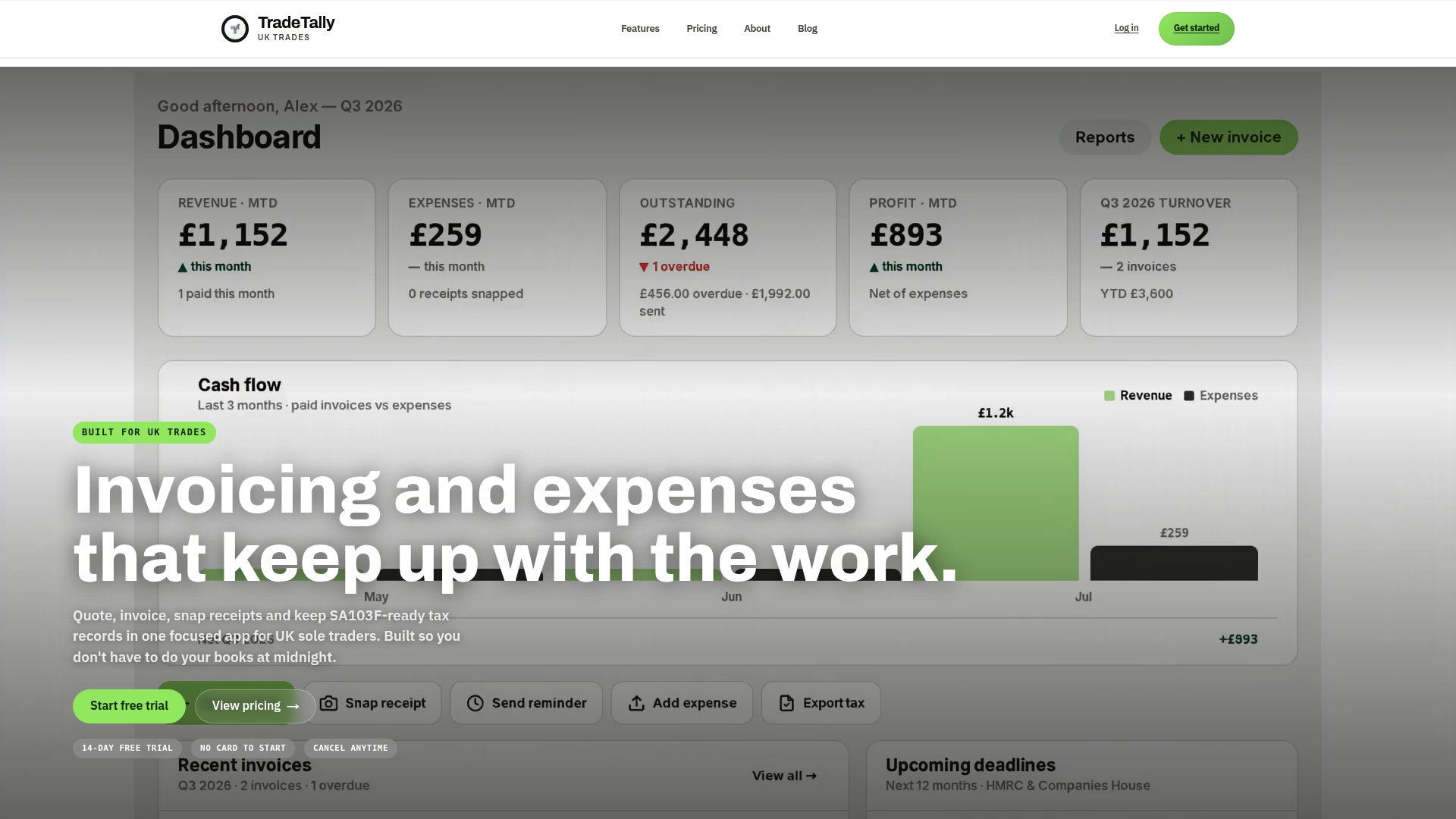
If you want invoices that look professional and a record you can pull up when a customer queries a bill, you can start with TradeTally.
FAQ
How long should I wait before chasing an overdue invoice?
There is no official number of days. A polite reminder a day or two after the due date is common, and a quick, friendly email rarely upsets anyone. The Small Business Commissioner describes a gentle reminder first, then direct contact if there is no response.
Can I charge interest on a late invoice to a business?
Yes, in business-to-business work you can claim statutory interest of 8% plus the Bank of England base rate, unless your contract sets a different rate. You can also claim fixed compensation of £40, £70 or £100 depending on the debt. Using these rights is your choice.
Should I phone or email?
Start with email so there is a written trail, then phone if it is ignored. After any call, send a short email confirming what was promised and by when. That keeps a record of the customer’s own words.
Do I have to send a letter before going to court?
In England and Wales the court expects pre-action steps, usually a letter before the claim and a fair chance to respond. Skipping them can affect your claim. If you aren’t sure how it applies, take advice from a solicitor or Citizens Advice first.
Sources
- Help with unpaid invoices, Small Business Commissioner
- Charging interest on late commercial payments, GOV.UK
- Users Guide to the Recast Late Payment Directive, BIS
- Money Claim Online user guide, GOV.UK
- Pre-Action Protocol for Debt Claims (draft)
- Pre-action protocol in debt cases, Shelter Legal England
- How the Office of the Small Business Commissioner is tackling late payments, North East Growth Hub
Recommended
Related articles

Claim Late Payment Interest in the UK
Find out what you can charge when a UK client pays late: the statutory 8%+Bank Rate, £40–£100 fixed compensation, plus invoice templates.

Credit Control: 10 Steps for Sole Traders
Set up credit control for UK sole traders with ten practical steps, daily and weekly checks, statutory interest rights, and Making Tax Digital records.

Late Fees on an Invoice in the UK: What You Can Charge
What UK tradespeople can legally charge on a late invoice: 8% statutory interest, £40 to £100 fixed fees, worked examples and how to word it.
Invoice Disputes: 72-Hour Resolution Playbook
Resolve invoice disputes within 72 hours. Step by step actions, evidence checklist, OSBC/ADR routes and ready templates. Tradetally: Starter free;...