72 Hours to Resolve an Invoice Dispute: Playbook for UK Tradespeople
Acknowledge the dispute in writing within hours, not days, and ask the client for precise reasons and dates. Split the invoice into disputed and undisputed sums, and offer to pay the undisputed portion straight away to protect your cash flow and the relationship. If informal talks stall, the Small Business Commissioner and statutory interest rules give you your next lever.
TL;DR:
- Acknowledging the dispute within hours, requesting specific reasons, and splitting the invoice into disputed and undisputed parts are crucial for swift resolution.
- Gathering detailed evidence such as signed contracts, photos, and messages before responding helps to establish a clear paper trail that supports your claim.
- Offering to pay the undisputed amount immediately and proposing settlement options like credits or staged payments protect your cash flow and maintain client relationships.
- Escalating disputes through the Small Business Commissioner or ADR only after unsuccessful negotiations ensures more efficient and cost-effective resolution.
- Using tools like Tradetally automates record keeping and evidence collection, making dispute management faster and more professional.
Table of Contents
- Step-by-step actions to take in the first 24 to 72 hours
- Evidence and paperwork checklist you must gather
- Negotiation and settlement options that protect the relationship
- Formal escalation: OSBC, ADR, letters before action and small claims
- Short prevention checklist for tradespeople
- How Tradetally helps you gather evidence and send professional dispute letters
- Timescales and deadlines you need in your diary
- When to check the debtor’s financial position first
- Common reasons invoices get disputed in the UK
- Impact of VAT and tax on invoice disputes
- Do debt collection agencies actually help with disputes?
- A short note on what actually stops disputes
- Get your dispute paperwork sorted with Tradetally
- Sources
- FAQ
Step-by-step actions to take in the first 24 to 72 hours
The first three days of an invoice disputes resolution UK process decide most of what happens next. React fast, keep everything in writing, and you protect both your cash flow and your evidence file simultaneously.
Here’s the order that works:
- Acknowledge the dispute the same day it lands. A short email confirming you’ve received the client’s objection and will respond within a set timeframe (48 hours is reasonable) stops the dispute drifting and shows good faith if this ever reaches a court or the OSBC.
- Ask for specifics in writing. Vague complaints (“this isn’t right”) get you nowhere. Request the exact line items disputed, the reason, and any dates or evidence the client is relying on. Verify contract terms, check the invoice for errors, and gather supporting evidence before you reply substantively.
- Split the invoice. Work out which parts are genuinely contested and which aren’t. If part of an invoice is disputed over a materials substitution, invoice or re-confirm the undisputed portion separately and ask for it to be paid on the original terms.
- Offer to accept the undisputed sum immediately. This single move does more for your cash flow than almost anything else in this guide, and it signals to the client that you’re being reasonable rather than combative.
- Decide whether to pause further work. If the dispute concerns ongoing works, get any decision to pause (or continue) confirmed by the client in writing, including who instructed it and when.
- Notify your own accounts process. Flag the disputed amount so it doesn’t get chased automatically or written off in your bookkeeping before it’s settled.
- Diarise every relevant deadline. Payment terms, any contractual notice period for raising disputes, and the point at which statutory interest could start accruing all need a date in your calendar, not just your memory.
Pro Tip: Never let “I’ll sort it out later” become your dispute strategy. A one-line email sent within 24 hours, timestamped and specific, is worth more in a later small claims hearing than an hour-long phone call nobody can prove happened.
Preserving job records matters as much as the paperwork trail. If you’re on-site day to day, screenshot the WhatsApp thread, save the delivery note, and photograph the completed work before anyone else touches it. Once a dispute is live, evidence has a habit of becoming inconvenient for the other side to remember accurately.

Evidence and paperwork checklist you must gather
A dispute isn’t won on who shouts loudest. It’s won on whoever has the clearer paper trail, and that’s true whether you end up at mediation, in front of the OSBC, or in a small claims hearing.
Gather these before you do anything else:
- The contract, quote, or statement of work that set out the original scope and price.
- Any purchase order or written variation confirmation covering changes to that scope.
- Delivery notes, sign-off sheets, or completion certificates proving the work or goods were provided.
- Time-stamped photographs of completed work, especially anything later disputed on quality grounds.
- Time logs or day sheets if you’re billing on time and materials.
- All emails, texts, and messages relating to approvals, instructions, or complaints, kept in date order.
Common grounds for disputing an invoice include incorrect charges, work falling outside the agreed scope, or missing documentation, and contemporaneous records are usually what settle the argument either way. A photo taken on the day of completion carries far more weight than one taken a week later once the dispute has already started.
Build a simple chronology once you’ve gathered everything: a dated list of what happened, who said what, and which document proves it. Label each piece of evidence (Exhibit 1, Exhibit 2, and so on) so it can be referred to quickly. Mediators and judges move faster through a clear timeline than a folder of unsorted emails, and a well-labelled bundle can shorten the entire process by days.
Negotiation and settlement options that protect the relationship
Most invoice disputes never need a court. They need a realistic offer, put in writing, with a deadline attached.
The common outcomes worth considering:
- A revised invoice reflecting an agreed adjustment to quantities, rates, or scope.
- A credit note against a future invoice, useful when the client is an ongoing customer you want to keep.
- Rework or a remedial visit where the complaint concerns quality, agreed and scheduled clearly.
- Staged payment of the disputed amount once a specific condition is met (a snag list cleared, for example).
- A goodwill discount, small enough not to set a precedent but large enough to close the matter.
A pragmatic approach that consistently works for sole traders is paying the undisputed portion immediately while documenting and pursuing the disputed portion separately rather than letting the whole invoice sit unpaid while tempers cool.
When you put a settlement offer to a client, include the amount, exactly what it settles, and a response deadline (seven to ten working days is standard). Vague offers with no deadline tend to be ignored, not because the client is being difficult, but because there’s no pressure to respond.
As a rule of thumb: if the disputed sum is relatively small and a discount or credit note closes it quickly, consider taking the commercial compromise. Chasing every last pound through formal channels can cost more in time and stress than it recovers. For larger disputed sums, or where the client is disputing in obvious bad faith, formal escalation earns its keep.
Formal escalation: OSBC, ADR, letters before action and small claims
When negotiation genuinely stalls, the UK has a structured escalation path, and following it in order tends to produce better outcomes than jumping straight to court.
- Small Business Commissioner (OSBC). This is a free, independent public body that supports small businesses with fewer than 50 staff in resolving payment disputes with larger businesses. Its recommendations are non-binding, but its investigatory involvement carries real reputational weight, particularly with larger commercial clients who don’t want a public complaint on record.
- Alternative dispute resolution (ADR) or mediation. A neutral third party helps both sides reach agreement without the cost of litigation. Since October 2024, English courts can order parties into ADR and may penalise unreasonable refusal to engage with adverse costs orders, so refusing to try mediation can cost you even if you eventually win in court.
- Binding neutral decision services. Private adjudication routes can deliver a determination in a matter of days for smaller commercial disputes, and judges tend to view genuine attempts at these routes favourably when costs are decided later.
- Letter before action. A formal pre-action letter, setting out the sum owed, the reasons, and a final deadline, is expected under UK court procedure before you issue a claim. Skipping it can count against you on costs even if your claim succeeds.
- Small claims court. For unpaid invoices, small claims for unpaid invoice cases usually fall within the small claims track in England and Wales, and the process is designed to be usable without a solicitor.
| Route | Typical cost | Typical timescale | Outcome |
|---|---|---|---|
| OSBC referral | Free | Weeks | Non-binding recommendation |
| Mediation / ADR | Modest fixed or hourly fee | Days to a few weeks | Negotiated settlement |
| Binding neutral decision | Fixed fee, varies by provider | Several business days for some providers | Binding determination |
| Small claims court | Court fee scaled to claim value | Several months to a hearing | Judgment, enforceable |
Unless you’ve agreed a different date, payment is due within 30 days of the invoice or the goods or service being supplied, and you’re entitled to charge statutory interest under the Late Payment of Commercial Debts (Interest) Act 1998 once that window passes. Before issuing proceedings, it’s worth getting basic legal advice on your specific claim, particularly around limitation periods and whether the debtor is even worth pursuing, a point covered next.
Short prevention checklist for tradespeople
Every dispute you head off is an afternoon you get back. A few habits do most of the work:
- Write clear scopes. State exactly what’s included, what counts as a variation, and how variations get priced and approved.
- Use staged payments on larger jobs so no single invoice carries the whole risk of a dispute.
- Put required fields on every invoice: your VAT number if registered, a clear description of works, payment terms, and the due date.
- Send invoices promptly, ideally the same day work completes, while the details are still fresh for both sides.
- Photograph completed work immediately and email a short confirmation the same day.
- Keep every client sign-off, even an informal “looks good, thanks” text, somewhere you can find it again.
A ready-made invoice template with the right fields built in removes most of the guesswork, and pairing it with a consistent invoicing cadence is one of the simplest ways to stop late payers before they start disputing altogether.
How Tradetally helps you gather evidence and send professional dispute letters
Assembling a dispute file at 9pm after a full day on site is exactly the problem Tradetally was built to remove. Every invoice you raise is timestamped automatically, and receipts snapped from your phone sit alongside the job they belong to, so your chronology is already half built before a dispute even starts.
When a client queries an invoice, you’re not hunting through old texts. You’ve got the original quote, the invoice, and the photo evidence in one place, ready to export for your accountant or an OSBC referral via the SA103F-ready records. Tradetally’s late payment letter templates also make it quick to send a professional acknowledgement or chase letter without staring at a blank page while you’re still deciding what to say.
Timescales and deadlines you need in your diary
Three dates matter more than any others in an invoice dispute, and missing any of them weakens your position.
First, your standard payment term, usually 30 days from invoice unless the contract says otherwise. This is your baseline: if no other date is agreed, payment is due within 30 days of the invoice or the supply, whichever is later.
Second, a proposed 30-day dispute window. A government consultation has proposed a 30-day invoice verification period for disputing invoices, after which raising a dispute could mean the invoice is treated as accepted and payable in full, with interest potentially applying. This isn’t yet settled law, but it signals where policy is heading, so treat 30 days as your working deadline for raising any objection, whichever side of the invoice you’re on.
Third, statutory interest triggers. Once an invoice is accepted rather than genuinely disputed, interest can begin accruing from that acceptance point, which is exactly why timestamped acknowledgement emails matter so much in the first 72 hours.
Add your own contractual notice periods on top of these, particularly on commercial contracts that specify a set number of days to raise a dispute after invoice or completion.
When to check the debtor’s financial position first
Before you spend a single pound on solicitors or court fees, check whether the client can actually pay. Chasing a debt from a company that’s insolvent, or close to it, is money spent for nothing.
A basic Companies House search takes minutes and shows filing history, any recent changes in directorship, and whether accounts are overdue, often an early warning sign of financial trouble. A check of the London Gazette flags formal insolvency notices, and a low-cost credit report can show county court judgments already against the debtor.
Many solicitors offer a low-cost initial assessment specifically to establish whether a debtor has the means to pay before you commit to court fees that may never be recovered. If the business looks shaky, weigh whether recovering part of the sum now through negotiation beats a full win on paper against a company that then goes under before it pays a penny.
Common reasons invoices get disputed in the UK
Most disputes fall into a handful of predictable categories, and knowing them means you can head several off before they happen.
Scope disagreements top the list: the client believes work fell outside what was agreed, or that a variation was never properly authorised. Pricing errors come next, wrong rates, duplicated line items, or materials charged that weren’t used. Quality complaints follow closely, particularly on finishing trades where subjective judgement plays a part.
Missing documentation causes more disputes than it should. If you can’t produce a signed variation or an approval email, a client has an easy route to dispute the charge even when the work was genuinely agreed verbally on site. Timing disputes also arise when a client claims work wasn’t completed by an agreed date, especially where delay penalties exist in the contract.
Work outside the agreed scope and missing agreed documentation are among the most common grounds cited in UK invoice disputes, which is exactly why the evidence habits covered earlier matter so much before a dispute ever starts.
Impact of VAT and tax on invoice disputes
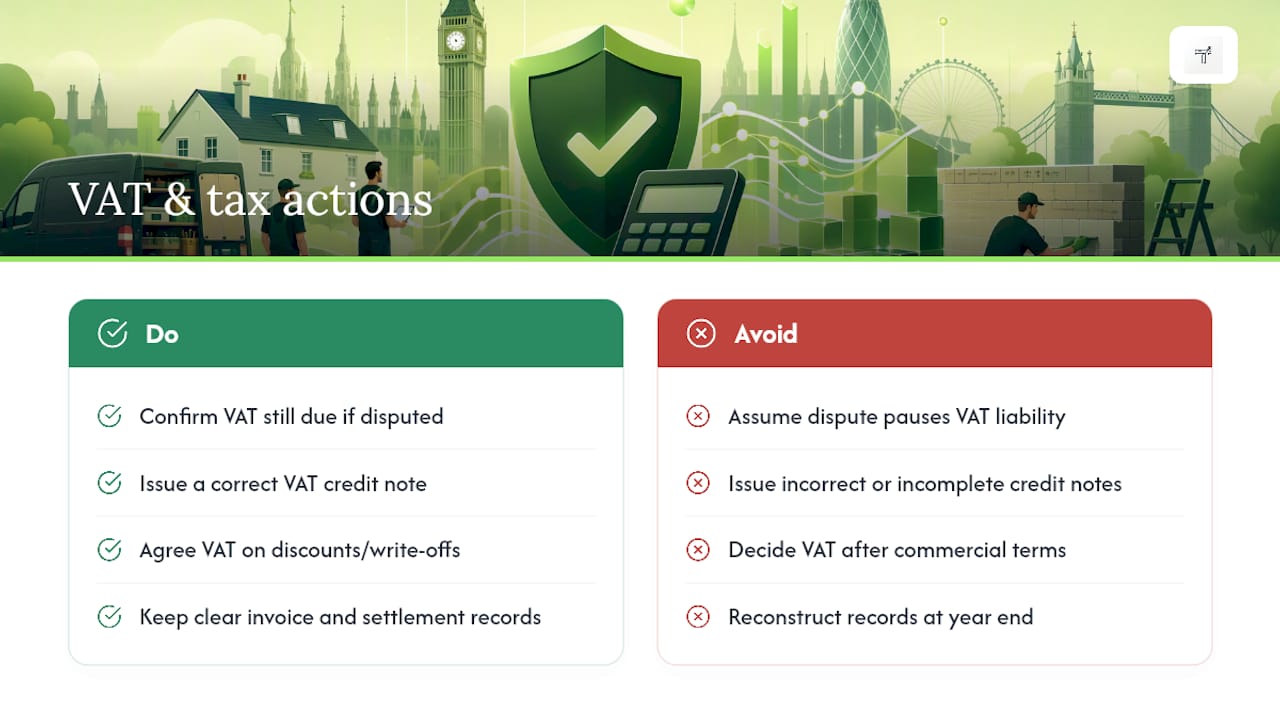
A disputed invoice doesn’t pause your VAT obligations automatically, and this catches out plenty of sole traders who assume it does. If you’re VAT registered and using standard VAT accounting, VAT on a disputed invoice may still fall due in the period it was issued, not the period it’s finally resolved, unless you’re on cash accounting, where VAT is only due once you’re actually paid.
Get the credit note process right if a settlement reduces the amount owed. A correctly issued VAT credit note adjusts both your output VAT and the client’s input VAT claim, and getting this wrong risks a mismatch that HMRC can query later. If you’re negotiating a discount or writing off part of an invoice, work out the VAT treatment at the same time as the commercial terms, not afterwards.
For Self Assessment, a disputed invoice that’s ultimately reduced or unpaid affects your reported income and may qualify for bad debt relief in some circumstances. Keeping a clear record of what was invoiced, what was settled, and when, makes this considerably easier to handle at year end rather than trying to reconstruct it from memory during tax season.
Do debt collection agencies actually help with disputes?
Debt collection agencies are built for chasing straightforward non-payment, not resolving genuine disputes over quality, scope, or pricing. If a client hasn’t disputed the invoice at all and simply isn’t paying, an agency can apply pressure that a sole trader often can’t on their own.
Where an invoice is genuinely disputed rather than just unpaid, agencies are far less useful. Their leverage comes from repeated contact and credit pressure, not from adjudicating who’s right about a variation that was never confirmed in writing. Sending a disputed invoice to collections too early can also harden a client’s position and damage a relationship you might otherwise have salvaged through negotiation or the OSBC.
The sensible order is: resolve or narrow the dispute first, then use collections only for the portion that remains genuinely undisputed and simply unpaid. Agencies typically work on a percentage of what they recover, so factor that cost into whether pursuing the balance is worthwhile at all, particularly on smaller invoices.
A short note on what actually stops disputes
Most invoice disputes trace back to a decision that was never confirmed in writing, not to genuine disagreement about the work itself. A client agrees a change on-site, nobody follows up with an email, and three weeks later nobody quite agrees what was said.
The fix isn’t complicated. A one-line confirmation sent the same day, “As discussed, we’re adding the extra socket at £45, confirm and I’ll proceed”, closes most disputes before they open. It costs thirty seconds and saves hours of argument later.
— Simon
Get your dispute paperwork sorted with Tradetally
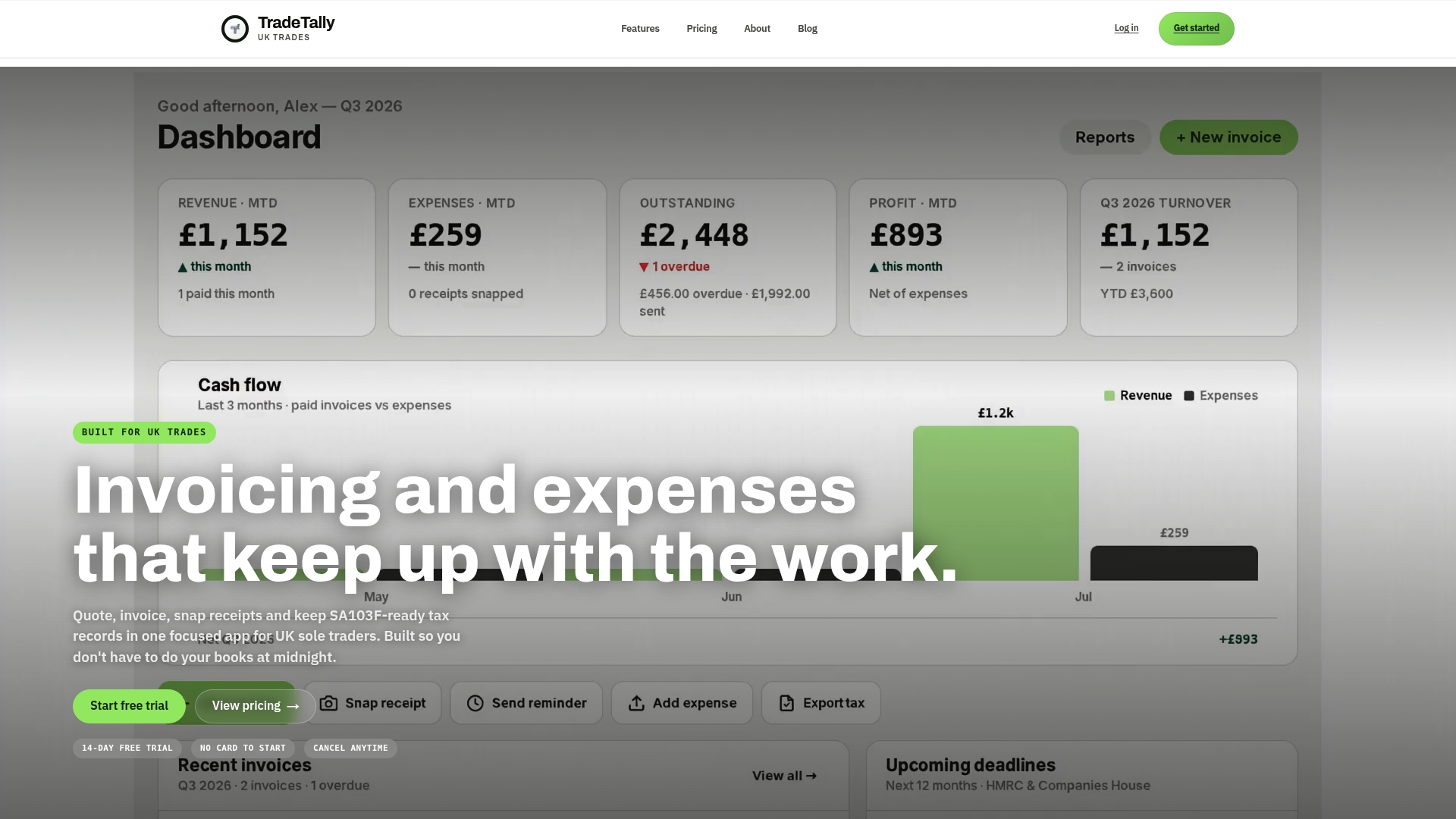
Tradetally is the tool that turns the checklist in this guide into something you actually do, rather than something you mean to get round to. Every invoice you send is timestamped and stored automatically, every receipt is photographed and filed against the right job, and your records export straight into SA103F-ready format when Self Assessment rolls around, so the evidence file for any dispute is already sitting there when you need it.
If you’re tired of rebuilding a chronology from memory every time a client queries a bill, start with the free invoice template and the late payment letter templates to send your first professional dispute acknowledgement today. The Starter plan is free for limited invoicing, and the Professional plan runs £12 a month or £120 a year for unlimited invoices, receipts, and tax exports. Have a look at the main Tradetally site and get your next invoice out the door properly documented from the start.
Sources
FAQ
How do I dispute an invoice in the UK?
Acknowledge the invoice in writing, state precisely which parts you dispute and why, and gather your contract, quotes, and email evidence before replying in detail. Offer to pay any undisputed portion straight away, then negotiate the disputed balance, escalating to the OSBC or ADR only if talks stall.
What can I do if my client won’t pay an invoice?
Start with a clear written chase referencing the original payment terms, and remind them that payment is due within 30 days unless otherwise agreed, with statutory interest potentially applying after that. If there’s no genuine dispute, a letter before action followed by a small claims for unpaid invoice claim is the standard next step.
How do I professionally dispute an invoice as the paying party?
Reply promptly, in writing, listing the specific line items or work you’re querying with dates and supporting detail rather than a general complaint. Propose paying the undisputed amount immediately and set out what evidence or explanation would resolve the remaining balance, keeping the tone factual rather than accusatory.
Is there a free alternative dispute resolution service in the UK?
Yes. The Office of the Small Business Commissioner is free and independent, and helps small businesses with fewer than 50 staff resolve payment disputes with larger customers through non-binding recommendations. Paid mediation and binding neutral decision services also exist for cases the OSBC can’t take on.
What does Tradetally cost for a sole trader?
The Starter plan is free for limited invoicing, while the Professional plan costs £12 a month or £120 a year for unlimited invoices, receipts, and SA103F-ready tax exports.
Recommended
Ready to sort your trade admin?
TradeTally gives UK sole traders invoicing, expenses, and SA103F-ready tax exports in one mobile-first app.
Start 14-day free trial →