UK Trades: Split Personal and Business Expenses with Snap Receipts

For UK self-employed people and small businesses, an expense is allowable on your tax return only if it was incurred wholly and exclusively for business purposes. Mixed-use items, like a phone you use for both quotes and Sunday calls to family, need a fair, documented split. Get this wrong and HMRC can disallow the whole claim, not just the personal share. So, the examples and record-keeping steps below matter more than they might first appear.
TL;DR:
- Only expenses incurred wholly and exclusively for business purposes are allowable, requiring careful record-keeping and clear separation of mixed-use items.
- Apps like TradeTally can simplify tracking and apportioning costs, including receipts, mileage, and time, ensuring compliance with HMRC rules.
- Flat-rate mileage rates for vehicles and simplified home-working expenses offer easier claims, but you must choose and stick with your method annually.
- Maintaining detailed, up-to-date records and reconciling weekly reduces errors and helps substantiate your claims during HMRC audits.
- Mixing personal and business finances via a single account significantly increases errors, whereas dedicated accounts and tagging expenses early improve accuracy.
Table of Contents
- What counts as a business expense under HMRC rules
- Common examples: allowable vs non-allowable expenses
- Mixed-use items: how to apportion costs between personal and business
- Vehicle and mileage rules: simplified rates, capital allowances and evidence
- Working from home: simplified expenses versus actual costs
- Record keeping: what to keep, how long and practical tips
- How to report expenses on Self Assessment: cash basis vs traditional accounting
- Practical bookkeeping habits and tools that make separation simple
- Common pitfalls and year-round priorities
- How TradeTally helps with the day-to-day split
- Sources
- FAQ
What counts as a business expense under HMRC rules
HMRC’s Business Income Manual sets the legal standard: a cost is deductible only if it was incurred wholly and exclusively for the purposes of your trade. If an expense has a personal element that cannot be clearly separated, the entire amount is generally disallowed, not just the personal portion. That single test decides most disputes between tradespeople and HMRC.
In practice, most legitimate claims fall into a handful of categories:
- Office costs, including stationery, software subscriptions and phone bills apportioned for business use.
- Travel between job sites, van running costs and public transport for client visits.
- Staff wages, subcontractor payments and CIS deductions where relevant.
- Stock, materials and tools bought specifically for jobs.
- Finance costs such as interest on business loans and bank charges.
- Premises costs including rent, business rates and a proportion of home-office bills.
- Insurance, professional indemnity cover and public liability policies.
- Marketing, website hosting and printed materials.
Commuting from home to a regular workplace, everyday clothing, client entertaining and any fines or penalties are not allowable, however business-related they might feel. The line HMRC draws is narrow but consistent.
Common examples: allowable vs non-allowable expenses
Some costs look similar on the surface but sit on opposite sides of the wholly and exclusively test. Working through paired examples makes the boundary clearer than reading the rule alone.
- Branded protective clothing with your logo or required safety gear is allowable; ordinary work trousers or boots you could wear outside work are not, even if you only wear them on site.
- A meal with a client while discussing a quote can be allowable as a business cost; staff nights out or personal celebrations are entertainment and are not deductible.
- Trade tools and materials bought for a specific job are allowable in full; a personal power tool used occasionally for work needs a fair apportionment, not a full claim.
- Accountancy or bookkeeping software used to run the business is allowable; personal budgeting apps are not, even if you occasionally check business figures there.
Sole traders and limited company directors both apply the wholly and exclusively test, though directors also need to watch benefit-in-kind rules on anything the company provides for personal use. When an item sits in a grey area, ask whether you would have incurred the cost anyway, without the business. If the answer is yes, it is probably personal.
Mixed-use items: how to apportion costs between personal and business
Plenty of costs serve both your trade and your life outside it. HMRC accepts a business claim on the business-use share, provided the split is fair, reasonable and backed by evidence you could show an inspector.
- Mobile phone and broadband: apportion by the percentage of calls, data or time genuinely used for work, based on a reasonable estimate or a call log.
- Van with personal use: track business versus private mileage and claim only the business share of running costs.
- Shared subscriptions, such as accounting software also used for a side project, split by usage.
- Home broadband or utilities: apportion by rooms used and hours worked, covered in more detail under working-from-home costs.
Where record-keeping for a genuinely mixed cost feels disproportionate to the amount involved, simplified expenses offer flat rates for vehicles and home-working instead of calculating actual costs, though once you choose a method for a vehicle you must stick with it for as long as you use that vehicle in the business.
Pro tip: Keep a simple weekly note of the split you’re using for each mixed-use item; a consistent, dated method is far easier to defend than a one-off estimate made at year-end.
Vehicle and mileage rules: simplified rates, capital allowances and evidence
For the 2026 to 2027 tax year, the simplified mileage rate for cars and goods vehicles follows the published flat rates, with a higher rate for initial business miles and a lower rate thereafter, and a separate rate for motorcycles. This flat-rate method suits most self-employed tradespeople who use a personal vehicle for work, since it avoids splitting fuel, insurance and servicing receipts.
Alternatively, you can claim actual running costs plus capital allowances on the vehicle, apportioned for business use, though this demands more detailed records. Whichever method you pick for a given vehicle, HMRC expects you to stay with it.
To support either claim, keep:
- A mileage log showing date, destination, purpose and miles for each business journey.
- Fuel and maintenance receipts if you’re claiming actual costs rather than the simplified rate.
- A simple journeys diary if you use the vehicle for both business and private trips.
Our guide to HMRC mileage claims walks through worked examples for tradespeople running a van or pickup.
Working from home: simplified expenses versus actual costs
If you do admin, quoting or invoicing from home, you have two options. The flat-rate simplified method scales with hours worked and needs no bill-splitting. The actual-costs method apportions real household bills, usually by room and time used, and can work out higher if your home-office footprint is significant.
- Simplified flat rate: straightforward, no receipts to apportion, best for lighter or occasional home-working.
- Actual costs: apportion heating, electricity, broadband and mortgage interest or rent by room and hours, better suited to those working from home regularly.
- Record-keeping: note which method you used and why, since switching between years without a clear reason can raise questions.
Avoid claiming any room as being in exclusive business use throughout the year, since this can affect Private Residence Relief if you later sell the property. Showing occasional personal use of the space protects that relief.
Record keeping: what to keep, how long and practical tips
You must keep business records, including receipts, invoices and bank statements, for at least 5 years after the 31 January submission deadline for the relevant tax year. That means records for the 2025 to 2026 return need keeping until early 2032.
- Open a separate business bank account so transactions don’t mix with personal spending and every feed reads clearly.
- Photograph or scan receipts immediately, rather than saving paper for a Sunday-night sort-out.
- Reconcile weekly, matching bank entries against receipts and invoices while the details are still fresh.
- If records go missing, reconstruct what you can from bank statements and supplier invoices, and note clearly where an estimate has been used.
Our expense tracking guide for sole traders covers this in more depth, including how to catch small recurring costs before they slip through.
How to report expenses on Self Assessment: cash basis vs traditional accounting
Most sole traders use cash basis accounting, recording income when it’s received and expenses when they’re paid. Traditional accounting records income when invoiced and expenses when billed, which changes the timing of what lands in which tax year. HMRC’s guidance on SA103F explains the practical difference and which businesses can choose cash basis.
Before filing, HMRC’s HS222 helpsheet sets out which items are allowable and gives worked examples for calculating taxable profits under either basis. You’ll use SA103S for a simpler return under £90,000 turnover or SA103F for a fuller return.
Before you start filing, gather:
- Total turnover and any other business income for the year.
- Total allowable expenses by category, matching the boxes on SA103S or SA103F.
- Mileage or home-working figures if you’re using simplified expenses.
- Details of any capital allowances claimed on tools, vehicles or equipment.
VAT-registered traders also need to check that expense figures used for Self Assessment match the net amounts used on VAT returns, since input VAT reclaimed shouldn’t be counted twice as an expense.
Practical bookkeeping habits and tools that make separation simple
The habits that keep personal and business spending apart are simple but easy to skip: a dedicated account, receipts captured the moment they’re issued, mixed-use items tagged as they happen, and a weekly reconciliation rather than a year-end scramble. Small recurring costs, like a monthly software fee or a top-up of consumables, are the ones most often missed.
An app that captures receipts on the spot and exports SA103F-ready figures turns this from an evening chore into a five-minute job between sites.

Pro tip: Tag every mixed-use expense at the point of purchase, not at year-end; you’ll remember the actual business-use split far better on the day than six months later.
Common pitfalls and year-round priorities

The costliest mistake is commingling accounts: once personal and business spending share one feed, every reconciliation takes twice as long and every apportionment becomes a guess dressed up as a calculation. The second is applying a split once and never revisiting it as circumstances change.
Prioritise reconciling monthly, chasing missing receipts before they’re forgotten, and writing down the method you chose for each mixed-use cost. Bring in an accountant, or check directly with HMRC, whenever a claim’s size or complexity outweighs your confidence in the answer.
— Simon
How TradeTally helps with the day-to-day split
Separating personal and business spending is mostly a habit problem, and habits stick better when the tool fits around a working day rather than a desk job. TradeTally was built by a working tradesperson for exactly this: snap a receipt from the van between jobs, tag it against a job or category on the spot, and let the app carry those figures through to a tax-ready export.
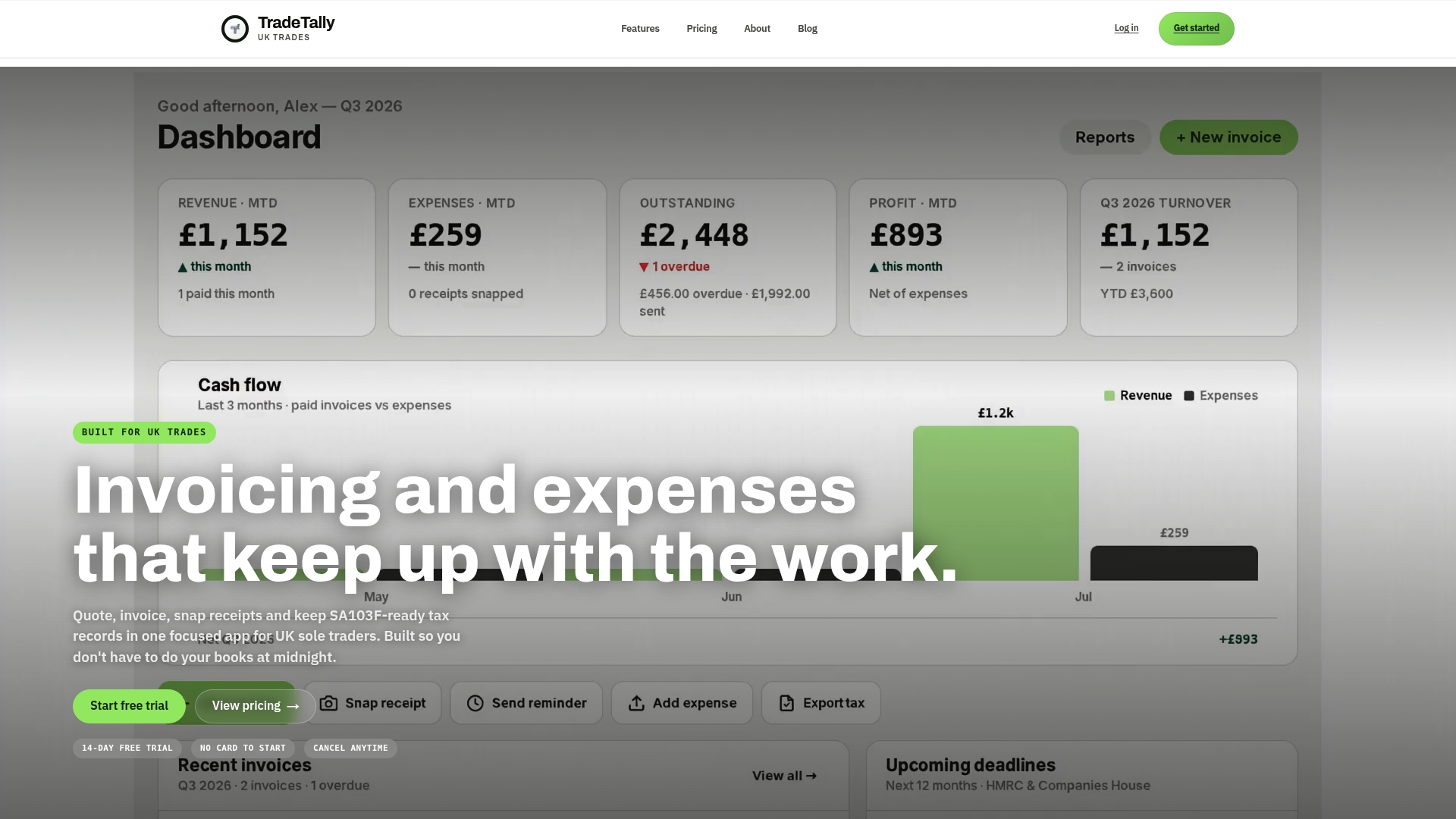
Features that map directly onto the tasks covered above include:
- Instant receipt capture and tagging, so mixed-use items are recorded with their split at the moment of purchase.
- Branded invoicing and quoting that keeps business income clearly separated from personal transfers.
- Mileage and time tracking alongside automatic SA103F export for Self Assessment.
- CIS deduction handling and a live profit dashboard for a running view of the year.
It suits UK sole trader tradespeople, plumbers, electricians, builders and carpenters among them, who want less time spent on bookkeeping and records ready for their accountant or their own return. Try the free Starter plan or move to Professional at £12 a month or £120 a year for full access to invoices, receipts and tax exports. Compare the plans and get started at Tradetally.
This article is general information, not a substitute for advice from a qualified financial advisor. Consult a qualified financial professional about your own circumstances before acting on anything here.
FAQ
What is the difference between personal and business expenses?
A business expense is a cost incurred wholly and exclusively for your trade, while a personal expense is spending that serves your life outside work. Anything with both elements needs a fair, documented split, and HMRC’s Business Income Manual sets out this test.
What counts as business expenses in the UK?
Allowable costs include office and travel expenses, staff and subcontractor pay, stock and materials, finance charges, premises costs, insurance and marketing, provided they meet the wholly and exclusively test. GOV.UK’s guidance for the self-employed sets out typical categories with examples.
What are five examples of a business expense?
Common allowable expenses include trade materials, van running costs apportioned for business mileage, business insurance, accountancy software subscriptions, and branded protective clothing. Ordinary clothing and commuting costs are excluded even when they feel work-related.
Can you put personal expenses through a business?
No, claiming a purely personal cost as a business expense breaches the wholly and exclusively rule and risks the whole claim being disallowed if HMRC queries it. Where a cost genuinely serves both purposes, only the business-use portion, calculated on a reasonable basis, can be claimed.
Recommended
Ready to sort your trade admin?
TradeTally gives UK sole traders invoicing, expenses, and SA103F-ready tax exports in one mobile-first app.
Start 14-day Pro trial →No card required