Late Fees on an Invoice in the UK: What You Can Charge

If a business customer pays you late, you can charge statutory interest of 8% above the Bank of England base rate, plus a fixed fee of £40, £70 or £100 depending on the size of the debt. That right comes from law, not from a clause you add yourself. If your customer is a homeowner, it works differently: you can only charge a late fee that was agreed in your quote or terms before the work started.
This guide covers what you can charge, how to work out the figure, what your invoice and terms should say, and how to avoid the dispute that turns a late payment into a non-payment.
TL;DR
- Business customers: you can claim 8% plus base rate as statutory interest, plus a fixed sum per late invoice.
- Fixed sums are £40 (debts under £1,000), £70 (£1,000 to £9,999.99) and £100 (£10,000 or more).
- With no agreed date, an invoice is late 30 days after the customer receives it or after the job is done, whichever is later.
- Homeowners are outside the statutory scheme. Put any late fee in your quote and terms before you start.
- Charge by sending a new invoice that references the original, with the calculation shown.
Table of Contents
- Who can you charge, and who can’t you?
- When does an invoice become late?
- What you can charge: the numbers
- Can you add your own late fee?
- What your invoice should say
- How to charge the late fee, step by step
- What is changing in the late payment rules?
- How to stop it happening in the first place
- Our perspective
- Keep invoices and chasing in one place
- FAQ
- Sources
Who can you charge, and who can’t you?
The statutory scheme is the Late Payment of Commercial Debts (Interest) Act 1998. It covers late commercial payments, meaning one business or public body paying another for goods or services. So it applies when you invoice a main contractor, a landlord who is a business, a letting agency, a housing association or a company.
It does not give you a statutory right against a private homeowner paying for a bathroom or a rewire. With domestic customers you are relying on your own terms. That means the fee has to be in your quote or terms and conditions, and the customer has to have seen it before work began. Adding a charge for the first time on an overdue invoice invites an argument, and the customer may use that argument to delay paying the whole invoice, as Sprintlaw’s guidance on late payment fees warns.
A few other points that catch tradespeople out:
- You cannot claim interest or compensation on an invoice the customer has disputed legitimately. The Small Business Commissioner’s FAQs say charges apply where an invoice has been accepted but not paid within the agreed time.
- You can choose not to charge. GOV.UK’s payment obligations page says you have the right to charge interest but can decide against it.
- If you work under CIS, the same rules apply to your invoice. Late payment of the net amount is still late payment. Our CIS deduction calculator helps you get the invoice total right first.
When does an invoice become late?
The due date is whatever you and the customer agreed. If you agreed nothing, the law says payment is late 30 days after the customer gets the invoice, or after you deliver the goods or service, whichever is later.
If you do agree a date, the government says it should usually be within 30 days for public authorities or 60 days for business transactions. A longer business period has to be fair to both sides. The Small Business Commissioner’s Guide to Payment Rights treats terms beyond 60 days as unacceptable unless both parties expressly agree and it is not grossly unfair to the supplier.
Pro tip: write the due date on the invoice as a calendar date, not just “30 days”. It removes any argument about when the clock started.
How late can you issue the invoice?
This is a separate question from when it becomes overdue, and the answer depends on VAT and on how long you leave it.
- If you are VAT registered, you normally have 30 days to issue a VAT invoice from the time of supply. HMRC’s guidance on extending the 30-day limit shows that this is the standard limit and that extensions are for specific situations, such as waiting on invoices from your own subcontractors. Our guide to when a pro forma becomes a VAT invoice goes through the trap in detail.
- For the interest clock, a late invoice means a late start. The 30 days run from when the customer receives the invoice, so every day you delay sending it is a day before you can charge anything.
- There is also a long-stop. The Small Business Commissioner says you can collect interest only for up to 6 years from the day after the contracted payment terms end. Do not leave it anywhere near that.
The practical answer: invoice the day the job finishes. Our piece on when tradesmen should invoice customers covers stage payments and finishing-day invoicing.
What you can charge: the numbers
Statutory interest
The rate is 8% plus the Bank of England base rate. It starts the day after payment was due and runs daily until you are paid. The base rate used is fixed twice a year: the rate on 31 December applies to debts that become late from 1 January to 30 June, and the rate on 30 June applies from 1 July to 31 December, according to the Small Business Commissioner’s calculator guidance. Include VAT in the invoice total when you calculate.

For debts that became late in the second half of 2026, the base rate on 30 June was 3.75%, so the rate is 11.75% a year. The base rate changes, so check the current figure on the official calculator before you send anything.
Fixed compensation
On top of interest, you can claim a fixed sum for each late invoice, set by the size of the debt:
| Debt (including VAT) | Fixed sum |
|---|---|
| Under £1,000 | £40 |
| £1,000 to £9,999.99 | £70 |
| £10,000 or more | £100 |
These match the figures on GOV.UK’s page on debt recovery costs, which also says you can claim reasonable extra recovery costs each time you try to recover the debt.
A worked example
You fit a boiler for a letting company and invoice £2,400 including VAT, due in 30 days. They pay 30 days late. Using the 11.75% rate:
- Annual interest: £2,400 × 0.1175 = £282.
- Daily interest: £282 ÷ 365 = about 77p.
- Interest for 30 days: about £23.18.
- Fixed sum for a debt of £1,000 to £9,999.99: £70.
- Total you can claim: about £93.18.
That is the method GOV.UK uses in its own worked example, with different figures: annual interest, divided by 365 for the daily rate, multiplied by the days late.
On a small job, the fixed sum is most of the claim. On a large, long-overdue invoice, interest is where the money builds up. Our guide to claiming late payment interest has more worked figures.

Can you add your own late fee?
Yes, with limits. A business can put a late fee or interest rate in its terms, but two rules shape it.
- It must be agreed in advance. A clause the customer never saw is hard to enforce. Harper James advises that a contract clause should set out the rate and when it applies, and the customer should know about it before signing.
- It cannot strip away the statutory right. Under section 8 of the 1998 Act, terms are void to the extent they exclude statutory interest, unless there is a substantial contractual remedy for late payment.
A fee that is out of proportion to your real cost and mainly meant to punish can also be challenged. Keep any figure you set sensible and explainable.
Be careful with the other direction too. Large customers sometimes send their own terms with long payment periods or weak late-payment remedies. The Small Business Commissioner advises that you review any contract thoroughly before signing, because signing without thought can restrict your rights later.
What to put in your terms
Set these out in writing before the work starts, in the quote or terms and conditions:
- The payment term, as a number of days from invoice date.
- That statutory interest and fixed compensation apply to late business invoices (or your agreed rate, for domestic customers).
- That you may claim reasonable recovery costs.
- That you can pause further work on an account that is overdue.
- That the quote is valid for a set period, and how deposits and stage payments work.
Our free quote template is a sensible place to add these lines, so they are in front of the customer from the start.
What your invoice should say
Your invoice can remind the customer of terms they already agreed. It should not introduce new ones. A clear invoice includes:
- Your name, address and, if registered, VAT number.
- A unique invoice number and the invoice date.
- The description of the work, and the total including VAT.
- A due date as a calendar date.
- Payment details.
- A short line such as: “Late payment: statutory interest and compensation may be charged under the Late Payment of Commercial Debts (Interest) Act 1998.”
A missing detail gives the customer a reason to hold the payment back. Our guide to UK invoice requirements for tradespeople lists the fields, including those a VAT-registered customer needs to reclaim VAT.
How to charge the late fee, step by step
The Small Business Commissioner recommends escalating in stages. In practice for a tradesperson that looks like this:
- Check the terms. Confirm the due date and that the customer accepted the work. If there is a genuine dispute about the job, resolve that first. Our 72-hour dispute playbook shows how.
- Send a polite reminder the day after the due date. Most late payers are disorganised, not hostile. Our four-step reminder wording gives you the messages.
- Phone them. A short call often gets a payment date, which you then confirm by email.
- Warn that charges will apply. Some businesses mention statutory charges in their reminders before applying them. Charging is a commercial decision as well as a legal one, and a warning often brings the money in without the extra invoice.
- Issue a new invoice for the charges. The Small Business Commissioner says to send a new invoice stating the amount owed and its due date, referencing the original invoice. Show the interest calculation so nobody has to guess.
- Offer instalments if cash flow is the problem. The same guidance suggests splitting payment and confirming the terms in writing by email.
- Send a Letter Before Action. PaymentCheck advises including the full amount with interest and compensation, a breakdown of the calculation, a final deadline (usually 14 days) and a statement that you will start a county court claim if unpaid.
You can copy ready-made wording from our late payment letter templates. For site-based work, invoice reminders for builders explains how to time them.
What is changing in the late payment rules?
The government has announced plans to tighten the system. Harper James reports that on 24 March 2026 the Department for Business and Trade announced measures under which large companies would have to pay smaller suppliers within 60 days, with interest at 8% above base rate applying automatically in commercial contracts. A Commercial Payments Bill is reported to be moving through Parliament, with the new limits not expected before 2027, according to Polytheseus.
Nothing stops you using the current rules today. Check GOV.UK for the position when you read this.
How to stop it happening in the first place
Charging interest recovers money. Preventing lateness protects your cash flow. The habits that work:
- Agree payment terms in writing before you start.
- Take a deposit or stage payments on bigger jobs.
- Invoice on the day the work finishes, with payment details on it.
- Send the reminder on day one after the due date, not day twenty.
- Keep photos, signed-off job sheets and messages that show the work was accepted.
We go through more of these in 8 best ways to stop late payers.
Our perspective
Most tradespeople we speak to know they are owed interest on late invoices. Very few ever claim it. The reason is rarely the law. It is that the admin falls at the end of a long day: working out the days late, doing the sum, drafting a new invoice, finding the original.
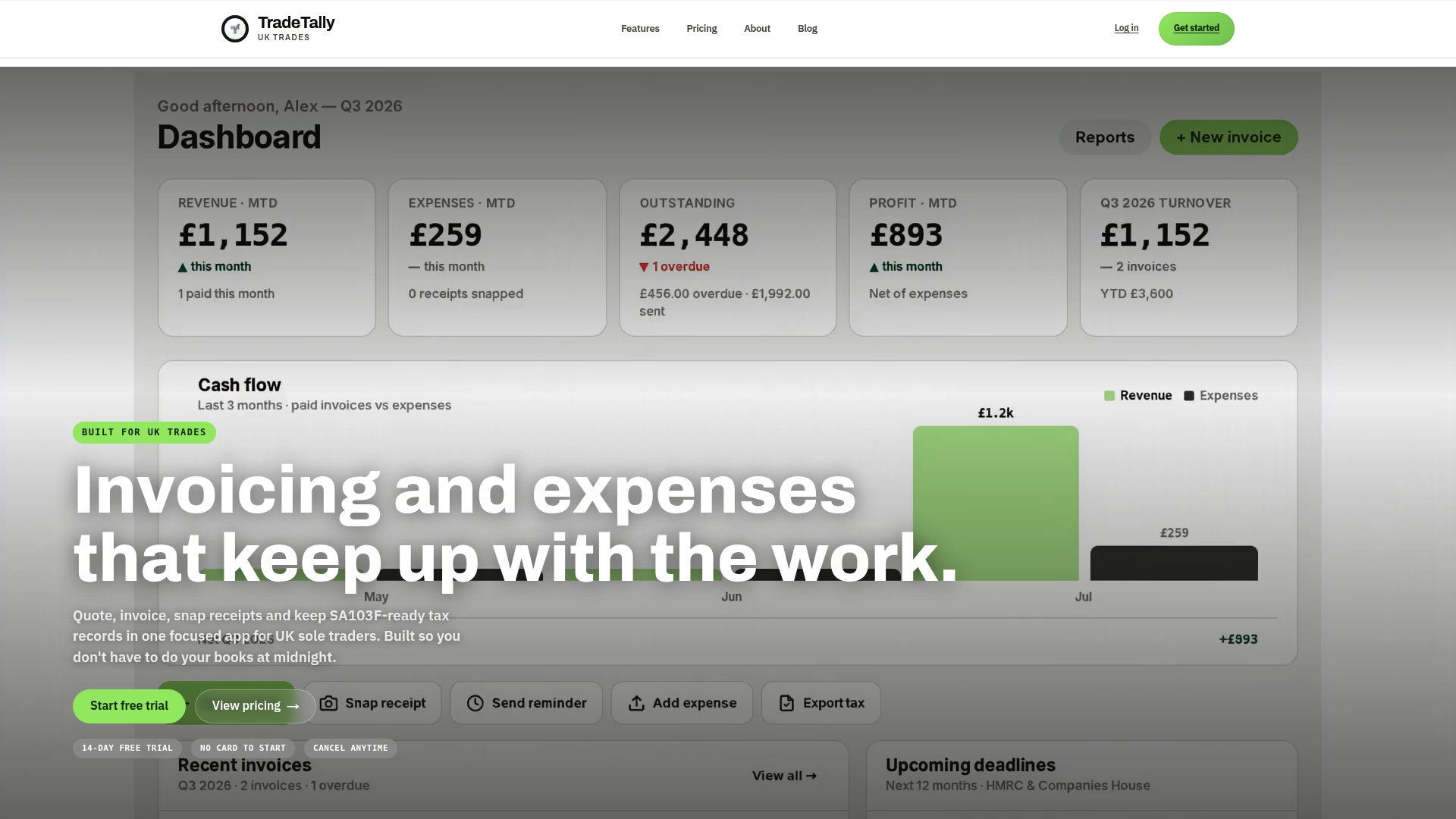
We built TradeTally around that problem. Invoices go out branded and with a clear due date, you can see what is outstanding at a glance, and your records stay in one place, so when a payment slips you already have the paperwork you need.
Our advice is simple. Put your terms in the quote, invoice the day you finish, and chase early and politely. Claim the fixed fee and interest when it is justified and you want to, and keep the paper trail tidy either way.
Simon
Keep invoices and chasing in one place
TradeTally is a UK app for sole tradespeople covering branded invoicing, quotes, expense and receipt tracking, CIS deductions, mileage and tax-ready records. The Starter plan is £0 per month for limited invoicing. Professional is £12 per month, or £120 per year, for full access. See the plans and pricing or start from the TradeTally homepage.
If you invoice under CIS, our CIS invoice software handles the deduction on each invoice.
FAQ
How much can I charge as a late fee on an invoice?
For business customers, you can charge 8% plus the Bank of England base rate as statutory interest, plus £40, £70 or £100 depending on the invoice size. For homeowners there is no statutory amount, so you can only charge what your quote or terms agreed beforehand.
Is it legal to add a late fee to an invoice?
Yes, if the customer agreed to it before the work started, and it is proportionate to your real costs. For business-to-business invoices you have a statutory right to interest and fixed compensation anyway, and a contract cannot take that away unless it gives a substantial alternative remedy.
How late can an invoice be issued in the UK?
If you are VAT registered, you normally have 30 days to issue a VAT invoice. For unpaid debts, the usual court time limit is long, and the Small Business Commissioner says interest can be collected for up to 6 years. In practice, invoice on the day the work ends, because the payment clock only starts once the customer has the invoice.
What are the new late payment rules in the UK?
The government announced measures in March 2026 to cap payment terms at 60 days for large companies paying smaller suppliers. The reported Commercial Payments Bill is not law yet, and the new limits are not expected before 2027. The 1998 Act rules in this article still apply.
Sources
- Late commercial payments: charging interest and debt recovery (GOV.UK)
- Charging interest on late commercial debt (GOV.UK)
- Claim debt recovery costs (GOV.UK)
- Invoicing and taking payment: payment obligations (GOV.UK)
- Extension of the time limit for issuing VAT invoices (HMRC)
- Late Payment of Commercial Debts (Interest) Act 1998
- Small Business Commissioner: Guide to Payment Rights
- Small Business Commissioner: FAQs
- Small Business Commissioner: Interest Calculator Guidance
- Small Business Commissioner: Help with unpaid invoices
- Cottons Group: Are late payments holding your business back?
- PaymentCheck: How to chase an unpaid invoice
- Sprintlaw: Charging late payment fees in the UK
- Harper James: Unpaid invoice legal options
- Polytheseus: Late payment interest calculator
Recommended
Related articles
Claim Late Payment Interest in the UK
Find out what you can charge when a UK client pays late: the statutory 8%+Bank Rate, £40–£100 fixed compensation, plus invoice templates.

Chasing Overdue Invoices in the UK: A Step-by-Step Guide for Tradespeople
How to chase overdue invoices in the UK: when an invoice is late, what to say, when to add interest and £40–£100 compensation, and when to go to court.

Credit Control: 10 Steps for Sole Traders
Set up credit control for UK sole traders with ten practical steps, daily and weekly checks, statutory interest rights, and Making Tax Digital records.

Partial Payment Invoice UK: How to Set One Up and Stay Paid
How UK tradespeople can invoice for part payments: deposits vs stage payments, what to put on the invoice, VAT tax points, late payment rights and recording balances.