Travel Time Billing for UK Tradespeople: How to Charge It

You can bill a customer for travel time. There is no rule against it, and for a sole trader it is a pricing decision, not a legal one. What matters is that you agree the method before the job, show it as its own line on the quote and invoice, and keep a record of the journeys. This guide covers the main ways to charge, a worked example, how VAT and HMRC mileage rules fit in, and the wording that avoids arguments.
TL;DR
- Travel time billing is a commercial choice for self-employed tradespeople. Pick a method (call-out fee, hourly travel rate, mileage, or built into the day rate) and tell the customer up front.
- Show travel as a separate, clearly described line on quotes and invoices. If you are VAT-registered, VAT is normally due on travel you recharge.
- What you charge a customer is separate from what you claim from HMRC. For 2026–27 the approved mileage rate is 55p a mile for the first 10,000 business miles, but you can charge a customer more than that.
- Keep a dated log of every journey. It backs up your invoice and your Self Assessment claim.
Table of Contents
- Can you charge a customer for travel time?
- Five ways to charge for travel
- Working out your number
- What to put on the quote and invoice
- VAT on travel charges
- Charging a customer is not the same as claiming from HMRC
- If you employ people, the rules change
- Perspective: why we think travel belongs on its own line
- Keeping the records without the late-night paperwork
- Wording you can borrow
- FAQ
- Sources
Can you charge a customer for travel time?
Yes. If you are self-employed, nobody sets your travel charge for you. You decide whether to charge it, how, and how much, and the customer decides whether to accept it. The Institute of Directors makes the same point about independent consultants: pricing is a commercial decision. You need to cover your costs, reach a realistic and profitable rate, and be open about whether expenses are included or billed separately.
That is why the search results for this topic are muddled. Many of the top pages are about employees: whether an employer must pay staff for travel, minimum wage, carers moving between visits. Those rules matter if you employ people (more on that below), but they do not set what you can invoice a customer.
For a plumber, electrician or carpenter, the real question is simpler. Every hour in the van is an hour you cannot spend on a paid job. If you give that time away on every call, your effective hourly rate drops without you noticing.
Five ways to charge for travel
There is no single correct method. The right one depends on how far you travel, how many jobs you do in a day and how your customers buy.
1. Build it into your hourly or day rate
For local work, many trades simply price travel into the rate. TradeLinkers’ pricing guide recommends exactly this for nearby jobs, and listing mileage, travel time, parking and road charges separately for more distant ones. It keeps quotes simple, but it hides the cost, so a distant job quietly earns you less than a local one.
2. A fixed call-out fee
A flat fee covers the first stretch of travel and sometimes the first short period of work. It is quick to explain and suits emergency and small repair work. The weakness is that a flat fee treats a 3-mile trip and a 25-mile trip the same, so set it on your average journey and add a distance charge beyond a stated radius.
3. Travel time at an hourly rate
You charge the time in the van, usually at your normal hourly rate or a reduced one. It is easy to justify to a customer because it is the same unit as the rest of the job. You need a log of start and finish times to support it.
4. A per-mile charge
You charge for the distance, often on top of a time charge. Be careful not to count the same cost twice. If your travel-time charge already covers the lost hour, the mileage charge should only cover the vehicle: fuel, wear, servicing and insurance.
5. A zone or distance band
You set bands, for example inside 10 miles, 10 to 20 miles and beyond, each with a fixed travel charge. Customers can see the price before they book, and you do not have to calculate each job.
| Method | Best for | Watch out for |
|---|---|---|
| Built into rate | Local, repeat work | Hides the cost of far-flung jobs |
| Call-out fee | Emergencies, small repairs | Same fee for short and long trips |
| Hourly travel rate | Larger or distant jobs | Needs a time log |
| Per-mile charge | Rural work, van-heavy trades | Double-counting time and mileage |
| Distance bands | Customers booking by quote | Bands need a regular review |
Working out your number
A travel charge that only covers fuel loses money. It should cover four things: your time, the fuel and running costs of the vehicle, a share of overheads such as insurance and tools, and some profit. BigChange’s call-out guidance makes the same point: fuel alone is not the cost of travel.
Here is a worked example. The figures are illustrative, not a recommendation of what you should charge.
- Your normal hourly rate: £45.
- Round trip to the job: 40 minutes each way, so 80 minutes.
- Distance: 14 miles each way, so 28 miles.
Time: 80 minutes is 1.33 hours, and 1.33 × £45 = £60.
Vehicle: at the HMRC approved rate of 55p a mile, 28 miles is £15.40. That is a useful floor, but a working van with its own insurance, servicing and tyres may cost you more, and the rate is a tax allowance, not a price list.
Total at cost: £60 + £15.40 = £75.40, before overheads and profit.
You might then offer the customer a simple choice: a fixed £75 travel line for the job, or travel built into the quote. If you do several jobs in the same area on one day, you can share the trip across them. Charging every customer a full round trip when you stop at three addresses is the quickest way to lose a customer’s trust.
You can also choose to charge only part of the journey, for instance waiving the first 30 minutes, as some professional bodies do. For example, the APA terms for one profession pay travel time at the basic hourly rate and exclude the first hour of each working-day journey, with mileage at 50p a mile outside the M25. That is one sector’s terms, not a rule for trades, but it shows how a threshold works in practice.

What to put on the quote and invoice
Disputes over travel charges nearly always come from surprise. Fix that at quote stage.
A good quote states:
- Whether travel is included in the price or charged separately.
- The method: fixed fee, hourly, per mile or band.
- The rate, and any free allowance (for example, the first 10 miles).
- What happens on return visits, for instance if parts are not in stock.
- Whether time spent collecting materials counts.
Keep fee types distinct. Contract guidance for mobile trades, such as Sprintlaw’s terms of trade article, recommends separating call-out, diagnostic, labour and return-visit fees so a customer can see whether the price is fixed, estimated, hourly or a mix.
On the invoice itself, GOV.UK says an invoice must show a unique number, supplier and customer details, a clear description, supply and invoice dates, amounts charged, VAT if applicable and the total owed. A sole trader must also show their name, any business name and an address where legal documents can be delivered. Put travel on its own line, such as “Travel, 28 miles at 55p plus 80 minutes at £45 an hour”, rather than folding it into labour. Our guides to what a sole trader invoice must include and how to invoice customers as a sole trader go through the rest of the layout, and there is a free invoice template if you want a starting point.
If you take on installation work through a dispatch platform, such as those built for domestic EV charger installers, check how that platform treats travel before you accept jobs, because the answer decides whether you need to add it to your own price.
VAT on travel charges
If you are not VAT-registered, this section does not apply to you. If you are, travel is not a free pass.
GOV.UK’s guidance says that travelling expenses a business incurs in supplying its service are normally recharges, not VAT disbursements. When you recharge them, you must charge VAT on them, whether or not the original cost included VAT. A genuine disbursement has to meet a list of conditions, including acting as the customer’s agent and the customer receiving the benefit of the supply. Your own van journey does not meet that test.
In practice: add VAT to the travel line like any other part of the job. If you are unsure how your particular set-up is treated, ask an accountant, or contact HMRC, before you issue the invoice, not after.
Charging a customer is not the same as claiming from HMRC
Two separate questions get mixed up here.
What you charge the customer is up to you. It is income, and it goes on your invoice.
What you claim as a business expense is set by HMRC rules. Both figures end up in your Self Assessment, but they are not linked. You might charge £75 for a trip and claim £15.40 in mileage. The £75 is turnover. The £15.40 is a deduction, and the rest of the £75 is your payment for time.
Mileage rates for 2026–27
HMRC’s table, updated on 21 May 2026, sets the 2026–27 approved rates at 55p per business mile for cars and vans for the first 10,000 miles, then 25p. Motorcycles are 24p and bicycles 20p. HMRC’s Agent Update says the increase was backdated to 6 April 2026, and self-employed customers can use the new rates in their 2026–27 tax return.
Simplified expenses are optional. HMRC’s Business Income Manual says they can replace detailed actual-cost records for eligible sole traders and partnerships, and that you should keep a contemporaneous record of business mileage to support a simplified-rate claim. Our guides to HMRC mileage claims, the 2026 mileage rates and what a mileage log needs cover the detail, and vehicle expenses for sole traders helps you compare the simplified and actual-cost routes.
Is your journey to site a business journey?
For many tradespeople, yes. HMRC’s manual says an itinerant self-employed trader, such as a jobbing builder, can normally deduct travel between home and successive temporary work sites where the trade is genuinely itinerant. It depends on the facts, and it does not automatically cover travel from home to a fixed place of business.
The 24-month rule
People often search for the “24-month rule”. HMRC’s employment guidance says a workplace is not temporary where someone attends it during continuous work lasting, or likely to last, more than 24 months. It is then treated as a permanent workplace. HMRC’s own example is a project expected to run for three years, which does not count as a temporary workplace.
That guidance is written for employees. If you are self-employed, the itinerant-trader test above is the one to look at first. But if you are on one long contract site every day for years, it is worth asking your accountant how your travel there will be treated.
If you employ people, the rules change
An employee’s travel is a different matter from a customer’s invoice. HMRC’s National Minimum Wage manual says travel between assignments is working time, while ordinary home-to-work travel is not, and actual conditions such as traffic and waiting matter. If you pay an employee or subcontracted worker less than the minimum wage once unpaid travel is taken into account, that is your problem, not the customer’s.
The lesson for pricing: if a person on your payroll spends 90 minutes in the van between jobs, that is a paid cost to you. Bill for it, or price it in.
Perspective: why we think travel belongs on its own line
We built TradeTally around the admin that follows a day on site, and travel is where most of it goes wrong. Tradespeople rarely forget to charge for materials. They forget the hour and a half in traffic, because it does not feel like work.
Our view is simple. Put travel on its own line, give it a method you can explain in one sentence, and write it down before the job starts. A customer who sees “Travel: 28 miles and 80 minutes” on a quote will rarely argue. A customer who sees an unexplained extra £75 at the end of a job will.
There is a second reason. A separate line gives you a record. When you look back at a quarter’s invoices, you can see which areas cost you more in time than they paid, and adjust your bands or your minimum job size. Bundled travel never tells you that.
Pro tip: log every journey on the day, even short ones. Reconstructing mileage at the end of the tax year is slow and guesswork does not stand up well if HMRC ask questions.
— Simon
Keeping the records without the late-night paperwork
Travel billing only works if the evidence is there. For every job you want:
- The date, start and finish address.
- Miles driven and journey time.
- The rate you charged and the line it sits on, on the quote and invoice.
- Parking, tolls or congestion charges, with receipts.
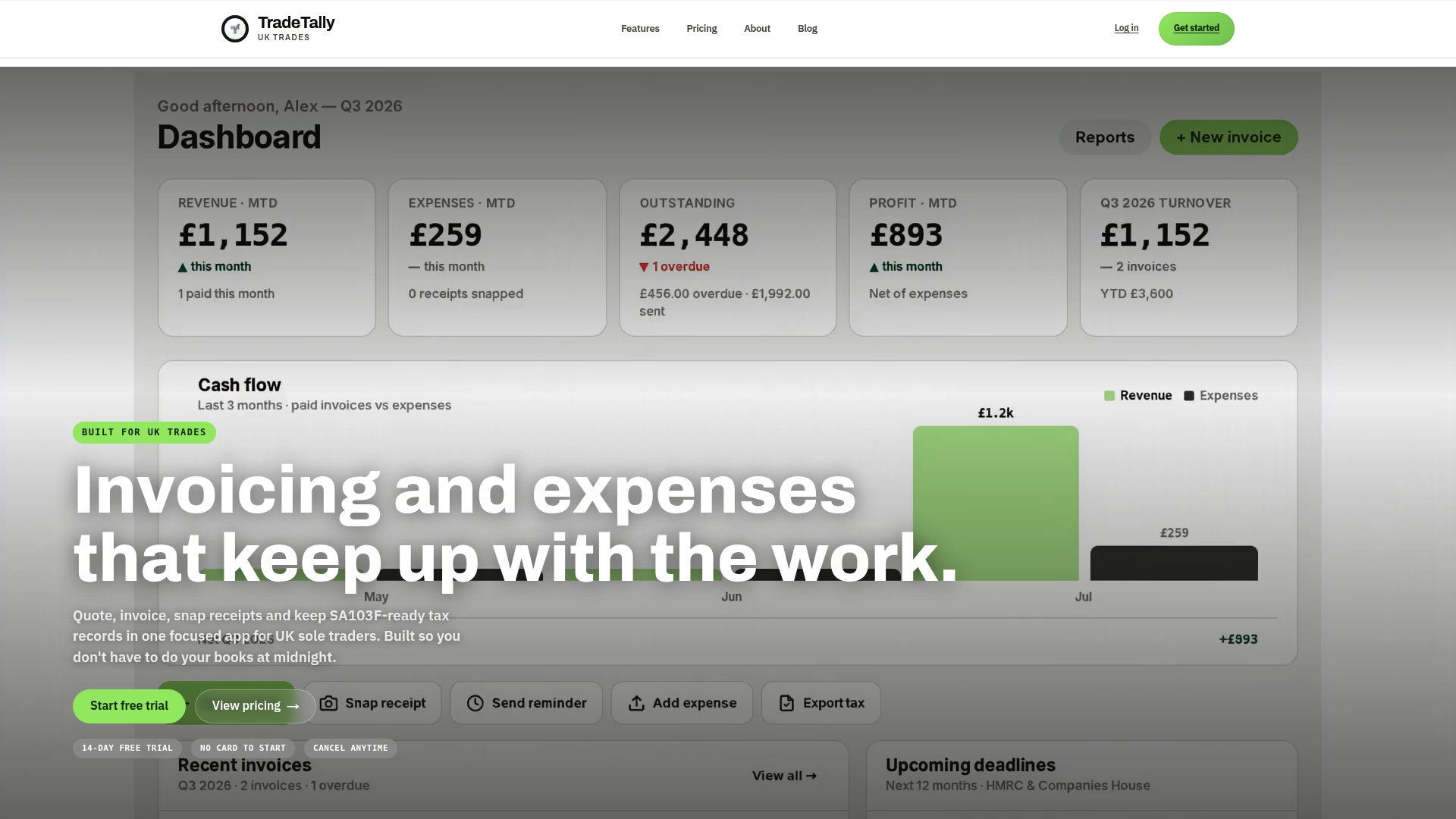
TradeTally is a UK app for sole traders that handles invoicing, quotes, expense and receipt tracking, mileage and time tracking, and SA103F export for Self Assessment, all from your phone, so you can finish it in the van rather than at the kitchen table at 10pm. The Starter plan is free for limited invoicing. Professional is £12 a month or £120 a year, and gives you unlimited invoices, receipts and tax exports. You can see both on our pricing page.
If you want to see what your own tax bill looks like once travel claims are in, try our Self Assessment tax calculator, or start with the free plan. Our guide to personal versus business expenses helps with the receipts that are not clear-cut.
Wording you can borrow
Adapt these lines to your own method.
- Fixed fee: “A travel charge of £X applies to jobs within 15 miles of [your base]. Beyond that, an additional £Y per mile applies.”
- Time and mileage: “Travel is charged at £X per hour and £Y per mile, measured from [base] to site and back.”
- Included: “Our price includes travel within [area]. Travel outside this area is quoted separately.”
- Return visits: “If a return visit is needed because parts are unavailable, travel is charged again unless otherwise agreed.”
Put the agreed wording on the quote and get a written yes, even a text or email, before you start.
FAQ
Should you be paid for travel time in the UK?
If you are an employee, travel between assignments counts as working time, while ordinary commuting does not. If you are self-employed, there is no rule either way: you set your terms and the customer accepts them or not. Agree it before the job.
How do you bill a client for travel time?
Add it as its own line on the quote and invoice, describe the method (fixed fee, hourly or per mile) and add VAT if you are VAT-registered. Keep the journey log in case the customer queries it.
How much should you charge for travel time?
Start from your normal hourly rate multiplied by the round-trip time, then add vehicle costs, a share of overheads and some profit. The HMRC mileage rate is a sensible floor for the vehicle part but not a ceiling. Many tradespeople waive a short first stretch to stay competitive.
What is the HMRC 24-month rule?
A workplace stops being temporary when you attend it during continuous work lasting, or likely to last, more than 24 months. HMRC’s guidance on this is written for employees. If you are self-employed and work from site to site, ask your accountant how it applies to a long contract.
Can I charge more than 55p a mile?
Yes. 55p is HMRC’s approved rate for tax claims, not a limit on what you charge. Your customer price should cover your time, vehicle costs, overheads and profit, so it will often be higher.
Sources
- Thinking of becoming a consultant? | IoD
- How to price a job: a guide for trades | TradeLinkers
- How To Calculate A Call Out Fee | BigChange
- APA Rate Revision September 2025
- Terms of Trade for Mobile Mechanics in the UK | Sprintlaw UK
- Invoices: what they must include | GOV.UK
- VAT: costs or disbursements passed to customers | GOV.UK
- Travel: mileage and fuel rates and allowances | GOV.UK
- Issue 143 of Agent Update | GOV.UK
- BIM75005 Simplified expenses | HMRC
- BIM37620 Wholly and exclusively | HMRC
- EIM31802 Travel for necessary attendance | HMRC
- EIM32101 Travel expenses | HMRC
- NMWM08300 Working time: travelling time | HMRC
- Built for Domestic EV Charger Installers | Installer.com
Recommended
Ready to sort your trade admin?
TradeTally gives UK sole traders invoicing, expenses, and SA103F-ready tax exports in one mobile-first app.
Start 14-day Pro trial →No card required