How to Give Your Accountant Your Self Assessment Records
To give your accountant what they need for Self Assessment, send one organised pack: your income records, your expenses with evidence, your mileage, your CIS statements, your bank statements and your identifiers (UTR and National Insurance number). Then authorise them with HMRC so they can file for you. The tidier the pack, the faster the return and the lower the bill. This guide covers what to include, how to share it, and how to build the pack through the year so you are not doing it on a January night.
TL;DR
- You do not legally need an accountant for Self Assessment, but you remain responsible to HMRC for the return even if they file it.
- Give your accountant income and expense records, evidence, mileage, CIS statements, bank statements and your UTR and National Insurance number.
- Authorise them with HMRC before they can act for you, and share records through a secure portal rather than loose emails.
- Flag estimates and gaps on a separate list instead of burying them in your totals.
- Keep records as you go: a small weekly habit beats a shoebox of receipts in January.
Table of Contents
- Do you need an accountant at all?
- What to give your accountant
- Invoices, receipts and bank statements: what matters most
- How to share records with your accountant
- Authorising your accountant with HMRC
- Timing: do not leave it until January
- Making Tax Digital changes the way you hold records
- How long to keep your records
- Can you claim your accountant’s fee?
- When professional help pays for itself
- Our perspective
- Build the pack as you go with TradeTally
- A simple yearly routine
- FAQ
- Sources
Do you need an accountant at all?
No. GOV.UK points out that the online return has help text and guidance for self-employment, employment, pensions, property and capital gains, so a sole trader with simple finances can file alone. Which? says straightforward finances may be manageable without one, while an accountant can help spot reliefs and allowable expenses.
An accountant earns their fee when the picture gets messier: CIS deductions to reconcile, a van bought mid-year, a mix of employment and self-employed income, rental income, or a first year trading. Whichever way you go, the same Which? guidance reminds taxpayers that the responsibility stays with you, even when an accountant files the return. That is the reason to hand over clean, honest records.
If you are weighing up cost, the figure depends on complexity and the firm, so ask for a fixed quote based on the pack you will send. A tidy pack is the best negotiating position you have.

What to give your accountant
Start with the basics, then add what applies to your trade. GOV.UK’s own Self Assessment preparation steps list the building blocks: your UTR and National Insurance number, records of untaxed income, employment documents such as a P60, P45 or P11D, self-employed income and expense records, pension statements, and details of any tax reliefs you are claiming.
For a tradesperson, a practical pack looks like this:
- Identifiers: your UTR, National Insurance number and, if you have it, your Government Gateway details or agent authorisation reference.
- Last year’s return: or the figures from it, so the accountant can spot changes.
- Sales records: every invoice you issued, marked paid or unpaid, plus any cash takings.
- Expense records: materials, tools, protective gear, insurance, phone, software, subscriptions and anything else you claim, each with a receipt or invoice.
- Mileage and vehicle costs: a log of business journeys, or fuel and running costs if you claim that way.
- CIS statements: the monthly deduction statements from each contractor who paid you under the Construction Industry Scheme.
- Bank and card statements: the full year for any account used for business, including any personal account that business money passed through.
- Assets bought or sold: a van, a machine, a set of scaffold towers, with dates and amounts.
- Other income: employment, pensions, interest, dividends, rental income or capital gains, with supporting statements.
If you want a ready-made list to tick off, our free sole trader tax and CIS checklist covers the same ground.
What you do not send to HMRC
One point that trips people up: GOV.UK says self-employed people total their allowable expenses and enter the figure on the return, but do not send the evidence. You must keep the proof in case HMRC asks. Your accountant needs to see it for the same reason, so they can check the totals are supportable.
Invoices, receipts and bank statements: what matters most
Invoices and income
Your accountant needs to know what you earned and when. GOV.UK explains that cash basis is the default for most sole traders, which means income and expenses are counted when money is received or paid, not when you invoice. So an invoice sent in March and paid in May sits in a different place from one you chased for a week. Keep your invoice list showing issue date, customer, amount and date paid. Our guide to self-employed invoice records shows what a clean record looks like.
Receipts and expenses
A receipt tells your accountant three things: what was bought, how much it cost and when. A photo is fine if it is legible. Anything bought for mixed personal and business use needs a note on the split. If you are unsure what counts, our expense tracking guide for UK sole traders goes through the common categories.
Bank statements
Statements prove what actually went in and out. Send the full year, not a selection, and explain any transfers between your own accounts so they are not mistaken for income. Our note on which bank statements to keep for Self Assessment explains the detail.
Mileage
Vehicle costs are a place tradespeople often overpay or underclaim. Keep a log with date, destination, purpose and miles, and tell your accountant which method you use. We cover the choices in stop overpaying on vehicle expenses.
How to share records with your accountant
The format matters less than the consistency. A pack that arrives the same way every year saves your accountant time, and that tends to show up in the fee.
Pick one route
The three common routes are:
- A secure client portal from your accountant: best for statements and personal documents, because it keeps everything in one place and avoids sensitive files sitting in an inbox.
- Shared accounting software or an export: best if you keep records digitally through the year, because the accountant works from the same figures you do.
- Email with attachments: workable for small jobs, but easy to lose track of and not ideal for bank statements and ID numbers.
Ask your accountant which they prefer before you start sending anything.
Add a cover sheet
A one-page cover sheet makes your pack easy to read. List each income source (self-employment, employment, pension, property, interest) and mark it as sent, still to come, or not applicable. Your accountant then knows at a glance what is complete and what they are waiting for.
Keep estimates separate
If you have a missing statement, a cash job with no paperwork, or a guess at personal use of your van, do not quietly bake it into the total. Put it on a short separate list with a plain note: “estimate, no receipt” or “statement requested, not yet received”. Your accountant can then decide how to treat it, and nothing is hidden if HMRC ever asks.
Pro tip: name files with the date and supplier, for example “2026-03-14 Screwfix pipe fittings”. Sorting by name then gives you a timeline without opening anything.
Authorising your accountant with HMRC
Handing over records is half the job. For your accountant to deal with HMRC about your Self Assessment, you have to authorise them. GOV.UK explains how to authorise an agent: you must be registered for Self Assessment first, and if you already have an account you can use the 64-8 form or an online route. Your accountant will usually guide you through which applies.
Once authorised, they can see your Self Assessment details, including your UTR. Check the authorisation covers what you want, and tell them if you change accountant so the old arrangement can be ended.
There is a separate case worth knowing: if health or personal circumstances make it hard to contact HMRC, you can appoint an accountant, friend or relative to complete and send your return.

Timing: do not leave it until January
Online filing is the route most people use. GOV.UK notes that filing online makes amendments easier, is more secure and gives you an extra three months compared with paper. Check the current deadlines on GOV.UK each year, because dates and penalties are set there.
In practice, accountants get busy in the weeks before the online deadline. If you send your pack in the summer or autumn, you are more likely to get a quick turnaround and time to pay any tax bill without panic. Ask your accountant when they want the pack by, and treat that date as your deadline.
Making Tax Digital changes the way you hold records
If your self-employment income is over a threshold, you will need to keep digital records and send quarterly updates. GOV.UK states that from April 2026, sole traders whose 2024 to 2025 qualifying income was over £50,000 must use compatible software, create digital records and send quarterly updates. HMRC’s guidance on digital records says you create and store digital records of self-employment income and expenses using software that works with Making Tax Digital, and keep the original records or copies used to prepare your return, such as bank statements and invoices.
Why this matters for your accountant: if you are in scope, they will want to work from digital records rather than a bundle of paper. Even if you are not in scope yet, building the habit now means you will not be starting from zero later. Our pages on Making Tax Digital software for sole traders and the six steps to be ready for MTD for ITSA explain what to set up.
How long to keep your records
HMRC expects you to keep the records behind your return for a set period after the filing deadline, and for self-employed people that is longer than many expect. Check the exact period for your situation on GOV.UK’s self-employed records page. Our records checklist turns it into a practical routine, and the guide on capturing records on site shows how to do it from the van.
Can you claim your accountant’s fee?
Partly. GOV.UK says accountancy fees can be allowable business expenses when incurred only for business reasons, but the cost of preparing and submitting your Self Assessment return cannot be claimed. HMRC’s Business Income Manual adds that normal recurring costs of preparing business accounts and agreeing tax on trading profits are allowed in practice, while the cost of completing a personal tax return is not.
In practice, ask your accountant to split their invoice between business accounts work and personal return work. That gives you a clean record of what is claimable.
When professional help pays for itself
There are moments when a good accountant is worth more than the fee: a first year of self-employment, a change from employed to self-employed, buying or selling a van or equipment, claiming reliefs you are unsure about, or income from several sources. It is also worth having an accountant in place when you need to evidence your income to a lender. If you plan to buy a home, this piece on using business accounts for a sole trader mortgage shows how lenders look at self-employed figures, and why year-end figures prepared by an accountant carry weight.
Our perspective
We built TradeTally because the hardest part of Self Assessment for most tradespeople is not the tax, it is the paperwork that piles up after a day on site. Invoices live in one place, receipts in the glovebox, mileage in your head. By January you are reconstructing a year from memory.
Our view is simple: the best handover to an accountant is the one you barely have to think about. If invoices, receipts and mileage are captured as you work, the pack is already built. Your accountant gets a clean export and can spend their time on advice rather than sorting. That tends to mean a quicker turnaround and a calmer January.
That is why TradeTally is designed around the van, not the office: branded invoices you can send on the spot, receipts you snap in seconds, CIS deductions recorded, and an SA103F export that lines up with the self-employment pages of the return. Whether you file yourself or pass it all to an accountant, the records are the same, and they are yours.
Simon
Build the pack as you go with TradeTally
If you want the handover to take minutes rather than evenings, TradeTally is a UK app for sole tradespeople that handles invoicing, quotes, expenses, receipts, mileage, CIS and tax-ready records in one place. You can send your accountant an export rather than a bag of paper.
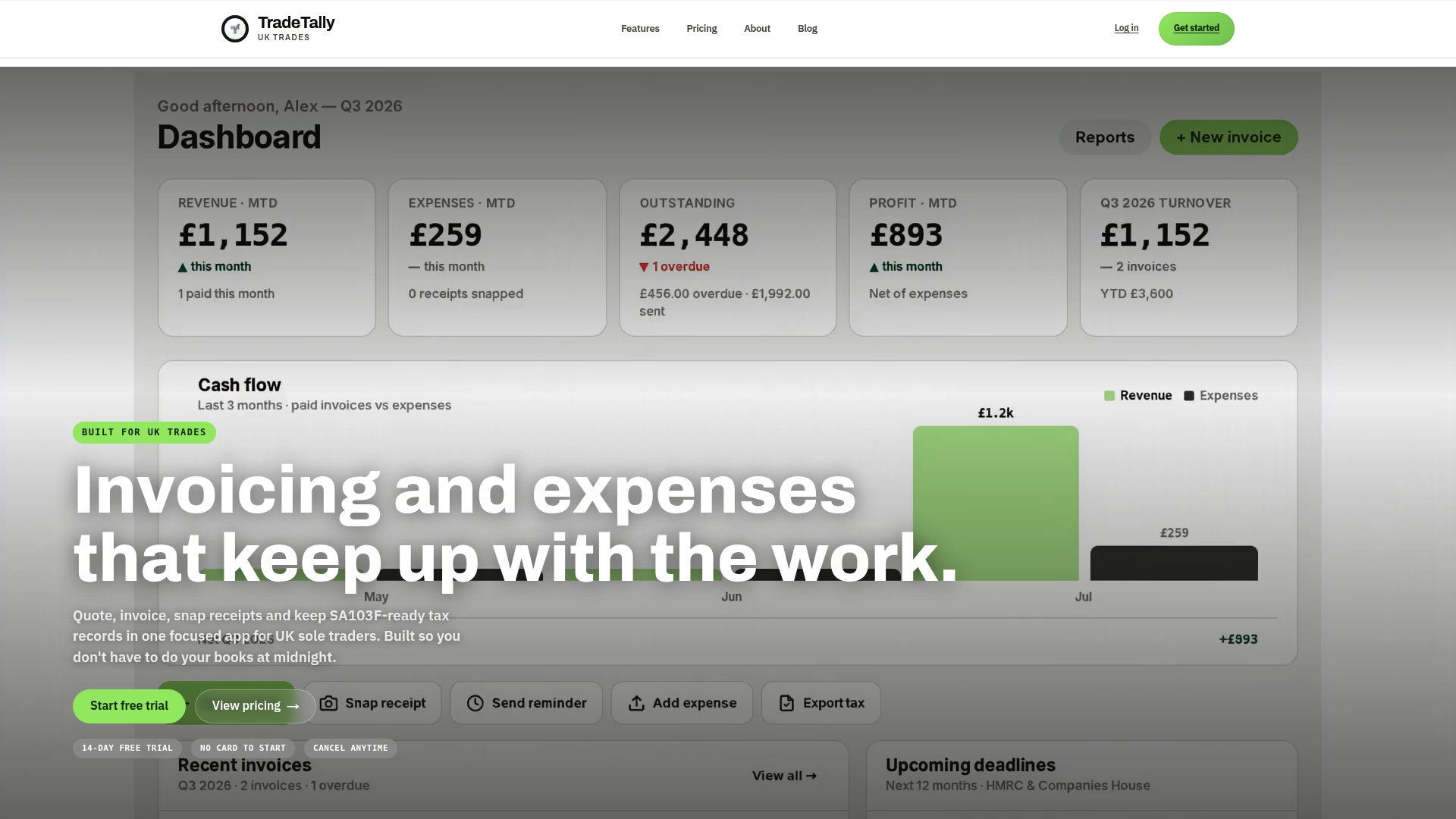
The Starter plan is £0 per month. The Professional plan is £12 per month or £120 per year; see the pricing page for what each includes. If you want a rough idea of what you might owe first, try our Self Assessment tax calculator for sole traders.
A simple yearly routine
A routine this small is enough to keep the pack in shape:
- Weekly (10 minutes): photograph receipts, mark invoices as paid, log any mileage you missed.
- Monthly: check your bank feed or statement against your records, and file CIS statements when they arrive.
- Quarterly: look at your profit figure and set aside money for tax.
- At year end: export your records, add your cover sheet and issues list, and send the pack to your accountant.
FAQ
What is the best way to share records with my accountant?
Use the route your accountant prefers, ideally a secure portal or an export from your bookkeeping software. Add a short cover sheet showing each income source as complete, outstanding or not applicable. This keeps everything in one place and makes it easy to see what is missing.
Do I need to send my accountant every receipt?
Yes, or at least have them available. HMRC does not want the evidence sent with your return, but you must keep it in case it is requested, and your accountant may need to check totals against it. Photos of receipts are usually fine if they are legible.
Does my accountant need access to my HMRC account?
They need to be authorised as your agent before they can deal with HMRC for you. You do this through the 64-8 form or an online route, after you are registered for Self Assessment. Your accountant will normally explain the steps.
Can I claim my accountant’s fees as an expense?
Partly. Accountancy costs for business accounts can be allowable when incurred for business reasons, but the cost of preparing and submitting your personal Self Assessment return cannot be claimed. Ask for your invoice to show the split.
Am I still responsible if my accountant files my return?
Yes. You remain responsible to HMRC for the accuracy of the return. That is why you should check what is filed on your behalf, keep your own records and tell your accountant about anything unusual.
Sources
- Self Assessment tax returns: How to get help, GOV.UK
- 8 ways to make filing your tax return easier, Which?
- Getting ready for Self Assessment, GOV.UK
- Help with self-employment on your Self Assessment tax return, GOV.UK
- Business records if you’re self-employed, GOV.UK
- Authorising an agent to deal with your tax affairs, GOV.UK
- Complete your Self Assessment tax return, GOV.UK
- Using Making Tax Digital for Income Tax for the first time, GOV.UK
- Create digital records, GOV.UK
- Expenses if you’re self-employed: legal and financial costs, GOV.UK
- BIM46450 professional fees, HMRC Business Income Manual
Recommended
Ready to sort your trade admin?
TradeTally gives UK sole traders invoicing, expenses, and SA103F-ready tax exports in one mobile-first app.
Start 14-day Pro trial →No card required