Uniform and Clothing Expenses for UK Sole Traders
If you are a self-employed tradesperson, you can claim the cost of buying, cleaning and repairing protective clothing and genuine work uniform as a business expense. You cannot claim ordinary clothes, even if you only ever wear them on site. That one line settles most cases, but the grey areas (branded polo shirts, jeans, work boots) are where claims go wrong, so this guide goes through them item by item.
TL;DR
- Protective clothing, work-only overalls and aprons, and specialist or uniform clothing are allowable for a sole trader. Everyday clothing is not.
- “I only wear it at work” is not enough. If the item could be worn in normal life, HMRC treats it as everyday clothing.
- The flat-rate uniform allowances you see online are for employees. As a sole trader you claim the actual cost.
- You do not send receipts with your return, but you must keep them and show them if HMRC asks.
- Log each purchase the day you make it. A photo of the receipt in the van is enough to start with.
Table of Contents
- What HMRC lets a sole trader claim
- What you cannot claim
- Quick reference: tradesperson clothing
- Sole traders do not use flat-rate uniform allowances
- How the claim works on your Self Assessment return
- Receipts and records
- Mixed spending and common grey areas
- Perspective: the small claims that get missed
- Keep clothing costs tidy without extra admin
- FAQ
- Sources
What HMRC lets a sole trader claim
The starting point is HMRC’s own page on clothing expenses for the self-employed. It says you can claim for:
- buying, cleaning and repairing protective clothing needed for your trade
- aprons or overalls that you wear only to protect your everyday clothes
- specialist clothing or uniform that is not part of an everyday wardrobe
- costumes for performers
For a tradesperson, that covers a lot of what you actually buy: hi-vis, safety boots, hard-wearing overalls, gloves, knee pads, waterproofs bought for site conditions, and a branded work uniform.
The legal test sits behind this. HMRC’s Business Income Manual explains that clothing needed to perform the duties of the trade can be allowable, and that whether specialist clothing qualifies is a question of fact and degree. It gives a nurse’s uniform and a waiter’s formal “tails” as examples of clothing that is not part of an everyday wardrobe. In other words, the more clearly an item only makes sense on the job, the safer the claim.
Protective clothing, boots and PPE
Protective clothing is the clearest category. If the item exists to protect you from a hazard your trade exposes you to, it belongs here. Typical examples for the trades:
- steel toe-cap safety boots or shoes
- hi-vis jackets and vests
- hard hats, safety glasses, ear defenders and dust masks
- work gloves, welding gear and flame-retardant overalls
- kneeling pads and protective trousers for flooring or roofing work
The same page covers the upkeep as well as the purchase: cleaning, repairing and replacing the item all count. So a replacement pair of boots after the soles have gone, or a stitching repair on your overalls, goes in your expenses as it happens.
Pro tip: keep safety kit as its own category in your records. When you add up the year, one clear total for PPE is easier to explain than a pile of mixed “clothing” entries.
Branded uniform and overalls
A uniform with your business name or logo on it is a stronger claim than a plain version of the same garment, because it is plainly a work item and not something you would choose for a night out. Work-only overalls or aprons that stop your own clothes getting ruined are specifically covered by HMRC’s guidance.
Be realistic about what a logo does, though. It helps your case, but it does not turn a plain everyday garment into allowable clothing by itself. A black T-shirt with a small logo is still a T-shirt that could be worn anywhere, and HMRC may take a different view of it than of a set of embroidered, heavy-duty work overalls. If the garment is borderline, the safer approach is to consider whether you would be comfortable explaining it to an inspector, then decide.
What you cannot claim
HMRC is just as clear on the other side. Everyday clothing such as suits, shirts, dresses and ordinary shoes is excluded, even when you wear it for work.
The reasoning goes back to a long-standing tax case, Mallalieu v Drummond. HMRC’s manual records the rule that clothing forming part of an everyday wardrobe is not deductible even if the trader wears it only for work. HMRC reads the case as meaning that the mere possibility the clothing could be worn privately is decisive. So these are usually refused:
- jeans, joggers and cargo trousers without a protective purpose
- plain polo shirts, T-shirts, hoodies and fleeces
- trainers and ordinary boots
- a suit for meeting clients or quoting
- clothes bought to look smart on a first visit
The common mistake is the argument “I would never wear this at home”. That does not change the answer. The test is about the nature of the item, not your habits.
If you buy something that is partly protective and partly everyday (for example, a pair of boots that are comfortable enough to wear to the pub), the safest position is to claim only if the item is genuinely safety-rated and chosen for the job. Where you cannot say that honestly, leave it out.
Quick reference: tradesperson clothing
This table is a guide to how the HMRC rules usually play out. The final call depends on the specific item and your circumstances.
| Item | Usually allowable? | Why |
|---|---|---|
| Steel toe-cap safety boots | Yes | Protective clothing for site hazards |
| Hi-vis jacket or vest | Yes | Protective, work-specific |
| Work-only overalls | Yes | Protects everyday clothes, not part of a normal wardrobe |
| Branded work uniform (embroidered or heavy-duty) | Usually yes | Specialist or uniform clothing for the trade |
| Gloves, hard hat, glasses, ear defenders | Yes | Protective equipment |
| Cleaning or repairing the above | Yes | HMRC covers upkeep of allowable clothing |
| Jeans or work trousers with no protective function | No | Everyday clothing |
| Plain T-shirt, hoodie, fleece | No | Everyday clothing, even with a logo |
| Ordinary trainers or boots | No | Everyday footwear |
| Suit or smart clothes for client visits | No | Everyday clothing |
Sole traders do not use flat-rate uniform allowances
A lot of search results on this topic talk about a fixed amount, often £60, that you can claim for uniform upkeep. That is the flat-rate expense system, and it is for employees. HMRC’s guidance on uniform and work clothing tax relief lists agreed rates for employees, for example £140 for building joiners and carpenters, £120 for electrical workers generally and £60 where the job is not listed. It also says the self-employed rules are different.
Two points to take from this:
- As a sole trader you claim what you actually spent, on allowable items, and keep the proof. There is no flat sum to fall back on.
- Even for employees, the claim is not a refund of the figure. A £60 claim gives tax relief on £60, which HMRC says is a £12 saving for a 20% taxpayer.
The employee rules are also stricter in one respect. HMRC says employees cannot claim the initial cost of buying clothing for work, only cleaning, repairing or replacing it. A sole trader, by contrast, can claim the purchase of allowable protective clothing. If you used to work as an employee and are used to the old rules, this is one of the things that changed when you went self-employed.
How the claim works on your Self Assessment return
Allowable expenses come off your profit before Income Tax is worked out. HMRC’s example is simple: £40,000 turnover less £10,000 allowable expenses leaves £30,000 taxable profit. So a £90 pair of safety boots does not cut your tax bill by £90. It reduces your taxable profit by £90, and the saving is that amount multiplied by your tax rate.
To claim:
- Record the purchase in your books with the date, supplier, amount and what it was.
- Add up the year’s clothing costs, kept separate from other expenses.
- Enter the total in the relevant expenses box on your Self Assessment return. HMRC says you report allowable expenses for the tax year on the return.
TradeTally’s Self Assessment export is built around the SA103F self-employment (full) pages, so the totals are already grouped the way the return asks for them.
One check before you claim anything: HMRC says the £1,000 trading allowance cannot be used together with claiming expenses. If your total expenses are small, compare the two routes. Most tradespeople with vans, tools and materials are far above that line, but a part-time sole trader might not be.
Receipts and records
You do not post receipts to HMRC with your return. HMRC’s guidance says to keep records of your business expenses as proof and show them if asked. That puts the burden on you if there is ever a check: no receipt, no easy defence.
For clothing, a useful record has:
- the receipt or invoice, or a clear photo of it
- the date and supplier
- a short note of what the item is and why the job needs it (“S3 safety boots, site work”)
- the tax year it belongs to
That note matters more for clothing than for most expenses, because clothing is one of the categories HMRC looks at closely. A line that says “boots, steel toe-cap, new build site” answers the obvious question before anyone asks it.
How long to keep it all is covered in our Self Assessment records checklist. If your receipts live in a glovebox or a carrier bag, capturing records on site is the habit that fixes it.
Mixed spending and common grey areas
Work boots you also wear at weekends. If they are safety boots chosen for site work, the protective purpose is the point. If they are ordinary boots that happen to be tough, expect resistance. Our guide on splitting personal and business expenses goes into how to treat items that serve both.
Laundry. Cleaning allowable work clothing is allowable. Cleaning everyday clothes is not. If you wash your overalls at home, a reasonable approach is to keep a sensible, consistent record of what you charge and why, rather than inventing a figure at year end.
Clothing bought for the whole team. If you have subcontractors or employees, the position changes, because uniform provided to staff has its own rules for the employer. This guide is for you as a sole trader buying for yourself.
Gifts and freebies. A free branded jacket from a supplier has no cost to claim. Do not record an expense for something you did not pay for.
Items that fail the test. Do not hide them in another category such as “materials” or “sundries”. Mislabelled expenses are a bigger risk than a missed claim.

Perspective: the small claims that get missed
We built TradeTally because the admin that follows a day on site is where money quietly disappears. Clothing is a good example. Nobody sets out to forget a £70 pair of boots or a £25 hi-vis, but if the receipt goes in a pocket and the pocket goes through the wash, the claim is gone.
Our view is that the tax rule is the easy part. The hard part is the habit. Most tradespeople we hear about do not lose money by claiming too little on one big item. They lose it through a dozen small ones across the year. Equally, the sole traders who get into trouble are rarely the ones who claim boots and PPE. They are the ones who push ordinary clothes through because the amount looked small.
So we suggest a simple rule: if you can name the hazard or the trade reason in one short sentence, claim it and write the sentence in the note. If you cannot, do not. And take the photo at the till, not at the end of the month.
— Simon
Keep clothing costs tidy without extra admin
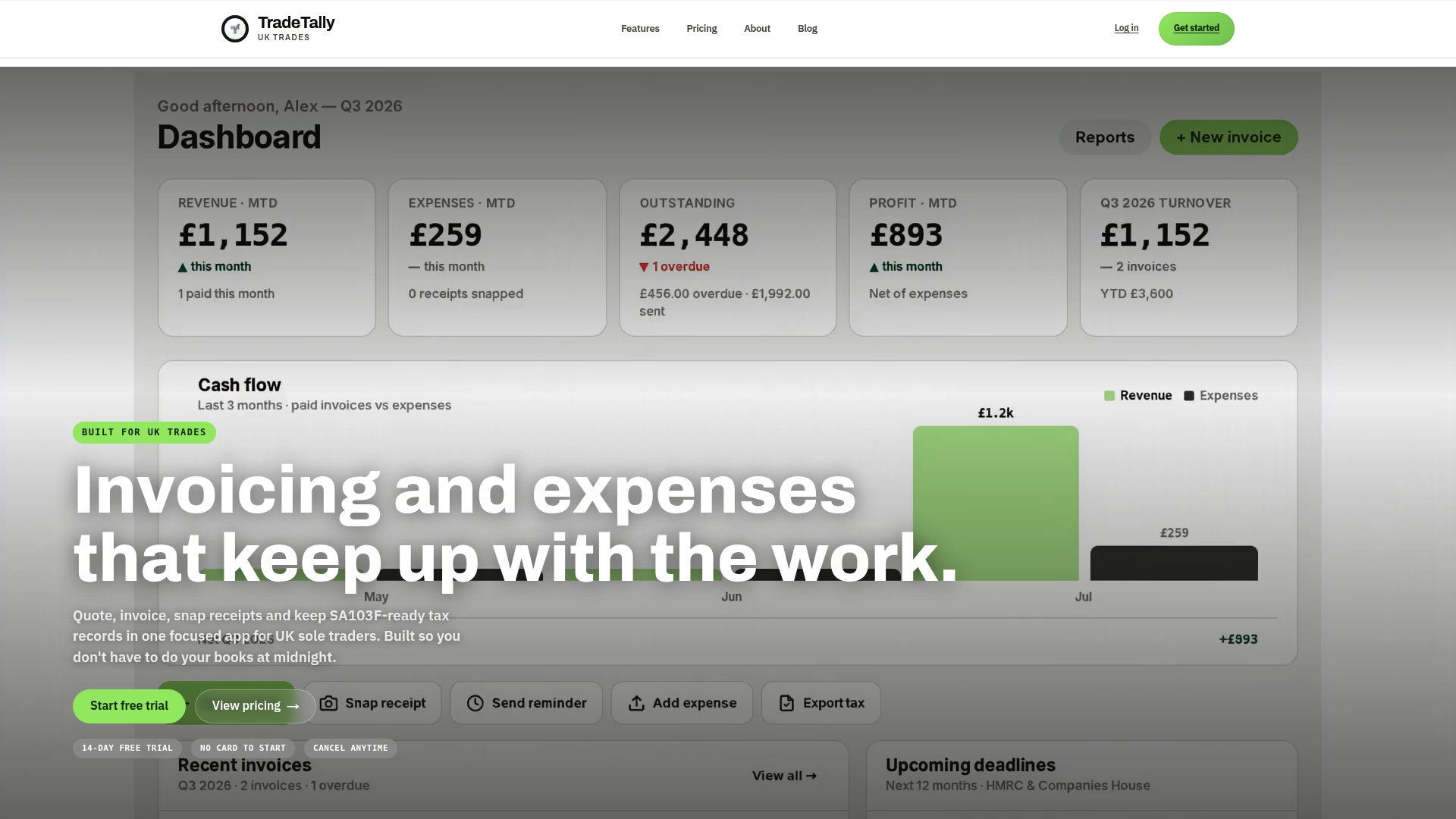
TradeTally is a web and mobile app for UK sole traders. You snap the receipt, give it a category, and it sits in your records ready for your tax return. Clothing and PPE can have their own category so the yearly total is already there when you need it, and the records export in a format built around SA103F.
Starter is free, with limited invoicing. Professional is £12 per month, or £120 per year, for unlimited invoices, receipts and tax exports. You can see the plans on the pricing page.
If you want a wider view of how to organise everything you spend, our expense tracking guide for UK sole traders and the piece on tracking job expenses are good next steps. If you also run a van, see vehicle expenses for sole traders. To see roughly what your expenses do to your bill, try the Self Assessment tax calculator.
FAQ
Can a sole trader claim work trousers and T-shirts?
Usually not. HMRC excludes everyday clothing from sole trader claims, and plain trousers and T-shirts fall into that group even when you only wear them to work. Items with a genuine protective function, such as flame-retardant or reinforced trousers, are treated differently.
Can I claim safety boots as a self-employed tradesperson?
Yes, if they are protective footwear needed for your work. HMRC allows the cost of buying, cleaning and repairing protective clothing for your trade. Keep the receipt and note what the boots are for.
Can I claim the £60 flat-rate uniform allowance?
No. Flat-rate expenses are agreed rates for employees, and HMRC says the rules for the self-employed are different. As a sole trader you claim the actual cost of allowable items and keep your records.
Do I need to send receipts to HMRC?
No, they do not normally go in with your Self Assessment return. You must keep accurate records, though, and show them if HMRC asks. Without proof, a claim is hard to defend.
Does a logo make clothing allowable?
It helps show the item is a work uniform, but it does not guarantee the claim. A plain everyday garment with a logo can still be treated as everyday clothing. Specialist, protective or work-only items are the safer claims.
Sources
- Expenses if you’re self-employed: Clothing expenses, GOV.UK
- BIM37910: Wholly and exclusively, HMRC Business Income Manual
- Check how much tax relief you can claim for uniforms, work clothing and tools, GOV.UK
- Claim tax relief for your job expenses: Uniforms, work clothing and tools, GOV.UK
- Expenses if you’re self-employed: How to claim expenses, GOV.UK
- Expenses if you’re self-employed: Overview, GOV.UK
Recommended
Ready to sort your trade admin?
TradeTally gives UK sole traders invoicing, expenses, and SA103F-ready tax exports in one mobile-first app.
Start 14-day Pro trial →No card required