Tradespeople, stop overpaying on vehicle expenses as a sole trader

Yes, as a UK sole trader you can claim vehicle costs that are wholly and exclusively for business. You do this either by using HMRC’s simplified mileage rates (55p per mile for the first 10,000 business miles, 25p after that, from 6 April 2026) or by claiming the business proportion of your actual running costs. The method you pick is generally fixed per vehicle, so it is worth getting the decision right and keeping proper records from day one.
TL;DR:
- Claiming vehicle costs as a sole trader is limited to wholly business journeys; commuting from home or a permanent site is not allowable.
- The 2026 simplified mileage rate is 55p per mile for the first 10,000 miles, then 25p afterward, while actual costs involve detailed record-keeping and apportionment.
- Capital allowances benefit high-value vans and commercial vehicles, whereas low-mileage, low-cost cars often save more with the flat mileage rate.
- VAT-registered traders can reclaim VAT on repairs, servicing, and parking but rarely on vehicle purchase unless used exclusively for business.
- Accurate, contemporaneous records of miles driven and receipts are essential to substantiate claims and avoid penalties or disallowed expenses.
Table of Contents
- What vehicle costs you can claim as a sole trader
- Simplified mileage (flat-rate) method explained
- Actual-costs method and capital allowances
- VAT and motoring costs for VAT-registered sole traders
- Record-keeping: mileage logs and evidence HMRC expects
- How to choose between simplified mileage and actual costs
- How vehicle expenses affect your taxable profit and tax bill
- Handling mixed-use vehicles: business and personal driving
- Lease vehicles and hire purchase: what you can claim
- Electric vehicles and emissions-linked rules
- A tradesperson’s take on mileage versus actual costs
- Keeping your vehicle records tax-ready with TradeTally
- FAQ
- Sources
What vehicle costs you can claim as a sole trader
HMRC’s own guidance on car, van and travel expenses sets out a fairly generous list of what counts, provided the journey itself is for business. The costs below are allowable whether you use simplified mileage or actual costs, though how you calculate them differs between the two methods.
- Fuel, vehicle insurance, servicing, repairs and MOT
- Vehicle tax, breakdown cover and hire or lease charges
- Parking charges incurred on a business journey
Tolls, the congestion charge and ULEZ charges are treated as incidental travel costs rather than motoring expenses in the strict sense, but they are still claimable when the trip itself was for business, and you record them separately from your mileage or running-cost figures.
The trickier area for tradespeople is commuting. Ordinary travel from home to a permanent workplace is not allowable, full stop, even if you are carrying tools and materials. A site that counts as your regular base, typically one you work at continuously for more than two years, usually falls under the same rule. Travel between jobs, to merchants’ yards, or to a genuinely temporary site is different and normally qualifies.
Simplified mileage (flat-rate) method explained
Simplified expenses let you skip itemising every fuel receipt and instead claim a flat rate per business mile. From 6 April 2026, HMRC’s increase to the simplified mileage rate sets this at 55p per mile for the first 10,000 business miles in the tax year, dropping to 25p per mile after that. It applies to cars, vans and motorcycles, with a separate rate for motorcycles.
- The rate is designed to cover fuel, insurance, servicing, repairs and depreciation in one figure, so you do not add these costs on top.
- Incidental costs such as parking, tolls and congestion charges are not included in the rate and can be claimed separately.
- Once you choose simplified mileage for a particular vehicle, HMRC expects you to keep using it for that vehicle, and BIM75005 confirms you cannot then also claim capital allowances on it.
That last point is permanent. If you later want to claim capital allowances on the same vehicle, you cannot switch back once you have used the flat rate for it.
Actual-costs method and capital allowances
The alternative is to total up everything the vehicle actually cost you over the year, fuel, insurance, servicing, repairs, tax and finance charges, and then apportion that total by the share of your mileage that was for business.
- Keep every receipt and work out your business-use percentage from a mileage log, then apply that percentage to the total cost.
- If you buy a vehicle outright, you may be able to claim capital allowances on the purchase, either the annual investment allowance for vans and commercial vehicles or a writing-down allowance for cars, again apportioned for private use.
- Say a van cost £18,000 and you use it 90% for business. Actual running costs plus a capital allowance claim on the purchase price will usually beat the mileage rate in the early years, because the mileage rate has to cover depreciation inside a flat 55p or 25p figure.
- For an older, cheap-to-run car used mainly for business, actual costs rarely pull ahead once you have deducted the time spent itemising everything.
Capital allowances tend to favour higher-value vans and specialist vehicles bought for the business, while low-mileage, low-value cars often do better under the flat rate.
VAT and motoring costs for VAT-registered sole traders
If you are VAT-registered, the rules shift slightly. HMRC’s Notice 700/64 on motoring expenses sets out what you can and cannot reclaim.
- VAT on repairs, servicing and off-street business parking can generally be reclaimed in full, provided the vehicle is used for the business.
- VAT on buying a car is almost always blocked unless the car is used exclusively for business with no private use at all, which is a high bar to clear.
- Where fuel has any private use, you either apportion the VAT reclaim to match business mileage or apply the fuel scale charge, a flat adjustment that accounts for private fuel use.
- For full detail on fuel apportionment and the scale charge tables, the notice itself is the reference point, and our guide to fuel cost claims walks through the sums in practice.
Record-keeping: mileage logs and evidence HMRC expects
None of this matters if you cannot back it up. HMRC’s guidance on self-employed expenses expects a contemporaneous mileage log, not a reconstruction done the week before your return is due, and records need keeping for six years in case of an enquiry.
- Date, start and end points, purpose of the journey and miles driven, for every business trip.
- A split for mixed journeys: if you call at the builders’ merchant on the way to a job, note the extra miles as business and the rest as you normally would.
- If you use actual costs, keep every fuel receipt, insurance renewal and invoice from the garage, filed by tax year.
- Photograph receipts as you get them rather than stuffing them in the glovebox, and log the mile count and purpose while you are still parked outside the job.
Pro Tip: Note the job reference or client name against each mileage entry at the time, not later. It turns a vague log into solid evidence if HMRC ever asks.
Our guide to HMRC mileage claims has templates if you want a starting point for a log that will stand up to scrutiny.
How to choose between simplified mileage and actual costs
There is no single right answer, it depends on the vehicle and how you use it. A short checklist helps.
- Estimate your annual business mileage as accurately as you can, even a rough log from the last few months gives a usable figure.
- Run the sums both ways: flat rate against business-apportioned actual costs plus any capital allowance you would be entitled to claim.
- Decide whether you want the option to claim capital allowances on this vehicle in future, because choosing mileage closes that door for good.
- Be honest about whether you will keep the paperwork actual costs demand, a method you cannot sustain is not really a saving.
As a rough guide, mileage tends to suit cheaper vehicles and moderate annual mileage, while actual costs with capital allowances tend to suit newer or higher-value vans and heavier business use. Whichever you pick, it is usually locked in for that vehicle for as long as you own it.
How vehicle expenses affect your taxable profit and tax bill
Every pound of allowable vehicle expense reduces your taxable profit pound for pound, which in turn reduces both the Income Tax and Class 4 National Insurance you owe on your self-employment income. For a trade where fuel, van finance and servicing are a genuine chunk of outgoings, getting this claim right can move the needle noticeably on your final bill.
The effect compounds with how your other allowances and reliefs stack up, so a vehicle claim does not exist in isolation. If you are close to a tax band threshold, an extra few hundred pounds of properly claimed vehicle costs can shift income out of a higher rate, not just reduce the amount taxed at the rate you are already paying. Under-claiming because you lost receipts or did not log miles consistently has the opposite effect: you pay tax on profit you never actually kept.
The reverse risk matters too. Over-claiming, whether by including commuting miles or forgetting to apportion for private use, creates an understated tax bill that HMRC can challenge on review, with interest and penalties on top of the correction. Because the mileage method and the actual-costs method produce genuinely different totals for the same vehicle and mileage pattern, it is worth running both calculations before you file rather than defaulting to whichever feels simpler. Our tax calculator gives a quick way to see how a change in your vehicle claim shifts your estimated Self Assessment liability before you submit anything.

Handling mixed-use vehicles: business and personal driving
Most sole traders use the same vehicle for work and for everything else, the school run, the weekend shop, visiting family. That is completely normal, but it means every claim has to be apportioned rather than claimed in full.
Under simplified mileage, apportionment happens automatically because you only log and claim business miles in the first place, private trips simply are not counted. Under actual costs, you need a business-use percentage, typically business miles divided by total miles for the year, and you apply that percentage to every cost: fuel, insurance, servicing, the lot. If you drove 12,000 miles in the year and 8,000 were for business, your business-use percentage is roughly two-thirds, and that is the proportion of each bill you claim.

The percentage needs reassessing each year rather than assumed to be static, since work patterns and personal driving both change. It also needs to be defensible: a log that shows business mileage trip by trip supports the percentage far better than an estimate worked out at year end. Get the split wrong, whether through optimism or carelessness, and you risk a disallowed claim if HMRC asks to see how the figure was reached.
Lease vehicles and hire purchase: what you can claim
Leasing or financing a van rather than buying outright changes how the costs flow through your accounts, though the underlying principle, wholly and exclusively for business, still applies.
For a straightforward lease or contract hire agreement, the monthly payments are generally treated as a running cost and claimed as an expense, apportioned for any private use in the same way as fuel or insurance. You are not buying an asset, so capital allowances do not come into it. The lease payment itself is the deductible figure.
Hire purchase works differently because you are gradually acquiring ownership. The vehicle is usually treated as a capital asset from the start, meaning you may be able to claim capital allowances on its value, while the interest element of the finance payments is claimed separately as a running cost. This is one of the more fiddly areas of vehicle expenses, and the SA103F notes referenced in the official Self Assessment guidance set out how capital and interest elements should be separated. If you are using simplified mileage for a hire purchase vehicle, remember that the flat rate still rules out a capital allowance claim on it, so the finance structure does not override the per-vehicle restriction.
Electric vehicles and emissions-linked rules
Government policy on vehicle emissions increasingly shapes what you can claim, and electric and low-emission vehicles are treated more generously in several respects. Capital allowances for fully electric vans and cars have historically been more favourable than for higher-emission equivalents, reflecting a push to encourage cleaner fleets among the self-employed and small businesses.
Running-cost treatment for electric vehicles broadly follows the same wholly-and-exclusively principle as a petrol or diesel vehicle: charging costs, servicing, insurance and tax are claimable in the same way fuel and maintenance are for a combustion vehicle, apportioned for private use if the vehicle is mixed-use. Where charging happens at home, working out the business share of the electricity cost is less straightforward than reading a fuel receipt, so a consistent, documented method for estimating business charging costs matters if you want the claim to hold up.
Emissions-based restrictions can also work against you, since vehicles over certain emissions thresholds have historically faced reduced capital allowance rates compared with cleaner alternatives. If you are weighing up a new van or company car purchase, it is worth checking the current capital allowance rate for the specific vehicle’s emissions band before assuming the figures from a previous tax year still apply, because these thresholds do shift.
A tradesperson’s take on mileage versus actual costs
Most tradespeople we talk to default to the mileage rate because it is simpler, and for a modest car doing moderate miles, that is often the right call. But if you are running a decent van with real finance or purchase costs behind it, actual costs with capital allowances can be worth the extra admin, especially in the early years of ownership.
The real risk is not picking the wrong method, it is picking either method and then failing to log journeys properly as you go.
— Simon
Keeping your vehicle records tax-ready with TradeTally
Whichever method you use, the admin tends to pile up fastest from the cab of a van between jobs, which is exactly when it is easiest to let it slide.
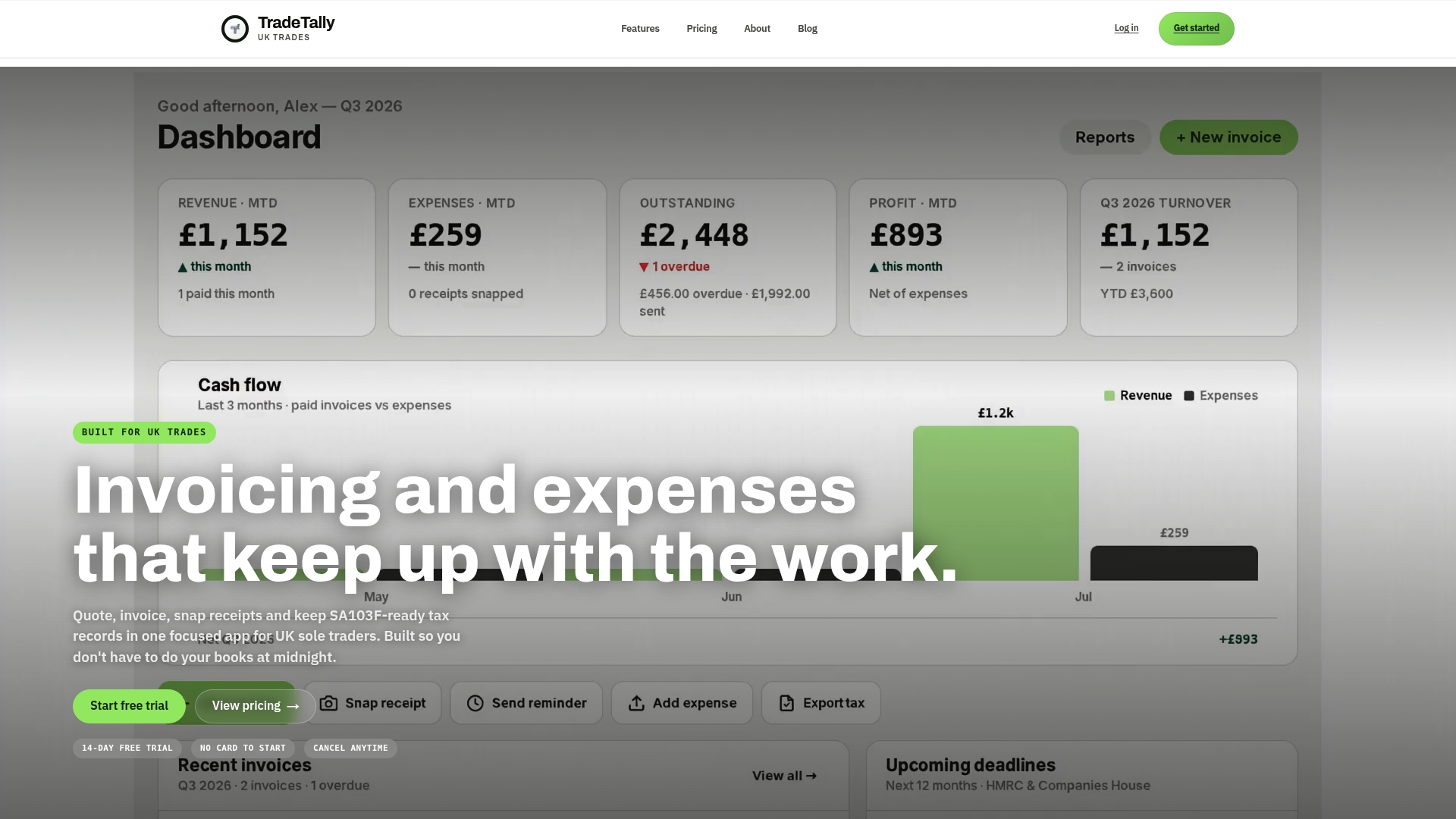
- Log mileage and business journeys as you drive between sites, so the record exists before you forget the details.
- Snap receipts for fuel, servicing and repairs the moment you get them, instead of hoping the glovebox pile survives until January.
- Export records formatted for SA103F, so your vehicle expenses land in the right boxes without manual reformatting at tax time.
We offer a free Starter plan for basic invoicing, and a Professional plan at £12 per month or £120 per year for unlimited invoices, receipts and tax-ready exports. If you want to see how it fits your trade, get started with TradeTally and set up mileage and receipt tracking before your next job.
FAQ
Can I claim a car as a business expense as a sole trader?
Yes, if you use the car for business journeys, you can claim either through simplified mileage or by claiming the business proportion of actual running costs. The 2026 simplified rate is 55p per mile for the first 10,000 business miles, dropping to 25p after that.
What is the 40,000 car tax rule?
This is often confused with vehicle expenses, but it actually refers to the Vehicle Excise Duty expensive car supplement on new cars priced above a high threshold, which is a separate matter from claiming business motoring costs on Self Assessment. It does not change how sole traders claim running costs or mileage.
Can I claim 45p per mile as a sole trader?
From 6 April 2026 HMRC’s simplified mileage rate increased to 55p per mile for the first 10,000 business miles, with 25p per mile after that. Use the current rate for any claim covering the 2026/27 tax year.
What is the most tax efficient way to buy a car as a sole trader?
There is no single answer, it depends on the vehicle’s cost, your mileage and whether you want to claim capital allowances. Lower-cost, lower-mileage vehicles often suit simplified mileage, while higher-value vans with heavy business use often do better under actual costs with capital allowances, so running both calculations before you commit is the safest approach.
Sources
- Increase to Approved Mileage Allowance Payments (AMAPs) and self employed simplified mileage rates
- SA103F notes (HMRC) — boxed guidance on vehicle and travel costs
Recommended
Ready to sort your trade admin?
TradeTally gives UK sole traders invoicing, expenses, and SA103F-ready tax exports in one mobile-first app.
Start 14-day Pro trial →No card required