CIS safe time and materials invoicing for UK trades

Time and materials invoicing charges a client for the actual hours worked and the actual cost of materials used, usually with an agreed markup on materials and sometimes a not-to-exceed ceiling. It’s the right model when the scope of a job can’t be pinned down at the outset, such as reactive repairs, renovations that might reveal hidden problems, or ongoing maintenance work. The safeguard that makes it defensible is simple: contemporaneous timesheets, signed off by the client as you go.
TL;DR:
- Time and materials invoicing is most suitable for jobs with uncertain scope, such as reactive repairs, renovations, and ongoing variable workload contracts.
- Accurate record-keeping, including signed timesheets, detailed dayworks, and photographic receipts, is essential for compliance and dispute prevention.
- Invoices must itemize labour and materials separately, include a unique reference, and adhere to HMRC standards with VAT and CIS-specific fields.
- Setting clear rates, markup percentages, and not-to-exceed ceilings upfront helps prevent disputes and ensures fair billing practices.
- Using specialized invoicing tools like TradeTally can streamline on-site data capture, CIS compliance, and facilitate year-end audit preparation.
Table of Contents
- What is time and materials invoicing and when should you use it?
- How T&M invoicing works in practice: rates, markups and dayworks
- What should a T&M invoice include for UK compliance?
- How do you avoid disputes and get paid faster on T&M work?
- Setting rates, markups and payment terms fairly
- What does a T&M invoice actually look like?
- How TradeTally puts these controls into practice on site
- Priorities and the three mistakes I see most often
- TradeTally: built for T&M invoicing on the move
- Sources
- FAQ
What is time and materials invoicing and when should you use it?
Time and materials invoicing sits between two other pricing models. Fixed-price work quotes a single figure for a defined scope, which suits jobs where you can measure and specify everything upfront, like fitting a known number of kitchen units. Cost-plus invoicing charges actual costs plus a fee, often used on larger commercial contracts with open-book accounting. Time and materials (T&M) invoicing bills labour hours at an agreed rate and materials at cost plus a markup, which makes it the natural fit when nobody can say for certain what the job will involve.
You’ll see T&M used most often in:
- Emergency repairs and reactive maintenance, where diagnosis happens on site
- Renovation and refurbishment work, where opening up walls or floors can reveal surprises
- Ongoing service contracts with variable monthly workloads
- Any job where the client wants flexibility but needs cost visibility
Most well-run T&M arrangements include a not-to-exceed (NTE) ceiling and a variation control process, so costs don’t run away from either party.
How T&M invoicing works in practice: rates, markups and dayworks
Turning site work into a clean invoice comes down to five habits, done consistently rather than perfectly.
- Agree and document labour rates by role before work starts, ideally in the contract. A qualified electrician’s rate differs from an apprentice’s, and both should be written down, not assumed.
- Record dayworks properly. A dayworks sheet lists the operative, hours, plant used, and materials consumed for that day, signed by whoever is on site for the client.
- Log material costs with the markup already agreed. If your standard markup is 15% on trade price, apply it consistently and keep the supplier invoice as backup.
- Set a not-to-exceed ceiling where possible, and agree a threshold (say, 10% over estimate) that triggers a client approval conversation before you carry on.
- Keep gang sheets and plant hire notes as supporting evidence, filed against the job reference, not loose in a van.
Pro Tip: Photograph delivery notes and receipts the moment they land on site. A blurry photo taken three weeks later, from memory, is worth far less than a sharp one taken on the day.
None of this needs to be complicated. It just needs to happen every day, not retrospectively at invoice time when memories have already faded.
What should a T&M invoice include for UK compliance?
An invoice that satisfies HMRC and keeps a Construction Industry Scheme (CIS) contractor happy needs specific fields, not just a total figure. Keeping VAT records sets out what HMRC expects to see, and it’s worth building your invoice template around this list rather than reinventing it.
Your invoice should include:
- A unique, sequential invoice number
- Your business name, address and VAT number (if registered)
- The client’s name and address
- The date of supply (tax point) and invoice date
- A description of the work, itemised by labour and materials
- The net amount, VAT rate applied, and VAT amount
- Payment terms and bank details
Splitting labour and materials onto separate lines matters more than it might seem. Under CIS rules, deductions apply only to the labour element of a subcontractor’s invoice, so lumping everything into one figure risks HMRC querying, or a contractor over-deducting, tax from materials that were never liable in the first place, according to CIS340 guidance.
If you’re VAT-registered, Making Tax Digital for VAT requires digital record-keeping compatible with HMRC’s systems, and invoice records must be retained for at least six years. Keep delivery notes, supplier invoices, and signed timesheets as your evidence trail. Plant hire and fuel used directly on the job usually count as materials for CIS purposes, while travel and subsistence generally don’t and should sit on their own line.
Our guide on what a sole trader invoice must include walks through each field in more depth if you’re setting up a template from scratch.
How do you avoid disputes and get paid faster on T&M work?
Most T&M disputes trace back to the same root cause: the client is surprised by the bill. Fix the surprise and you fix most of the argument.
- Run a weekly or fortnightly sign-off cadence. Get the client (or their site rep) to sign the timesheet and dayworks sheet before you leave, or at worst within a few days. A signature dated the same week carries far more weight than one chased a month later.
- Present variations as they happen, not at invoice stage. A short written note, even a text message with a photo, describing the extra work and its likely cost, gives the client a chance to say yes or no before the cost is sunk.
- Set sensible payment terms. Fortnightly or monthly invoicing on longer jobs keeps cash moving and limits how much exposure builds up before a dispute surfaces. A modest deposit on larger jobs is normal; asking for more than half upfront tends to raise flags with clients and can weaken your position if things go wrong later.
- Use your contract’s late payment clauses. Late Payment of Commercial Debts legislation lets you charge statutory interest and a fixed compensation sum on overdue commercial invoices, and having this written into your contract makes chasing payment less awkward.
Pro Tip: Send a short “week in review” message to the client alongside the signed timesheet. It takes two minutes and closes off any ambiguity about what happened, and when.
Setting rates, markups and payment terms fairly
Pricing T&M work well means being transparent enough that the client can’t reasonably dispute the numbers later, while still covering your overheads properly.
- Build your hourly or daily rate from your wage cost, plus a share of overheads (van, insurance, tools, admin time), plus profit. A rate that only covers wages will erode your margin the moment a job overruns.
- Choose a markup model for materials and state it upfront. A flat percentage (commonly 10 to 20%) is simplest for clients to understand; a fixed handling fee per delivery works better on jobs with few, large-ticket items.
- Keep deposits proportionate. Consumer protection guidance treats very large upfront deposits as a red flag, and moderate deposits with stage payments tend to be far more defensible if a dispute ever reaches adjudication.
- Write your NTE ceiling into the contract, not just the quote email. It shapes behaviour on both sides: the client stops worrying about a runaway bill, and you have a clear trigger point for raising a variation.
A written contract that spells out scope, payment terms and variation procedure protects you more than any invoice template can on its own, as professional construction marketing advice makes clear.
What does a T&M invoice actually look like?
A worked example makes the labour/materials split concrete. Say a subcontractor completes three days of work for a contractor operating CIS deductions at the standard the standard CIS rate

The CIS deduction applies only to the £660 labour line, never to the materials, which is exactly why the split matters so much on the invoice itself. Reference the delivery note number directly on the materials line, and attach the supplier invoice as backup if the contractor’s accounts team asks for it.
A few habits make life easier at review time:
- Number invoices sequentially, ideally with the job reference embedded (e.g. INV-0234-JOBREF)
- Attach both a PDF and the source file (spreadsheet or invoicing app export) where the client’s accounts system allows it
- Keep a copy of the signed timesheet alongside the invoice, not filed separately
How TradeTally puts these controls into practice on site
Most of the controls above only work if they’re easy to do in the moment, not something you catch up on after dark with a cold cup of tea. That’s the gap TradeTally is built to close for sole traders and small gangs.
- Branded invoices with labour and materials tagged separately, so the CIS split happens automatically rather than being reconstructed at month end.
- CIS-aware entries that apply deductions to labour only, reducing the risk of over-deducting on materials.
- Mobile receipt snapping, so a delivery note photographed on site links straight to the job and the invoice line it supports.
- SA103F export, turning a year of jobs into a Self Assessment-ready summary rather than a shoebox of paper in January.
The result is a live audit trail: timesheet, receipt, and invoice line all tied to the same job reference, built as the work happens rather than reassembled from memory.
Priorities and the three mistakes I see most often
Choose T&M when scope is genuinely uncertain, fixed-price when it isn’t. The three recurring failures are: not splitting labour and materials on the invoice, missing client sign-off on timesheets, and treating variations as a conversation to have later rather than now. Fix those three and most T&M disputes disappear before they start.
— Simon
TradeTally: built for T&M invoicing on the move
There are other ways to handle T&M billing: a spreadsheet, a general accounting package, or a folder of paper timesheets in the glovebox. All of them work until the job gets busy, at which point the labour/materials split gets fudged and the receipt trail goes missing. There are apps built to manage branded invoices with labour and materials tagged from the start, CIS-aware fields that apply deductions correctly, and receipt snapping features to keep your evidence trail intact without an evening of admin.
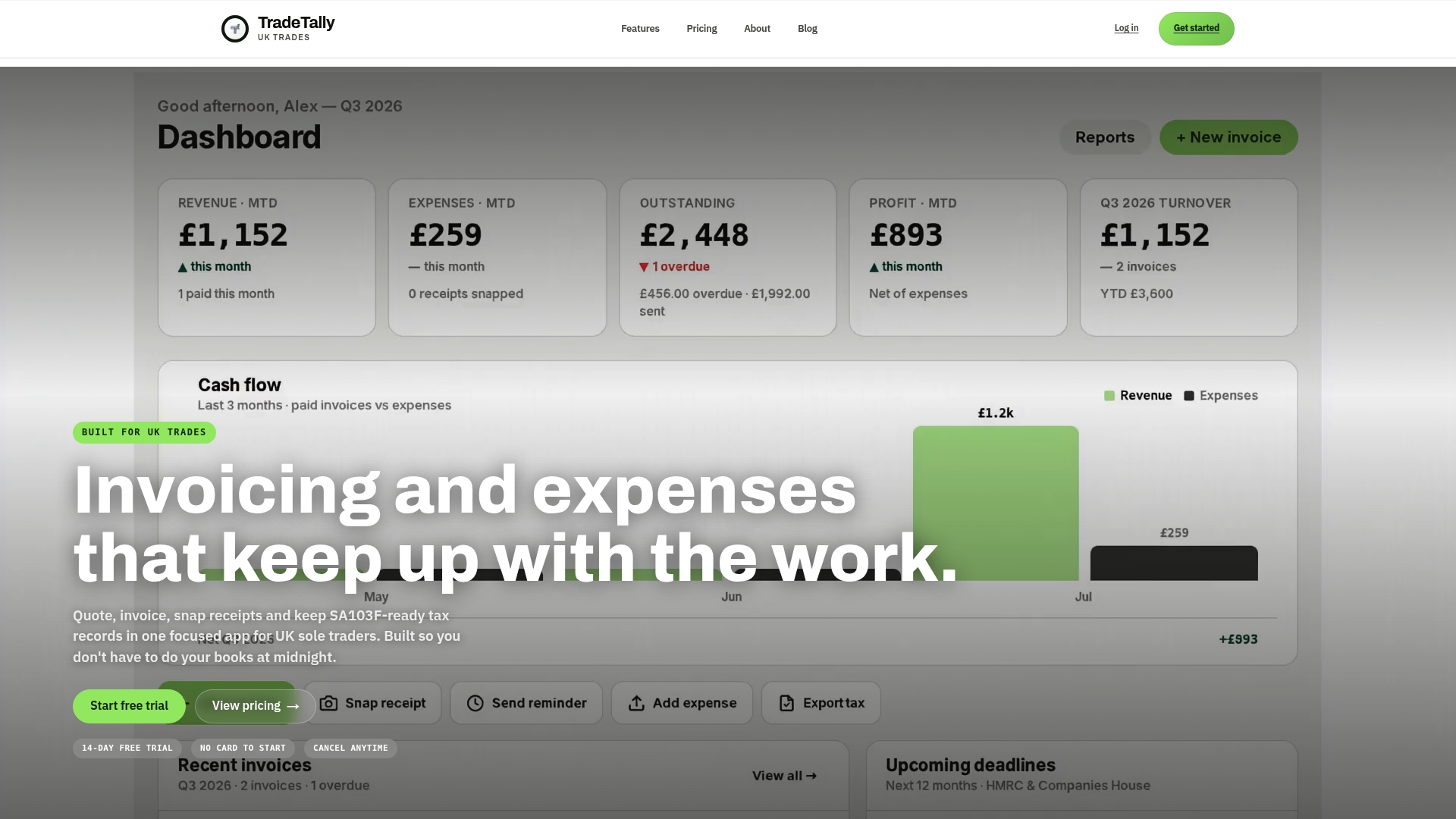
It suits sole traders and small gangs across the trades, plumbers, electricians, carpenters, and builders alike, where jobs regularly involve a mix of hours and materials and where producing a clean SA103F export at year end can save time. If you’re a builder running T&M jobs, take a look at the invoicing tools built for builders and see how the workflow fits your own site routine.
FAQ
How do you charge for time and materials?
You bill actual hours at an agreed rate per role, plus the cost of materials with an agreed markup, itemised separately on the invoice so CIS deductions and VAT apply correctly to each element.
What is the T&M billing model?
Time and materials billing charges a client for verified labour hours and material costs, rather than a single fixed sum, and typically includes a not-to-exceed ceiling to control cost overruns.
Is T&M cost reimbursable?
T&M invoicing reimburses actual costs incurred, labour time and materials, usually with an agreed markup on materials, which distinguishes it from fixed-price work where the price is set regardless of actual cost.
Can you give an example of a time and materials contract?
A typical example is a reactive maintenance contract where a contractor bills three days of labour at a daily rate, plus materials from a delivery note with a an agreed markup (commonly a flat percentage) on materials, with CIS deducted from the labour line only, as shown in the worked example above.
Does a T&M invoice need a not-to-exceed clause?
It isn’t a legal requirement, but a not-to-exceed ceiling written into the contract gives both parties a clear trigger point for approving extra cost before work continues, and it materially reduces disputes over final bills.
Recommended
Ready to sort your trade admin?
TradeTally gives UK sole traders invoicing, expenses, and SA103F-ready tax exports in one mobile-first app.
Start 14-day free trial →