55p per mile: UK sole traders' mileage log template and HMRC rules
55p per mile: UK sole traders’ mileage log template and HMRC rules

HMRC requires a contemporaneous mileage record that shows the date, the business purpose and the start and finish postcodes for every business journey. Without that, you risk having claims disallowed. The 2026 simplified mileage rates now sit at 55p per mile for cars and vans, so it pays to start or check your log today.
TL;DR:
- Mileage logs must be kept contemporaneously, including the date, purpose, start and finish postcodes, and miles for each journey to avoid disputes or disallowance.
- Using apps that automatically timestamp and record postcode data provides the most reliable evidence for HMRC, while manual logs should be backed with clear, timely entries.
- The 2026 mileage rate for cars and vans is 55p per mile for up to 10,000 miles, then 25p after, making actual costs worth comparing for higher annual mileages.
- Records should be retained for at least five years after the tax submission deadline in case of HMRC audits or inquiries.
- Choosing a simple, daily logging habit—such as entering details before or immediately after each trip—significantly improves compliance and audit readiness.
Table of Contents
- What HMRC requires from a mileage log: fields, format and retention
- A practical log template and example entries tailored to sole traders
- AMAPs and simplified mileage vs claiming actual running costs: the 2026 change explained
- How to keep contemporaneous records: practical tools and daily workflows for tradespeople
- Common mistakes and red flags that lead to rejected or queried mileage claims
- Why a boring daily habit beats a clever system
- How TradeTally can help sole traders keep HMRC-ready mileage records
- Sources
- FAQ
What HMRC requires from a mileage log: fields, format and retention
HMRC does not hand you a template, but its own internal guidance is clear about what a compliant record must contain. According to HMRC’s simplified expenses manual, a valid log needs:
- The date of the journey
- The business purpose, ideally with a client or site name
- The start postcode and finish postcode
- The distance travelled in miles
- The vehicle used, where you run more than one
Paper diaries, spreadsheets and mileage apps are all acceptable to HMRC, provided the record is contemporaneous and can be produced when asked. Contemporaneous simply means logged at the time or shortly after, not reconstructed from memory months later.
HMRC has found that reconstructed logs are frequently challenged or disallowed because they lack the reliability of a record made close to the journey, according to HMRC’s own guidance. That single point explains most of the disputes that arise during a compliance check.
Keep your mileage records for at least five years after the 31 January submission deadline for the relevant tax year, in line with the general record-keeping rules for Self Assessment. HMRC can open a compliance check within that window and will ask for the underlying log, not just the total you claimed.
A practical log template and example entries tailored to sole traders
A workable log needs only a handful of columns, but each one earns its place. Use this structure whether you’re on paper, in a spreadsheet or inside an app:
- Date: the day the journey happened
- From postcode and to postcode: the exact start and finish points
- Purpose: the client, site or reason for travel
- Miles: the distance covered, rounded down rather than up
- Vehicle: if you use more than one for work
A plumber driving from home to a boiler call-out in Reading might log: “14 March, HP11 2AB to RG1 3EX, emergency call-out for Mrs Patel, 22 miles.” A carpenter visiting two sites in one day would log each leg separately rather than combining them into a single total, since HMRC’s evidence guidance for mileage claims expects the reason and postcodes for each journey to be identifiable. An overnight job away from base still counts as business travel for the outward and return legs, so log both.
Measure distance using your sat-nav trip counter or a mapping tool like a mileage calculator, and when the figure sits between two whole numbers, round down rather than up.
Pro Tip: Keep the job or invoice number in the purpose column too. If HMRC ever asks for evidence, that link between mileage and invoice does most of the explaining for you.
AMAPs and simplified mileage vs claiming actual running costs: the 2026 change explained
From 6 April 2026, the approved mileage rate for cars and vans rose to 55p per mile for the first 10,000 business miles in a tax year, dropping to 25p after that threshold. Motorcycles stay at 24p and bicycles at 20p.
- Cars and vans: 55p per mile for the first 10,000 miles, then 25p
- Motorcycles: 24p per mile
- Bicycles: 20p per mile
- The rate applies for the 2026 to 2027 tax year and continues until HMRC announces a further change
Simplified mileage is designed to cover fuel, insurance, servicing and depreciation in one flat figure, so you cannot also claim those running costs separately for the same vehicle. Choosing simplified mileage locks you into that method for as long as you own the vehicle. You cannot switch to actual costs partway through, according to HMRC’s guidance on simplified expenses.
If you drive an older van with heavy repair bills, or cover very high annual mileage, it’s worth comparing the simplified rate against your actual costs before you commit. Our own breakdown of the 2026 rate change walks through that comparison in more detail.

How to keep contemporaneous records: practical tools and daily workflows for tradespeople
The method that works is the one you’ll actually keep up, not the one that looks most thorough on day one.
- App entry at the job: log the postcode and purpose the moment you park, using your phone’s GPS to fill in the location automatically
- End-of-day spreadsheet: jot a quick note with a timestamped photo of the job or invoice as backup, done once before you finish for the day
- Paper log in the vehicle: a notebook kept in the door pocket, filled in at each stop, works fine as long as it’s legible and dated
Apps tend to be the most reliable for HMRC purposes because entries carry a timestamp automatically, which supports the contemporaneous requirement. Paper logs are cheap and simple but easy to forget, and a spreadsheet filled in from memory at the weekend loses the contemporaneous quality that HMRC values most.
Whichever method you choose, always capture the time, the postcode and the client or site name together. That combination is what turns a bare mileage figure into a defensible record, and it’s also what makes exporting your figures for Self Assessment straightforward at year end.
Pro Tip: Set a habit of logging the journey before you start the engine, not after the job’s done. It takes ten seconds and it’s the difference between a complete log and a guessed one.
Common mistakes and red flags that lead to rejected or queried mileage claims
- Reconstructing journeys weeks later from memory, which HMRC treats as far less reliable than a contemporaneous entry
- Missing postcodes or purpose, leaving a bare mileage figure with no way to check it
- Claiming ordinary commuting to a permanent workplace as business travel, which HMRC does not allow
- Round, suspiciously even mileage totals every single day, which can prompt a closer look during a compliance check
If you spot an error in an existing log, correct it with a clear note explaining why, rather than simply deleting the entry. A conservative adjustment, clearly annotated, holds up far better under scrutiny than a silent edit. Where a pattern of errors runs across several months, it’s worth speaking to an accountant before you submit your return.
Why a boring daily habit beats a clever system
The traders who never worry about mileage at tax time aren’t the ones with the fanciest spreadsheet. They’re the ones who log the journey before they’ve even taken their boots off. I’ve seen logs that were a single line per day, postcode to postcode, purpose in three words, and they held up perfectly well because they were done on the day.
Compare that with a log rebuilt from memory in January: gaps, guessed mileage, no postcodes. Same driving, wildly different confidence when HMRC asks a question.
Pick the simplest method you’ll actually stick with for a year, not the one that impresses you today.
— Simon
How TradeTally can help sole traders keep HMRC-ready mileage records
TradeTally offers features designed for tradespeople to manage admin tasks after a day on site, including mileage tracking. Instead of using multiple tools for mileage and invoicing, you can log journeys in one place and have records organized for tax purposes.
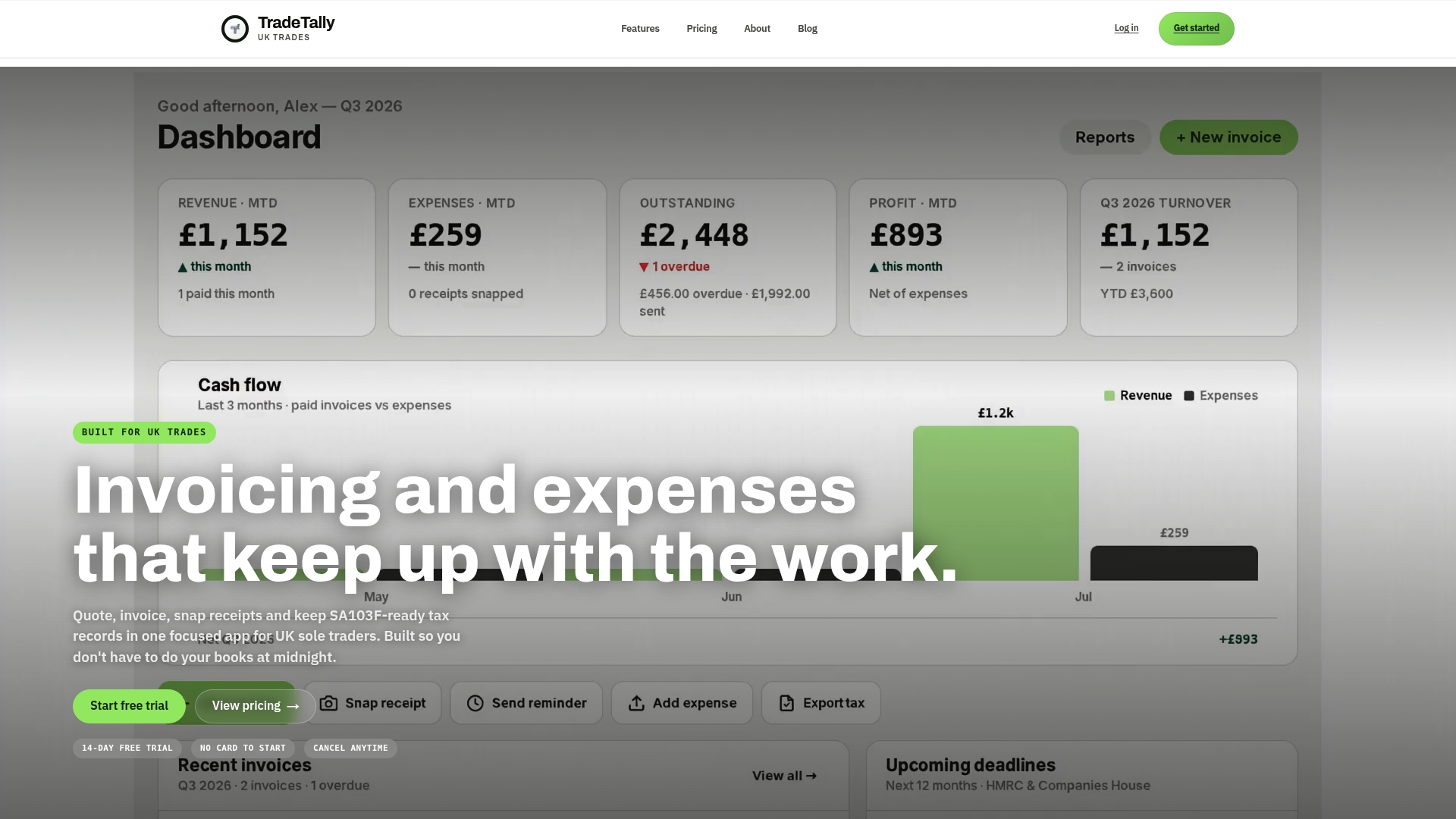
- Mileage tracking that captures date, postcode and purpose in one entry
- Export features to help prepare your tax return
- Receipt and expense capture alongside invoicing, all in one interface
| Plan | Price | Best for |
|---|---|---|
| Starter | Free plan available | Limited invoicing to get started |
| Professional | Subscription plans available | Full invoicing, expenses and tax exports |
If you’re tired of reconstructing mileage from memory every January, see TradeTally’s plans and get your log sorted before the next job.
Sources
Save these for your own records or for an HMRC enquiry: BIM75005 on simplified expenses, the P87 evidence briefing, GOV.UK’s vehicle expenses page, and the Commons Library briefing on AMAP rates.
- Gov
FAQ
What are the requirements for logging mileage for HMRC mileage allowance?
HMRC expects a contemporaneous record showing the date, business purpose, and start and finish postcodes for each journey, according to HMRC’s simplified expenses manual. Paper, spreadsheet or app formats are all acceptable as long as the record is made at the time and kept available for inspection.
What is the 45p per mile rule?
The approved mileage rate for cars and vans on the first 10,000 business miles rose from 6 April 2026 to 55p per mile, with 25p applying after that threshold.
Do I need a mileage log for tax purposes?
Yes. If you claim business mileage on your Self Assessment return, HMRC expects a supporting log with postcodes and purpose for each journey, and it may be requested during a compliance check. Without one, a claimed deduction can be disallowed.
What is the standard mileage rate for 2026 in the UK?
For the 2026 to 2027 tax year, the approved mileage rate is 55p per mile for cars and vans on the first 10,000 business miles, dropping to 25p after that. Motorcycles are set at 24p per mile and bicycles at 20p per mile.
Recommended
Ready to sort your trade admin?
TradeTally gives UK sole traders invoicing, expenses, and SA103F-ready tax exports in one mobile-first app.
Start 14-day Pro trial →No card required