55p from 6 April, UK mileage rates 2026 for tradespeople
From 6 April 2026, HMRC’s approved mileage rate for cars and vans is 55p per mile for the first 10,000 business miles, dropping to 25p thereafter. Motorbikes sit at 24p and bicycles at 20p. The change is backdated, so employees and self-employed tradespeople using their own vehicles for work are entitled to the higher rate for the whole tax year, not just from whenever the announcement landed on your desk.
TL;DR:
- The new HMRC approved mileage rate for cars and vans is 55p per mile for the first 10,000 miles and 25p thereafter, effective retrospectively from April 6, 2026.
- Employees and self-employed tradespeople must check their April and May payslips for possible under-reimbursement and can claim the difference through payroll corrections or tax relief.
- Only vehicles personally owned qualify for the new rates under AMAPs and the simplified mileage method, not company cars, which are governed by separate advisory fuel rates.
- Proper mileage records must include date, start and end locations, purpose, and miles traveled, and should be kept for at least two years to meet HMRC standards.
- Employers are not legally required to reimburse at the new rate, but employees can claim relief if they are paid less than the updated figures.
Table of Contents
- HMRC mileage rates 2026 UK: the approved figures
- Who qualifies: AMAPs, sole traders and the simplified method
- Payroll and backdating: what to check now
- Record keeping: what a valid mileage claim actually needs
- Advisory fuel rates: why company cars are different
- Worked examples: two quick calculations
- What tradespeople consistently get wrong on mileage
- Where TradeTally fits into your mileage claims
- Sources
- FAQ
HMRC mileage rates 2026 UK: the approved figures
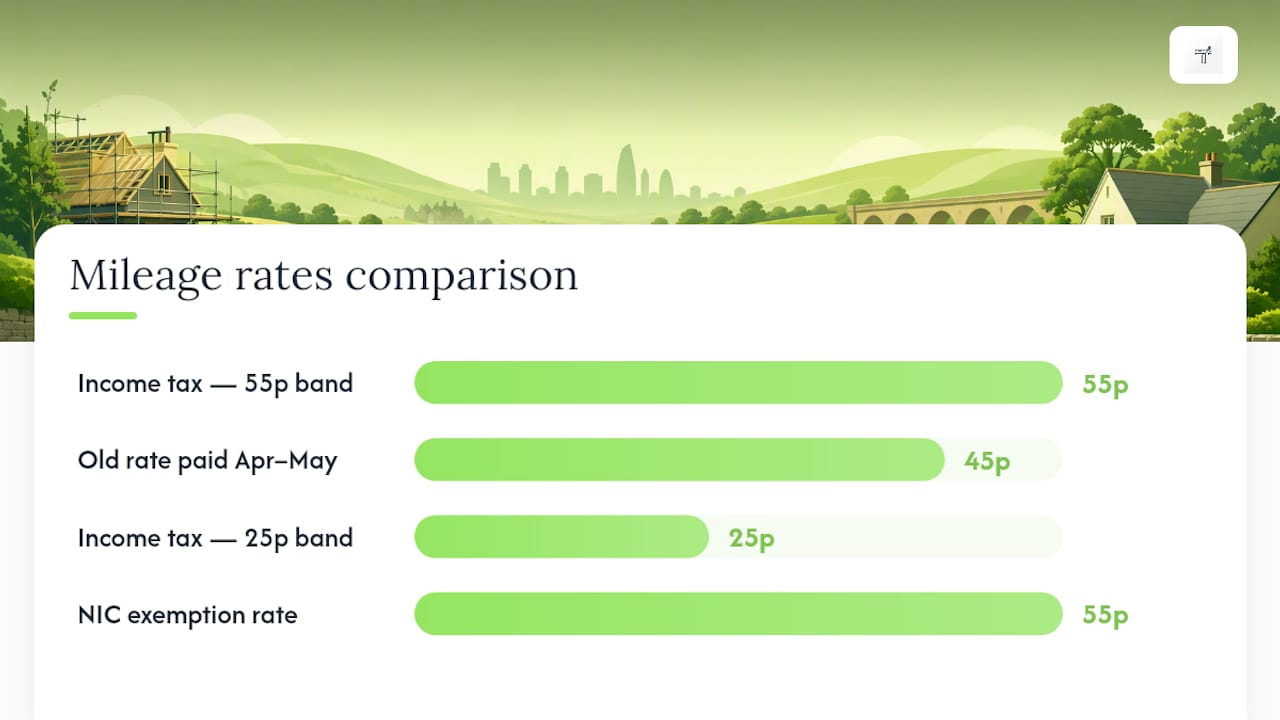
This is the first change to car and van rates since 2011, and it’s a proper jump, not a token gesture. The old 45p rate had been static for 15 years while fuel, insurance, and servicing costs climbed steadily, so the 10p uplift confirmed by the House of Commons Library reflects a genuine catch-up rather than routine indexing.
| Vehicle type | First 10,000 business miles | Over 10,000 business miles |
|---|---|---|
| Cars and vans | 55p | 25p |
| Motorcycles | 24p | 24p |
| Bicycles | 20p | 20p |
These are the official HMRC-approved rates for 2026/27, and they’re the ceiling for tax-free reimbursement, not a minimum you’re guaranteed to receive. A few extras worth flagging:
- Employers can pay up to 5p per passenger per mile tax-free when a colleague travels with you on business.
- The 55p rate replaces 45p specifically from 6 April 2026, so any mileage claimed before that date still sits at the old rate.
- Rates apply per vehicle owner, not per employer, so a second job using the same car doesn’t reset your 10,000-mile threshold.
Who qualifies: AMAPs, sole traders and the simplified method
Approved Mileage Allowance Payments (AMAPs) are the scheme that lets employers reimburse staff for business travel in their own vehicle without triggering tax or National Insurance, provided they stick to the HMRC rate. Self-employed tradespeople get the equivalent through the simplified mileage method, which lets you claim a flat rate per mile instead of tracking fuel receipts, insurance, depreciation, and servicing separately.
Both routes work the same way in practice:
- Pay or claim up to the approved rate and the payment is tax-free.
- Pay or claim above it, and the excess counts as a taxable benefit that needs reporting.
- Pay below it, and you (or your employee) may be able to claim the shortfall back through tax relief.
One distinction catches people out constantly: AMAPs and the simplified method only apply to vehicles you personally own, including a personally owned electric van or car. Drive a company car, and you’re in different territory entirely, governed by advisory fuel rates rather than the 55p figure, covered further down.
Payroll and backdating: what to check now
Because the increase applies retrospectively from 6 April 2026, anyone paid mileage in April or May under the old 45p rate is technically owed the difference. That’s not a minor administrative footnote. It’s real money sitting unpaid in a lot of payroll systems right now.
- Check your April and May 2026 payslips against the new 55p and 25p bands to spot any shortfall.
- Flag the gap to your employer and ask whether they’ll re-run payroll to correct it, since employers aren’t legally obliged to bump reimbursements to the new rate.
- Claim Mileage Allowance Relief through your Self Assessment or a P87 form if your employer won’t top up the difference themselves.
Employers face a slightly trickier job. Re-running payroll for backdated mileage means correcting both tax and NIC deductions, and NIC treats the whole picture a little differently, since the exemption uses a flat 55p across all business mileage in the year rather than the two-tier split that applies for income tax.
Pro Tip: If you overpaid tax on mileage reimbursed above the old 45p rate between April and the announcement, don’t assume it corrects itself. Ask payroll directly whether a correction has been processed, and keep a written record of the request.
Record keeping: what a valid mileage claim actually needs
HMRC doesn’t take your word for business mileage. Every claim needs to survive a records check, and the tradespeople who get caught out are almost always the ones logging journeys from memory weeks later.
A defensible mileage log needs:
- The date of each journey.
- Start and finish postcodes or addresses.
- The business purpose (a callout, a supplier collection, a site visit).
- Total miles travelled and the vehicle used.
Keep these records for at least the standard Self Assessment retention period, since HMRC can review claims retrospectively and a gap in your log is far harder to explain two years on than two days on. Contemporaneous electronic logs beat a notebook in the glovebox precisely because they timestamp the entry automatically. A mobile app that captures mileage at the point of travel, or one that links journeys directly to the invoice they relate to, closes the gap between doing the work and proving you did it. Our guide to HMRC mileage claims walks through the specifics for sole traders.
Advisory fuel rates: why company cars are different
Advisory fuel rates cover a completely separate scenario: reimbursing fuel costs for a company car, rather than mileage in your own vehicle. Employers use these rates to work out fuel-only reimbursement, or to calculate how much an employee should repay for private mileage in a company vehicle, and HMPC publishes them separately from AMAPs.
- Fully electric company cars have their own advisory rate, distinct from petrol and diesel bands, and it moves independently of the 55p AMAP figure.
- If you drive your own EV for work, you still use the 55p/25p AMAP structure, not the electric advisory rate, since AMAPs are about vehicle ownership, not fuel type.
- Fuel benefit multipliers, which affect the taxable value of free private fuel in a company car, sit under a different set of rules again and aren’t changed by this update.
Mixing these up is one of the most common payroll errors we see among small trade businesses running a couple of company vans alongside personal vehicles.
Worked examples: two quick calculations
Numbers make this concrete faster than explanation does.
- Sole trader, 6,000 business miles: All miles sit under the 10,000-mile threshold, so the whole claim uses 55p. A claimable amount calculated by multiplying 6,000 miles by the per-mile rate through the simplified mileage method on your Self Assessment return.
- Employee, 12,000 business miles: The first 10,000 miles at 55p gives a substantial amount; the remaining 2,000 miles at 25p adds further, for a total tax-free allowance considerably higher than under the old 45p/25p split, representing a meaningful difference worth checking for in payslips.
For the sole trader, this £3,300 reduces taxable profit directly rather than being a straight cash refund, so the actual saving depends on your tax band. Our mileage rate breakdown for sole traders covers how that plays out against different income levels.
What tradespeople consistently get wrong on mileage
The mistake I see most often isn’t dishonesty, it’s inconsistency. A plumber logs the big jobs, the 40-mile round trip to a new client, but forgets the three short hops to the merchant for fittings that same afternoon. Those small trips add up to hundreds of pounds a year in unclaimed mileage, and they’re the first thing that falls apart under scrutiny if HMRC ever asks for a full log rather than a sample.
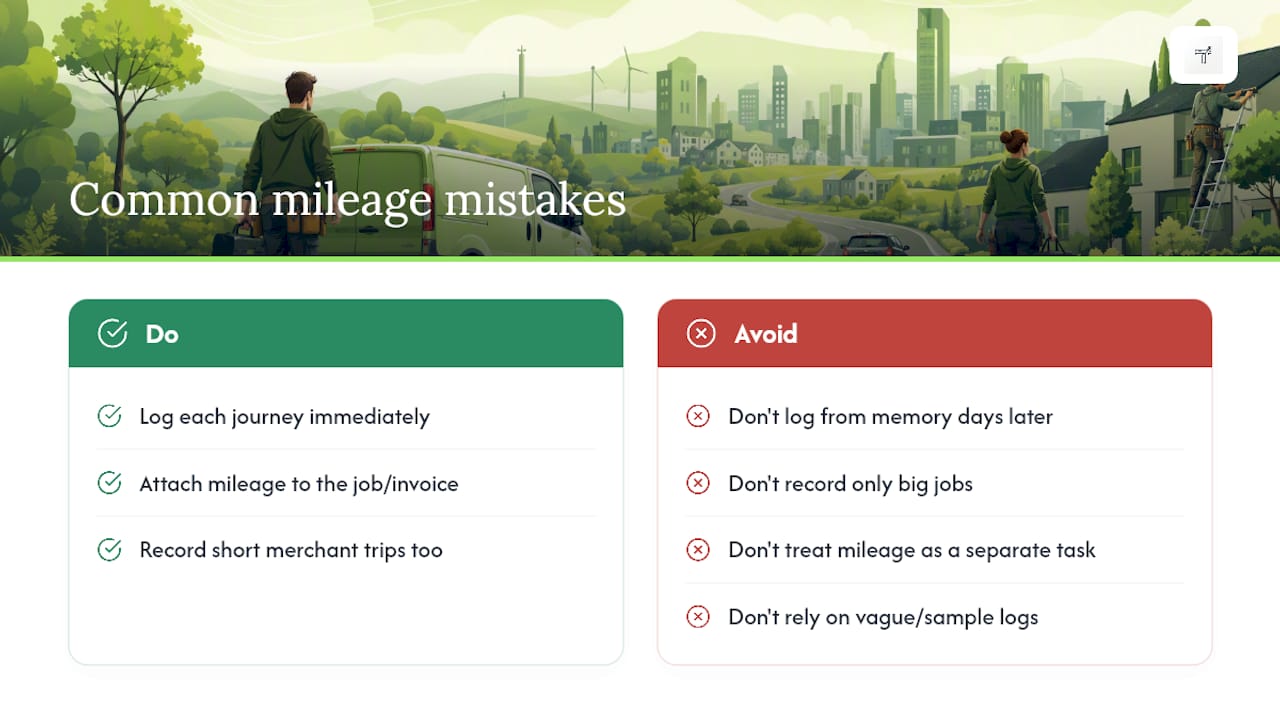
The second issue is timing. Logging mileage a week after the job, from memory, produces numbers that are close enough to look plausible and vague enough to be useless as evidence. The tradespeople who claim confidently are the ones who log the journey the moment they’re back in the cab, before the next callout wipes it from memory.
What actually moves the needle is treating mileage as part of the invoicing workflow, not a separate task bolted on at tax time. Attach the journey to the job it relates to, and by the time your accountant asks for a mileage total, you’re exporting a report rather than reconstructing a year.
— Simon
Where TradeTally fits into your mileage claims
TradeTally gives you the calculator built to the current HMRC rate, so you’re never applying last year’s 45p by accident, and it captures each journey from your phone the moment you finish a job, before the details blur. Mileage links straight to the invoice it belongs to, and everything exports SA103F-ready when Self Assessment season arrives, so there’s no scrambling through a shoebox of fuel receipts in January.
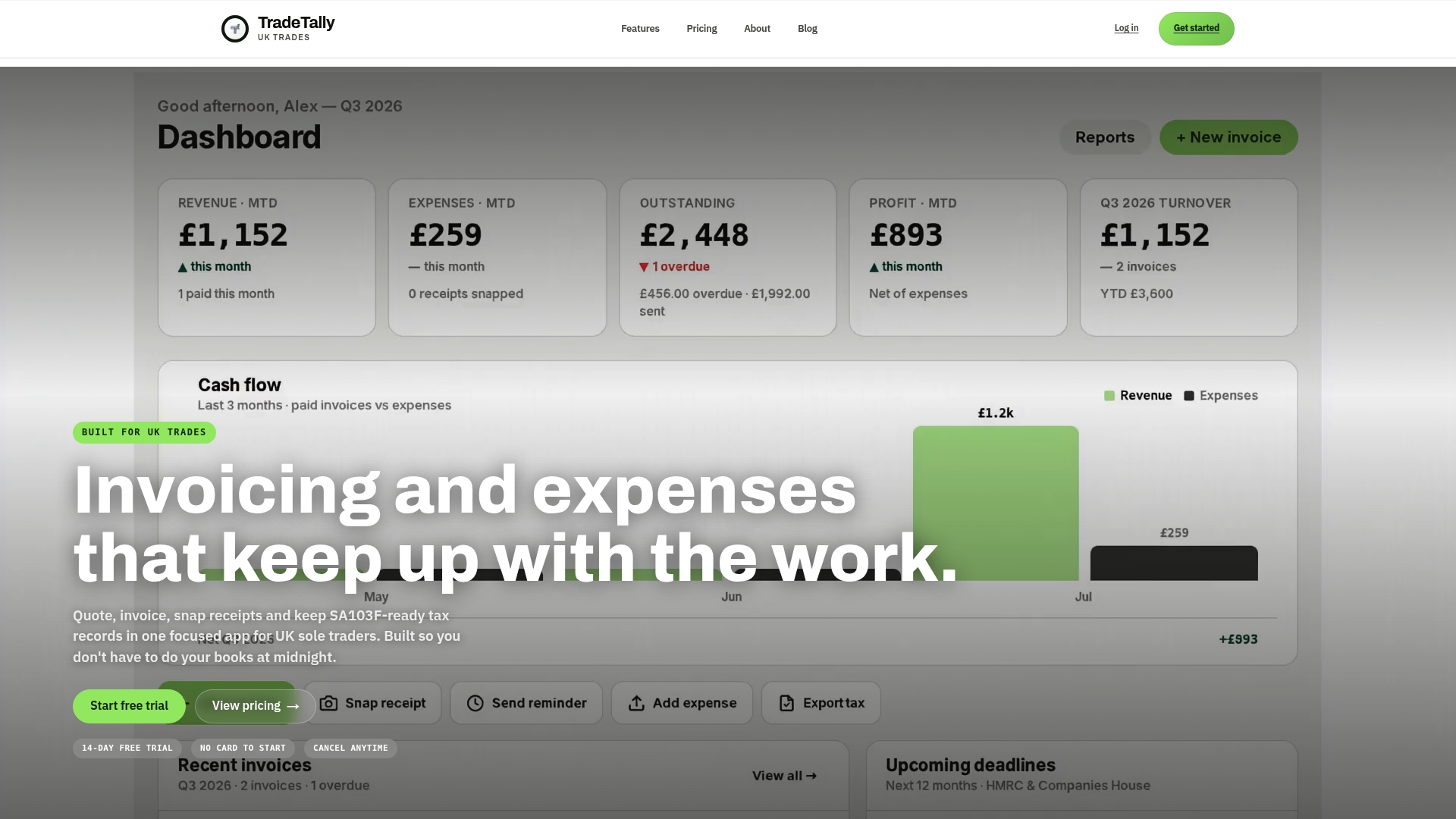
If you’re a sole trader who’s tired of guessing at year end, start with the free mileage and tax calculators to see what your current logging is actually worth, then look at the Self Assessment tax calculator to model what a full year of accurate mileage claims does to your tax bill. Trade-specific tools are available too, including setups built for carpenters and other specialist trades, so your invoicing and mileage records sit in one place from the first job of the tax year.
Sources
- Travel — mileage and fuel rates and allowances
- Mileage Allowance Payments - House of Commons Library
- What the increase in mileage rates for 2026/27 means for you | LITRG
This article is general information, not a substitute for advice from a qualified financial advisor. Consult a qualified financial professional about your own circumstances before acting on anything here.
FAQ
What is the mileage reimbursement rate for 2026?
The approved rate for cars and vans is 55p per mile for the first 10,000 business miles and 25p per mile after that, effective retrospectively from 6 April 2026.
Is mileage still 45p per mile?
No. The 45p rate applied until 5 April 2026; from 6 April 2026 it rose to 55p for the first 10,000 business miles, the first increase since 2011.
What are the new NHS mileage allowance rates for 2026?
NHS mileage rates follow separate agreements set through NHS employer terms rather than the standard HMRC AMAP figure, so NHS staff should check their trust’s own mileage policy rather than assuming the 55p rate applies automatically.
What are the current mileage allowance rates in the UK?
For 2026/27, cars and vans get 55p (first 10,000 miles) and 25p thereafter, motorcycles get 24p, and bicycles get 20p, with an additional 5p per passenger per mile available tax-free.
Do employers have to pay the new higher rate?
No, employers aren’t legally required to increase reimbursements to 55p; if they pay less, employees can claim Mileage Allowance Relief on the difference through Self Assessment or a P87 form.
Recommended
Ready to sort your trade admin?
TradeTally gives UK sole traders invoicing, expenses, and SA103F-ready tax exports in one mobile-first app.
Start 14-day Pro trial →No card required