Bank Reconciliation for Sole Traders: A Practical UK Guide

Bank reconciliation is matching what your records say you received and spent against what your bank statement says actually happened, then explaining every difference. For a UK sole trader it takes about 20 minutes a month if you keep up with it, and it is the quickest way to catch missing receipts, unrecorded bank charges and private spending before they reach your Self Assessment return.
This guide walks through the method, a worked example with real-looking trade figures, what to do when something does not match, and how to handle card and payment-platform payouts. It is written for plumbers, electricians, carpenters, builders and other sole traders who do their admin after a day on site.
TL;DR
- Reconciling means ticking off every line in your records against your bank statement and explaining anything left over. Your closing balances should then agree.
- Do it monthly. There is no legal deadline for how often, but monthly keeps the job small and the mistakes fresh.
- Investigate every unmatched item. The usual causes are a missing receipt, an unrecorded bank charge, a payment still in transit or a private payment through the business account.
- Reconciling does not replace keeping the original records. You still need statements, invoices and receipts for at least five years after the 31 January deadline.
- Your bank balance is not your profit. Reconciliation proves the records are complete, then your tax figures come from those records.
Table of Contents
- What bank reconciliation means for a sole trader
- Before you start: keep the business account separate
- How to reconcile your bank account, step by step
- A worked example
- What to do when something does not match
- How often should you reconcile?
- Card readers, card payments and payment platforms
- Reconciliation, profit and your tax return
- Records you must keep, and for how long
- Our view: make reconciliation a by-product
- Making the monthly check easier with TradeTally
- FAQ
- Sources
What bank reconciliation means for a sole trader
HMRC’s own guidance for its inspectors describes the process plainly: matching cash-book entries to bank statements and preparing a reconciliation to prove the bank balance in the accounts is accurate. Your “cash book” can be a spreadsheet, a paper book or an app. What matters is that it lists every payment in and out of the business.
The purpose is control, not paperwork for its own sake. If your records say the business account should hold £3,420 and the bank says £3,180, something is wrong somewhere: a payment you forgot to log, a supplier who was charged twice, a direct debit you thought you had cancelled. The gap is the thing you are hunting.
ICAEW’s training material lists the usual reasons for a difference: errors in the cash book, errors by the bank, transactions missing from the cash book, and cheques or payments that have not yet cleared. For a typical tradesperson, the most common are missing items: the fuel you paid for by card and never logged, the bank fee, the customer who paid you a different amount than you invoiced.
Why it matters more than it sounds
HMRC’s guidance on small-trader records notes that reviewing bank statements can show non-business receipts, business spending left out of the books, private spending and bank charges missing from the cash book. In other words, your bank statement is the first place anyone checking your figures looks, so it pays to have looked there first.
There is a practical upside too. Missed expenses mean paying tax on money you did not keep. Under the cash basis, HMRC says bank charges and bank interest can be business expenses, subject to the rules, so even small monthly fees are worth capturing.
Before you start: keep the business account separate
Reconciliation is far easier when the business account carries only business money. If your fuel, groceries and the kids’ school trip all go through the same account as customer payments, you will spend most of the session sorting private from business.
A separate account is not a legal requirement for a sole trader, but it is the single biggest time saver. If you are mixing, our guide to splitting personal and business expenses shows how to sort it as you go rather than in January.
Have these to hand before you sit down:
- The bank statement for the month (download the PDF from your banking app).
- Your records for the same month: invoices issued, payments received, receipts and expenses.
- Statements for any business credit card or other account used for the business.
- Payout reports from any card reader or payment platform you use.
How to reconcile your bank account, step by step
The method below follows the same logic ICAEW teaches: compare the records with the statement, tick matching items on both sides, check the opening balances agree, and list anything that appears on only one side. Commercial guides to small-business reconciliation follow a similar order: define the period, gather the records, match one by one, investigate, adjust, and file the finished reconciliation with its evidence.
Step 1: Pick the period and confirm the opening balance
Use a calendar month, or the statement dates your bank uses. Check that the closing balance from last month’s reconciliation equals this month’s opening balance in both your records and on the statement. If they do not agree, stop: you have an error from last time, and it will carry on until you fix it.
Step 2: Tick off matching items
Go down the statement line by line. For each line, find the matching entry in your records and tick both. Match on amount and date first, then on the name. A £480 payment from a customer should match an invoice you issued, and a £62.40 debit at a builders’ merchant should match a receipt.
Step 3: List what is left on each side
Two piles remain:
- On the statement but not in your records. Add these to your records after you have worked out what they are: bank fees, direct debits, a customer paying early, a refund.
- In your records but not on the statement. These are usually payments in transit (a bank transfer sent on the last day of the month, a cheque not yet paid in) or something you recorded but never actually paid.
Step 4: Adjust and prove the balance
After you add the missing entries, work out what your records say the closing balance should be. Then adjust it for the items genuinely in transit. If the result equals the statement’s closing balance, you have reconciled. If not, there is still an error to find.
Step 5: Save the evidence
Keep the statement, the reconciliation and any note explaining unusual items together. Our guide to which bank statements to keep for Self Assessment covers what to hold on to and in what form.

A worked example
Here is a short, made-up month for a self-employed electrician, to show how the mechanics work. The figures are illustrative only.
| Item | Your records | Bank statement |
|---|---|---|
| Opening balance | £2,150.00 | £2,150.00 |
| Customer payment, rewire | +£1,800.00 | +£1,800.00 |
| Wholesaler, cables and fittings | -£312.50 | -£312.50 |
| Van fuel, three fill-ups | -£165.00 | -£145.00 |
| Bank account fee | not recorded | -£6.50 |
| Insurance direct debit | not recorded | -£38.00 |
| Invoice paid by transfer, sent 30th | +£640.00 | not yet shown |
| Closing balance | £4,112.50 | £3,448.00 |
The records say £4,112.50 and the bank says £3,448.00, a £664.50 difference. Work through it:
- The £640.00 transfer is in transit. It explains most of the gap and will appear next month.
- The £6.50 fee and the £38.00 direct debit are missing from the records. Add both.
- The fuel total is out by £20.00. Two receipts were logged correctly, but one fill-up was entered as £40.00 when the statement shows £20.00. Correct the entry.
After the adjustments, the records show £4,112.50 less £6.50, less £38.00, plus the £20.00 correction, giving £4,088.00. Take off the £640.00 in transit and you reach £3,448.00, matching the bank. The reconciliation is proved, and you have caught two expenses and one typing slip.
What to do when something does not match
Expect this to happen. Every unmatched line has a cause, and the job is to find it rather than to force the balance with a “miscellaneous” entry. Work through these checks in order, from the cheapest to the most awkward.
- Check for timing. Is the item a payment that left your account on the last day of the month, or arrived on the first of the next? Weekend and bank holiday payments often show up days after you made them.
- Check for a typo. Transposed digits (£54.30 against £53.40) are very common. If the difference divides evenly by 9, a transposition is a likely suspect.
- Look for a missing receipt. Search your photos, email and the van glovebox. If you cannot find it, note the merchant, date and amount from the statement and record the expense with a note that the receipt is missing. Do not leave the line unexplained.
- Look for a double entry. The same invoice logged twice, or a payment entered once as an expense and once as a transfer.
- Check for bank errors. Rare, but possible: a duplicate charge, or a payment taken that you did not authorise. Contact your bank promptly and keep a record of the call or message.
- Decide whether it is private. A payment you cannot tie to the business may be personal spending through the account. Record it as drawings or private use, not as a business expense.
- Ask the customer or supplier. If a customer paid £450 against a £500 invoice, find out whether it is a part payment, a deduction or a mistake, and chase or adjust accordingly.
Pro tip: if a small difference stays unexplained after a reasonable search, write down what you checked and when, then move on. A documented, tiny discrepancy is far better than a balancing figure with no explanation.
A note on automation
Bank-connected software can suggest matches, but it cannot judge them. ICAEW’s view of automation in the accounting cycle is that tools can flag matches and discrepancies while people still have to investigate unusual items and apply judgement. GOV.UK makes a related point for digital records: bank-connected software may not show every transaction in full, so you cannot assume the feed is complete.
How often should you reconcile?
There is no statutory deadline for reconciling. Practitioner guidance suggests monthly, or at least at each VAT return period end, with more frequent checks for high transaction volumes. Most sole traders are not VAT-registered, so monthly is the practical rule.
A simple rhythm works for most trades:
- Weekly, five minutes: log invoices sent and payments received, and photograph the week’s receipts. HMRC’s small-business record-keeping guidance recommends updating records weekly or monthly and photographing receipts promptly.
- Monthly, 20 to 30 minutes: do the full reconciliation once the statement is out.
- Year end: reconcile the final month, then run your totals for the return.
If you are in Making Tax Digital for Income Tax, the monthly habit matters even more. GOV.UK says that from April 2026 sole traders and landlords with qualifying income above £50,000 must send quarterly updates through compatible software. GOV.UK also says you remain responsible for checking digital records are accurate before you submit a quarterly update. A reconciled month is the easiest way to be sure. Our page on MTD-ready software for sole traders and the guide to MTD for ITSA requirements explain what changes in practice.
Card readers, card payments and payment platforms
Card income is where reconciliations most often go wrong, because the bank rarely shows what the customer paid. Intuit’s UK card-processing guide explains that processors may pay one bank credit covering several cards, with transaction charges taken off before settlement. So three jobs worth £200, £350 and £150 might arrive as a single payment of less than £700.
To reconcile it properly:
- Get the payout report from your card provider, which itemises the sales behind each deposit.
- Match each sale to its invoice in your records.
- Record the gross sale as income and the processing fee as a separate expense, so the figures still tie to the bank deposit.
- Check that the payout total less fees equals the amount that hit the account.
One UK payment provider suggests matching four records: the sale, the provider’s record, the bank entry and your accounting record. For a one-person trade, that translates to invoice, payout report, bank line and your own books.
The same applies to any business credit card. Reconcile it as its own account, using its statement, and record the repayment from your bank account as a transfer rather than a second expense.
For cash jobs, the bank statement will not help you until you pay the money in. Record the sale on the day with the date, customer and amount, and tick it off when the cash is deposited. Our guide to recording cash sales as a UK sole trader covers the routine.
Reconciliation, profit and your tax return
A reconciled bank balance is not your profit, and it is not your taxable income. It tells you the records are complete. Profit comes from what is in the records: income less allowable expenses for the tax year.
The tax year runs 6 April to 5 April, and GOV.UK says that from 2024 to 2025 the cash basis is the default unless you opt out or cannot use it. Under cash basis HMRC says you record only income actually received and expenses actually paid, including by cash, card or cheque. That means the bank statement lines up closely with your tax figures, which is exactly why reconciling pays off. Our guide to cash basis accounting for UK trades explains the consequences for your March to April position.
Watch for three traps that make the bank balance a poor stand-in for profit:
- Money in that is not income: a loan, your own money paid in, a customer’s refund of a deposit.
- Money out that is not an expense: drawings, personal spending, tax payments and loan capital repayments.
- Money that is not yet in the bank: an unpaid invoice is not cash-basis income, but you should still chase it.
If you work under the Construction Industry Scheme, customers deduct tax before paying you, so the bank receipt is lower than the invoice. Record the gross amount, the deduction and the net receipt, otherwise the reconciliation will never agree with the invoices.
Records you must keep, and for how long
Reconciling does not remove the need to keep the paperwork behind it. GOV.UK says sole traders must keep records of business income and expenses for Self Assessment. It requires you to keep them for at least five years after the 31 January submission deadline for the relevant tax year. For a 2022 to 2023 return filed online by 31 January 2024, that means until at least the end of January 2029.
HMRC’s definition is broad: business records include receipts, expenses, goods bought and sold, and supporting accounts, books, contracts, vouchers and computer records. For payments you receive, HMRC’s guidance says to note the date, customer, amount, purpose and payment method, and to keep statements, invoices, sales confirmations and card-machine summaries.
Under MTD, GOV.UK says original supporting records or copies, including bank statements and invoices, must still be retained. Our checklist for storing records for five years and the guide to digital receipts show how to do that without a shoebox.
Our view: make reconciliation a by-product
We built TradeTally because the admin that follows a day on site is where good tradespeople lose evenings and, sometimes, money. Reconciliation is the clearest example. It is not hard, but it becomes miserable when it is a once-a-year rescue job with 300 loose receipts and a bank statement.
Our view is simple. The work should happen at the moment it is cheapest: you finish a job, you send the invoice from your phone; you buy materials, you photograph the receipt in the van before the ink fades. By month end, most of the matching is already done, and the reconciliation is checking, not data entry.
We would also say this plainly: no app should be trusted to reconcile without you looking. Software can collect and organise the records, but a human has to decide that a £90 transaction was a tool purchase rather than a personal one. The good news is that if your records are complete and tidy, that decision takes seconds.
Three habits do most of the work:
- Photograph every receipt the same day.
- Raise the invoice before you leave the site.
- Set a fixed monthly slot for the statement, and treat it like a booked job.
— Simon
Making the monthly check easier with TradeTally
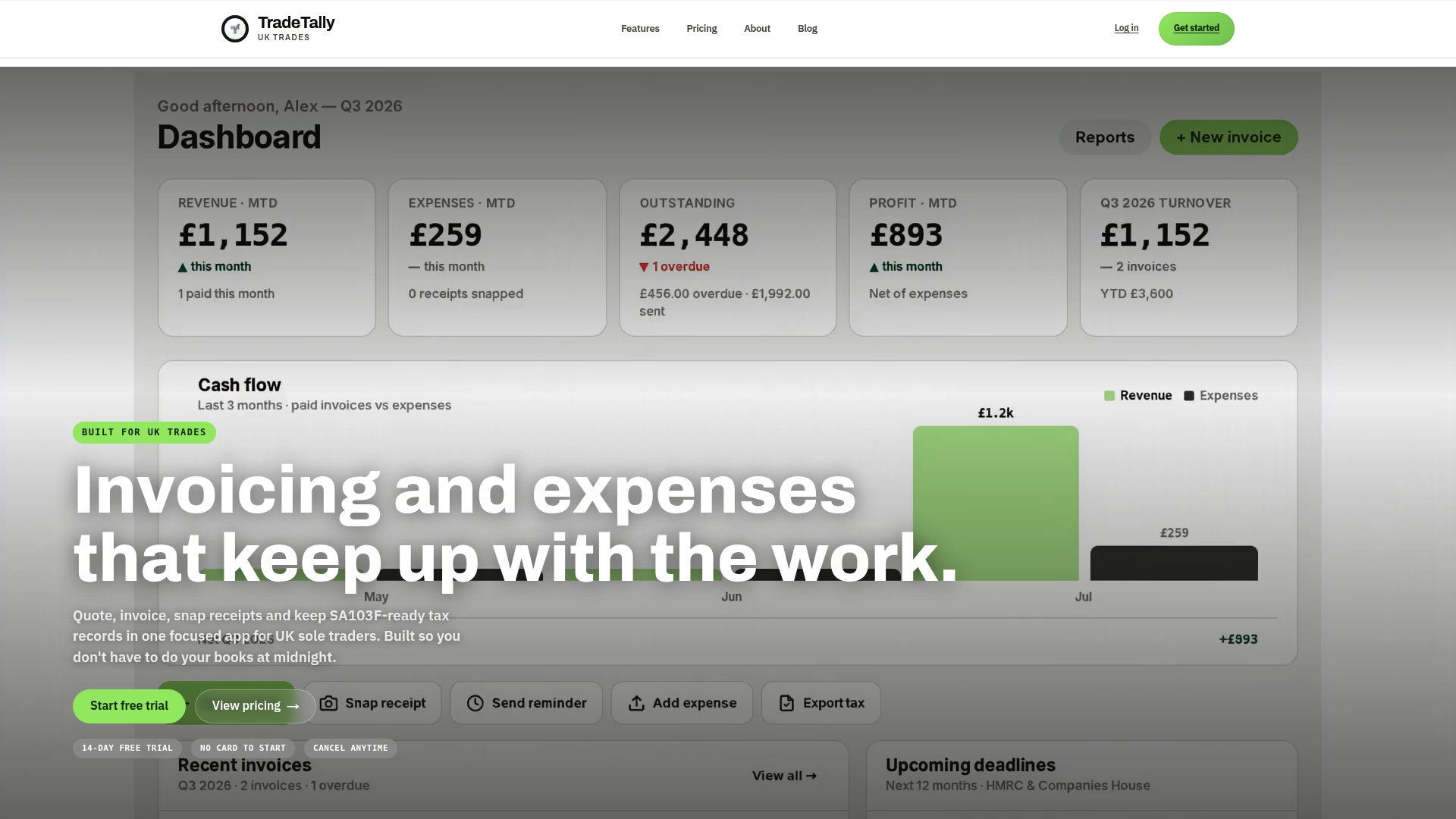
TradeTally is a UK app for sole traders that keeps branded invoices, quotes, receipts, mileage, CIS deductions and a live profit view in one place, with SA103F export and MTD-ready records. That means the list you tick against your bank statement is already complete and dated when the statement arrives.
The Starter plan is free for limited invoicing. Professional costs £12 per month or £120 per year and adds unlimited invoices, receipts and tax exports. You can see both on our pricing page or start from the TradeTally home page. If you want a rough idea of where your year is heading before you reconcile, try the Self Assessment tax calculator, and see our expense tracking guide for the categories that matter.
FAQ
Do sole traders have to do a bank reconciliation?
There is no law that names the process or sets a deadline for it. However, you must keep accurate records of income and expenses, and HMRC’s guidance treats reconciling the cash book to the bank as the way to prove the balance is right. In practice, doing it monthly is the easiest way to meet your record-keeping duty.
Can I reconcile if I use a personal account for the business?
Yes, but it takes longer because every line must be sorted into business or private first. Anything private is left out of the business figures and treated as drawings or personal spending. Opening a separate account for business use is the simplest fix.
What if my records and the bank still differ by a few pounds?
Check for timing differences, typing errors and bank fees first. If you still cannot explain a small gap, write down what you checked and when, and carry the note with that month’s reconciliation. Do not hide it in a balancing entry.
How long should I keep my bank statements?
GOV.UK says self-employed records must be kept for at least five years after the 31 January submission deadline for the tax year. Keep the statements, and your reconciliations, with the other supporting records for that period.
Is bank reconciliation the same as checking my profit?
No. Reconciliation shows that your records agree with the bank and nothing is missing. Profit is calculated from those records as income less allowable expenses, so a healthy bank balance does not tell you what you will owe in tax.
Sources
- EM2860, Examining Accounts: Cash Book (HMRC)
- EM2851, Examining Accounts: Small Businesses (HMRC)
- Accounting activities (ICAEW)
- Bank Reconciliation: A Practical Guide for UK Small Businesses (RSBC)
- How GenAI can save you time during the accounting cycle (ICAEW)
- Use Making Tax Digital for Income Tax: create digital records (GOV.UK)
- Deadline approaches for first Making Tax Digital quarterly update (GOV.UK)
- How to Keep Records as a Small Business (Tax Confident)
- Card Processing Guide (Intuit Pay)
- Payment reconciliation for small businesses (Wonderful)
- Business records if you’re self-employed (GOV.UK)
- How long to keep your records (GOV.UK)
- Cash basis: how to record income and expenses (GOV.UK)
- SALF211, Self Assessment legal framework (HMRC)
Recommended
Ready to sort your trade admin?
TradeTally gives UK sole traders invoicing, expenses, and SA103F-ready tax exports in one mobile-first app.
Start 14-day Pro trial →No card required