Keep public sector work: UK invoicing compliance before April 2029
Yes, the UK has confirmed mandatory e-invoicing for VAT invoices from April 2029, and VAT-registered businesses need to start preparing now. HMRC has chosen Peppol as the interoperability network, PDFs will not satisfy the new structured-format requirement, and a full implementation roadmap is due at Budget 2026. If you invoice customers or suppliers, the clock has already started.
TL;DR:
- Businesses must start preparing now for the April 2029 deadline by evaluating their invoicing software’s compatibility with Peppol and structured formats.
- HMRC’s adoption of Peppol’s decentralized four-corner model means invoices will pass directly between access points, not through a central government gateway.
- Accurate, compliant invoices now require specific details such as sequential numbering, VAT registration, customer info, and correct VAT rates to avoid disputes and delays.
- Transitioning to structured e-invoices will involve minor updates for those already using Peppol-compatible systems but could be disruptive for manual or ad hoc software users.
- Small tradespeople should focus on basic record-keeping and digital receipt capture today to simplify compliance and software integration before the 2029 mandate.
Table of Contents
- Invoicing compliance UK: the 2029 mandate and its timeline
- What must legally appear on a UK VAT invoice right now
- Structured e-invoices, Peppol and why your PDF invoices won’t cut it
- How e-invoicing fits with Making Tax Digital
- Self-billing, NHS suppliers and other edge cases you need a plan for
- Your preparation checklist before April 2029
- Common penalties and consequences of non-compliance
- Fixing invoice errors: credit notes and corrective invoices
- Brexit’s lasting effect on UK invoicing rules
- Reverse charge and industry-specific invoicing rules
- What tradespeople should actually do about this now
- Get ready for e-invoicing without the late-night admin
- Sources
- FAQ
Invoicing compliance UK: the 2029 mandate and its timeline
The confirmed target is April 2029. From that date, businesses trading with other businesses (B2B) or with the public sector (B2G) will need to issue and receive VAT invoices in a structured, machine-readable format, rather than the free-text PDFs and Word documents most trades businesses use today. That commitment came out of the government’s consultation response on promoting electronic invoicing, and it settles a question that had been open since the original 2025 consultation launched.
Consumer-facing (B2C) transactions sit outside the initial rollout. If you are a plumber invoicing a homeowner directly, that transaction is not caught by the mandate on day one, though the direction of travel across Europe suggests scope could widen later. B2B and B2G invoicing is where the real change lands, and for tradespeople who invoice letting agents, main contractors, housing associations, or NHS trusts, that covers a meaningful slice of daily work.
Two policy decisions matter more than most guides give them credit for. First, HMRC has ruled out building a central government clearance platform. Instead, the UK is adopting Peppol’s decentralised four-corner model, where invoices pass directly between accredited access points rather than through a single government gateway. Second, there is no continuous transaction control at launch, meaning you will not be reporting invoice data to HMRC in real time the way some EU member states now require. The UK 2029 mandatory B2B e-invoicing analysis confirms both points were locked in during the mid-2026 policy confirmations.
The timeline running up to 2029 looks roughly like this:
- January 2026 onwards: HMRC and the Department for Business and Trade begin stakeholder engagement and technical working groups to finalise UK-specific specifications.
- Budget 2026: A detailed implementation roadmap is due, covering phased onboarding, technical standards, and likely support for smaller businesses.
- 2027 to 2028: Expect software vendors to roll out Peppol access point support, pilot schemes with larger suppliers, and possibly voluntary early adoption incentives.
- April 2029: Mandatory go-live for B2B and B2G VAT invoicing.
That gap between now and 2029 feels generous until you remember how many businesses only start reviewing invoicing software after a compliance deadline is confirmed in writing. Industry commentary from ICAEW’s e-invoicing explainer expects structured e-invoicing to cut administrative costs and reduce error rates once adopted, but only businesses that start integration work early will see those savings before the deadline rather than after it.
What must legally appear on a UK VAT invoice right now
Before you worry about structured formats and Peppol access points, get the basics right, because a large share of invoice disputes and VAT recovery problems stem from invoices that were never compliant in the first place. HMRC’s guidance on record keeping for VAT sets out exactly what a valid VAT invoice must contain.
Every VAT invoice you issue needs to include:
- A unique, sequential invoice number that follows on from the last one you issued.
- Your business name, address, and VAT registration number.
- The customer’s name and address.
- The invoice date and the tax point (the date of supply, if different from the invoice date).
- A clear description of the goods or services supplied.
- The quantity and unit price of each item, where applicable.
- The rate of VAT charged on each item (standard, reduced, or zero).
- The total amount payable, excluding VAT.
- The total VAT chargeable, shown in sterling.
- Any discount offered, where relevant.
Miss one of these and you risk your customer’s accountant querying the invoice, delaying payment, or worse, your customer being unable to recover the input VAT at all. For a sole trader chasing payment on a kitchen fit or a rewire, that delay can be the difference between a comfortable month and a stressful one.
Timing matters as much as content. HMRC expects a VAT invoice to be issued within 30 days of the date of supply. The tax point, broadly the date you actually deliver the goods or complete the service, drives which VAT period the transaction falls into, which in turn affects your VAT return. Invoice late and you can find a job falling into the wrong quarter, throwing off your VAT reconciliation.
Retention is the other half of the compliance picture that gets overlooked. You must keep VAT invoices and records for several years, whether you are VAT registered as a sole trader, a partnership, or a limited company. HMRC retains the right to inspect these records at any point within that window, and “I lost the invoice” is not a defence during a compliance check. Digital storage solves most of this problem outright, provided the system you use preserves the original document and an audit trail of any amendments.
Structured e-invoices, Peppol and why your PDF invoices won’t cut it
A PDF invoice looks fine to a human reading it on screen. It fails the e-invoicing mandate entirely, because a PDF is not machine-readable in the sense HMRC means. Structured e-invoicing means the invoice data, supplier details, VAT amounts, line items, tax codes, is encoded in a standardised format that accounting software can read, validate, and process automatically, without a person retyping anything.
The technical backbone for this is UBL (Universal Business Language), and within the UK’s chosen framework, that means Peppol BIS documents. Peppol itself is not new. It began as a European public procurement network and has since become the interoperability standard several countries have adopted for domestic e-invoicing mandates. The UK’s decision to build on Peppol rather than invent a bespoke system was informed by exactly this: businesses that already trade with EU partners or use Peppol-compliant software have a head start.
The architecture works on what is called a four-corner model:
- Corner 1: The supplier (you) creates the invoice in Peppol-compliant software.
- Corner 2: Your software connects to an accredited Peppol access point, which validates and transmits the invoice.
- Corner 3: Your customer’s access point receives the invoice.
- Corner 4: The invoice lands directly in your customer’s accounting system, structured and ready to process.
No government server sits in the middle reading every invoice. That decentralised design is deliberate. It supports a competitive software market rather than funnelling every UK business through one platform, and it avoids creating a single point of failure that would bring commerce to a halt if it went down.
Expect the UK’s specific implementation to reference Peppol BIS 3.0 as the base standard, with a country-specific extension, likely branded something like PINT UK, layered on top to handle UK VAT rules, HMRC reference codes, and domestic reporting quirks. Countries that have gone through this process before, Australia and New Zealand among them, have taken the same approach: adopt the Peppol base specification, then extend it for local tax law.
Pro Tip: If your accounting software already supports Peppol invoicing for EU trade, even in a limited way, ask your provider now whether they plan to extend that support to a UK profile. Early movers on this tend to get smoother rollouts than those who wait for the Budget 2026 roadmap to force the issue.
One insight worth flagging: because the UK is building on an existing international standard rather than a from-scratch specification, businesses that start using generic Peppol-compliant invoicing now are likely to face only minor adjustments once the UK-specific profile is published, according to analysis from Smart e-Invoicing’s UK mandate breakdown. Waiting until 2028 to touch this at all means retrofitting everything at once, under time pressure, during your busiest trading period.
How e-invoicing fits with Making Tax Digital
Making Tax Digital for VAT and the 2029 e-invoicing mandate are related but not identical, and conflating them causes real confusion. MTD is about how you keep your VAT records: digitally, in functional compatible software, with digital links between the individual pieces of your record-keeping rather than manual re-entry at each stage. E-invoicing is about the format in which invoices travel between businesses.
Think of MTD as governing what happens inside your accounts, and e-invoicing as governing what happens between you and the person you are invoicing. From April 2029, a structured invoice you send through a Peppol access point will need to land inside MTD-compatible software as a proper digital record, not get printed out, re-keyed, or bridged in manually.
Practical steps worth taking now:
- Check whether your current invoicing software is already MTD compatible, most modern platforms are, but plenty of tradespeople still run invoicing through spreadsheets bridged into HMRC via separate bridging software.
- Ask your software provider directly whether digital links exist between invoice creation, expense capture, and your VAT return submission, or whether any manual step breaks that chain.
- If you use legacy EDI (electronic data interchange) systems inherited from a larger client relationship, confirm these can be adapted to Peppol rather than assuming EDI compliance automatically satisfies the new mandate. It generally will not.
The most common pitfall is what HMRC calls a broken digital link, where data is manually copied between two systems instead of transferring automatically. That already breaches MTD rules today, and it will breach the e-invoicing mandate too, since a manually retyped structured invoice defeats the purpose of machine-readability. TradeTally’s MTD-compatible record-keeping is built around avoiding exactly that gap for sole traders.
Self-billing, NHS suppliers and other edge cases you need a plan for
Self-billing arrangements need particular attention under the current rules, and that will only intensify once structured invoicing becomes mandatory. If your customer issues invoices on your behalf, a common arrangement in subcontracting and CIS work, HMRC requires a formal self-billing agreement in place before any self-billed invoice is issued. Without it, your customer’s input VAT recovery is at risk, and so is yours.
The self-billing notice sets out the required wording precisely: the invoice must be clearly labelled as self-billed and contain the same data elements as a standard VAT invoice, your VAT number included. Keep every self-billing agreement on file for the full six-year retention period. Losing track of one is a common reason input VAT gets disallowed on inspection.
NHS suppliers already have a Peppol requirement in place today for procurement invoicing, and that existing precedent is worth understanding because it previews what other public bodies will likely require well before the 2029 deadline forces the issue. If you supply goods or services to an NHS trust or another public body, check now whether Peppol invoicing is already expected, rather than waiting for the mandate to catch you out.
For everything else in the transition period:
- Non-Peppol suppliers: Expect a period of dual-running where you accept both traditional and structured invoices, particularly from smaller suppliers who adopt late.
- Cross-border suppliers: EU suppliers already using Peppol for their domestic mandates may find UK integration relatively smooth; non-EU suppliers may need more support.
- Petty cash and low-value transactions: These generally sit outside strict e-invoicing requirements, but keep receipts and records regardless, since HMRC’s six-year retention rule still applies.
Your preparation checklist before April 2029
Waiting for the Budget 2026 roadmap before doing anything is the single most common mistake finance teams will make. Here’s a sequence that spreads the work sensibly across the run-up to the deadline.
- Audit a sample month of invoices. Pull every invoice you issued and received in a typical month. Categorise them by format (PDF, paper, structured) and count how many trading partners you deal with regularly. This tells you the real scale of the change, not the theoretical one.
- Map your high-volume trading partners. Identify the customers and suppliers you invoice most often. These relationships matter most because getting the transition wrong with a major client costs more than getting it wrong with a one-off job.
- Check your software’s Peppol readiness. Ask your invoicing or accounting provider directly whether they support, or plan to support, Peppol access point connectivity. If the answer is vague, treat that as a warning sign.
- Run a pilot with one willing trading partner. Once Peppol-compatible tools are available to you, test sending and receiving a structured invoice with a cooperative supplier or customer before you need it to work under pressure.
- Train whoever handles your invoicing. Whether that’s you, a partner, or a bookkeeper, make sure they understand the difference between a PDF and a structured invoice, and why the switch matters for VAT recovery.
- Document how you’ll handle exceptions. Decide in advance how you’ll manage non-Peppol suppliers, self-billing agreements, and retention of six years’ worth of structured invoice data.
- Confirm your disaster-recovery and backup procedures. Structured invoices stored only on one device or one piece of software create risk. Make sure your storage approach survives a lost phone or a failed hard drive.
Pro Tip: Don’t wait for the “final” software decision before you start the sample-month audit. That exercise costs you an afternoon and tells you exactly how disruptive the 2029 switch will be for your specific trading pattern, regardless of which platform you eventually choose.
Common penalties and consequences of non-compliance
Getting your invoicing wrong under current VAT rules already carries real cost, before the e-invoicing mandate adds a new layer. An invoice missing mandatory details can see your customer’s input VAT claim rejected, which damages the trading relationship even when the underlying transaction was entirely legitimate. HMRC can charge penalties for inaccurate VAT returns, and persistent record-keeping failures increase the likelihood of a full compliance check, which costs time you would rather spend on the tools rather than the paperwork.
Once the 2029 mandate takes effect, non-compliance risk widens. A business that cannot issue or receive structured invoices may find larger customers, particularly public sector bodies, unable or unwilling to transact with it at all, since those organisations will have their own compliance obligations to meet. While the specific penalty regime for e-invoicing failures will be confirmed alongside the Budget 2026 roadmap, the direction is clear: invoicing compliance UK-wide is moving from a “get the paperwork right” exercise to a “get the paperwork right in the correct technical format” one, and HMRC’s existing VAT penalty framework for record-keeping failures gives a reasonable indication of how seriously non-compliance will be treated.
Fixing invoice errors: credit notes and corrective invoices
Mistakes happen, wrong VAT rate applied, incorrect quantity, a transposed invoice number, and HMRC has a clear mechanism for correcting them without unpicking the whole transaction. The standard approach is a credit note (to reduce or cancel a previous invoice) or a debit note (to increase the amount owed), rather than simply reissuing a corrected invoice under the same number.
A valid credit note needs to reference the original invoice number, state the reason for the correction, and show the VAT adjustment clearly, following the same statutory fields required on a standard VAT invoice. Never delete or overwrite an issued invoice. Keep the original, issue the corrective document, and retain both for the same six-year period that applies to every other VAT record.
Under structured e-invoicing from 2029, this process becomes more rigid rather than less. A credit note will itself need to be a structured document that references the original invoice’s unique identifier within the Peppol network, allowing your customer’s software to reconcile the correction automatically rather than a human matching two PDFs by eye. Getting your current credit note process right now, consistent numbering, clear reasoning, proper VAT adjustment, sets you up for a much smoother transition than trying to formalise sloppy habits under time pressure later.
Brexit’s lasting effect on UK invoicing rules
Brexit reshaped how VAT applies to cross-border trade, and those changes remain the backdrop against which the 2029 e-invoicing mandate operates. Since leaving the EU VAT area, UK businesses trading with EU customers generally treat those sales as exports, with different VAT treatment than the old intra-EU distance-selling rules, and businesses trading with Northern Ireland operate under the distinct arrangements set out in the Windsor Framework.
For invoicing compliance specifically, the practical effect is that UK businesses now need to be more precise about where VAT applies, at what rate, and whether reverse charge treatment is relevant, because the automatic simplifications that existed under EU membership no longer apply uniformly. The 2029 e-invoicing mandate does not resolve this complexity; it sits on top of it. A structured invoice still needs the correct VAT treatment applied before it is transmitted, Peppol validates the format, not whether you’ve charged the right rate for a post-Brexit cross-border transaction. If your business trades with EU counterparts, get your VAT treatment right first, because a structured invoice with the wrong VAT logic behind it is still a wrong invoice, just one that arrives faster.
Reverse charge and industry-specific invoicing rules
Not every invoice follows the standard “charge VAT, show it on the invoice” pattern, and the construction sector runs into this constantly through the domestic reverse charge for building and construction services. Under reverse charge, the supplier does not charge VAT on the invoice at all; instead, the customer accounts for both the output and input VAT themselves. Get an invoice under reverse charge wrong, VAT wrongly charged, or the reverse charge wording omitted, and you create a genuine compliance problem for both parties.
A reverse charge invoice must state clearly that the reverse charge applies and specify the VAT amount that would have applied, even though it is not being charged, so your customer can account for it correctly. This applies across most construction and building trade services supplied between VAT-registered businesses within the Construction Industry Scheme, which is precisely the population of sole traders and contractors most likely to be affected by both reverse charge rules and the incoming e-invoicing mandate simultaneously.
Other sectors carry their own quirks. Businesses supplying digital services, second-hand goods under the margin scheme, or operating the Flat Rate Scheme all have variations on standard invoice wording. If your trade involves any of these, the safest approach is confirming your specific invoice wording requirements now, well before you also need that invoice to be Peppol-structured. Layering a new technical format on top of an already-incorrect VAT treatment doubles the correction work later.
What tradespeople should actually do about this now
Most of the coverage of the 2029 mandate is written for finance directors at companies with dedicated accounts teams. Sole traders and small trades businesses get treated as an afterthought, which is backwards, because you have less slack to absorb a badly timed software migration than a business with a finance department.
The practical reality for a plumber, electrician, or carpenter running their own invoicing is that most of the groundwork for 2029 overlaps almost entirely with getting your day-to-day admin right today. If you’re already issuing sequentially numbered invoices with the correct VAT details, capturing receipts as you go rather than in a shoebox at year-end, and keeping six years of records somewhere you can actually find them, you’re closer to e-invoicing readiness than businesses with far more sophisticated-looking systems that are quietly held together with manual re-keying.

Some invoicing software is built around mobile invoicing, receipt capture, and SA103F export specifically because that day-to-day discipline is where compliance actually gets won or lost, not in a Budget 2026 announcement. Creating a branded invoice from the cab of your van after finishing a job, rather than typing it up at midnight from memory, closes the exact gap that leads to missed tax points and late issuing. Snapping a receipt the moment you buy materials, instead of hoping it survives in a pocket until the next Self Assessment deadline, is what six years of retrievable records actually looks like in practice, not a filing cabinet.
The mandate itself does not change how a trades business should be running its books. It just makes visible what was always true: businesses with clean, digital, well-timed invoicing will adapt to Peppol with minor software updates, and businesses relying on handwritten invoice books or ad hoc spreadsheets will face a genuinely disruptive rebuild. Start now, and 2029 becomes a software update. Wait, and it becomes a crisis with a fixed deadline.
— Simon
Get ready for e-invoicing without the late-night admin
Some software solutions focus on admin that follows a day on site, offering branded invoicing, receipt capture, and tax-ready exports, so getting ahead of the 2029 mandate doesn’t mean overhauling how you already work. Rather than treating e-invoicing readiness as a separate project, TradeTally keeps your invoicing digital and your VAT records structured from the first invoice you send, which is exactly the foundation the Peppol transition will build on.
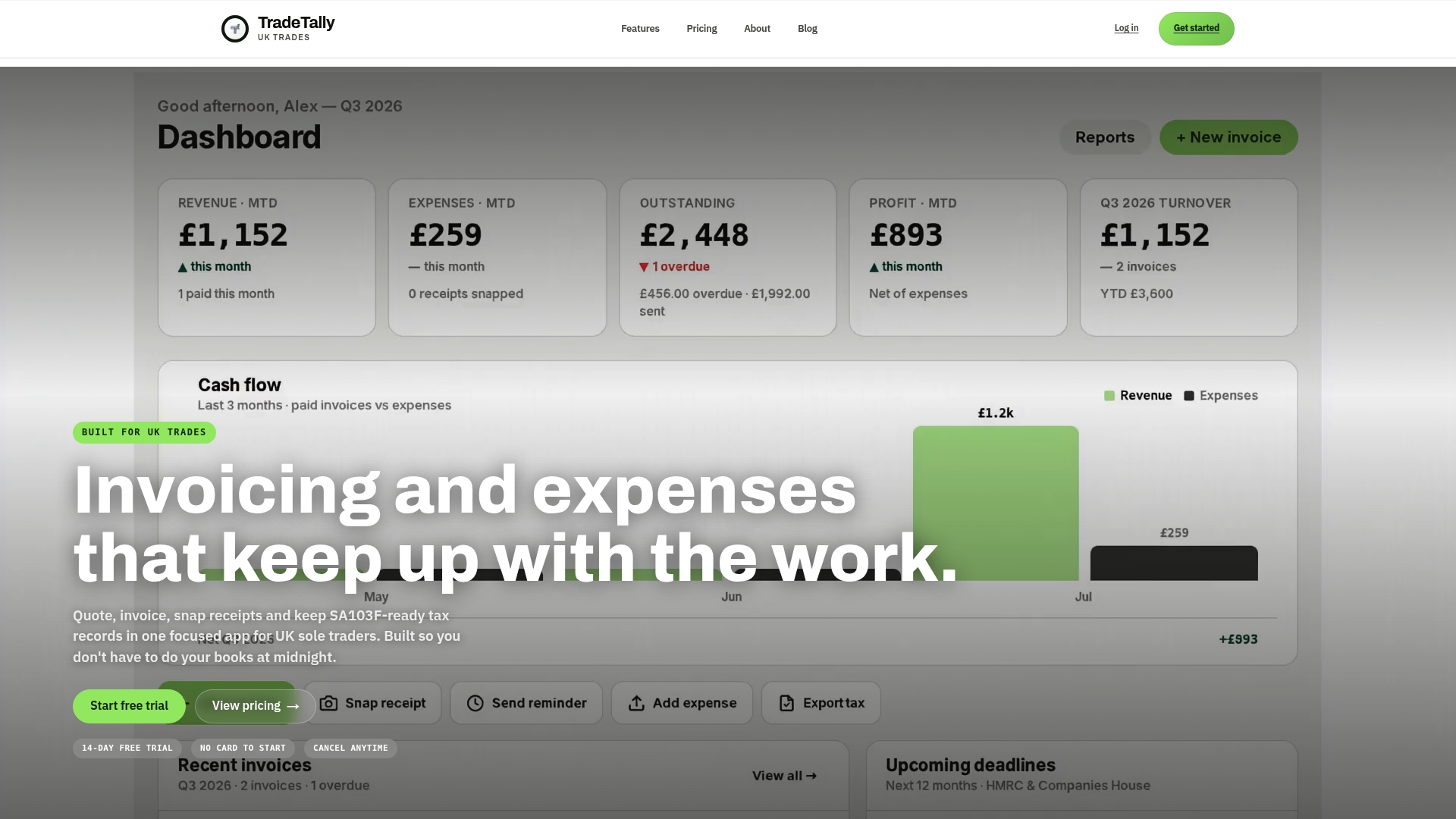
Users can create and send branded invoices easily, capture receipts automatically to avoid the shoebox-of-receipts problem at tax time, and generate exports formatted for SA103F Self Assessment, helping to reduce bookkeeping hours. The Starter plan is free and covers limited invoicing if you want to try the workflow first; the Professional plan runs £12 per month or £120 per year for unlimited invoices, receipts, and tax exports. If your trade is covered by one of TradeTally’s industry-specific setups, the templates are already built around your paperwork. Start with a free invoice template or set up your account at Tradetally and get your invoicing digital before the 2029 deadline forces the issue.
FAQ
What is legally required on an invoice in the UK?
A valid VAT invoice needs a unique sequential number, your business name, address and VAT number, the customer’s details, the invoice and tax point dates, a description of goods or services, the VAT rate and amount in sterling, and the total payable, as set out in HMRC’s VAT record keeping guidance. Missing any of these fields can put your customer’s VAT recovery at risk.
Is e-invoicing mandatory in the United Kingdom?
Not yet, but it will be. E-invoicing becomes mandatory for B2B and B2G VAT invoices from April 2029, following the government’s consultation on promoting electronic invoicing, with a detailed roadmap due at Budget 2026.
Is there a time limit to issue an invoice in the UK?
Yes, VAT invoices should generally be issued within 30 days of the date of supply, which is confirmed in HMRC’s VAT Notice 700/21. This timing also affects which VAT period the tax point falls into, so late issuing can distort your VAT return.
Is Peppol mandatory in the UK?
Peppol will become the standard network for structured e-invoicing once the April 2029 mandate takes effect, chosen by HMRC over a centralised clearance platform. It is not mandatory today, but NHS suppliers already face Peppol requirements for procurement invoicing, giving an early indication of how the wider rollout will work.
How does e-invoicing affect sole traders using TradeTally?
Some digital invoicing tools enable sole traders to create digital, correctly formatted invoices and store receipts electronically, helping them prepare for the 2029 mandate. Such tools often include SA103F export and mobile-first invoicing features designed to keep records MTD-compatible, reducing retrofitting work needed once Peppol-based e-invoicing becomes compulsory.
Recommended
Ready to sort your trade admin?
TradeTally gives UK sole traders invoicing, expenses, and SA103F-ready tax exports in one mobile-first app.
Start 14-day Pro trial →No card required