30 day rule for tradespeople: when a pro forma becomes a VAT invoice
A final invoice is a VAT document and a legal request for payment; a pro forma is a preliminary quote that carries no VAT weight of its own. The test is simple: if goods or services have been supplied or money has changed hands, you need a proper VAT invoice. If you’re still at the quoting or approval stage, a pro forma does the job without creating any tax or accounting obligation.
TL;DR:
- A pro forma invoice is a non-binding estimate used for approvals, deposits, or customs, and does not create a VAT tax point on its own.
- A final VAT invoice is a legal document required for VAT reclaim and creates a tax point when issued or payment is received.
- Payment against a pro forma, such as a deposit, triggers the VAT tax point, and a proper invoice must be issued within 30 days to avoid penalties.
- It is essential to label and record pro formas separately from VAT invoices to prevent accounting errors and incorrect VAT reporting.
- International shipments require a commercial invoice with HS codes and origin details, not a pro forma, to avoid customs delays.
Table of Contents
- Proforma vs invoice: what a final VAT invoice actually is
- Proforma vs invoice: what a pro forma actually is
- Where the two documents overlap
- Proforma vs invoice: the differences that actually carry legal weight
- Proforma vs invoice: the VAT tax point rules you can’t ignore
- Pro forma, commercial invoice, and customs: the international trade angle
- Building a pro forma that leads cleanly to a VAT invoice
- Common pitfalls worth avoiding
- Why this trips up more tradespeople than it should
- Getting your invoicing right without the late-night admin
- Sources
- FAQ
Proforma vs invoice: what a final VAT invoice actually is
A VAT invoice is the legally recognised document that proves a supply has taken place and formally requests payment for it. It’s not just a nice-looking bill. It’s the paperwork HMRC relies on to confirm what was sold, when, and how much VAT applies, and it’s the document your accounting software uses to post a genuine sale into your ledger.
For a VAT invoice to hold up, HMRC expects certain fields as standard:
- A unique invoice number that follows on sequentially from the last one
- Your business name, address, and VAT registration number
- The customer’s name and address
- The date of issue and the date of supply (the tax point)
- A description of the goods or services, quantities, and unit price
- The VAT rate applied and the amount of VAT charged, broken down clearly
- The total amount payable, including VAT
Miss the VAT registration number or the tax point date, and you’ve got a document that won’t stand up if HMRC ever queries a return. Worse, your customer can’t use it to reclaim input VAT, which is often the first thing a supplier hears about when the invoice goes missing a field. Getting the fields right matters more than getting the design right.
Proforma vs invoice: what a pro forma actually is
A pro forma invoice is a preliminary commercial document. Think of it as a formal quotation dressed up to look like an invoice, sent before a sale is finalised, before goods are delivered, or before a deposit lands in your account. Stripe describes it as a preview of a sale rather than the sale itself, and that distinction is the whole point of the document.
Because it resembles a real invoice so closely, it needs clear labelling to avoid confusion. A well-built pro forma includes:
- The words “Pro Forma Invoice, Not a VAT Invoice” prominently at the top
- An estimated total, itemised in the same way a final invoice would be
- Expected delivery or completion dates
- Payment terms, including any deposit requested
- A note that the figures are subject to change before the final invoice is issued
Pro formas earn their keep in a few specific scenarios: giving a buyer something to show their finance department for approval, requesting a deposit before work starts, or providing customs with an estimated value ahead of a shipment. In each case, the document is doing a job that a VAT invoice isn’t designed for.
Where the two documents overlap
The overlap explains why so many sole traders mix them up. Both list the items or services on offer, the quantities involved, and the agreed prices. Both typically include shipping arrangements and payment terms, and both can look, at a glance, like the customer owes you money right now.
A pro forma for a kitchen refit might list cabinet units, worktop metres, and labour hours at the same line-item level as the eventual VAT invoice. A shipment’s pro forma might carry the same product codes and quantities that appear later on the commercial invoice. The visual similarity is exactly why labelling matters. Without a clear heading stating what the document is, a bookkeeper skimming through a pile of paperwork has no way to tell a quote from a bill, and that’s when errors creep into the accounts.
Proforma vs invoice: the differences that actually carry legal weight
Appearance aside, the two documents sit in completely different legal categories, and mixing them up has consequences beyond a red face.
| Final (VAT) invoice | Pro forma invoice | |
|---|---|---|
| Creates a tax point | Yes, on issue or on supply | No, not on its own |
| VAT reclaimable by buyer | Yes | No |
| Posted to sales ledger | Yes | No |
| Legal status | Enforceable request for payment | Informal, non-binding estimate |
| Triggered by | Supply of goods/services or receipt of payment | Quotation, deposit request, or customs estimate |
The tax point, the date that determines when VAT becomes due, is triggered by delivery of goods, completion of a service, or receipt of payment, whichever happens first. A pro forma sitting in someone’s inbox does none of those things. It’s only when a customer actually pays against it that the clock starts.
Get the labelling wrong and the fallout is predictable: a buyer tries to reclaim VAT on a document that was never a VAT invoice and gets rejected, or a bookkeeper posts a pro forma as a sale and the business ends up reporting revenue, and VAT liability, before it’s actually due.
Proforma vs invoice: the VAT tax point rules you can’t ignore
This is where HMRC’s guidance stops being background reading and starts being something you need to get right. HMRC’s VAT manual is explicit: a pro forma invoice does not function as a VAT invoice and does not, by itself, create a tax point. You can send as many pro formas as you like without triggering any VAT obligation.
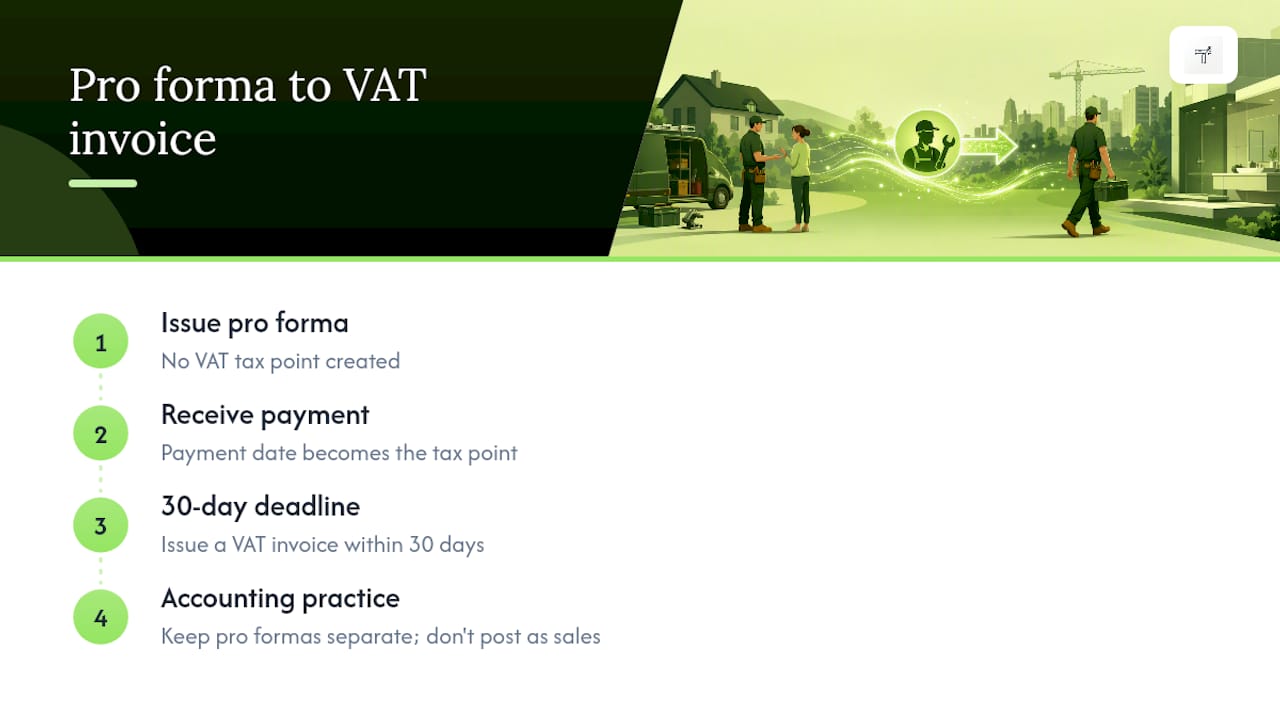
The moment that changes is payment. The instant a customer pays against a pro forma, even as a deposit, that payment date becomes the tax point. From there, you’re on the clock.
The 30-day rule: once a tax point has been triggered, whether by supply or by payment, you must issue a proper VAT invoice within 30 days. Miss that window and you risk penalties, and your customer risks having their input VAT claim challenged.
This is also where the accounting side needs discipline. HMRC’s guidance on VAT trader records warns against posting a pro forma into your nominal ledger as if it were a sale. Do that and you overstate revenue for a period before the sale is real, and you can end up declaring VAT you haven’t actually collected yet. Stripe’s guidance on UK proforma rules makes the same point from a practical angle: a pro forma is useful for collecting deposits and securing approvals, but any money that changes hands against it needs a VAT invoice to follow, without exception.
Keep a simple habit: pro formas live in a separate folder or document type, never in the sales ledger, until they’ve converted into the real thing.
Pro forma, commercial invoice, and customs: the international trade angle
Cross-border shipments bring a third document into the mix, and confusing it with a pro forma causes real delays at the border.
A commercial invoice is the mandatory customs document for any international shipment. It needs specific fields that a domestic invoice often skips entirely: the Harmonised System (HS) code for each item, the country of origin, the agreed Incoterms (who’s responsible for shipping, insurance, and duties at each stage), and a full description of the goods for customs valuation. Business sets out exactly what customs authorities expect to see before they’ll clear a shipment.
A pro forma can sometimes stand in for an early estimate, useful when a buyer needs a value figure to arrange financing or import licences ahead of shipping. But customs will not accept it as final documentation. Once goods actually move, Stripe’s guidance on commercial versus tax invoices is clear that a full commercial invoice is required, and using the wrong document at the border is one of the most common causes of shipment delays.
Before anything leaves the country, check you have:
- A commercial invoice with HS codes and country of origin
- Agreed Incoterms stated clearly
- Accurate customs valuation, not an outdated pro forma figure
- Any export licences relevant to the goods
Building a pro forma that leads cleanly to a VAT invoice
A pro forma template doesn’t need to be complicated, but it does need the right line stopping anyone from mistaking it for the real thing. Include your business details, the customer’s details, an itemised breakdown, an estimated total, and payment terms, then anchor it with a line such as: “This is a pro forma invoice for quotation purposes only. It is not a VAT invoice and does not represent a request for payment.”
From there, the sequence is straightforward:
- Send the pro forma to the customer for approval or to request a deposit.
- Wait for confirmation, or for payment to land against it.
- The moment payment is received or the work is completed, note the tax point date.
- Issue a full VAT invoice within 30 days of that tax point, using the pro forma’s figures as your starting point.
- File the pro forma separately from your sales records; only the VAT invoice gets posted as a sale.
Pro Tip: Set up a distinct document type for pro formas in your accounting software rather than duplicating your invoice template with the word “pro forma” typed on top. Software that treats them as separate document classes won’t accidentally pull a pro forma into your VAT return.
Common pitfalls worth avoiding
Most of the mess around pro formas comes down to a handful of repeatable mistakes, and they’re all avoidable with a bit of process discipline.
- Never post a pro forma into your sales ledger. It isn’t a sale and shouldn’t look like one in your books.
- If a customer pays a deposit against a pro forma, issue an interim VAT invoice for that amount straight away rather than waiting until the job’s finished.
- Use accounting software that keeps quotes, pro formas, and invoices as genuinely separate document types, not just relabelled copies of each other.
- Chase the 30-day rule actively. It’s easy to lose track of a tax point date buried in an email thread from weeks ago.
Pro Tip: If you regularly take deposits before starting a job, build the interim VAT invoice step into your standard workflow rather than treating it as an exception. It saves the scramble at year end when your accountant asks why a job’s total doesn’t match your VAT return.
Why this trips up more tradespeople than it should
Most of the confusion around pro formas doesn’t come from a lack of intelligence. It comes from busy people trying to move fast between a quote, a deposit, and a finished job, without a clean line between the three.
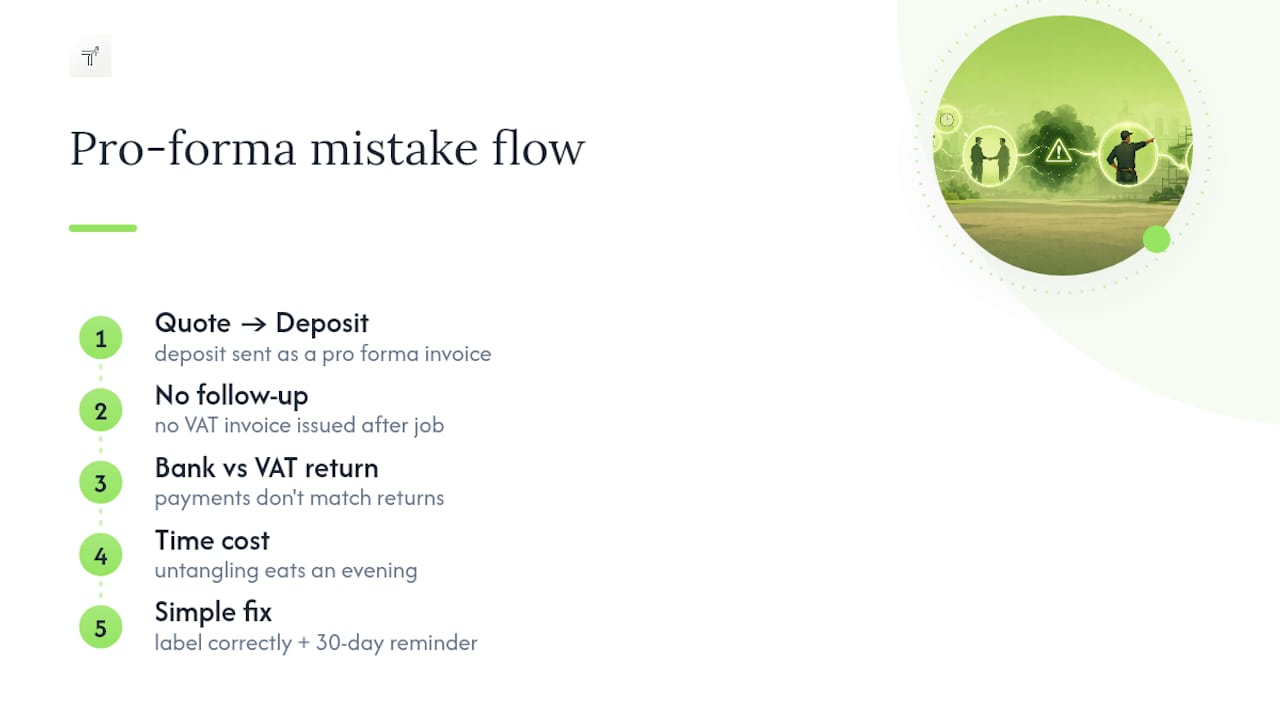
The pattern I see most often is a plumber or electrician sending a quick “invoice” for a deposit, which is really a pro forma in disguise, then forgetting to follow it with a proper VAT invoice once the job’s done. Weeks later, their VAT return doesn’t match their bank statement, and untangling it eats an evening that should have been spent anywhere else.
The fix isn’t complicated. It’s a labelling habit and a 30-day reminder, nothing more. But small habits like this are exactly what get skipped when you’re doing the books at 11pm after a full day on site, which is precisely the gap that specialized financial management tools aim to close.
— Simon
Getting your invoicing right without the late-night admin
There are other ways to handle this, spreadsheets, generic invoice templates, or a folder of Word documents relabelled by hand each time. They work, until the labelling slips and a pro forma ends up in the sales ledger by mistake. Some financial management apps for sole traders keep pro formas and VAT invoices as genuinely separate document types from the start, helping ensure there’s no risk of one masquerading as the other in your records.
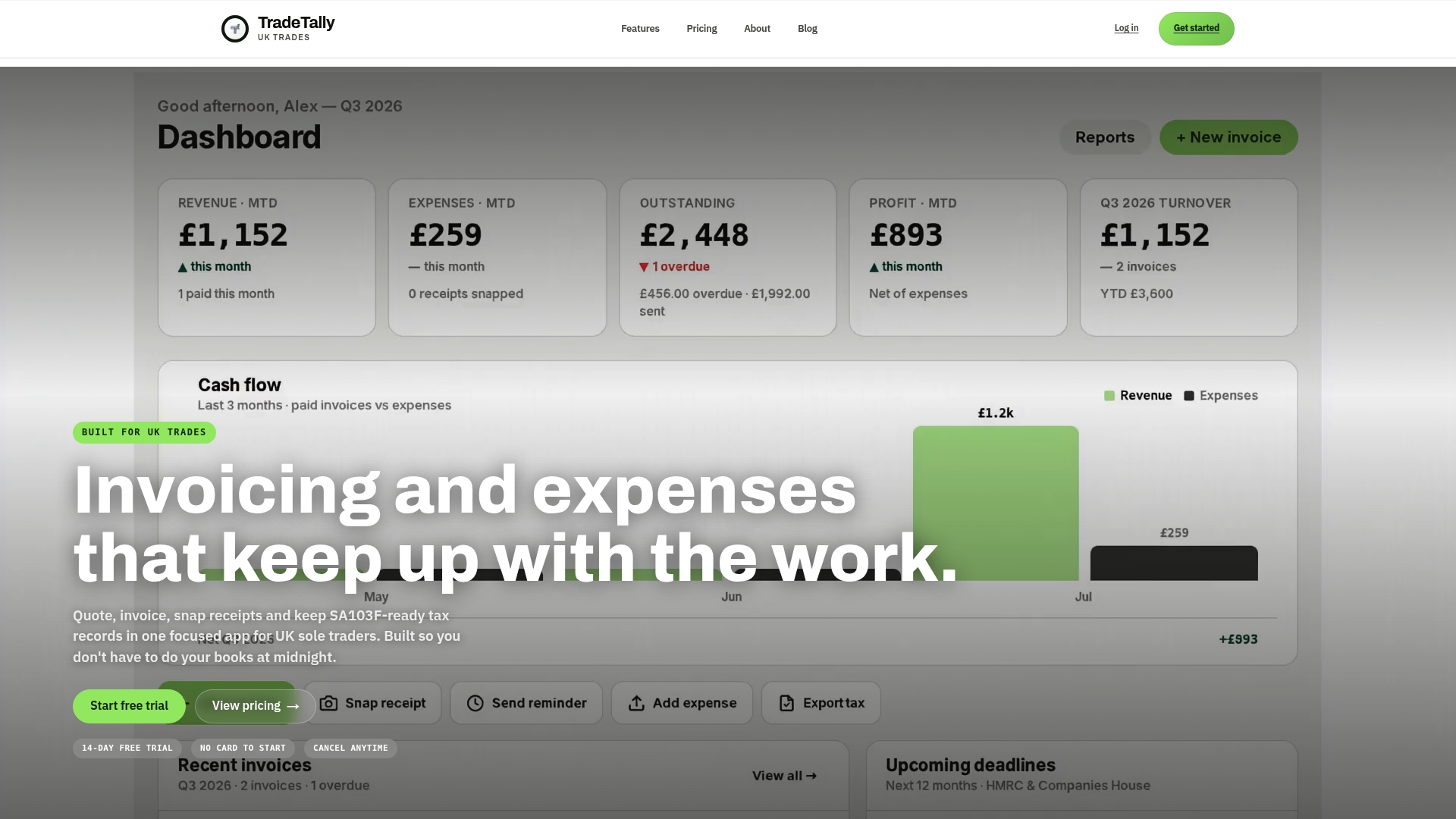
Create a branded quote in seconds, convert it to a VAT invoice the moment a job’s confirmed, and let the app handle the 30-day tax point tracking in the background. Every invoice and expense feeds straight into tax-ready records with SA103F export, so Self Assessment stops being a scramble every January. Whether you’re a builder, a carpenter, or working any other trade, you can check your figures on the Self Assessment tax calculator and see exactly what your books look like before you commit. Start with Tradetally’s free tier today and issue your first branded invoice from the van, before the kettle’s even boiled.
Sources
For the legal detail behind the rules covered here, HMRC’s VAT trader records manual sets out the tax point and invoicing requirements directly from the source. Sage’s guide to pro forma invoices and AccFirm’s UK business guide both offer practical examples worth bookmarking for quick reference.
- HMRC internal manual: VAT trader records (VATREC9020)
- Pro Forma Invoice vs. Tax Invoice: What to know (Stripe)
FAQ
What’s the difference between a proforma invoice and a bill?
A bill, or final VAT invoice, is a legal request for payment tied to a completed supply and a specific tax point. A proforma invoice is a preliminary estimate sent beforehand and carries no legal payment obligation on its own.
Is it okay to pay a proforma invoice?
Yes, customers can pay against a proforma, most commonly as a deposit, but that payment creates a tax point immediately. The seller must then issue a proper VAT invoice within 30 days of receiving that payment.
What’s the difference between a proforma invoice and a purchase invoice?
A purchase invoice (from the buyer’s side, a supplier’s VAT invoice) is the finalised, legally binding document used for accounting and VAT reclaim. A proforma is only an estimate and cannot be used to reclaim VAT under any circumstances.
Why do companies issue proforma invoices?
Businesses use proforma invoices to secure buyer approval, request deposits before starting work, or give customs an estimated value ahead of a shipment, all without triggering VAT or sales-ledger entries. Software like Tradetally keeps these as separate document types precisely so they never get mistaken for a finalised sale.
Recommended
Ready to sort your trade admin?
TradeTally gives UK sole traders invoicing, expenses, and SA103F-ready tax exports in one mobile-first app.
Start 14-day Pro trial →No card required