E-Invoicing in the UK: What Tradespeople Need to Know

E-invoicing in the UK is not mandatory for most trade work today, but it is coming. HMRC’s roadmap says VAT-registered businesses will have to issue and receive VAT invoices as e-invoices from 1 April 2029. If you are a sole trader below the VAT threshold, nothing changes on that date. If you are VAT-registered, or about to be, the sensible move is to get your invoicing into one tidy system now. That is what TradeTally is built for: branded invoices, receipts and tax-ready records in one place, on your phone, from the van.
TL;DR
- E-invoicing means an invoice issued and received as structured data that software can read automatically. A PDF you email is not the same thing.
- The UK requirement is due from 1 April 2029 for VAT-registered businesses, including sole traders. The detailed rules are still to be published.
- If you are not VAT-registered, the mandate does not apply to you yet, but your customers may ask for e-invoices if they are.
- You do not need to do anything technical today. You do need numbered, complete invoices and receipts stored in one place.
- Clean records now make any later switch far easier.
Table of Contents
- What e-invoicing actually is
- Is e-invoicing mandatory in the UK?
- Does it apply to you as a sole trader?
- Do your invoices work today? What a VAT invoice must contain
- What HMRC already says about electronic invoices
- Why this matters even if 2029 feels far away
- A practical readiness checklist for tradespeople
- What it looks like on a real job
- Where e-invoicing sits next to Making Tax Digital
- Our view
- Getting your records in order with TradeTally
- FAQ
- Sources
What e-invoicing actually is
Most tradespeople already invoice electronically in the everyday sense: a PDF, sent by email or WhatsApp. In the formal sense, that is not an e-invoice.
The European Commission explains that a true e-invoice is issued, sent and received in a structured data format that allows automatic processing. PDFs and other visual files generally need someone to read them and key the figures in by hand.
Put simply:
- PDF invoice: a picture of an invoice. Your customer’s bookkeeper types the numbers into their system.
- E-invoice: the same information as labelled data (invoice number, date, net amount, VAT, and so on). Their software imports it with no typing.
The benefit is fewer errors, faster processing and, in theory, faster payment. The catch for a one-person business is that you rarely build the data file yourself. Your software does it.
Is e-invoicing mandatory in the UK?
Not yet for most businesses. Here is the position as the government has set it out.
- From 1 April 2029: HMRC’s e-invoicing implementation roadmap says VAT-registered persons will need to issue and receive VAT invoices as e-invoices unless an exemption applies. It names businesses, sole traders, partnerships, charities and public bodies.
- October 2027 to April 2028: the roadmap says detailed scope, standards and exemptions are due in this window.
- April 2028 to April 2029: the roadmap sets this period aside for communications, preparation, testing and onboarding.
- Peppol: the roadmap names Peppol, an international network and set of standards for exchanging e-invoices, as the core interoperability framework.
HMRC’s tax information and impact note, published on 28 October 2026, says enabling powers will support e-invoicing and that scope, technical requirements and exemptions will follow in regulations or an HMRC notice. In other words, the date is fixed but the small print is not.
The roadmap also says no decision has been taken to add digital reporting (sending invoice data to HMRC in real time) alongside e-invoicing. Any such step would need a separate policy decision.
Pro tip: treat 2029 as a planning date, not a panic date. Nobody can tell you the exact technical format yet, and anyone claiming otherwise is guessing.
Does it apply to you as a sole trader?
The test is VAT registration, not the size of your van.
The roadmap ties the requirement to VAT invoices. It follows the existing VAT context: typically taxable supplies between VAT-registered persons. It also says VAT invoices are not required for consumer supplies, and that the full list of exclusions is still to be confirmed.
For a typical tradesperson, that gives three situations:
| Your situation | What it means |
|---|---|
| Not VAT-registered, mostly domestic customers | No mandate expected to apply to you. Keep invoicing professionally. |
| Not VAT-registered, but growing | Watch your turnover. Once you pass the registration threshold you join the VAT invoicing rules. |
| VAT-registered, working for contractors, landlords or businesses | You are the person the 2029 requirement is aimed at. |
On the threshold: the House of Commons Library notes that businesses must register for VAT when taxable turnover goes above £90,000. Check the current figure on GOV.UK when you plan, because thresholds can change at a Budget.
If you are VAT-registered by choice because you want to reclaim VAT on materials, the same applies to you.
Do your invoices work today? What a VAT invoice must contain
Before thinking about formats, make sure the basics are right. A badly built invoice does not become a good e-invoice by changing its file type.
HMRC’s VAT Notice 700/63 lists what a VAT invoice needs:
- A unique, sequential invoice number.
- The date of supply and the date of issue.
- Your name, address and VAT number.
- Your customer’s name and address.
- A description of the goods or services.
- The unit price, and the quantity or extent of the service.
- The VAT rate.
- The amount excluding VAT.
- Any cash discount rate.
- The total VAT charged, in sterling.
The unique sequential number is where tradespeople most often slip. Duplicate numbers, gaps after a deleted draft or a number typed from memory all cause questions later. Our guide to invoice numbering for tradespeople shows how to make it automatic, and our piece on UK invoice requirements and VAT reclaim delays covers the rest of the checklist. If you are not VAT-registered, what a sole trader invoice must include is the shorter list to follow.
What HMRC already says about electronic invoices
Electronic VAT invoices are not new. Notice 700/63 already allows them, and it tells you what has to be true for them to count.
The notice defines electronic invoicing as the electronic transmission and storage of invoices without duplicate paper documents. Under the current notice the format can be structured, such as XML, or unstructured, such as PDF. That is why a PDF is acceptable today even though it is not an e-invoice in the structured sense that the 2029 rules are expected to require.
The conditions in the notice are practical:
- Authenticity: your customer can be sure the invoice came from you.
- Integrity: the content has not been altered.
- Legibility: it can be read clearly.
- Agreement: your customer agrees to receive invoices electronically.
On storage, the same notice says copies of VAT invoices must normally be kept for six years. Electronic storage must preserve the related data and evidence, allow the original invoice data to be recreated and keep history files.
The notice also advises checking that your customer’s system accepts the format you choose. That one is worth doing before you send your first invoice to a new commercial client, not after they have rejected it.
Why this matters even if 2029 feels far away
Three reasons to act early, none of them requiring a technical setup.
1. Bigger customers move first. Main contractors, housing associations and facilities managers run accounts-payable systems. Invoices that are complete, numbered and consistent are easier for them to process, and that tends to mean quicker payment. Our article on UK invoicing compliance before April 2029 looks at this for people who want to keep public sector and contractor work.
2. Your records are your defence. Six years is a long time to keep invoices. If they live across email, a camera roll and a glove box, you will not find them when HMRC or your accountant asks.
3. Switching is easier from clean data. If your invoices, customers and receipts sit in one system with consistent fields, moving to a structured format later is a software update, not a rebuild.
A practical readiness checklist for tradespeople
Use this once, then keep it up.
- Decide whether you are, or soon will be, VAT-registered. Track your rolling 12-month turnover.
- Use one invoice template. Same layout, same fields, your business name and details every time.
- Number invoices automatically. No typing numbers by hand.
- Record each customer once. Full name, address and, for business customers, VAT number.
- Describe the work properly. “Replace boiler, 1 x 24 kW” beats “labour and parts”.
- Capture receipts the same day. Photograph them on site, before they fade or go in the bin.
- Handle CIS deductions on the invoice. If you are a subcontractor, the deduction should be recorded where the job is recorded. Our CIS explained guide covers the basics.
- Keep everything for six years, in a form you can retrieve.
- Ask commercial customers how they want to receive invoices. Do this when you start the job.
- Check GOV.UK each year for the published scope and standards once they appear.
What it looks like on a real job
Take an electrician doing a rewire for a small letting agent. The agent is VAT-registered and passes invoices to a bookkeeper.
With the old routine, you write the invoice in a notes app at the end of the week, export a PDF, and email it. The bookkeeper retypes the number, the net amount and the VAT. A typo in the VAT number gets it bounced. Your materials receipts are in three places.
With one system, you build the invoice from the job in minutes, with the number added for you, the customer’s details filled in, and the receipts for that job attached. The data is consistent, which is exactly what any future structured format needs.

If you want to see how this plays out in a particular trade, we have pages for electricians, plumbers and builders.
Where e-invoicing sits next to Making Tax Digital
Making Tax Digital (MTD) is a separate programme. It is about keeping digital records and reporting income tax and VAT through software. E-invoicing is about how an invoice itself travels between you and your customer.
They point the same way: records kept digitally, in consistent form, from the moment the work is done. That is why tidy invoicing and receipt capture now help with both. TradeTally keeps MTD-ready records and exports formatted for SA103F, the self-employment pages of the Self Assessment return, so the same entries serve your invoices, your expenses and your tax return.
Our view
We are tradespeople first. TradeTally was built by a working tradesperson, for the admin that follows a day on site.
E-invoicing sounds like a big-business topic, and most of the noise around it is aimed at finance teams. But the rule, when it arrives, lands on sole traders too, if they are VAT-registered. The people who will find it easiest are the ones whose invoices are already complete, numbered and stored in one place.
That is why we put invoicing, receipts, expenses, CIS deductions and a live profit view in a single mobile-first app. You do the paperwork from the van in a few minutes, not on a Sunday night. When the detailed rules are published, your records will already be in good order.
We would rather you start with the basics today than wait for 2029 and scramble.
Simon
Getting your records in order with TradeTally
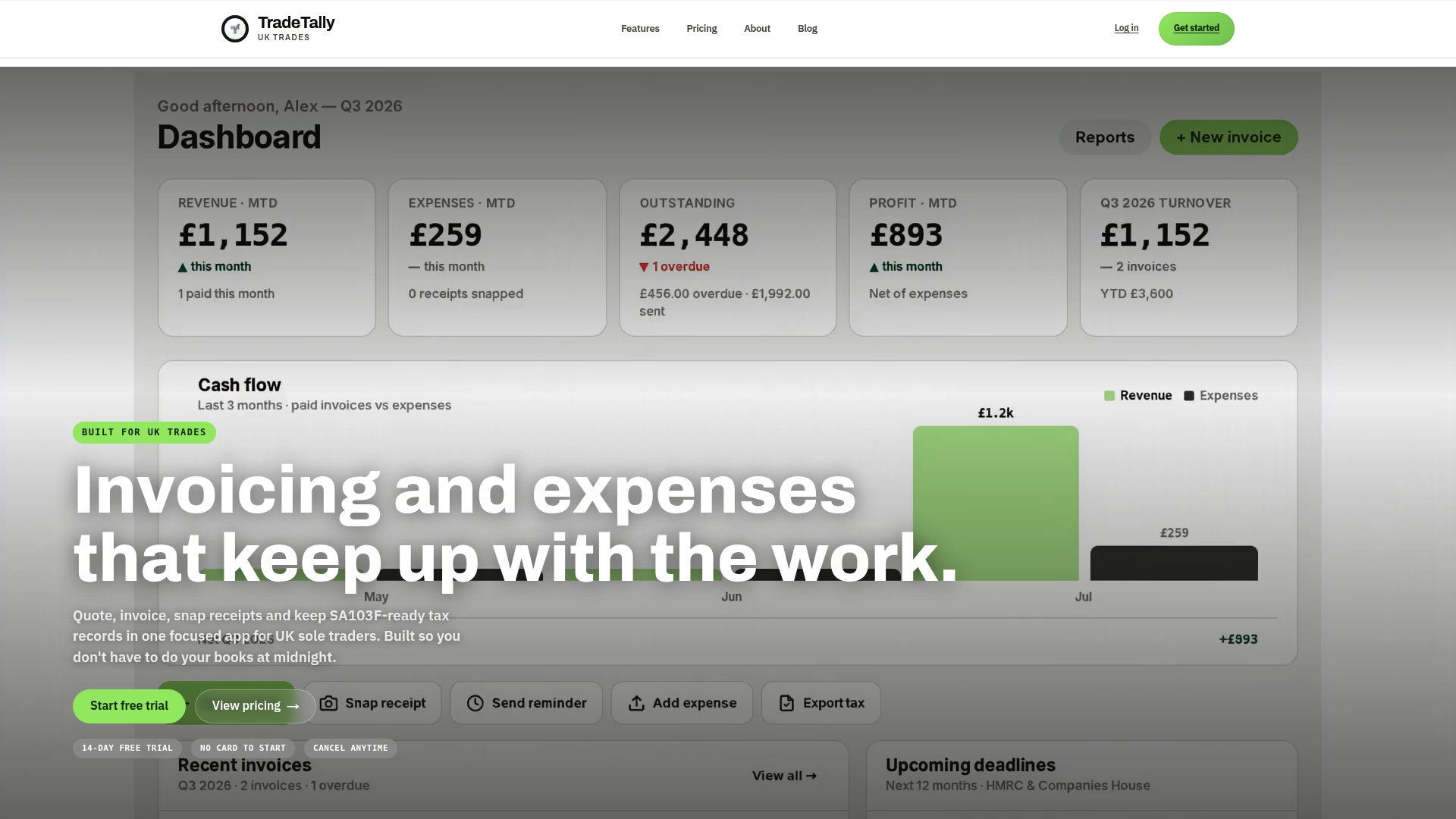
TradeTally is a UK web and mobile app for sole tradespeople. It covers branded invoicing, quotes, a live profit dashboard, expense and receipt tracking, CIS deduction handling, mileage and time tracking, and tax-ready exports for Self Assessment and your accountant.
The Starter plan costs £0 per month and covers limited invoicing. Professional costs £12 per month, or £120 per year, and gives you unlimited invoices, receipts and tax exports. You can see both on our pricing page, or start from the TradeTally home page.
If you work under CIS, our CIS invoice software page shows how deductions are handled on the invoice.
FAQ
Is e-invoicing compulsory for sole traders in the UK?
Only if you are VAT-registered, and only from 1 April 2029 under the current roadmap. The roadmap names sole traders among the VAT-registered persons covered. Sole traders below the VAT threshold are not covered by the VAT invoice requirement, though the final exemptions are still to be confirmed.
Is a PDF invoice an e-invoice?
Not in the structured-data sense. A PDF is a visual document that someone has to read and key in. HMRC’s current VAT notice still accepts PDFs as electronic invoices, but the 2029 requirement is aimed at structured formats. The detailed standards are due between October 2027 and April 2028.
What is Peppol?
Peppol is an international network and set of standards for exchanging e-invoices between suppliers and customers. The government’s roadmap names it as the UK’s core interoperability framework. As a sole trader you would normally reach it through your invoicing software, not directly.
Do I need to do anything now?
No technical step is required today. The useful steps are to keep invoices complete and sequentially numbered, store receipts and invoices for six years, and track your turnover against the VAT threshold. Check GOV.UK for updates as the detailed rules are published.
Sources
- Roadmap for e-invoicing implementation, GOV.UK
- VAT: electronic invoicing, GOV.UK
- E-invoicing digital reporting consultation, GOV.UK
- Electronic invoicing (VAT Notice 700/63), GOV.UK
- What is eInvoicing, European Commission
- VAT Registration, House of Commons Library
Recommended
Related articles

UK Invoicing Compliance for Public Sector Work
HMRC's April 2029 e-invoicing deadline requires UK VAT-registered businesses to send Peppol-structured invoices. Practical MTD and trades-ready steps to...
UK Invoice Requirements for Tradespeople
UK invoice checklist for tradespeople: when £250 simplified VAT invoices apply, keep records for six years, and use software to avoid VAT reclaim delays.

VAT Flat Rate Scheme: Is It Worth It for Tradespeople?
How the VAT Flat Rate Scheme works for UK tradespeople: who can join, the 16.5% limited cost rate, worked examples against standard VAT, and how to choose.

PO Number on an Invoice: Where It Goes and How to Get It Right
What a PO number on an invoice is, where to put it, how to get it from the customer, and what to do when it is missing, written for UK sole traders.