PO Number on an Invoice: Where It Goes and How to Get It Right

A PO number is the reference your customer gives to the purchase order (PO) they raise for your job. You copy it onto your invoice, exactly as given, so their accounts team can match your bill to the order they approved. It is not your invoice number, and the law does not require it on every invoice. But for many customers, councils, universities and larger contractors especially, an invoice without it simply does not get paid. Our invoicing app lets you keep the customer’s PO reference with the job, so it is on the invoice when you send it.
TL;DR
- A PO number belongs to the customer and identifies their order. Your invoice number belongs to you and identifies your bill. Never swap them.
- Put the PO number in the invoice header, in its own labelled field, copied character for character.
- Ask for the PO when you are booked, not when you invoice. If the customer says none is needed, get that in writing.
- One invoice, one PO. Never guess or invent a number: leave the field off and chase the customer.
- Many public bodies run “No PO, no pay” rules, so a missing or wrong number can stall payment.
Table of Contents
- What a PO number is, and what it is not
- Is a PO number legally required on an invoice?
- Where to put the PO number on your invoice
- How to get the right PO number before you invoice
- Why customers match invoices to POs
- What to do if the PO number is missing or wrong
- A worked example
- Perspective
- Keep PO numbers and invoices in one place
- FAQ
- Sources
What a PO number is, and what it is not
A purchase order is a document a customer issues to say “we want this work or these goods, at this price”. Each one carries a unique reference, the PO number, usually a mix of letters and numbers. A UK collections firm’s guide describes it as a reference unique to the order that should be quoted throughout the transaction, so that the invoice, already pre-approved under that number, can be paid promptly.
The key point for a tradesperson is who owns which number:
| PO number | Invoice number | |
|---|---|---|
| Who creates it | Your customer | You |
| What it identifies | The order (the commitment to buy) | Your bill (the demand for payment) |
| Where it comes from | The customer’s purchasing system | Your invoicing software |
| Format | Whatever the customer uses | Your own sequence |
The invoice number is yours: UK VAT invoices have needed a sequential number from a unique series since 1 October 2007. If you want to set that up properly, our guide to automatic invoice numbering covers it.
Mixing them up is a quiet mistake. As one analysis of invoice processing puts it, an invoice with your own number in the PO field looks complete, then fails when the customer looks the number up against their open orders and finds nothing.
Is a PO number legally required on an invoice?
No. GOV.UK lists what a UK invoice must include: a unique identification number, your name, address and contact details, the customer’s name and address, a clear description of what you are charging for, the supply date, the invoice date, the amounts charged, VAT if applicable, and the total owed. A PO number is not on that list.
If you are VAT registered, a full VAT invoice has further requirements, including your VAT registration number, quantity and unit price, and the VAT rate and amount, set out in Regulation 14 of the VAT Regulations 1995.
The PO number is a requirement the customer sets. That is why it matters so much: it is their rule, and they decide whether to pay against it.
Who insists on one
Public bodies are the clearest case. Under “No PO, no pay” policies:
- The DWP will not pay suppliers who do not quote a valid DWP purchase order number on the invoice, and it sends the order before work starts.
- Devon County Council says invoices without a correct, valid PO number will not be paid, and its 30-day payment clock does not start until the invoice is valid and undisputed.
- The University of Southampton says it cannot pay an invoice without the PO number shown.
- Manchester City Council returns invoices that lack a valid PO number. Its own order numbers are ten digits long and start with 41.
Housing associations, facilities management firms and larger main contractors often work the same way. If you take on subcontract work for any of them, assume a PO is needed until told otherwise. Our guide on keeping public sector work covers the wider compliance picture.
Where to put the PO number on your invoice
Put it in the header, in a field of its own with a clear label such as “PO number”, next to your invoice number, invoice date and the customer’s account reference. Copy the customer’s number exactly: same prefix, same dashes, same leading zeros.
Three rules keep the invoice clean:
- One PO per invoice. A major bank’s supplier guide says each invoice should reference one PO only, and that incorrect PO or line numbers are a common cause of payment delays. If a job runs under two orders, send two invoices.
- One invoice per document. The DWP lists more than one invoice in a single PDF as a reason to dispute payment, so send each invoice as its own file.
- Match the order. Your description, dates and amounts should line up with what the PO covers.
For how a full invoice should be laid out for builders, see our builders’ invoice template.
How to get the right PO number before you invoice
This is the step that saves you the most chasing. The Small Business Commissioner advises asking for a PO number early to avoid delays in submitting your invoice, and lists it among the essential invoice details when you have been given one.
A simple routine:
- Ask at booking. “Do you use purchase orders, and who sends them?” Do it when you agree the job, alongside the price. A clear written quote helps here, and this guide to subcontractor quotations shows what to put in one.
- Ask when it will arrive. Some customers raise the PO after the work, so find out the timing rather than waiting in silence.
- Get “no PO needed” in writing. A short email is enough. It protects you if their accounts team queries the invoice later.
- Check it on arrival. Read the number, the amount and the description against your quote. If the PO is lower than your price, say so before you start, not after.
- Never guess. If you do not have a number, leave the field off rather than inventing one.
If you work for several customers at once, a system matters. Our piece on invoicing multiple clients sets one out.
Why customers match invoices to POs
It helps to know what happens on their side. When a PO number is quoted, the DWP’s system tries to match it to the order on record. If validation fails, payment goes on hold. That can happen if:
- your invoice total is higher than the PO amount;
- your invoice has more lines than the PO;
- the customer has not yet confirmed that the work or goods were received.
Larger organisations often run what is called three-way matching: the invoice is checked against both the PO and a record of what was delivered before payment is released, as Spendesk describes. So a variation on site that is not reflected in an updated PO is a common reason for a held invoice. Ask for a revised PO whenever the scope or price changes.
What to do if the PO number is missing or wrong
Catch it before sending where you can. If it has gone out wrong, act fast:
- Contact the person who instructed the work, not just the accounts inbox. Octavia’s supplier FAQ says an invoice sent without a PO number is returned, and the supplier should ask the staff member who gave the instruction to provide one, then resubmit.
- Check the usual causes. The DWP’s list of dispute reasons includes a PO that is closed or out of date, a number that does not match the order, a number that does not fit the invoice description or dates, and several POs on one invoice.
- Reissue cleanly. Send a corrected invoice with the right number. Keep the same invoice number only if the first was rejected and never processed; if in doubt, ask their accounts team which they prefer, and keep a record.
- Note the payment clock. With some bodies the payment period does not start until the invoice is valid, so a quick fix protects your cash flow. Our guide to invoice payment terms explains how to set terms that are clear from the start.
A worked example
An electrician quotes £1,850 to rewire a flat for a housing association. At booking she asks about purchase orders and is told one will follow by email. It arrives as 4100123456 for £1,850. She checks it against her quote, then invoices with that number in the header field, a description that mirrors the PO, and one invoice for that one order.

Midway, the client asks for an extra circuit at £240. She asks for a revised PO before doing it. The final invoice then matches the order total, and the customer’s system passes it without a query. The example is illustrative, but the sequence is the one the policies above reward.
Perspective
Most PO problems we hear about from tradespeople are not about the number itself. They are about timing. The job gets done, the invoice goes out, and only then does someone in accounts say the PO is missing.
Our view is that the PO number should be treated like the job address: something you capture at the start and keep with the job. It then flows onto the invoice without retyping, which is where typos creep in.
TradeTally is built by a working tradesperson for the admin that follows a day on site. Branded invoices you can send from your phone, in the van, mean the invoice goes out while the job is fresh and the details are to hand.
Simon
Keep PO numbers and invoices in one place
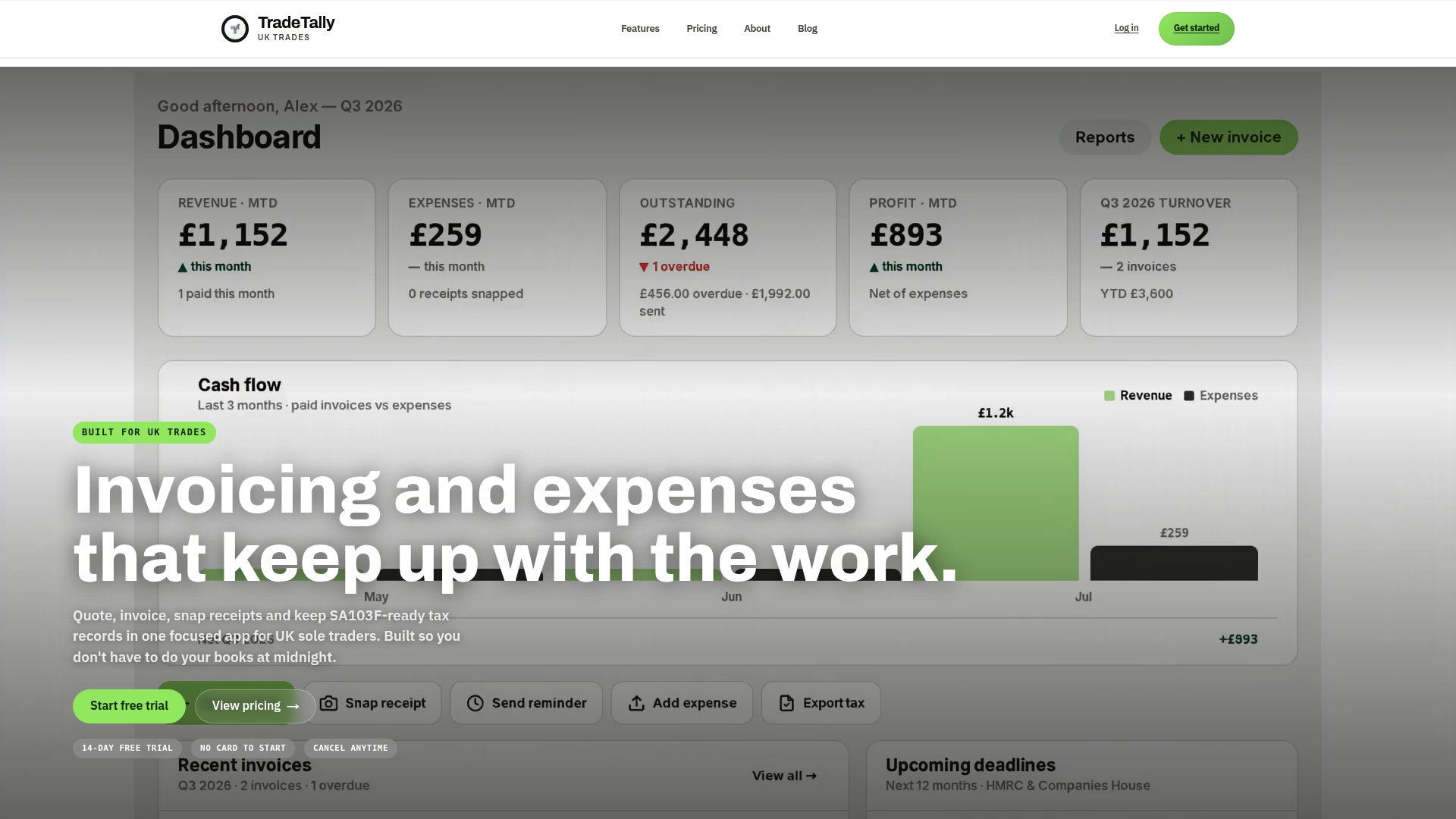
TradeTally is a UK web and mobile app for sole tradespeople. It covers branded invoicing, quotes, expense and receipt tracking, CIS deduction handling, mileage and time tracking, and tax-ready records with an SA103F export for Self Assessment. The Starter plan is free for limited invoicing. The Professional plan is £12 per month or £120 per year, for unlimited invoices, receipts and tax exports. See the plans and pricing or start on the Starter plan.
If you work under CIS, our CIS invoice software page shows how deductions are handled on the same invoice.
FAQ
Can I invoice without a PO number?
Yes, if the customer has not asked for one. The law does not make it a mandatory invoice detail. If the customer does use POs, ask for the number first, because many will return or hold an invoice without it. If they say none is needed, keep that in writing.
Is a PO number the same as an invoice number?
No. The customer creates the PO number to identify their order. You create the invoice number to identify your bill, in your own unbroken sequence. Each goes in its own labelled field.
Is a purchase order the same as a payment?
No. A PO is an instruction to supply, which in an ordinary business-to-business deal may form part of a binding contract depending on its wording. Payment only follows once you invoice and the invoice passes the customer’s checks.
Can I put two PO numbers on one invoice?
It is best not to. Guidance from the DWP lists more than one PO on an invoice as a reason it may be disputed. Send a separate invoice for each purchase order.
Sources
- Using PO Numbers, Direct Route Collections
- What is an invoice number? UK rules explained, Transalis
- What Is a PO Number? Where It Sits on Your Invoice
- GOV.UK: Invoices, what they must include
- Spendesk: VAT receipts
- GOV.UK: DWP No Purchase Order, No Pay Policy
- Devon County Council purchase order policy
- University of Southampton: information for suppliers
- Manchester City Council: purchase order information
- Lloyds Banking Group: what to include on your invoice
- Small Business Commissioner: Getting invoices right
- Octavia: No PO No Pay supplier FAQs
- Spendesk: Purchase order processes
Recommended
Related articles
Invoice Numbering for UK Trades
Clear UK rules for sole traders and tradespeople. Use sequential, gap proof invoice numbers and mobile automation to keep records audit ready and HMRC...

Multiple Client Invoicing for Sole Traders
How to invoice several clients at once without mix-ups: numbering, templates, CIS, chasing and tracking, written for UK sole traders in the trades.

Carpenter Invoice Templates With CIS Wording
Get three editable UK carpenter invoice templates, HMRC’s required fields, and exact CIS and VAT reverse charge wording for faster site paperwork.

Chasing Overdue Invoices in the UK: A Step-by-Step Guide for Tradespeople
How to chase overdue invoices in the UK: when an invoice is late, what to say, when to add interest and £40–£100 compensation, and when to go to court.