Mobile invoice numbering UK: make numbers automatic for tradespeople
Every invoice you raise in the UK needs a unique, sequential number, and if you’re VAT-registered, that number must come from an identifiable series with no gaps you can’t explain. The format is largely up to you, whether that’s plain digits, a year prefix, or a client code, but the sequence itself has to be verifiable from one invoice to the next. HMRC cares far more about traceability than style.
TL;DR:
- VAT-registered businesses must maintain sequential invoice numbers within each series, with no unexplained gaps, to pass VAT inspections.
- Using automated invoicing tools that lock numbering sequences and prevent reusing or skipping numbers reduces audit risks and simplifies record keeping.
- Explaining any gaps or voided invoices with clear audit notes is crucial for compliance, especially if invoices are canceled or skipped during the year.
- Changings formats should only happen at clean break points, such as the start of a new tax year, with a documented note of the switch to avoid overlaps.
- Simple, consistent numbering schemes like sequential or year-prefix formats work best for small tradespeople managing multiple invoices annually.
Table of Contents
- Invoice numbering UK: what HMRC and the law actually require
- Common invoice number formats and practical examples
- What to do about gaps, voided invoices and duplicates
- Setting up an invoice numbering system that won’t let you down
- Publisher perspective: why numbering discipline saves tradespeople more than time
- Tradetally: automate compliant invoice numbering from your van
- Sources
- FAQ
Invoice numbering UK: what HMRC and the law actually require
Gov is blunt about it: an invoice must include a unique identifying number, alongside your business details, the customer’s details, a description of the goods or services, and the date. That applies whether you’re VAT-registered or not. Miss it off, and technically your invoice isn’t valid.
Where things tighten up is VAT. HMRC’s internal manual, VATREC5010, states that a VAT invoice must carry “a sequential number based on one or more series which uniquely identifies the document.” That wording matters. It doesn’t say every invoice needs one single unbroken chain forever, but it does say each series you use must itself run in order with no unexplained holes.
This isn’t just HMRC guidance you can shrug off. Regulation 14 of the VAT Regulations 1995 puts the same requirement into statute, so it’s a legal obligation for VAT-registered traders, not a suggestion.
In practice, that leaves two tiers:
- Non-VAT businesses: you need a unique number on every invoice, but the rules on series and sequence are looser.
- VAT-registered businesses: your numbers must run sequentially within a series, and that series has to hold up under scrutiny during a VAT inspection.
If you’re below the VAT threshold, focus on uniqueness. Once you register, sequence becomes the thing an inspector will actually check.
Common invoice number formats and practical examples
There’s no single mandated format. HMRC cares about sequence and uniqueness, not whether you use hyphens or how many digits you pad with.
Simple sequential is the easiest to maintain: INV-0001, INV-0002, and so on. Zero-padding (four digits rather than one) keeps everything sorting correctly once you pass invoice number 9 or 99, which matters more than people expect when you’re scrolling through a spreadsheet at 11pm looking for one missing job.
Year-prefixed sequences like 2026-001 let you reset the counter each tax year without creating duplicates, because the year itself acts as a second identifier. This is a genuinely useful compromise for a self-employed electrician who might rack up a few hundred invoices annually and doesn’t want six-digit numbers by year three, an approach backed by practical UK invoicing guidance.
Alphanumeric and client-prefixed formats, such as SM-JON-014 for a job at the Jones property, help with filing but only work if there’s still an unbroken master sequence underneath. Use the prefix for your own convenience, not as a replacement for order.
| Format style | Example | Best suited to |
|---|---|---|
| Simple sequential | INV-0001 | Freelancers with low invoice volume |
| Year-prefixed | 2026-001 | Sole traders resetting annually |
| Client/project prefix | SM-JON-014 | Tradespeople juggling multiple sites |
| Combined | 2026-SM-014 | Small businesses wanting both traceability and filing ease |
Whichever format you pick, download a free UK sole trader invoice template and lock the numbering pattern in from invoice one. Changing your mind halfway through a tax year is where most numbering headaches start.
What to do about gaps, voided invoices and duplicates
Gaps aren’t automatically illegal. What HMRC actually wants is an explanation it can follow if it ever audits your records.
- Document every gap the moment it happens. A cancelled job, a duplicate entry caught early, or a software glitch all count; write down why the number is missing.
- Keep the voided invoice itself, don’t delete it. If you cancelled invoice 0047, retain a copy marked “void” rather than skipping straight to 0048 with no trace.
- Issue a credit note for anything already sent to a customer. Never simply reissue the same number with different figures.
- Never reuse a number, even if the original was never sent. Move forward, not sideways.
- Keep a short audit note with your records, something as simple as “Invoice 0052 voided, duplicate entry, corrected as 0053” is often enough to satisfy an HMRC query.
Pro Tip: Keep a single running log, even a plain notepad file, listing every voided or skipped number with a one-line reason. When an accountant or HMRC officer asks about a gap two years later, that log saves you hours of digging through old emails.
Setting up an invoice numbering system that won’t let you down
Decide early whether you’ll run one master sequence or several parallel series, say, one per client or per year. Either works, but if you split into multiple series, keep a master traceable log linking them together, so you can always answer “what number comes next?” without guessing.
Change your format only at a clean break point, ideally the start of a new tax year, and write down the exact date you switched. A short internal note (even a line in your bookkeeping app) prevents any overlap between your old and new numbering.
Software removes most of the risk here: learn how to streamline your bookkeeping for small UK hospitality businesses to keep your records audit-ready. Payment platform guidance from Stripe makes the same point: automating your numbering is one of the simplest ways to avoid the gaps and duplicates that cause audit headaches. Look for tools that let you:
- Set a starting number and lock the series so it can’t be edited retroactively.
- Auto-increment every new invoice without manual entry.
- Export your full invoice history for your accountant or for Self Assessment records.
- Back up records automatically, so a lost phone doesn’t mean a lost audit trail.
Retention matters too. HMRC generally expects VAT and Self Assessment records kept for several years, so whatever numbering system you choose needs to survive a device upgrade or an app switch intact.
Publisher perspective: why numbering discipline saves tradespeople more than time
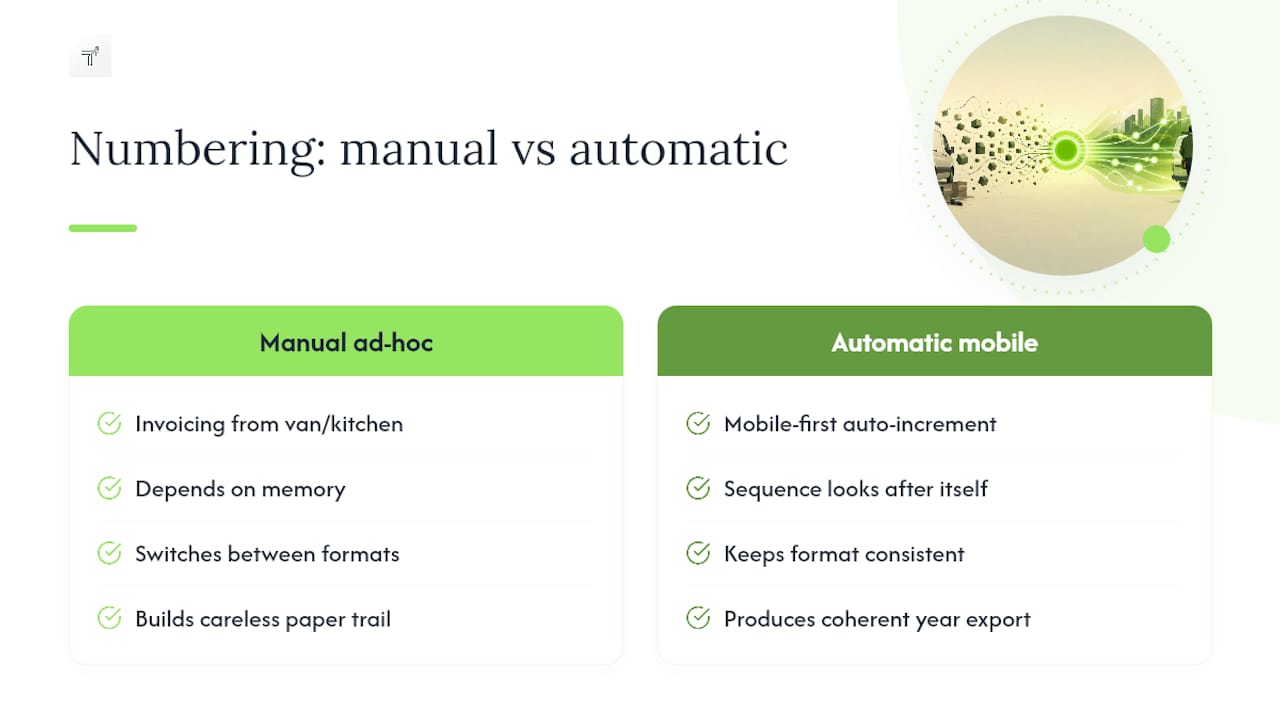
Most invoice numbering mistakes happen because a self-employed tradesperson is writing invoices from a van, a job site, or the kitchen table at 10pm, not because they don’t understand the rules. When invoicing is automatic and mobile-first, the numbering sequence looks after itself rather than depending on someone remembering where they left off.
The bigger issue I see isn’t dodgy invoice numbers, it’s inconsistent ones. A plumber who switches between three formats in one tax year isn’t breaking the law outright, but they’re building a paper trail that looks careless the moment HMRC asks a question. Consistency, not cleverness, is what actually protects you. Tools that snap receipts and auto-increment numbers exist precisely to remove that inconsistency before it becomes a liability, and features like SA103F export matter because they turn a year of individual invoices into one coherent record an accountant can actually use.
— Simon
Tradetally: automate compliant invoice numbering from your van
There are practical alternatives to juggling spreadsheets and half-remembered numbering rules between jobs. Instead of manually tracking which invoice number you’re on, some apps auto-increment every invoice, lock chosen series so numbers can’t be duplicated or overwritten, and let you set client or project prefixes without losing the master sequence underneath.
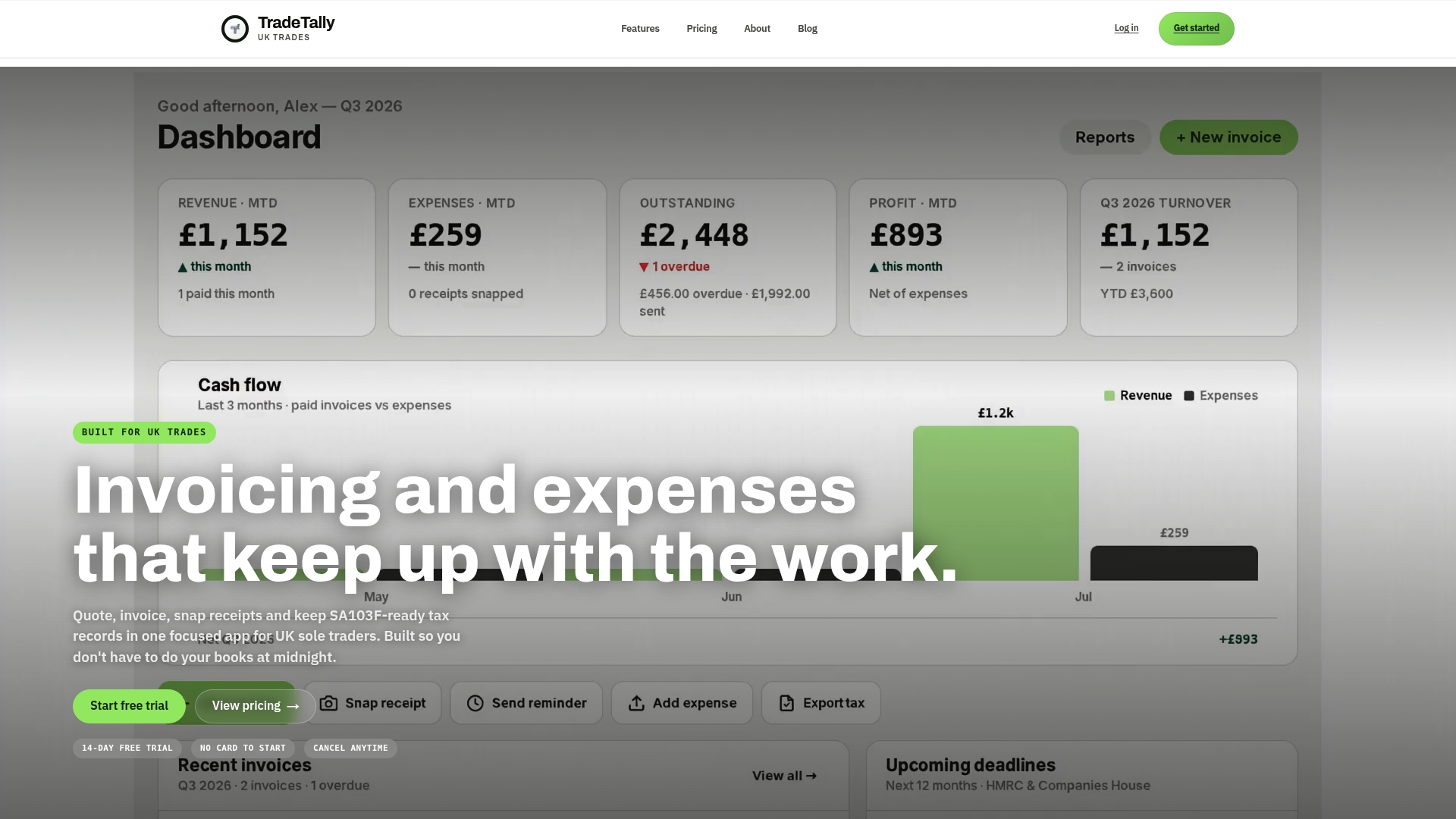
That matters most at tax time. Every invoice you raise feeds straight into audit-ready records and an SA103F export, so there’s no late-night scramble trying to reconstruct a year of paperwork before your Self Assessment deadline. Whether you’re a carpenter, a scaffolder, or a window fitter, the same principle applies: numbering that runs itself is numbering that never lets you down during an inspection.
Check out the tradespeople-specific invoicing pages to see which setup fits your trade, and start your next invoice with a number system that’s already doing the compliance work for you.
Sources
FAQ
What are the legal requirements for an invoice in the UK?
Every invoice needs a unique identifying number, your business and customer details, a description of the goods or services, and the date, as set out in GOV.UK’s invoicing guidance. VAT-registered businesses must also show additional details, including the VAT rate and amount.
What is the standard UK invoice format?
There’s no single mandated layout, but a compliant invoice typically includes a unique number, issue date, supplier and customer details, a description of the work, the amount due, and VAT details if registered. Tools like Tradetally’s invoice templates build these fields in automatically.
What are the rules for numbering invoices?
Every invoice needs a unique number, and VAT invoices must use “a sequential number based on one or more series,” per HMRC’s VATREC5010 guidance. Gaps are permitted if you can explain them, but numbers should never be reused.
What is the correct format for invoice numbers?
Any format works as long as it’s unique and sequential, including simple sequences like INV-0001, year-prefixed formats like 2026-001, or client-prefixed codes. The format is your choice; the sequence integrity is the legal requirement.
Recommended
Ready to sort your trade admin?
TradeTally gives UK sole traders invoicing, expenses, and SA103F-ready tax exports in one mobile-first app.
Start 14-day free trial →