UK Plumber Invoicing: HMRC Ready From Your Phone in 15 Minutes
To issue a valid UK invoice, you need an itemised breakdown with every field GOV.UK requires, correct VAT and CIS treatment where they apply, and digital records kept in MTD-compatible software if you’re in scope. TradeTally gives sole trader plumbers a ready way to do this from a phone or van. In the next 15 minutes you can copy the template below, save a digital invoice record and switch on receipt capture for your next job.
TL;DR:
- Sole traders with qualifying income above £50,000 must use compatible software from April 6, 2026; thresholds fall to £30,000 in 2027 and £20,000 in 2028.
- For qualifying construction services, the reverse charge shifts VAT accounting to the customer; invoices must say it applies and state the VAT amount due.
- Plumbers working as subcontractors should show gross pay, any CIS deduction, and net payment, while contractors verify tax status and make required deductions.
- Get written approval for an estimate before starting, record changes and receipts as the job progresses, and send the itemized invoice within 24 to 48 hours.
- For invoice errors, issue a credit note referencing the original number, then send a corrected invoice with a new number to preserve the audit trail.
Table of Contents
- What a compliant UK invoice must include
- Tax and compliance essentials: VAT, CIS and Making Tax Digital for plumbers
- Practical invoicing workflow and checklist plumbers can use today
- Ready-to-use invoice template and a short filled example for UK plumbers
- Tools and best practices for mobile invoicing and record-keeping
- Data protection and privacy when storing client invoicing data
- Integrating invoicing with bookkeeping and tax filing software
- Credit notes, corrections and disputes in plumbing invoicing
- Why invoicing deserves the same care as the job itself
- How TradeTally helps plumbers send compliant invoices and stay tax-ready
- FAQ
- Sources
What a compliant UK invoice must include
Every invoice you send needs to stand up to scrutiny from a customer, your accountant or HMRC. Gov that apply whether you’re VAT-registered or not.
At minimum, each invoice needs:
- A unique invoice number that you never reuse.
- Your business name, address and contact details.
- Your customer’s name and address.
- The date you supplied the work and the date you issued the invoice.
- A clear description of the work carried out.
- The quantity and unit price for each item, plus the total amount owed.
For plumbing jobs, break these line items down further so the customer can see exactly what they’re paying for. Separate the call-out fee, labour hours, parts (with part codes where you use them), waste disposal and travel into their own rows. Which? recommends this kind of itemised approach because it heads off disputes before they start: a customer who can see “2 hours labour at £45” and “1 x compression fitting, £8.50” rarely queries the total.
If you’re VAT-registered, your invoice needs extra detail: your VAT registration number, the VAT rate applied, and the VAT amount shown separately from the net total. A quick worked example: 2 hours labour at £45 comes to £90, plus parts at £22, giving a net total of £112. At 20% VAT, that’s £22.40, bringing the total owed to £134.40.

Tax and compliance essentials: VAT, CIS and Making Tax Digital for plumbers
Three rules shape how you prepare and store plumbing invoices, and getting them wrong can cost you time and money at tax return season.
Making Tax Digital for Income Tax changes how sole traders keep records. Sole traders with qualifying income over £50,000 must use compatible software from 6 April 2026, with the threshold dropping to £30,000 in April 2027 and £20,000 in April 2028. “Compatible software” means digital record-keeping that can submit updates to HMRC directly, rather than a shoebox of paper receipts totted up once a year.

VAT and the reverse charge catch out plumbers working on larger construction projects. The domestic reverse charge applies to certain construction services, meaning the customer accounts for VAT rather than you charging it on the invoice. When it applies, your invoice needs a clear note stating the reverse charge applies and the VAT amount the customer must account for.
CIS affects plumbers working as subcontractors to a contractor. Contractors must verify a subcontractor’s tax status and may need to make deductions before paying them, so your invoice and your own records should show the gross amount, any CIS deduction, and the net payment received.
Your action checklist:
- Check whether your turnover brings you into MTD scope and from which date.
- Confirm your VAT and CIS status before you invoice a construction client.
- Mark invoices clearly where reverse charge or CIS applies.
- Keep digital copies of every invoice, matched to bank payments, for at least the period HMRC requires.
Practical invoicing workflow and checklist plumbers can use today
A consistent workflow turns invoicing from an evening chore into a five-minute job you finish on site.
- Visit the job and assess the work needed.
- Give the customer a written estimate before you start, so there’s no argument later about scope.
- Get the customer to confirm acceptance, even if it’s just a text message.
- Record parts and expenses as you buy them, ideally by photographing the receipt there and then.
- Complete the job and note any variation from the original estimate.
- Issue a detailed invoice within your agreed timescale, ideally within 24 to 48 hours.
Set your payment terms up front and put them in writing on the invoice itself. A simple line such as “Payment due within 7 days of invoice date. Bank transfer preferred” removes ambiguity. For larger jobs, consider a deposit before work starts and a staged payment on completion, both noted on separate invoices or clearly split on one.
If payment doesn’t arrive on time, a short, polite chase works better than silence. Something like “Just checking you received invoice 0042, sent on the 3rd. Let me know if you need anything to process payment” keeps the relationship intact while prompting action.
Link every invoice to its matching bank payment as it lands, and keep receipts filed against the job they relate to. This turns year-end, or handing records to an accountant, into an export rather than a reconstruction project.
Pro Tip: Invoice on the day you finish the job, not the day you get round to it. Jobs invoiced within 24 hours get paid faster because the work is still fresh in the customer’s mind.
Ready-to-use invoice template and a short filled example for UK plumbers
A reusable template saves you building each invoice from scratch. Yours should include:
- Your business name, address and contact details, plus the customer’s name and address.
- Invoice number and the date you supplied the work.
- Line items split into labour, parts and other costs (call-out, disposal, travel).
- A VAT line showing rate and amount, where you’re VAT-registered.
- A CIS or reverse charge note, where either applies.
- The total owed, your payment terms and your bank details.
A short filled example: Invoice 0051, dated 15 January 2026. Call-out fee £35, two hours labour at £45 per hour (£90), parts including a new ballcock valve at £18. Net total £143. If VAT-registered at 20%, VAT is £28.60, bringing the total to £171.60. Payment due within 7 days by bank transfer.
If you’re not VAT-registered, drop the VAT line entirely and show the net figure as your total. Zero-rated items are rare in standard plumbing work but worth flagging separately if they apply. Where CIS deductions are relevant, add a statement showing gross pay, CIS deduction and net amount due. You can copy a ready-made UK sole trader template here and adapt it to your own jobs.
Tools and best practices for mobile invoicing and record-keeping
The right software does the admin while you’re still in the van. Look for:
- MTD-compatible exports that keep your digital records in the format HMRC expects.
- SA103F export for a straightforward Self Assessment submission.
- Branded invoices that look professional to the customer.
- Receipt snapping, so a parts receipt becomes a job expense the moment you photograph it.
- CIS support, to calculate and record deductions automatically.
- A mobile-first interface you can use standing in a customer’s kitchen.
Combining invoicing and expense tracking in one place avoids double handling: you capture a receipt once and it flows into both the job cost and your tax records, which keeps cash flow visible without a separate spreadsheet.
Plumbers generally reach for one of three approaches: a simple field app for quotes and jobs, a full accounting package built for larger businesses, or a spreadsheet paired with bank exports. Each has its place, but all three tend to leave a gap between the invoicing side and the tax-ready record-keeping side. TradeTally was built to close that gap specifically for sole trader plumbers, combining invoicing, receipt capture and SA103F export in one mobile-first tool.
Pro Tip: Snap every receipt the moment you get it. A pile of paper receipts at the end of the month costs you far more time than photographing each one on the spot.
Data protection and privacy when storing client invoicing data
Client invoicing records hold personal data: names, addresses and payment details. Under UK data protection law, you need a legitimate reason to hold this information, you should only keep what you need for the job and your tax records, and you should store it securely rather than leaving paper invoices loose in a van or on an unprotected spreadsheet.
Practically, this means using software with password protection or encryption for stored records, and deleting or anonymising customer data you no longer have a business or legal reason to keep. HMRC requires you to retain invoices and financial records for a set period for tax purposes, so your retention policy should balance that requirement against holding data for no longer than necessary.
If you use cloud-based invoicing software, check that the provider stores data securely and doesn’t share it with third parties beyond what’s needed to deliver the service. This matters more as your records move from paper to digital under Making Tax Digital for Income Tax, since a larger share of your client data now lives in one searchable system rather than scattered paperwork. Treat login details for any invoicing app the same way you’d treat a till float: not shared, not left open on a shared device.
Integrating invoicing with bookkeeping and tax filing software
Invoicing shouldn’t sit in isolation from the rest of your bookkeeping. When every invoice and receipt flows into the same system you use for your Self Assessment, you avoid re-entering figures twice and reduce the chance of a mismatch between what you invoiced and what you declared.
A few habits help this work smoothly. Record expenses against the job they relate to as you go, rather than batching them later, so your profit picture for each job is accurate in real time. Reconcile invoices against bank payments weekly rather than waiting for a quarterly scramble. Export your records in a format your accountant can use directly, such as an SA103F-ready summary, rather than handing over a folder of receipts for them to sort.
Choosing software that handles invoicing, expense tracking and tax export together, rather than three separate tools, removes the manual step of transferring data between systems. That matters most at year-end, when the difference between an afternoon’s work and a week of chasing paperwork usually comes down to whether your records were kept together from the start.
Credit notes, corrections and disputes in plumbing invoicing
Mistakes happen: a wrong quantity, a miscalculated VAT line, or a customer disputing a charge after the fact. How you handle it affects both your cash flow and your relationship with the customer.
If you’ve made a genuine error on an issued invoice, don’t simply edit and resend it. Issue a credit note referencing the original invoice number, then raise a corrected invoice with a new number. This keeps a clean audit trail for your own records and for HMRC, rather than leaving two conflicting versions of the same invoice in circulation.
For disputes over the amount charged, go back to the written estimate you gave before the job started. This is why giving a written estimate and getting the customer to confirm it matters: it gives you something concrete to point to if the final bill is questioned. Where a refund is genuinely due, whether for a defective part or work that needs redoing, issue a credit note for the refunded amount and keep a record of why it was issued.
Clear, itemised invoices reduce the number of disputes you face in the first place. Which? notes that clear communication about costs and transparent billing helps secure prompt payment and avoid the back-and-forth that eats into your week.
Why invoicing deserves the same care as the job itself
Tidy invoicing isn’t paperwork for its own sake. It’s what stops a six-month-old dispute landing in your inbox, and what turns a January tax deadline into a half-hour job instead of a weekend lost to receipts. The plumbers who treat invoicing as part of the trade, not an afterthought to it, tend to get paid faster and spend far less time arguing about figures nobody wrote down at the time.
— Simon
How TradeTally helps plumbers send compliant invoices and stay tax-ready
We built TradeTally around the admin that follows a day on site, not around a desk you never sit at. From your phone or van, you can raise a branded invoice on the spot, snap a parts receipt before it goes missing, and keep CIS deductions logged against the right job automatically.
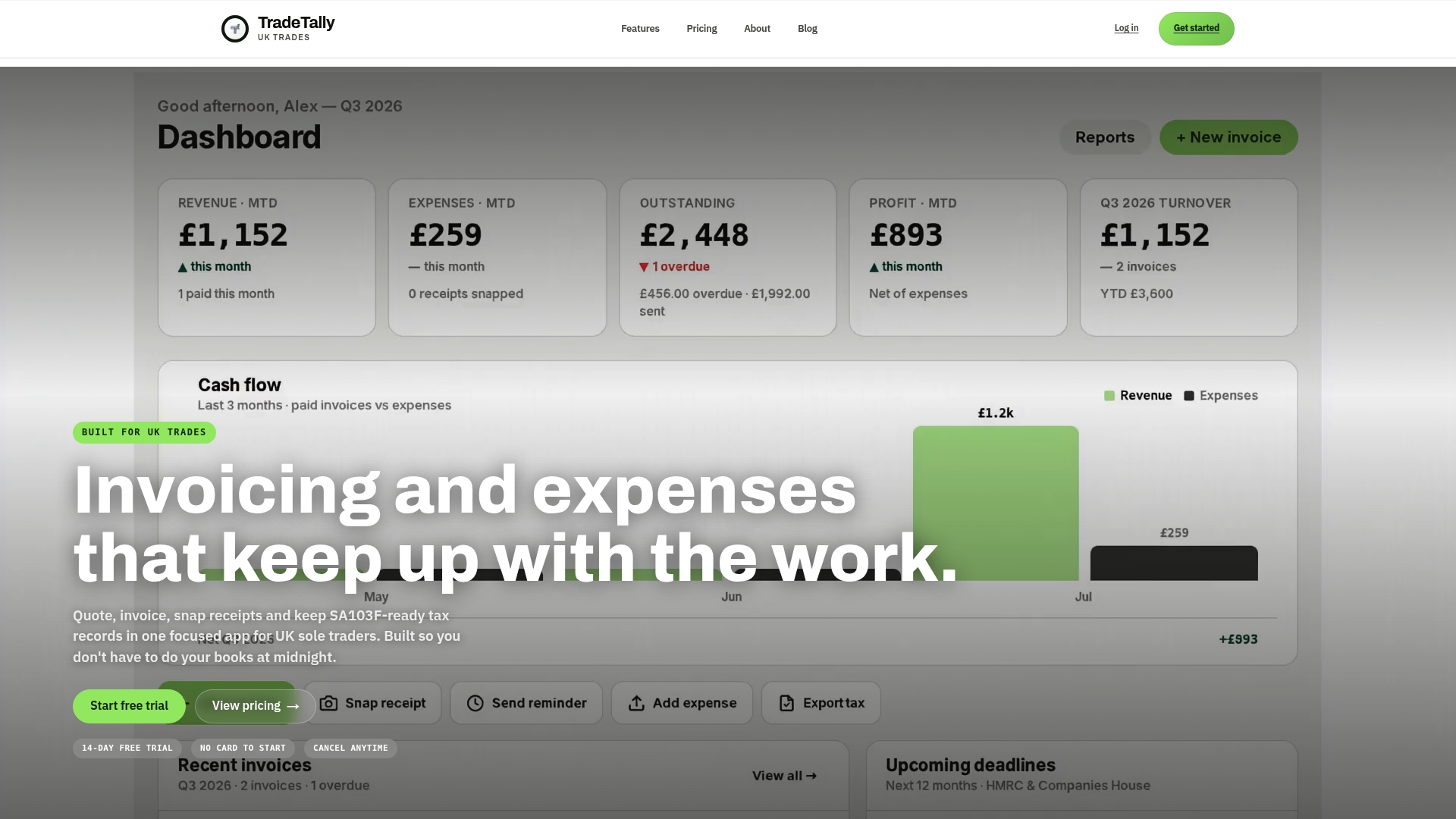
- Create and send branded invoices in seconds, with VAT and CIS fields built in.
- Capture receipts by photo and have them matched to the right job automatically.
- Export tax-ready records formatted for SA103F ahead of Self Assessment.
- Use a mobile-first interface designed for working from a van, not a desktop.
We offer a free Starter plan and a Professional plan at £12 per month or £120 per year for unlimited invoices, receipts and tax exports. Start with TradeTally or check current plans and pricing to see which suits your workload.
This article is general information, not a substitute for advice from a qualified financial advisor. Consult a qualified financial professional about your own circumstances before acting on anything here.
FAQ
How much should a plumber charge for 2 hours work?
Rates vary by region and the nature of the job, so there’s no single UK figure that applies everywhere. Which? recommends getting a written, itemised estimate before work starts so both you and the customer agree the labour rate and likely total in advance.
What are the three types of invoices?
Plumbers typically use a standard invoice for completed work, a VAT invoice when registered for VAT, and a credit note to correct or refund a previous invoice. GOV.UK sets out the required fields for each, with VAT invoices needing extra detail like your VAT number and rate.
Can I be a plumber without qualifications in the UK?
There’s no single licence legally required to call yourself a plumber in the UK, but gas and certain water work require specific registration and competence certification. Always check the governing body’s requirements for the specific work involved before taking on a job that touches gas or water supply safety.
What do plumbers do in the UK?
UK plumbers install, maintain and repair water, heating and drainage systems in homes and businesses, from fixing leaks to fitting bathrooms and boilers. Day-to-day, this work sits alongside the admin side of the trade: quoting jobs, buying parts, and issuing compliant invoices for each piece of work completed.
Sources
Recommended
Ready to sort your trade admin?
TradeTally gives UK sole traders invoicing, expenses, and SA103F-ready tax exports in one mobile-first app.
Start 14-day Pro trial →No card required