Sole trader cash flow: 13 week forecast and 25 to 30% tax pot

Set aside 25 to 30% of every payment you receive for tax, keep it in a separate account, and run a rolling 13-week cash forecast you update weekly. That single habit, backed by GOV.UK’s cash basis guidance, stops most of the surprises that catch sole traders out. A tool like TradeTally can automate the tagging and tracking, but the discipline matters more than the app.
TL;DR:
- Automatically set aside 25 to 30% of every payment for tax and NI, and ring-fence VAT when applicable to prevent spending what isn’t truly yours.
- Use a weekly rolling 13-week forecast to identify potential cash shortfalls early and take immediate action such as chasing overdue invoices or delaying non-urgent expenses.
- Invoicing immediately after job completion and requesting deposits on jobs over a few hundred pounds significantly speed up cash inflows and reduce late payment risks.
- Maintain a dedicated business bank account and reconcile entries weekly to improve visibility and spot cash flow issues before they become critical.
- Prioritize developing a simple routine, like automatic tax transfers and regular forecast reviews, over complex financial plans to catch potential problems days rather than months in advance.
Table of Contents
- Cash flow vs profit: why sole traders run out of money while “doing fine”
- How do payments on account affect your cash flow?
- [How do you build a simple cash flow forecast?](#how-do-you-build-a-simple-cash-flow-forecasthttpsblogklariteaappblogbusiness-planning-software-4-alternatives)
- What are the best ways to improve cash flow as a sole trader?
- Which bookkeeping habits keep your forecast honest?
- What should sole traders check every week for cash flow?
- Why simple routines beat complexity for sole traders
- How TradeTally makes cash flow easier to manage
- Official guidance and practical templates to consult next
- Sources
- FAQ
Cash flow vs profit: why sole traders run out of money while “doing fine”
Cash flow is the money actually moving in and out of your bank account. Profit is what’s left on paper after you subtract costs from sales, whether or not that money has landed yet. A sole trader can be profitable on their year-end figures and still be unable to pay a supplier on Tuesday, because profit doesn’t care about timing and your bank balance does.
Several timing gaps cause this mismatch repeatedly:
- Invoices that go unpaid for 30, 60, or even 90 days after the job’s done
- VAT collected from customers that has to be handed over to HMRC on a fixed quarterly date
- A Self Assessment tax bill landing in one lump, months after you earned the income it’s based on
- Loan or equipment finance repayments that stay fixed even when a job falls through
A carpenter finishing three jobs worth £8,000 in a month looks profitable on any spreadsheet. But if two clients pay on 45-day terms and materials, van finance, and a subcontractor invoice are all due before that money arrives, the same carpenter can be short of cash while technically in profit. That gap is where most sole traders come unstuck, not in the annual totals.
How do payments on account affect your cash flow?
Tax timing is where cash flow problems often start, and cash-basis accounting is the first thing worth understanding. Sole traders earning under £150,000 can use cash basis accounting, recording income and expenses only when money actually moves rather than when it’s invoiced. This keeps your taxable profit closely aligned with what’s actually in the bank.
Payments on account are the bigger cash shock for most sole traders. If your last Self Assessment tax bill was over £1,000 and less than 80% of your tax was collected at source, HMRC asks you to pay towards next year’s bill in two advance instalments: 31 January and 31 July. That means a sole trader can face a full tax bill plus half of next year’s estimated bill on the same January date.
Statistic: Small businesses in the UK are lost to cash pressure at a striking rate. Government research attributes roughly 38 small business closures per day to late payments alone. A tax bill landing on top of an already stretched month can be the final push.
- Reserve 25 to 30% of every receipt for Income Tax and National Insurance, moved automatically on invoice payment
- If VAT registered, ring-fence the VAT element separately; it’s never really your money
- If your income has dropped, you can apply to HMRC to reduce your payments on account rather than overpay and wait for a refund
How do you build a simple cash flow forecast?
A forecast doesn’t need software or an accountancy degree. The FSB’s five-step method and the British Business Bank’s four-step version both boil down to the same core routine, and either works well for a sole trader.
- Choose your period. Weekly forecasts suit trades with lumpy, unpredictable income; monthly suits steadier retainer-style work.
- List every income row. Include invoices due, deposits expected, and anything else landing in the account.
- List every expense row, split into fixed (rent, insurance), variable (materials, fuel), irregular (tools, repairs), and tax set-asides.
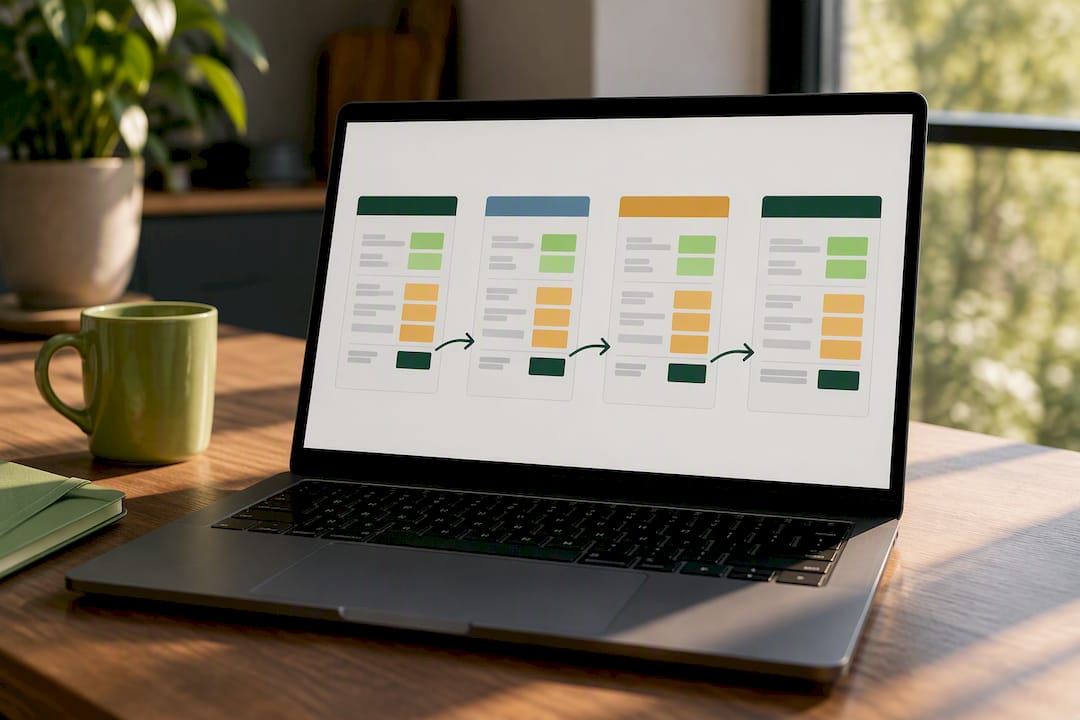
- Calculate net cash flow for the period, then carry the running balance forward into the next column so you can see the trend building, not just a single snapshot.
- Review it on the same day each week or month. New businesses should keep it rolling and short; established ones can lean on historical data to plan further ahead, a point the FSB makes well.
If the running balance dips below zero in any future week, act immediately: chase an overdue invoice, delay a non-urgent purchase, or ring your supplier about payment terms before the shortfall arrives, not after.
Pro Tip: Keep the forecast in a spreadsheet with one tab per month and copy the closing balance into the next tab automatically. Seeing the number carry forward is what makes the habit stick.
What are the best ways to improve cash flow as a sole trader?
Fixing cash flow is mostly about speed and friction, not clever finance. Small changes to how you invoice and chase payment tend to matter more than any funding product.
- Invoice the same day the job finishes. Every day you delay is a day added to your payment wait, and clear terms (7 or 14 days, stated on the invoice) leave no room for ambiguity.
- Ask for deposits or staged payments on any job over a few hundred pounds, particularly where materials are involved.
- Chase on a fixed cadence: a reminder the day payment is due, another at 7 days overdue, then a firmer letter at 14 days. You have statutory rights to claim interest and compensation on late business payments, which is worth mentioning to a client who’s stalling.
- Review subscriptions and suppliers every quarter. Renegotiate rates or drop tools you’re not using; small recurring costs add up faster than most sole traders expect.
- Build two reserves: a tax pot (25 to 30% of receipts) and a separate emergency operating reserve for slow months.
- Treat overdrafts, short-term lines, and invoice financing as last resorts, not routine tools. They can bridge a genuine short gap, but the fees stack up quickly if used as a habit rather than an exception.
Which bookkeeping habits keep your forecast honest?
A forecast is only as good as the numbers feeding it, and mixed personal and business spending is the fastest way to lose visibility. Keep a dedicated business account from day one; it’s far easier to see genuine cash pressure when your figures aren’t tangled up with weekly groceries.
Weekly habits matter more than clever software:
- Record every receipt as it happens, not in a end-of-month scramble
- Tag the tax portion of each payment the moment it lands
- Reconcile bank entries against your forecast weekly, not monthly
Mobile invoicing and instant receipt capture shorten the gap between finishing a job and getting paid for it, particularly for tradespeople invoicing straight from the job site. TradeTally is built around that exact workflow: create a branded invoice from your van before you’ve left the driveway, snap a receipt at the till, and let the app tag the tax amount and export tax-ready records for your SA103F when the time comes.
Pro Tip: Reconcile little and often. Fifteen minutes every Friday afternoon beats a three-hour session the night before your tax return is due.
What should sole traders check every week for cash flow?
If time is short, prioritise the tax pot, same-day invoicing, and the running balance forecast first; the rest follows naturally once those three are habits.
- Set up an automatic tax pot transfer of 25 to 30% on every payment received.
- Invoice the same day a job finishes, with clear payment terms stated.
- Ask for a deposit on any job involving significant materials cost.
- Keep a 13-week rolling cash balance, updated weekly.
- Review your forecast on the same day each month without fail.
- Separate business and personal bank accounts completely.
- Set automated payment reminders for every invoice you send.
Why simple routines beat complexity for sole traders
The sole traders who struggle most rarely lack financial knowledge. They lack a routine they’ll actually repeat under pressure. A spreadsheet reviewed weekly beats a sophisticated model reviewed once a quarter, every time, because cash problems are caught in days, not months.
The single habit worth adopting first is the automatic tax transfer. It removes the temptation to spend money that was never really yours.
— Simon
How TradeTally makes cash flow easier to manage
Most of the tactics above come down to speed: invoicing faster, seeing your numbers sooner, and never letting tax set-asides slip your mind. That’s precisely what TradeTally was built to handle for working tradespeople.
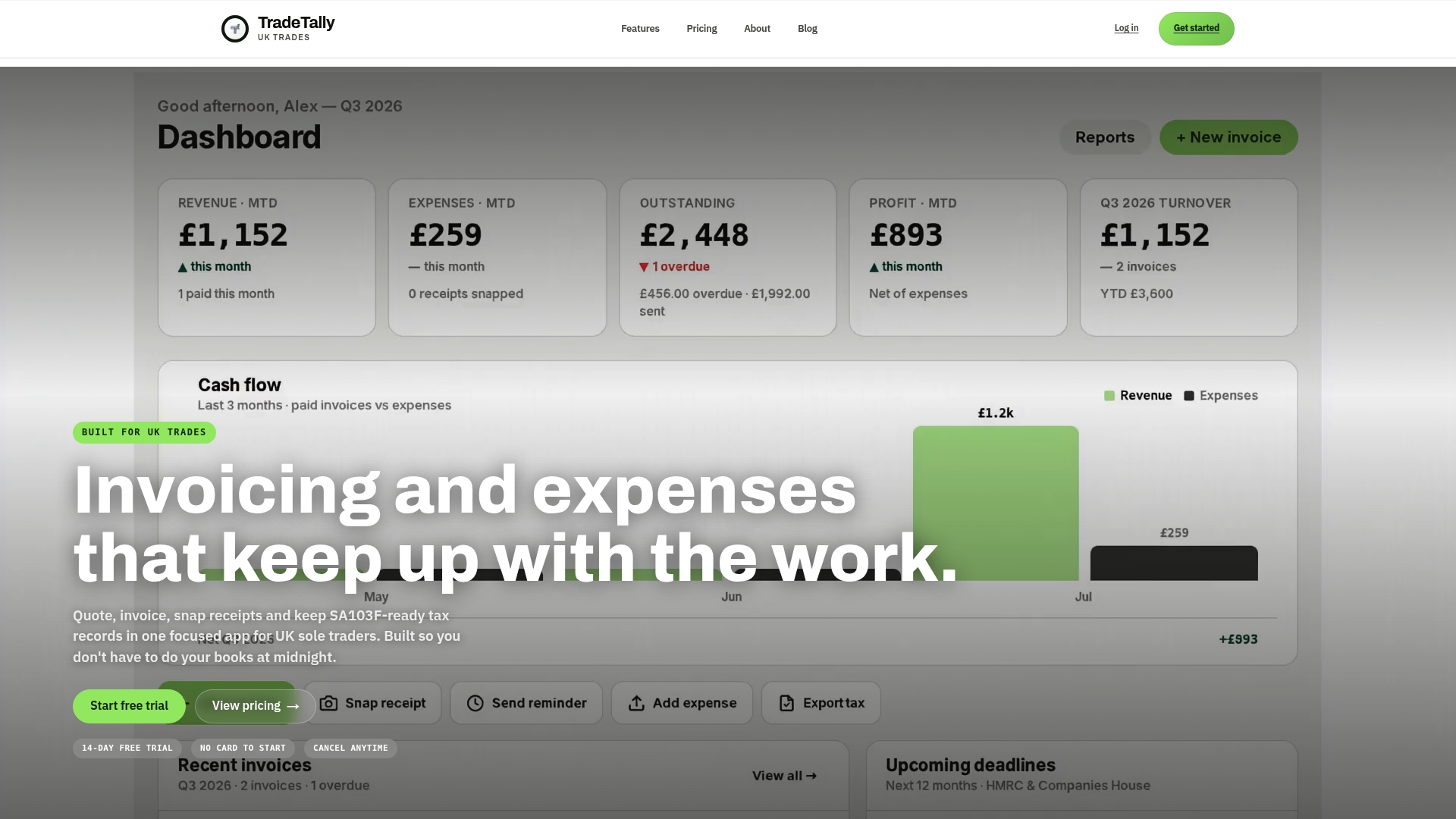
TradeTally lets you create an invoice on-site the moment a job’s done, snap a receipt with your phone instead of stuffing it in the glovebox, and tag the tax portion of every payment. When Self Assessment rolls around, your records export straight into SA103F format, ready to hand to your accountant or submit yourself, cutting out the late-night bookkeeping scramble that catches so many sole traders every January. The Starter plan is free for limited invoicing, and the Professional plan, at £12 a month or £120 a year, unlocks unlimited invoices, receipts, and tax exports. If cash flow visibility is where you’re currently guessing rather than knowing, check out TradeTally and see whether it fits how you actually work.
Official guidance and practical templates to consult next
- Gov for the official rules on when and how to use it
- FSB’s cash flow forecast guide for a step-by-step forecasting template
- British Business Bank’s four-step forecast method for scenario planning advice
- Gov for what to keep and for how long
This article is general information, not a substitute for advice from a qualified financial advisor. Consult a qualified financial professional about your own circumstances before acting on anything here.
Sources
- How to prepare a cash flow forecast — FSB
- How to create a cash flow forecast in 4 steps — British Business Bank
- Gov
FAQ
What’s the best way to pay yourself as a sole trader?
There’s no separate “salary” as a sole trader; you simply transfer money from your business account once tax, National Insurance, and operating costs are covered. Many sole traders set a fixed monthly drawing amount based on average income, topping it up in strong months and holding back in quiet ones.
How much cash flow is good for a small business?
There’s no universal figure, but a common working target is holding enough in reserve to cover several weeks of fixed costs plus your tax set-aside. Running a rolling forecast, as recommended by the FSB, is a better guide than any single number, since it shows whether your specific balance is trending up or down.
Who keeps the profit in a sole trader business?
As a sole trader, you and the business are legally the same entity, so all the profit belongs to you personally after tax. That’s different from a limited company, where profit belongs to the company until it’s paid out as salary or dividends.
What are the five rules of cash flow?
There’s no single official “five rules” list, but the closest recognised framework is the FSB’s five-step forecasting process: choose a period, list income, list expenses, calculate net cash flow, and review it regularly. Sole traders who follow that cycle weekly catch shortfalls early enough to act on them.
Recommended
Ready to sort your trade admin?
TradeTally gives UK sole traders invoicing, expenses, and SA103F-ready tax exports in one mobile-first app.
Start 14-day free trial →