Avoid March to April Tax Shocks: Cash Basis Accounting for UK Trades
Cash basis accounting is now the default method for most UK sole traders and ordinary partnerships, following changes that took effect from 6 April 2024. It means you pay tax on money actually received, not on invoices you’ve sent but haven’t been paid for. HMRC’s HS222 helpsheet sets out the mechanics, and apps exist that are specifically designed to capture the records this method requires.
TL;DR:
- The removal of turnover thresholds means businesses can stay on cash basis indefinitely, even as they grow, unless they carry stock or need finance-ready accounts.
- Moving between cash basis and accruals requires careful transitional adjustments, especially for unpaid invoices, supplier bills, and stock to avoid double taxation or missed expenses.
- VAT and income tax cash accounting are separate systems, allowing businesses to run one with standard accounting and the other under cash basis without restrictions.
- Accurate record-keeping involves capturing receipts, reconciling bank payments weekly, and issuing invoices on the day work is completed to ensure correct tax calculations and cash flow management.
- Apps that log payments and receipts in real time can simplify compliance with HMRC’s cash basis rules, especially for trades with multiple sites or those wanting a live view of their profitability.
Table of Contents
- What is cash basis accounting UK rules cover, and who qualifies?
- What changed from 2024/25 and why it matters
- How do you calculate taxable profit under cash basis?
- What expenses can you claim, and how does VAT interact with cash basis?
- Building a record-keeping routine that survives Self Assessment
- How does cash basis affect tax planning and cash flow?
- Common mistakes sole traders make with cash basis
- Practical verdict: when to stick with cash basis, when to add accruals
- A practical option for keeping cash-basis records straight
- Sources
- FAQ
What is cash basis accounting UK rules cover, and who qualifies?
Cash basis accounting records income when it lands in your bank account and expenses when you actually pay them, rather than when an invoice is raised or a bill arrives. HMRC’s guidance is blunt about the benefit: you’re never taxed on money you haven’t received yet. If a customer sits on your invoice for four months, that income doesn’t touch your tax bill until it clears your account.
Most sole traders and ordinary partnerships can use it. The exclusions matter, though:
- Limited companies and limited liability partnerships (LLPs) cannot use cash basis at all.
- Partnerships with a corporate partner (a limited company as one of the partners) are excluded.
- Some specialist trades and certain elections (such as farmers’ averaging in specific circumstances) sit outside the standard rules.
- Lloyd’s underwriters and a handful of other niche categories are also excluded.
From the 2024/25 tax year, cash basis is the default. If you’re an eligible sole trader or partner and you do nothing, HMRC assumes you’re using it. If you’d rather use accruals (also called traditional accounting), you now need to actively elect for it on your tax return, which is a reversal of the old opt-in system.
What changed from 2024/25 and why it matters
Three changes reshaped this area of tax law, and they’re worth understanding even if you’ve used cash basis for years.
- Default status. Cash basis is now assumed unless you elect otherwise, replacing the old opt-in approach.
- No turnover thresholds. The previous entry and exit limits have been scrapped entirely, so a growing plumbing or electrical business no longer has to switch accounting methods just because it’s had a good year.
- Loss and interest relief aligned. Restrictions that previously made cash basis less attractive for offsetting losses and claiming interest relief have been brought closer in line with accruals accounting.
The practical upshot is that a tradesperson who used to worry about outgrowing cash basis can now stay on it indefinitely. That said, removing the turnover ceiling doesn’t remove the volatility that comes with taxing cash received rather than income earned. A big invoice paid late in March instead of early April can shunt an entire year’s tax liability into a different period.
Pro Tip: If your income swings a lot month to month, a quarter spent watching your bank balance under cash basis will tell you more about your real cash position than any invoice ledger ever could.
Accountants still sometimes recommend accruals for businesses carrying significant stock, or those needing finance-ready accounts for a mortgage or business loan application, as AccountingWEB’s industry commentary points out.
How do you calculate taxable profit under cash basis?
The core calculation is simpler than accruals accounting, and it follows three steps:
- Add up total receipts for the basis period. This means money actually banked from sales, not invoices raised.
- Add up total payments for allowable business expenses paid out in the same period.
- Subtract payments from receipts. The result is your taxable profit (or loss) for Self Assessment purposes.
VAT-registered traders using the VAT flat rate scheme include VAT-inclusive figures; those on standard VAT accounting generally use net figures, excluding VAT collected or reclaimed.
Where the calculation gets more involved is switching between bases. HS222 sets out the entering and leaving adjustments HMRC expects, covering debtors, creditors, stock and prepayments. Move from accruals to cash basis, for example, and you strip out amounts already taxed as debtors under the old method to avoid double taxation. Move the other way, and any resulting “transitional adjustment income” is typically spread and taxed over six years rather than landing in one lump.
| Adjustment scenario | When it’s needed | How to handle it |
|---|---|---|
| Unpaid customer invoices at switchover | Moving from accruals to cash basis | Remove debtor income already taxed under accruals to avoid taxing it twice |
| Unpaid supplier bills at switchover | Moving from accruals to cash basis | Add back creditor expenses already claimed under accruals |
| Closing stock value | Moving between either basis | Adjust so stock isn’t taxed or relieved twice across the transition |
| Part-paid equipment | Either direction | Match the deduction to the basis under which the payment was actually made |
What expenses can you claim, and how does VAT interact with cash basis?
Everyday running costs work exactly as you’d expect: materials, tools, fuel, insurance, subcontractor payments and phone bills are all deductible when you pay them, provided they’re wholly for business use. Mixed-use costs, like a phone used for both personal calls and quotes, need a fair apportionment.
Capital expenditure is where cash basis diverges from instinct:
- Most equipment and tools are deducted in full when paid, which is far simpler than tracking depreciation.
- Cars are the exception. They stay under capital allowances rules rather than being deducted as a lump sum, so you claim a percentage each year based on CO2 emissions.
- Certain items, including land, buildings and some non-depreciating assets, sit outside the simplification entirely and follow standard capital allowances guidance.
VAT confuses people here because it’s a completely separate system. The VAT cash accounting scheme governs when you account for VAT to HMRC, while income tax cash basis governs when you recognise profit for Self Assessment. You can run VAT on standard accounting while using income tax cash basis, or the reverse. If you’re VAT-registered, our VAT calculator is a quick way to check inclusive and exclusive figures when you’re pricing a job.
Building a record-keeping routine that survives Self Assessment
Cash basis simplifies the maths, but it doesn’t reduce what you need to keep on file. At minimum, hold onto bank statements, receipts for every payment, copies of invoices sent and received, and mileage logs if you’re claiming vehicle costs. HMRC expects these kept for at least five years after the 31 January submission deadline.
A workable weekly routine looks like this:
- Photograph receipts the moment you buy materials, rather than stuffing them in the glovebox.
- Reconcile bank payments against jobs once a week, not once a year.
- Issue invoices the same day you finish a job, not whenever you get round to it.
This is exactly a common gap that some apps are built to close. It lets you snap a receipt from the van between jobs, raise a branded invoice on site, and export everything in SA103F format when Self Assessment rolls round, without a laptop or a shoebox of paper involved.
Pro Tip: Invoice on the day the job’s done and chase overdue payments within a week. Under cash basis, a slow-paying client doesn’t just hurt your cash flow, it can shift your entire tax liability into a different year.
How does cash basis affect tax planning and cash flow?
Cash basis ties your tax bill directly to your bank balance, which changes how you plan around it. Under accruals, profit and cash can drift apart for months. Under cash basis, they move together, for better and worse.
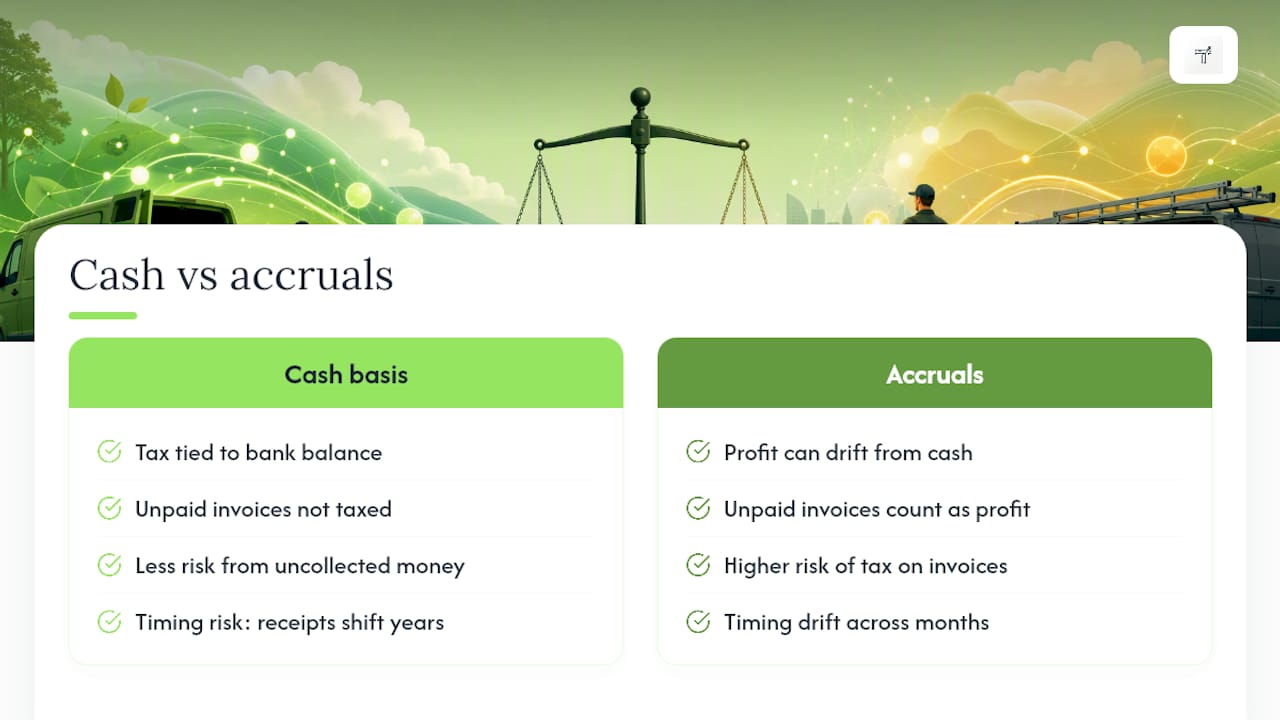
The upside is transparency. If your bank balance looks healthy, your taxable profit broadly reflects that, so there’s less risk of owing tax on money you never actually collected. That matters enormously for trades that deal with slow-paying commercial clients or retention payments held back until snagging lists are cleared.
The downside is timing risk around your tax return. A cluster of large payments landing in March instead of April can inflate one year’s profit and deflate the next, even though your actual workload was steady. Sole traders who take on a big commercial contract sometimes get caught out by a spike in profit in the year the final payment clears, followed by a Payment on Account demand based on that inflated figure.
The practical fix is to keep a rolling view of receipts throughout the year rather than waiting for your accountant in January. Tools that track live profit as invoices get paid, rather than as they’re raised, make it far easier to set aside the right amount for tax as you go, instead of discovering a large bill in one sitting. Setting aside a fixed percentage of every payment the moment it arrives, rather than estimating at year end, is the single habit that does the most to smooth this out.
Common mistakes sole traders make with cash basis
Most of the errors HMRC sees under cash basis come from habits carried over from accruals thinking, or simply from patchy records.
- Recording the invoice date instead of the payment date. This is the single most common mistake. Cash basis cares when money moved, not when you raised the invoice.
- Forgetting to add back a car’s capital allowance separately, having deducted it as a normal expense.
- Mixing personal and business bank transactions without apportioning mixed-use costs like phone contracts or a shared vehicle.
- Skipping the transitional adjustment when switching from accruals, leading to income being taxed twice, or not at all.
- Under-recording cash payments and cash sales, particularly for trades that still take cash from a handful of customers.
The fix for nearly all of these is timing discipline. Log the date money actually leaves or enters your account, not the date on the paperwork, and keep a running note whenever you buy something that’s part business, part personal.
Practical verdict: when to stick with cash basis, when to add accruals
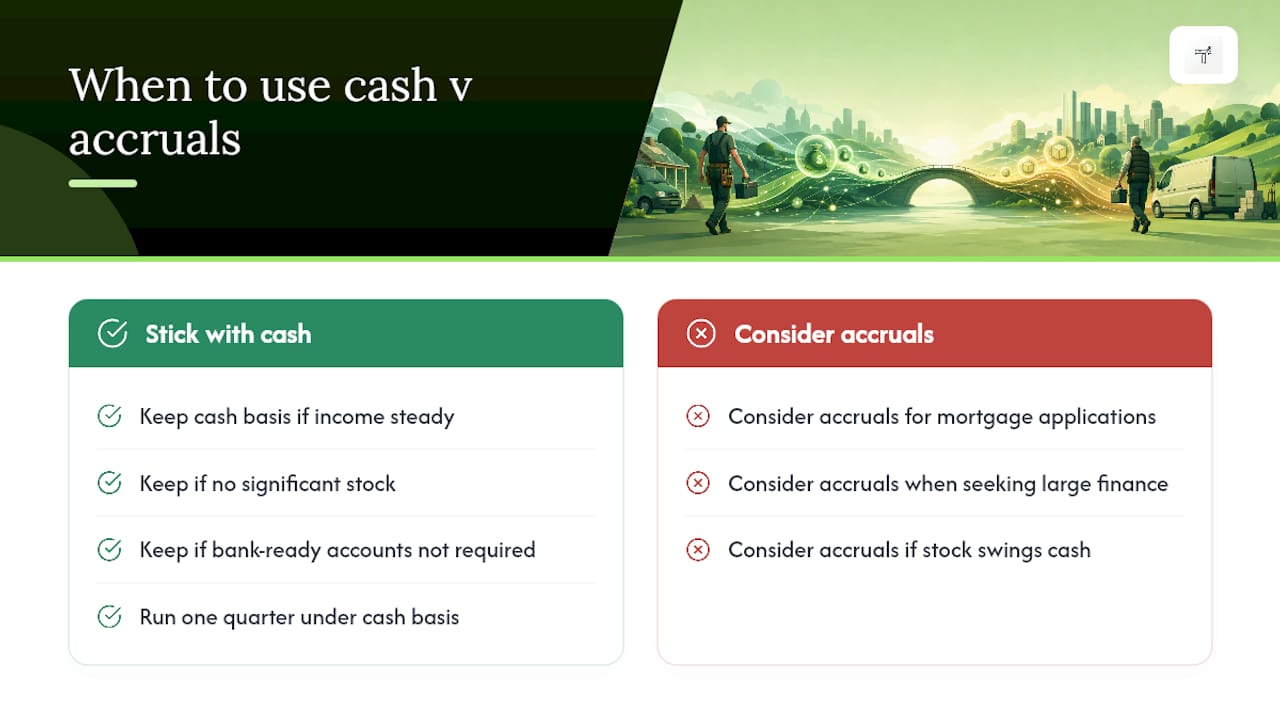
Cash basis suits you if your income is fairly steady, you don’t carry significant stock, and you don’t need bank-ready accounts. It also suits growing trades now the turnover ceiling is gone.
Consider accruals, or at least parallel management accounts, if you’re applying for a mortgage, chasing significant business finance, or carrying stock that swings your cash position without reflecting real profit. The sensible next step: run one quarter under cash basis, compare it against your gut sense of profitability, and talk to an accountant before you formally elect either way.
— Simon
A practical option for keeping cash-basis records straight
If tracking receipts and reconciling payments under cash basis sounds like the kind of admin that gets pushed to the evening, that’s the exact kind of admin problem some apps aim to solve, letting you raise invoices, snap receipts, and log mileage easily, then export everything in SA103F format when your Self Assessment is due.
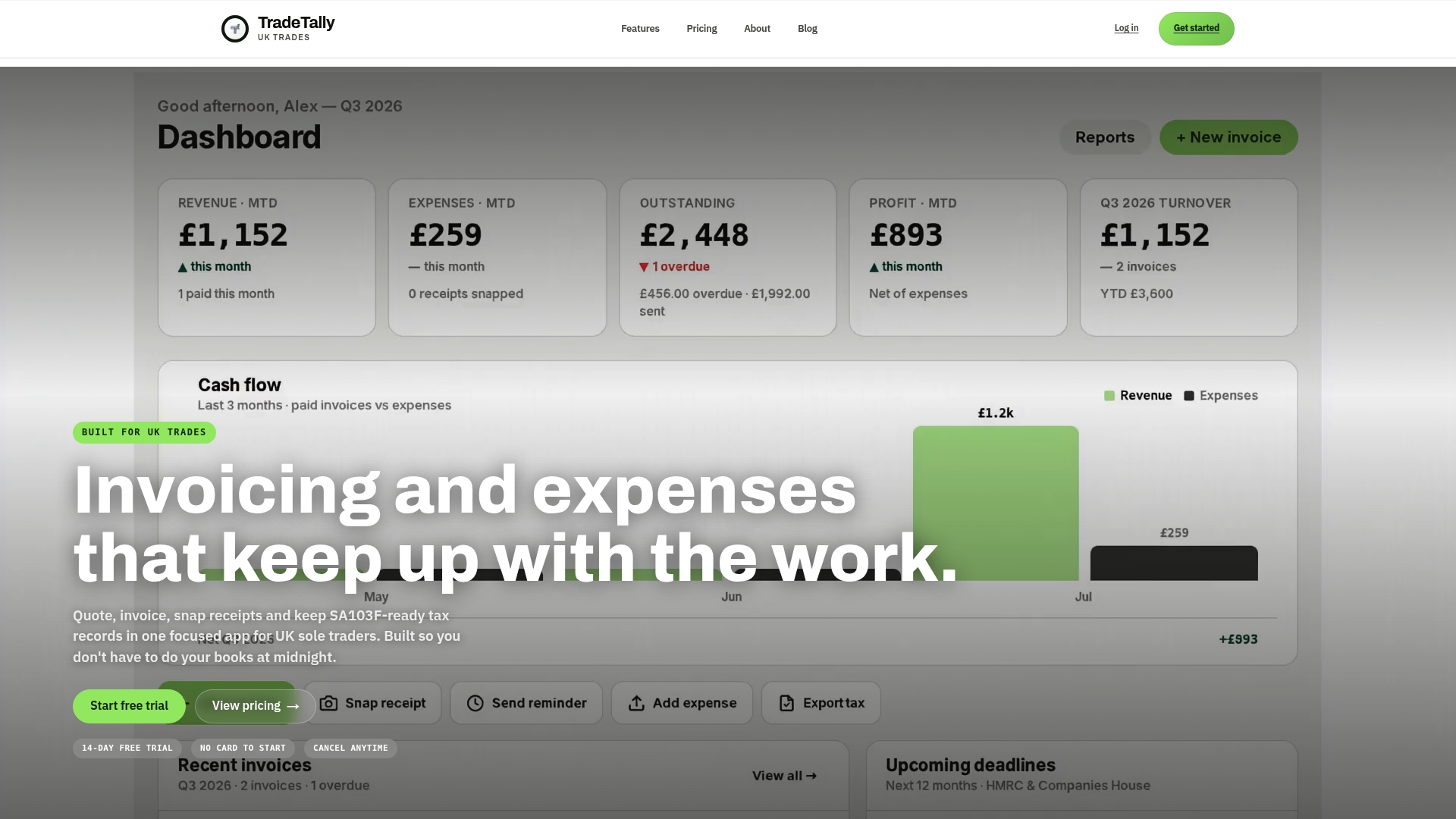
Whether you’re a builder juggling several sites or a window fitter with one job a day, some apps map invoicing and expenses directly onto the cash basis records HMRC expects. For carrying a live view of what’s actually owed to you, collecting payments online speeds up the receipts you’re recording, which matters directly under cash basis timing rules. Trades pages exist for builders, joiners and carpenters, or you can check your estimated tax position now with the Self Assessment tax calculator and see what your figures look like before January creeps up on you.
This article is general information, not a substitute for advice from a qualified financial advisor. Consult a qualified financial professional about your own circumstances before acting on anything here.
Sources
- Gov
- Cash basis or accruals accounting: How UK accountants should advise sole traders — AccountingWEB
FAQ
What is cash basis accounting?
It’s a method that records income when it’s received and expenses when they’re paid, rather than when invoiced or billed, and it’s now the default for most eligible UK sole traders and partnerships.
Who can’t use cash basis?
Limited companies, LLPs, and ordinary partnerships with a corporate partner are excluded, along with a small number of specialist elections such as Lloyd’s underwriters.
Can you give an example of cash basis accounting?
If you invoice a customer in March but they pay in April, that payment counts towards April’s tax year under cash basis, not March’s, regardless of when the job was completed.
How do you calculate profit under cash basis?
Add up all receipts banked in the tax year, subtract all allowable payments made in the same period, and the result is your taxable profit, with any entering or leaving adjustments applied per HS222.
Do apps exist that handle cash basis records automatically?
Some apps capture receipts, invoices and payment dates as they happen, then export them in SA103F format, which aligns with how HMRC expects cash basis figures to be reported.
Recommended
Ready to sort your trade admin?
TradeTally gives UK sole traders invoicing, expenses, and SA103F-ready tax exports in one mobile-first app.
Start 14-day free trial →