Monthly Bookkeeping Checklist for UK Sole Traders

A good monthly bookkeeping routine for a sole trader comes down to seven jobs: gather every statement, match money in to invoices, match money out to receipts, reconcile the bank, chase what is owed, deal with CIS if it applies, and keep a short note of anything unresolved. Do it on a fixed date and it takes about an hour. Leave it to the end of the tax year and it takes a weekend, with gaps you can never fill. With Making Tax Digital now in force for the higher income band, monthly records are also what your quarterly updates are built from. We built TradeTally so that most of this checklist happens as you work, from the van, rather than at the kitchen table.
TL;DR
- Pick one date each month and treat it like a job: same day, same hour, calendar-blocked.
- Every payment in and out needs evidence attached: an invoice for income, a receipt for spending, the date and what it was for.
- Reconcile against the real bank statement, and never force a balance by inventing an entry.
- If you work under CIS, check each payment statement against your invoice every month and keep them.
- Keep records for at least five years after the 31 January filing deadline. Digital records also make Making Tax Digital far easier.
Table of Contents
- Why monthly is the right rhythm
- The monthly checklist, step by step
- Extra steps if you work under CIS
- What the rules require you to keep, and for how long
- How Making Tax Digital changes your month
- A realistic hour: how to split the time
- Common mistakes to avoid
- Where we come in
- Our view: the checklist should shrink
- FAQ
- Sources
Why monthly is the right rhythm
Weekly is better if you are busy, but monthly is the minimum that works. A mistake found after four weeks is usually a five-minute fix: a receipt in the glovebox, a customer who short-paid. A mistake found after eleven months is a guess.
There is a legal reason too. GOV.UK says self-employed people must keep records of sales and income, business expenses, VAT if registered, and PAYE if they employ people, with proof such as receipts, bank statements and invoices. And under Making Tax Digital for Income Tax, the Low Incomes Tax Reform Group explains that digital records must show at least the amount, date and category of each income and expense. A monthly routine is how you make sure those details exist when you need them.
The monthly checklist, step by step
Set a date you will actually keep, such as the first Friday after the 5th, and work through these in order. The order matters: each step makes the next one quicker.
1. Pull together every statement
Download or collect the statement for every account the business touches: the business current account, any credit card, a payment app, and a note of cash you took or spent. If you pay for materials from a personal account, include it, because those costs are still business costs and they are the ones that go missing.
Where it goes wrong: forgetting the account you only use occasionally. A single card used for one trade counter order is enough to leave a gap.
2. Record and match your income
For each customer payment, Tax Confident, the GOV.UK small business campaign, says to record the date, the customer’s name, the amount, what it was for and how they paid (cash, card, bank transfer or online). Keep copies of invoices, sales confirmations, card machine summaries and bank statements.
Then match each deposit to an invoice. Three things to look for:
- Short payments: the customer paid £850 against an £900 invoice. Was it a deduction, a dispute or a typo?
- Refunds and reversals: these reduce income and need their own entry.
- Deposits that match no invoice: often a stage payment you never invoiced, or a customer who paid the wrong person.
Keep your own money separate in the records. Money you put into the business, and money you take out for yourself, is not sales and not an expense.
3. Record and categorise your spending
The same GOV.UK guidance says you must keep records of business expenses, including cash purchases, with receipts, purchase orders or invoices. For each cost, do three things: attach the evidence, choose a category (materials, tools, fuel, insurance, subcontractors, phone), and mark anything private so it never reaches your tax figures.
A photo called “receipt” is nearly useless in March. A photo tied to a date, a supplier and a transaction is something you can defend. Photograph receipts on the day, while you are still holding them, because thermal paper fades and pockets go through the wash. Our guide on receipt keeping for sole traders covers what HMRC expects to see.
Pro tip: do not wait for month end to photograph receipts. The monthly job is to check that every spending line has one, not to create them from memory.

4. Reconcile the bank
Reconciling means checking that the balance in your records equals the balance on the bank statement, line by line. Tick off every transaction against an invoice, a receipt or a note. Whatever is left unmatched is your to-do list.
The rule that saves you: if the figures differ, find out why. Never add a made-up adjustment to make the total agree. A forced entry hides the real error, which then comes back at year end, bigger. If you cannot explain something after ten minutes, flag it and move on. Our practical guide to bank reconciliation for sole traders walks through the common mismatches.
5. Chase what you are owed and look at what you owe
List every unpaid invoice, how long each has been overdue and who is behind it. Set a simple rule and stick to it: a polite reminder a week after the due date, a phone call at three weeks. Late-paying customers are rarely stopped by a single message, but they do respond to a routine.
Then look at the bills coming the other way: supplier accounts, van insurance, tool-hire, subscriptions, the quarterly bills that arrive when you have forgotten them. Look a month further ahead than feels necessary. Timing a big supplier payment against a customer payment you know is due is the cheapest cash-flow management there is.
6. Check each job against its quote
For every open job, add up the costs so far (materials, subcontractors, your own fuel and time) and compare them with the quote. If a job is running over, you find out in week three, while you can still raise a variation with the customer, not after the final invoice. A simple tool such as our profit margin calculator for trades shows quickly whether a job still earns what you priced it to earn.
7. Note the oddities and back up
Write a short list: unusual costs, customers you are worried about, questions for your accountant, items you could not match. Keep it in one place, and tick items off next month. Then make sure your records are backed up, so a lost phone does not take a year of evidence with it.
Extra steps if you work under CIS
The Construction Industry Scheme (CIS) is HMRC’s system where contractors deduct tax from payments to subcontractors and pass it on. If you are a subcontractor, add these to your month:
- Check each payment and deduction statement against your invoice. The gross amount, the materials and the deduction should all agree. If they do not, query it with the contractor now.
- File the statements. Keep them with your invoices, because the deductions are credited against your tax bill later.
- Total your deductions so far, so there are no surprises when your tax is calculated.
If you are a contractor paying subcontractors, HMRC’s CIS340 guide says you must record the gross amount (excluding VAT), the cost of materials and the deduction before each payment, and give each subcontractor a written statement within 14 days of the end of each tax month, which falls on the 19th. The monthly return is due by the same date. Our guides explain how CIS works for subcontractors and the three deduction rates. TradeTally handles CIS deductions on your invoices, so the figures on your statements are worked out as you invoice.
What the rules require you to keep, and for how long
GOV.UK states that self-employed people must keep records for at least five years after the 31 January submission deadline of the relevant tax year. Tax Confident gives the example of the 2025–26 tax year: keep everything until at least 31 January 2032, five years after the 31 January 2027 filing deadline.
That is a long time to hold a shoebox. Storing receipts and invoices digitally, where each one is linked to its transaction, is the practical answer. Our Self Assessment records checklist sets out what to store.
Cash basis or traditional accounting
For most sole traders, GOV.UK says cash basis is the default from the 2024–25 tax year. You record income when money arrives and expenses when you pay a bill, so a March invoice paid in April counts in the year the cash lands. That makes monthly bookkeeping simpler: your bank statement is your main guide. If you use traditional accounting instead, you record income when you earn it and costs when you owe them, which means unpaid invoices need tracking in your records too.
How Making Tax Digital changes your month
Making Tax Digital for Income Tax (MTD) means keeping digital records and sending HMRC regular updates through compatible software. GOV.UK confirms it applies from 6 April 2026 to sole traders and landlords with qualifying income above £50,000, widening to above £30,000 from April 2027 and above £20,000 from April 2028. The regulations themselves set out the same phased thresholds.
If you are in scope, there are four cumulative quarterly updates. The Low Incomes Tax Reform Group lists the dates as 7 August, 7 November, 7 February and 7 May, and notes that if gross income is below £90,000 you can enter total expenses without a category breakdown. Each update is only as good as the three months of monthly bookkeeping behind it.
If you are under the threshold today, the same routine puts you ahead of the curve. Our guides on Making Tax Digital for sole traders and MTD for ITSA requirements explain what to set up and when.

A realistic hour: how to split the time
Here is how one month might look for a sole trader with around 40 transactions:
| Task | Time |
|---|---|
| Gather statements and receipts | 10 minutes |
| Match income to invoices | 10 minutes |
| Categorise spending and check evidence | 15 minutes |
| Reconcile bank | 10 minutes |
| Chase overdue invoices, review bills | 10 minutes |
| Job costs against quotes, notes list | 5 minutes |
These are our working estimates, not a rule. The point is that it only stays near an hour if the receipts and invoices are captured as you go. If they are not, step three alone swallows the evening.
Common mistakes to avoid
- Mixing personal and business spending in one account without marking which is which.
- Skipping a month because it was quiet. Quiet months hide the odd refund and the forgotten subscription.
- Recording a total, not the detail. “Materials £312” is not evidence. Supplier, date and receipt are.
- Treating the bank balance as your profit. It includes tax you owe, money owed to suppliers and your own drawings.
- Leaving CIS statements until January. Mismatches are far easier to settle with a contractor while the job is fresh.
Where we come in
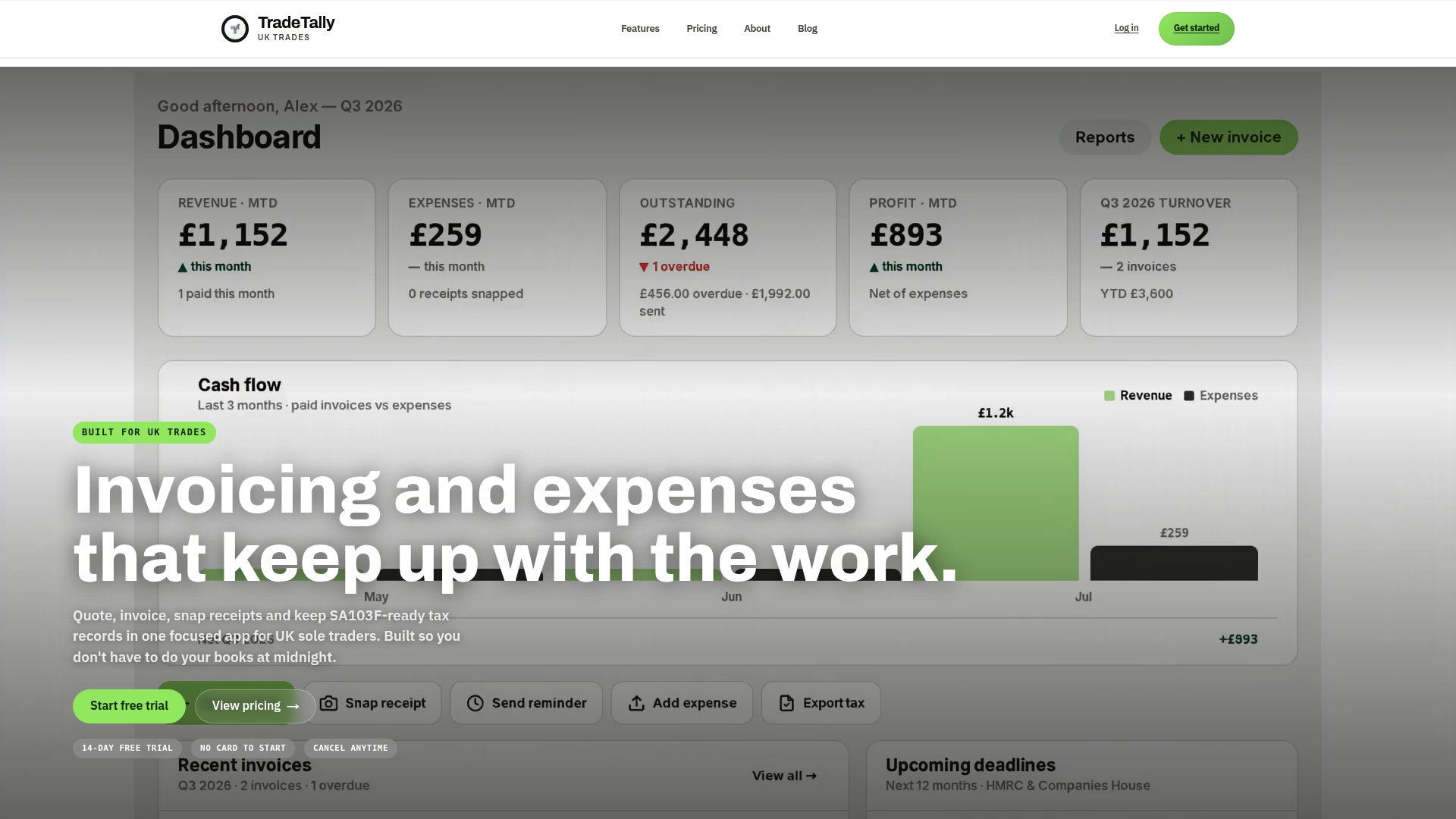
TradeTally is a UK web and mobile app for sole tradespeople. It covers branded invoicing, quotes, a live profit dashboard, expense and receipt tracking, mileage and time tracking, CIS deduction handling and tax-ready records, including an SA103F export, with MTD-ready record-keeping and exports for Self Assessment or handing to an accountant.
The Starter plan is £0 per month for limited invoicing. Professional is £12 per month, or £120 per year, for unlimited invoices, receipts and tax exports. Plans and details are on our pricing page, and you can start from the TradeTally homepage.
If CIS is a big part of your work, our CIS invoice software page shows how deductions are handled on the invoice itself.
Our view: the checklist should shrink
We built TradeTally because the admin that follows a day on site is the part of the job nobody trains you for. You finish at five, you are in the van, and the receipts, the invoice and the mileage are all still in your head.
A monthly checklist is the right idea, and the steps above are the ones that matter. But the best version of it is one where most steps are already done. If you photograph the receipt at the trade counter, send the invoice from the driveway and see the profit on the job before you drive off, the month-end hour is mostly checking, not catching up.
That is what we designed for: mobile-first invoicing and receipt capture, a live profit figure for each job, CIS deductions handled for you, and records that export in the SA103F format for your Self Assessment. Fewer steps, done at the moment they are easiest, with records that are ready for MTD when your income band reaches it.
Simon
FAQ
How often should a sole trader do their bookkeeping?
Monthly is the sensible minimum, with a quick weekly check on receipts and unpaid invoices if you are busy. A month is short enough to catch errors while you can still remember the job. If you are in Making Tax Digital, your records also need to be ready for quarterly updates.
What records do I need to keep as a self-employed tradesperson?
GOV.UK lists sales and income, business expenses, VAT records if you are registered and PAYE records if you employ people. Keep the proof too: invoices, receipts, bank statements and, under CIS, your payment and deduction statements.
How long must I keep my bookkeeping records?
At least five years after the 31 January submission deadline for the tax year, according to GOV.UK. For the 2025–26 tax year that means at least 31 January 2032. Digital copies are accepted, which saves you the shoebox.
Do I need to reconcile my bank account every month?
Yes, it is the single check that proves your records match reality. Match every bank, card and payment-app transaction to an invoice, receipt or note, and investigate any difference instead of forcing a balance.
Sources
- Business records if you’re self-employed: what records to keep (GOV.UK)
- Business records if you’re self-employed: how long to keep your records (GOV.UK)
- Business records if you’re self-employed: overview (GOV.UK)
- How to keep records as a small business (Tax Confident, GOV.UK)
- Act now: 864,000 sole traders and landlords face new tax rules (GOV.UK)
- The Income Tax (Digital Obligations) Regulations 2026 (legislation.gov.uk)
- Record keeping and quarterly updates for Making Tax Digital (Low Incomes Tax Reform Group)
- CIS340 Construction Industry Scheme guide (HMRC)
Recommended
Related articles

Bank Reconciliation for Sole Traders: A Practical UK Guide
How UK sole traders reconcile the business bank account: the steps, how often to do it, what to do with mismatches, and how it keeps your tax records clean.

MTD ITSA Deadlines 2026/27: Every Date Sole Traders Need
Every Making Tax Digital for Income Tax date for 2026/27: quarterly update deadlines, the 31 January final return, penalties and who is in from 2027.

Builder Bookkeeping: What to Record, Keep and Claim
Builder bookkeeping explained for UK sole traders: the records to keep for each job, CIS and invoice basics, how long to store them, and a simple weekly routine.

Mobile Bookkeeping for Trades: A Practical UK Guide
How UK sole traders can keep invoices, receipts, mileage and Self Assessment records up to date from the van, with a simple routine and a checklist.