Invoice Line Items: What to Include and How to Write Them

An invoice line item is one row on your invoice that describes a single job, product or charge, with its quantity, price and total. Every row adds up to the amount the customer owes. For a tradesperson, getting those rows right decides whether the customer pays on time, whether a VAT-registered customer can reclaim their VAT, and whether your records are ready at tax time. Build the lines once as a clean set of labour, materials and extras, and the rest of the admin follows from them. That is the thinking behind how we built TradeTally’s invoicing, which lets you raise branded invoices from your phone.
TL;DR
- A line item is one row: description, quantity, unit price and line total. Keep one charge per row.
- On a VAT invoice, UK rules require per-item detail: quantity or extent of the service, VAT rate and the amount excluding VAT.
- Split labour, materials and extras (call-out, travel, waste disposal) so the customer sees what they are paying for and you can see what each part earned.
- If you work under CIS or the VAT reverse charge, your lines also need the right wording, or the invoice gets queried.
- Itemised lines feed straight into profit per job, expense records and your Self Assessment figures.
Table of Contents
- What a line item is, in plain terms
- What the law says each line must show
- How to break a trade job into line items
- Writing descriptions that stop disputes
- Line items under CIS and the VAT reverse charge
- Why itemised lines pay off beyond the invoice
- Keeping numbering and layout consistent
- A checklist before you send
- Where TradeTally fits
- Our view: the invoice is where the job gets finished
- FAQ
- Sources
What a line item is, in plain terms
Think of an invoice as a table. The header holds who you are, who the customer is, the date and the invoice number. The table underneath holds the line items. Each row is one thing you are charging for: two hours of labour, a new mixer tap, a skip, a call-out fee.
A typical row has four parts:
- Description: what the charge is for, in words the customer recognises.
- Quantity: hours, metres, items or a single unit for a fixed-price task.
- Unit price: the price of one hour, one metre or one item.
- Line total: quantity multiplied by unit price.
The line totals add up to the subtotal. VAT, a CIS deduction or a deposit already paid then sit underneath, and the final figure is the amount due. If a customer can read each row and work out the total themselves, you have written the lines properly.
What the law says each line must show
What you need depends on whether you are VAT-registered.
If you are not VAT-registered
GOV.UK sets out what every UK invoice must include: a unique invoice number, your name and contact details, the customer’s name and address, a clear description of what you are charging for, the supply date, the invoice date, the amounts charged and the total owed. As a sole trader you must show your own name, and your business name if you use one, plus an address where legal documents can reach you if you trade under a business name.
Note the phrase “a clear description”. It is the legal requirement that makes “Work done, £850” a weak invoice and “Replace consumer unit, 10 circuits” a good one.
If you are VAT-registered
The rules get stricter at line level. Under regulation 14 of the VAT Regulations 1995, a full VAT invoice must show, for each description of goods or services, the quantity or extent of the service, the rate of VAT and the amount payable excluding VAT. HMRC’s own manual on VAT invoice particulars also lists the unit price, the total excluding VAT, the total VAT chargeable in sterling and any cash discount rate.
In practice, that means every row on a VAT invoice should carry its own VAT rate. This matters when you mix rates, for example standard-rated labour and materials alongside a zero-rated or reduced-rate item. Put each on its own row so the figures stay separate.
Two more VAT points worth knowing:
- A full VAT invoice is needed for supplies over £250 including VAT. For £250 or less, a simplified invoice with a description and the VAT-inclusive total per rate is allowed.
- You must normally issue a VAT invoice within 30 days when supplying another VAT-registered business, and keep a copy of every one for at least 6 years.
The reader on the other end cares too. GOV.UK states that VAT cannot be reclaimed on an invalid invoice, which is why a VAT-registered customer will bounce an invoice with missing details. For the full list of what a tradesperson’s invoice needs, see our guide to UK invoice requirements for tradespeople.
How to break a trade job into line items
The best line items match how you priced the job. If your quote had labour and materials as separate figures, the invoice should too. Here is a worked example for a plumber replacing a leaking radiator valve and fitting a new tap.
| Description | Qty | Unit price | Line total |
|---|---|---|---|
| Call-out and diagnosis | 1 | £60.00 | £60.00 |
| Labour: replace radiator valve and bleed system | 1.5 hrs | £55.00 | £82.50 |
| Labour: fit customer-supplied kitchen mixer tap | 1 hr | £55.00 | £55.00 |
| Materials: thermostatic radiator valve | 1 | £18.40 | £18.40 |
| Materials: fittings, PTFE and isolation valve | 1 | £9.60 | £9.60 |
| Waste disposal: old valve and fittings | 1 | £10.00 | £10.00 |
| Subtotal | £235.50 |
Those prices are illustrative, not a recommended rate. The point is the structure. Each row is one charge, the arithmetic can be checked in seconds, and the customer can see that the labour and the parts are separate costs.
For a VAT-registered trader, you would add a VAT column or a VAT rate to each row, then show the total VAT at the bottom. If you need to add or strip 20% quickly, our VAT calculator does it.
Common line items for tradespeople
- Labour: by the hour, by the day or as a fixed price for a defined task. State which.
- Materials: itemise anything significant. Group small consumables (screws, sealant, tape) into one row.
- Call-out or minimum charge: shown on its own so it does not look like inflated labour.
- Travel time: if you charge for it, make it a separate row. Our guide to billing travel time covers how.
- Waste and skip hire: one row, with the quantity if relevant.
- Hire of equipment: scaffold tower, floor sander, whatever you rented for the job.
- Variations: extra work agreed after the quote, each with its own description and a date or reference.
- Deposits or payments on account: shown as a deduction below the subtotal, not mixed into a line.
Writing descriptions that stop disputes
Most invoice arguments come from vague rows. A good description answers “what exactly did I get?” before the customer asks.
Weak: “Bathroom work”
Stronger: “Bathroom: supply and fit 1700mm bath, waste and overflow, silicone seal”
A few habits help:
- Use the customer’s words. If their quote said “new consumer unit”, do not invoice it as “CU upgrade”.
- Say what was done, not just what was supplied. “Supply and fit” tells the customer labour is included.
- Split large jobs into stages. The Small Business Commissioner advises describing the work clearly and specifying sub-tasks where significant work is broken up.
- Reference the quote or purchase order. The same guidance recommends asking for a PO number early, and it should appear on the invoice if the customer gave you one.
- Do not hide extras. A surprise charge is the quickest route to a late payment. If it was agreed, label it as agreed.
Pro tip: photograph the finished job and the materials receipt before you leave site. When a customer questions a row three weeks later, you have the evidence in your phone.
Line items under CIS and the VAT reverse charge
If you work as a subcontractor in construction, two schemes change what your lines should look like.
CIS (Construction Industry Scheme). Under CIS, the contractor deducts tax from your payment, but the deduction applies to labour, not to materials you bought. So labour and materials need to sit in separate rows, and the invoice should show the CIS deduction as a line below the subtotal. If everything is lumped together as “works”, the contractor cannot work out the right deduction, and you end up with a payment that does not match your invoice. Our CIS deduction calculator shows the sums, and the CIS explained guide covers the rules for subcontractors.
VAT domestic reverse charge. For many construction services supplied to a VAT-registered contractor, the customer accounts for the VAT instead of you. The invoice still lists each line with its net value, but the VAT is shown for reference and not added to the amount payable, with a note that the reverse charge applies. We cover the wording and where the figures go in our guide to the domestic reverse charge. For ready-made layouts, see our builder invoicing guide, or the carpenter invoice templates and plumber invoicing guide if those are your trade.
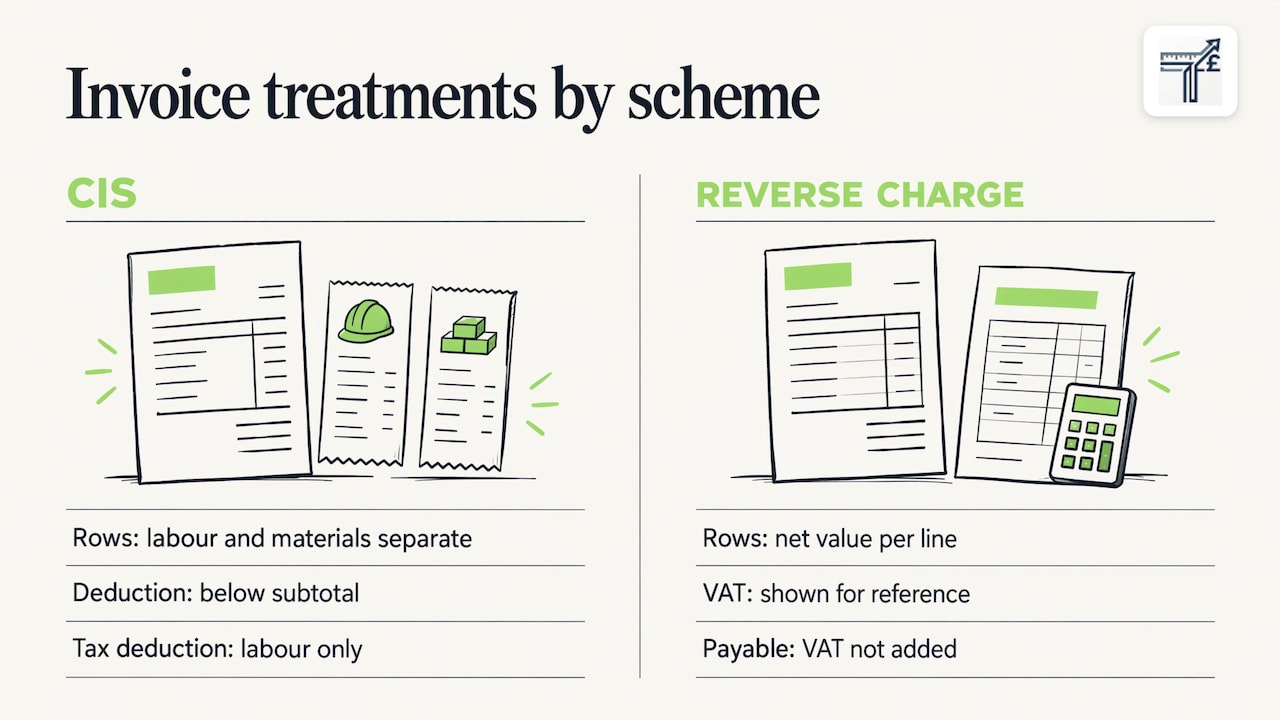
The common thread: the cleaner your lines, the easier it is for the other side to process the invoice correctly. That is a payment issue as much as a tax one.
Why itemised lines pay off beyond the invoice
The Institute of Credit Management calls invoicing a vital first step to healthy cashflow and advises getting invoices right first time, because credit notes and reissued invoices use up time and change the payment due date. Line items are where most errors creep in: a wrong quantity, a missing VAT rate, a materials row with no description.
There is a second benefit. When your rows are consistent, you can see where the money comes from:
- Labour rows show what your time earned on each job.
- Materials rows show what you recharged against what you paid, which is where margin quietly disappears if you forget to add your mark-up.
- Extras show whether travel, call-outs and disposal are being charged or absorbed.
Match those against your supplier receipts and you can see profit per job, not just turnover. Our profit margin calculator and guide to pricing your trade services help set the rates that go into those rows in the first place.
There is also the tax angle. As a self-employed person you must keep records of your sales and expenses, and itemised invoices make your income side easy to evidence. On the cost side, the same discipline applies to receipts: see our receipt keeping guide for sole traders.
Keeping numbering and layout consistent
A unique invoice number is a legal requirement, and gaps or duplicates raise questions. Pick one format and stick to it, for example year, then a running number. Our guide to automatic invoice numbering explains how to set that up so you never have to think about it.
For layout, keep the line items table in the same order every time: description, quantity, unit price, VAT rate (if registered), line total. Customers learn where to look, and your own bookkeeping gets faster because every invoice reads the same way.
A checklist before you send
- Invoice number is unique and in sequence.
- Your name (and business name if used), address and contact details are on it.
- Customer name and address are correct, and the PO number is shown if one was given.
- Supply date and invoice date are both there.
- Each line has a clear description, a quantity and a unit price.
- Labour and materials are in separate rows.
- VAT rate and net amount shown per line if you are registered; VAT total at the bottom.
- CIS deduction or reverse charge wording included where it applies.
- Payment terms, due date and bank details are clear. The ICM guide also recommends printing the statutory late-payment interest wording on the invoice.
- The total matches the quote plus any agreed variations.
The Small Business Commissioner adds a practical step: check who actually processes payment, because the person who hired you may not be the person who pays. Addressing the invoice to the right recipient, and confirming the payment date in advance, avoids delays that no amount of neat line items can fix.
Where TradeTally fits
If you build these rows by hand in a word processor or a spreadsheet, you are re-keying the same descriptions, prices and VAT sums on every job. TradeTally is a UK web and mobile app for sole tradespeople that handles branded invoicing, quotes, expense and receipt tracking, CIS deduction handling and a live profit dashboard in one place. It is built mobile-first, so you can finish the invoice from your van at the end of the day.
The Starter plan is free for limited invoicing, and the Professional plan is £12 per month or £120 per year for unlimited invoices, receipts and tax exports, including an SA103F export for Self Assessment.
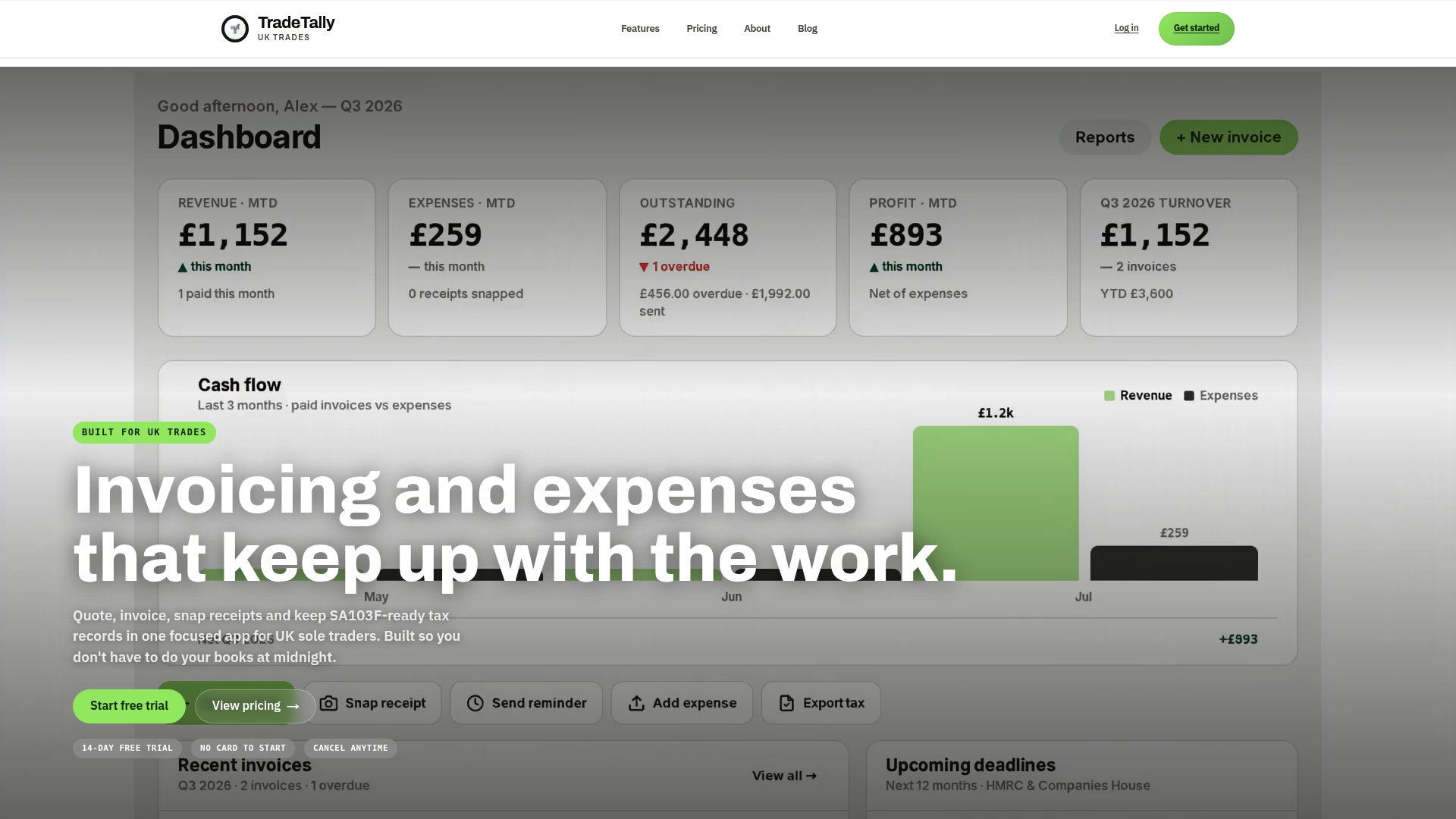
You can see both plans on our pricing page, or start on the TradeTally homepage.
Our view: the invoice is where the job gets finished
Most tradespeople we talk to think of the invoice as the paperwork at the end. We think of it as the last part of the job, and the line items are the part that decides whether it is closed or reopened.
TradeTally was built by a working tradesperson, so we start from the end of a day on site: tired, in the van, with a handful of receipts and a customer waiting. In that moment, nobody wants to design a table. They want labour, materials and extras to drop into the right rows, with the right wording, and the numbers to add up.
That is why we put quoting, invoicing, expenses and CIS in one place. When the quote lines flow into the invoice, and the receipts sit against the same job, the profit figure on the dashboard is the real one. And when it is time for Self Assessment, the records are already shaped for the SA103F export, so you are not rebuilding the year from a shoebox.
Our advice is simple: one charge per row, labour apart from materials, and nothing on the invoice that the customer has not already agreed. Do that every time and you will spend less time chasing and more time working.
Simon
FAQ
What does “line item” mean on an invoice?
A line item is one row on the invoice describing a single charge, such as an hour of labour or a piece of equipment. Each row normally shows a description, quantity, unit price and total. The rows add up to the amount due.
How many line items should an invoice have?
As many as it takes to make each charge clear, and no more. For a small repair, three or four rows may be enough. For a larger job, split by stage or area and keep labour and materials separate. There is no legal maximum, but a customer should be able to follow the invoice without ringing you.
Do I need to show VAT on every line item?
If you are VAT-registered and issuing a full VAT invoice, yes: each description of goods or services needs its quantity or extent, VAT rate and amount excluding VAT. If you are not VAT-registered, you do not charge or show VAT, but you still need a clear description and amount for each charge.
Should materials and labour be separate line items?
Yes. It makes the invoice easier to read, it lets you apply a CIS deduction to labour only, and it shows you what you earned on each part of the job. Group small consumables into one row so the invoice does not become cluttered.
How long should I keep invoices?
If you are VAT-registered, HMRC’s guidance says to keep VAT records, including copies of every VAT invoice you issue, for at least 6 years. Check the official page for your own situation, or ask your accountant if you are unsure.
Sources
- GOV.UK: Invoices, what they must include
- The Value Added Tax Regulations 1995, regulation 14
- HMRC VATREC5010: VAT invoice particulars
- Bridgend County Borough Council: what a VAT invoice must show
- GOV.UK: Record keeping (VAT Notice 700/21)
- GOV.UK: Keeping VAT records
- Small Business Commissioner: Getting invoices right
- Institute of Credit Management: Invoicing
Related articles
Carpenter Invoice Templates With CIS Wording
Get three editable UK carpenter invoice templates, HMRC’s required fields, and exact CIS and VAT reverse charge wording for faster site paperwork.

Invoice Template for Builders UK
Use an invoice template for builders UK tradespeople can trust. See what to include, how to bill clearly, and how to get paid faster.
Builder Invoicing: VAT, CIS and MTD
A UK builders' guide to legally valid, on‑site invoices. Show the VAT reverse charge and CIS deductions, use copy ready templates, and be MTD ready from 6...
Builder Bookkeeping: What to Record, Keep and Claim
Builder bookkeeping explained for UK sole traders: the records to keep for each job, CIS and invoice basics, how long to store them, and a simple weekly routine.