Early Payment Discounts: How They Work and When Trades Should Offer One
An early payment discount is a reduction you offer on an invoice if the customer pays within a set number of days, before the normal due date. You give up a small slice of the price and get your cash sooner. Whether that is a good deal depends on three things: how much the discount costs you, how badly you need the money earlier, and whether your invoice is worded and priced correctly for VAT. This guide covers all three, with worked examples for a sole trader.
TL;DR
- “2/10 net 30” means 2% off if the customer pays within 10 days, otherwise the full amount is due within 30 days.
- If you are VAT registered, the VAT is calculated on the discounted price, so you charge and pay VAT on less if the discount is taken.
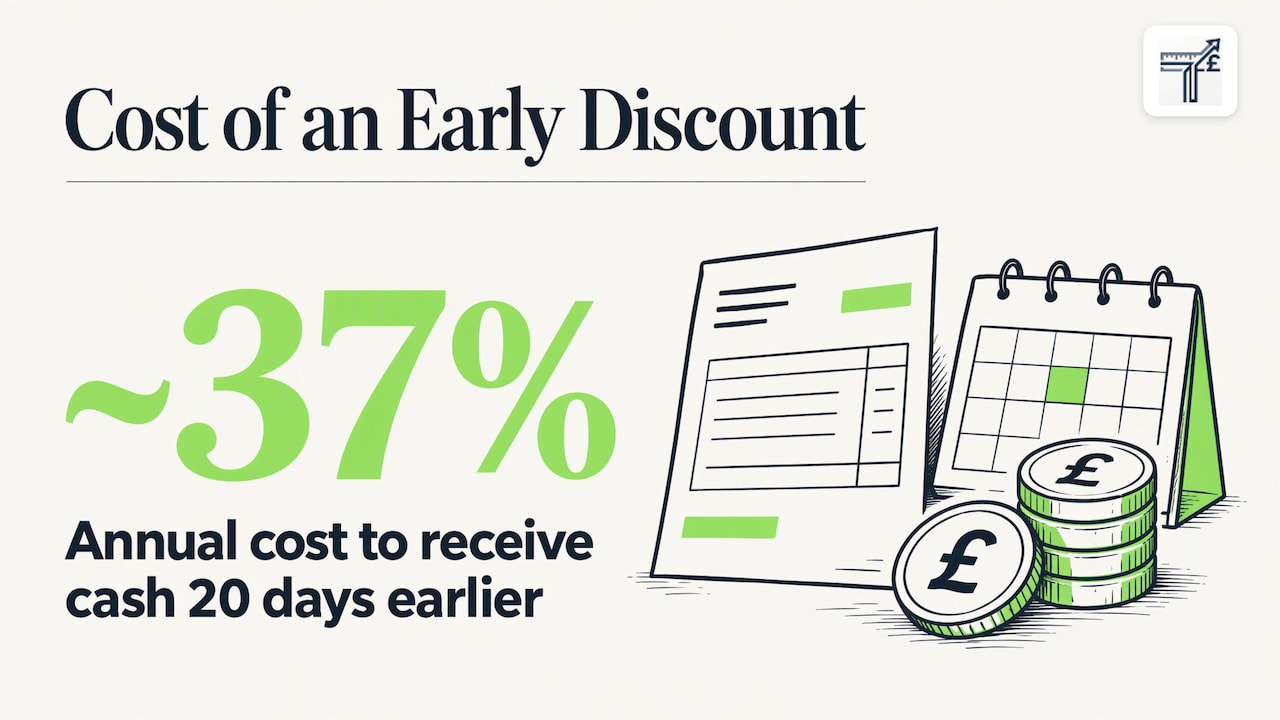
- A 2% discount for paying 20 days early costs you roughly 37% a year when expressed as a rate. It only makes sense if the margin still works and the cash really matters.
- Put the percentage, the number of days and the VAT position on the invoice itself, so nobody argues later.
- Offer it to customers who pay slowly on bigger jobs, not to everyone by default.
Table of Contents
- What an early payment discount is
- What “2/10 net 30” means
- The maths, with a trade example
- How VAT works on a prompt payment discount
- How to write it on an invoice
- When offering a discount makes sense
- Taking a discount as a customer
- Common mistakes
- Perspective
- Getting your invoices ready for early payment terms
- FAQ
- Sources
What an early payment discount is
An early payment discount is also called a prompt payment discount, an early settlement discount or a cash discount. All mean the same thing: a percentage off the invoice if the customer settles within a stated window, commonly written in the X/Y, net Z format.
HMRC defines it as an offer to reduce the price of goods or services if the customer pays promptly, after the invoice is issued and before full payment is due. Its own example is a 5% discount for payment within 14 days of the invoice date.
It is not the same as a late fee. A late fee or interest is a penalty added when someone pays after the due date. A discount is a reward for paying early. If you want the penalty side, our guide on late payment interest in the UK covers what you can claim.
What “2/10 net 30” means
The phrase comes up constantly in search because it looks like code. It is simple once you split it up:
- 2 is the discount percentage.
- 10 is the number of days in which the customer must pay to get it.
- Net 30 means the full amount is due within 30 days if they miss the discount window.
So with 2/10, net 30, the customer takes 2% off by paying within 10 days, otherwise the whole invoice is due within 30 days.
Both clocks start on the invoice date. In a standard textbook example, an invoice dated 5 September counts 6 September as day 1, the discount runs through day 10 and the full amount is due by day 30. Say whether the days are calendar days, and say the date the money must arrive, not the date it was sent. That one detail prevents most disputes about whether a payment “counts”.
The same format works with other numbers. “5/14, net 30” is 5% off for payment within 14 days. “2/7, net 14” is 2% off within a week, otherwise due in a fortnight, which suits small jobs.
The maths, with a trade example
The formula is simple: discounted price = invoice amount × (1 − discount percentage). On a £5,000 invoice with 2/10, net 30 terms, paying within 10 days costs £4,900 and paying later costs the full £5,000.
Now a job a sole trader might actually do. You fit a bathroom for £3,000 plus VAT at 20%, on 2/10, net 30 terms.
| Discount not taken | Discount taken | |
|---|---|---|
| Price before VAT | £3,000 | £2,940 |
| VAT at 20% | £600 | £588 |
| Customer pays | £3,600 | £3,528 |
| Paid by | Day 30 | Day 10 |
You give up £60 before VAT, and you get your money 20 days sooner. The VAT figure drops from £600 to £588 because, as explained below, VAT follows the discounted price.
What it really costs you
A 2% discount sounds trivial. Measured as a rate, it is not. You give up 2% to receive the money 20 days earlier. Taking £2,940 as what you receive for the early money, £60 is about 2.04% of that. There are roughly 18 twenty-day periods in a year, so the equivalent annual cost is around 37%. This is our own arithmetic, not a published figure, but it shows why the question is not “is 2% small?” but “is cash 20 days earlier worth 37% a year to me?”
For many trades the answer is yes at certain moments: you have materials to buy for the next job, a supplier account on 14 days, or an overdraft that is already stretched. Accountant Bev Wakefield makes the same point with a bigger example: on a £20,000 invoice with 60-day terms, a 2% discount for immediate payment gives up £400 but delivers the cash straight away, which can be worth more than that in borrowing costs or reinvestment. The longer your normal terms, the more attractive the discount becomes.
How VAT works on a prompt payment discount
This is where trades most often go wrong, so read it twice if you are VAT registered.
Since 1 April 2015, where your terms offer a prompt payment discount and the customer pays in line with them, the VAT consideration is the discounted price. The rules changed on 1 May 2014 for broadcasting and telecoms and on 1 April 2015 for everyone else: suppliers account for VAT on the amount actually paid, and customers recover only the VAT actually paid.
In plain terms:
- You charge VAT on the discounted amount, not the full price, if the customer takes the discount.
- Your customer, if VAT registered, can only reclaim the VAT they actually paid. In the bathroom example that is £588, not £600.
- If the discount is taken after you have already issued the invoice, the supplier adjusts by credit note or revised invoice, unless the invoice wording says no credit note will be issued (see below).
If you use the VAT cash accounting scheme, there is one more wrinkle. VAT is chargeable on the discounted price even if the customer does not take up the offer. Check with your accountant if you are on that scheme before you start offering discounts.
If you are not VAT registered, none of this applies and the discount is simply a lower price.
How to write it on an invoice
The invoice is where the discount either works or turns into an argument. HMRC’s recommended wording for the option where you do not issue a credit note is: “A discount of X% of the full price applies if payment is made within Y days of the invoice date. No credit note will be issued. Following payment you must ensure you have only recovered the VAT actually paid.”
Fill in the percentage and number of days, and you have a clear, compliant line. Enterprise Nation recommends stating the exact amount and deadline, such as a small reduction for payment within seven days, rather than something vague like “discount for prompt payment”.
A good invoice with a discount shows:
- The invoice date and the full due date.
- The discount percentage and the last day to pay to qualify.
- The amount payable if the discount is taken, in pounds, so the customer does not have to work it out.
- The VAT wording above, if you are VAT registered.
- Your bank details and a payment reference.
For the wider list of what every invoice must carry, see our guide to UK invoice requirements for tradespeople. If you need to correct an invoice after a discount is taken, the credit note rules and the 14 day rule explain how that works.
When offering a discount makes sense
A discount is a pricing decision, not a favour. Enterprise Nation’s advice is to use one only if the margin still works and to avoid training customers to expect it. Collections firm Hilton Baird sets out the trade-offs: discounts improve cash flow, reduce late-payment risk and cut the need for outside funding, but they reduce margins and make forecasting harder until you see who takes them up.
In practice, a few rules keep it sensible.
Check the margin first
If your margin on a job is 20%, a 2% discount takes a tenth of your profit. If it is 8%, it takes a quarter. Work out the job’s real profit before you commit. Our profit margin calculator for trades does the sum quickly, and the guide to pricing your trade services shows how to build a margin that can absorb a discount.
Target the jobs where it helps
Offering it on every invoice means you give away 2% to customers who would have paid in seven days anyway. Better targets are:
- Larger invoices where waiting 30 days hurts, such as a full rewire or a kitchen fit.
- Commercial customers and letting agents who work to long payment cycles.
- Customers who have paid late before.
For small domestic jobs, shorter terms or payment on completion are usually simpler than a discount.
Keep your terms tight to begin with
A discount only has value against a clear due date. If your standard terms are vague, the discount has nothing to beat. Our invoice payment terms guide for tradespeople covers how to set a due date that sticks. For big jobs, you can also split the invoice with a deposit and stage payments, which reduces the amount at risk: see how to set up a partial payment invoice.
Do not treat it as a late fee in reverse
The discount and the late payment penalty work together. If someone misses the discount window, the net 30 date applies. If they miss that too, you can chase and claim interest. Our step-by-step guide to chasing overdue invoices covers that stage, and the guide to late fees on an invoice explains what you can charge.
Taking a discount as a customer
Tradespeople are also customers. Your merchant may offer a discount for settling an account early. The same maths applies: 2% for paying 20 days sooner is a high return on your cash if you have the money sitting there, and not worth it if you would need to borrow to pay early.
The VAT point applies in reverse. If you are VAT registered and take a prompt payment discount, you can only reclaim the VAT you actually paid. Keep the invoice and the payment record together, so your figures match what you claim.
Common mistakes
- No deadline. “Discount for early payment” with no date invites a dispute. State the last day.
- Wrong VAT. Charging VAT on the full price and then expecting the customer to pay less in total leaves both of you with the wrong figures.
- Discounting without checking the margin. A deal that looks generous on a £5,000 job can wipe out the profit on a tight quote.
- Letting it become the norm. If every customer deducts 2% whether or not they paid in time, you have cut your price, not improved your cash flow. Refuse discounts taken after the deadline and say so politely, citing the invoice wording.
- Forgetting to record it. The discount changes what you received. Your records should show the invoice, the amount actually paid and the date, so your Self Assessment figures are right.
Perspective
Most tradespeople we hear from do not lose sleep over a 2% discount. They lose sleep over the invoice that is still unpaid after six weeks, because they sent it late, left the terms vague or never followed up.
That is why we think a discount is the second step, not the first. Get a clear, branded invoice out the same day, with a due date and payment details the customer cannot miss. Then decide whether a short discount window earns its place on the bigger jobs.
TradeTally was built by a working tradesperson for the admin that follows a day on site. We designed it so you can create and send invoices from your phone in the van, keep receipts and expenses in the same place and see profit on each job, which is the number you need before you decide how much you can afford to discount.
Simon
Getting your invoices ready for early payment terms
A discount is only as good as the invoice it sits on. TradeTally is a UK app for sole tradespeople with branded invoicing, quote creation, a live profit dashboard, expense and receipt tracking, and tax-ready records with an SA103F export for Self Assessment. You can send invoices from your phone, and see profit on each job before you set a discount.
The Starter plan is £0 per month, with limited invoicing. The Professional plan is £12 per month or £120 per year, with unlimited invoices, receipts and tax exports. You can start on the TradeTally home page or compare plans on the pricing page.
FAQ
What does 2/10 net 30 mean?
It means the customer can deduct 2% if they pay within 10 days of the invoice date. If they miss that window, the full amount is due within 30 days. The same format works for any percentage and number of days, such as 5/14, net 30.
Do I charge VAT on the full price or the discounted price?
If you are VAT registered and the customer pays in line with your discount terms, VAT is based on the discounted price. Your customer can only reclaim the VAT they actually paid. If you use the VAT cash accounting scheme, different treatment applies, so talk to your accountant first.
How do I mention a discount on my invoice?
State the percentage, the number of days from the invoice date and the amount payable if the discount is taken. If you are VAT registered, use HMRC’s suggested wording, which says no credit note will be issued and that the customer must recover only the VAT actually paid. Keep it on the invoice itself, not in a separate email.
Is an early payment discount worth offering?
It is worth it when the margin on the job can absorb it and getting the money sooner solves a real cash problem, such as paying for materials or avoiding an overdraft. A 2% discount for paying 20 days early works out at roughly 37% a year, so use it on larger invoices and slow payers rather than every job.
What is the difference between a discount and a late fee?
A discount rewards a customer for paying before the due date. A late fee or statutory interest is what you may charge when payment arrives after it. You can use both on the same invoice: a short discount window first, then the full due date, then interest if the customer is still late.
Sources
- Prompt Payment Discount: Meaning, Calculation & VAT Rules
- VATVAL08500: Special valuation provisions: prompt payment discounts, GOV.UK
- VCAS5100: Cash accounting scheme: Records and accounts, GOV.UK
- VAT: Prompt Payment Discounts consultation, GOV.UK
- Terms of Payment: Determining the discount and credit periods
- How to get paid on time and deal with late payments, Enterprise Nation
- The Secret to Getting Paid On Time, Vibrant Accountancy
- Early settlement discounts: The pros and cons, Hilton Baird Collections
Recommended
Related articles

VAT Credit Notes and the 14-Day Rule
VAT accurate guide for UK tradespeople and small businesses. When to issue credit notes, the 14 day rule, VAT return fixes and records.

VAT Flat Rate Scheme: Is It Worth It for Tradespeople?
How the VAT Flat Rate Scheme works for UK tradespeople: who can join, the 16.5% limited cost rate, worked examples against standard VAT, and how to choose.

Quote Follow-Up: When and What to Send to Win the Job
A practical quote follow-up schedule for UK tradespeople: when to chase, what to say by text, phone or email, and when to stop. Copy-ready wording included.

Late Fees on an Invoice in the UK: What You Can Charge
What UK tradespeople can legally charge on a late invoice: 8% statutory interest, £40 to £100 fixed fees, worked examples and how to word it.