Quote Follow-Up: When and What to Send to Win the Job

Follow up on every quote you send, and fix the dates the moment it goes out. Check it arrived within two working days, make contact again once or twice with something useful, then close it politely. Most quotes that go quiet have not been turned down. They have been forgotten, first by the customer and then by you. A fixed routine, written down on the day, is what stops that happening, and it takes about five minutes per quote.
This guide gives you the timings, the wording for text, phone and email, and the point where you stop. It is written for sole traders: plumbers, electricians, builders, carpenters and other tradespeople who price jobs between site visits and chase from the van.
TL;DR
- Send a short “did it arrive?” message within two working days of the quote.
- Make your main follow-up around day 5 to 7. Ring if the job is large, text if it is small.
- Add something new each time: a start date, an answer, a smaller option. Never just “checking in”.
- Send a final, easy-to-answer close message before the quote expires, then stop and mark it closed.
- Put the dates in your diary when you send the quote, not when you remember.
Table of Contents
- Why a quote goes quiet
- A follow-up schedule that works for trades
- What to say: wording you can copy
- How to follow up without sounding pushy
- Make the quote itself easier to follow up
- What if they accept, and then the money chase begins?
- Common mistakes that cost you work
- Keeping track without a spreadsheet
- Quote, invoice and track the profit in one app
- FAQ
- Sources
Why a quote goes quiet
A homeowner who asks three tradespeople for prices is not necessarily comparing yours line by line. More often the quote is sitting in an inbox between school runs and work. They meant to reply. Then something else came up.
That is why a follow-up is normal and expected, not pushy. You are not pressuring anyone. You are making it easy to take the next step: yes, no, or “can you change this?” Any of those answers is better for you than silence, because silence leaves you holding a day in the diary for work that may never happen.
There is a second reason to be organised. A quote is a serious document. Citizens Advice tells homeowners that a quote is a promise to do the work at a fixed price, and that once they say yes it is a binding agreement. So your follow-up is not only a sales message. It is a chance to confirm what the price covers before anybody has agreed to anything.
A follow-up schedule that works for trades
There is no official rule on timing, so treat the schedule below as a practical routine rather than a law. It scales with the size of the job, because a customer deciding on a £200 repair needs far less time than one deciding on a £12,000 extension.
| Job size | First check (did it arrive?) | Main follow-up | Final message |
|---|---|---|---|
| Small (a repair, a call-out, a one-day job) | Same day or next working day | Day 3 to 4, by text | Day 7 to 10 |
| Medium (a bathroom, a rewire, a few days’ work) | Next working day | Day 5 to 7, by phone, then text | Day 12 to 14 |
| Large (an extension, a full refit, a commercial job) | Within two working days | Day 7 to 10, by phone | A few days before expiry |
The exact day matters less than having one. Here is how the routine runs in practice.
Step 1: Ask when they expect to decide
The best follow-up starts before you send the quote. On the site visit or the phone call, ask: “When are you hoping to get this started or make a decision?” Write the answer on the quote record.
Now your follow-up has a reason. You are not chasing, you are ringing on the day they said they would know. People remember what they told you and they feel obliged to give an answer.
Where it goes wrong: skipping the question because the conversation felt awkward. Without a date you are guessing, and a guess usually means chasing too early or not at all.

Step 2: Check it arrived within two working days
Send one short message the next working day, or the day after. The point is only to confirm the quote landed. Emails go to spam, attachments fail to open and mobile numbers get mistyped.
Keep it to two sentences. Name the job, say you have sent the quote, and offer to answer questions. Do not ask for a decision yet.
Where it goes wrong: sending this at 9 pm or sending a long message. A short text during working hours looks like a tradesperson who is on top of things.
Step 3: Make the main follow-up with something new
Around day 5 to 7 (earlier for small jobs, later for big ones), get in touch properly. This is the message that wins or loses the job, so give the customer something they did not have before. Good options:
- Your next available start date, with a note that dates fill up.
- An answer to a question they asked on site.
- A cheaper or phased option, such as doing the essential work first.
- A line confirming what is included, if the quote was complicated.
A message that only says “just following up” gives the customer nothing to respond to, so they often don’t.
Step 4: Pick the right channel
Match the way the customer first contacted you. If they texted or used WhatsApp, text back. If they emailed, email.
A rough guide that suits most trade work:
- Text or WhatsApp: homeowners and small jobs. Short, quick to answer, read within minutes.
- Phone: medium and large jobs, and anyone who has gone silent after you have chased once already. A call lets you hear hesitation. A customer who says “it’s a bit more than we thought” is telling you something a text would never reveal, and you can deal with it there and then.
- Email: landlords, letting agents, commercial clients and anyone who needs to forward the quote to a partner or a budget holder.
On a call, keep to three questions: did the quote make sense, is there anything you would change, and when are you hoping to decide? Then stop talking and listen.
Step 5: Send a final message before the quote expires
Every quote should have an expiry date, because material prices and your diary both move. A few days before it lapses, send a final message. It should say the quote runs out on a stated date, that you are happy to go ahead or answer questions, and that it is fine if they have gone another way.
Giving people permission to say no makes it easier for them to say yes. Many of your replies will come from this message, and several will be “yes, sorry, been meaning to get back to you”.
Step 6: Stop, and mark the quote closed
After the final message, stop. Three or four contacts across the life of a quote is enough. A fifth is pestering.
Mark the quote closed in your records and free the diary slot you were holding. If the customer replies later, you can reopen it at current prices. That is why the expiry date matters: you are not committed to a price from three months ago.

What to say: wording you can copy
Keep every message short, put the job in the first line and ask one question. Use your own voice, but these work as starting points. Replace the brackets with the real details.
The “did it arrive?” text or email
Subject: Your [job] quote, [your name]
Hi [name], it’s [your name] from [business]. Just checking the quote for [job] reached you. Happy to talk through anything if you’d like. Thanks.
Put the quote number or job description in the subject line. A clear subject beats a clever one, and “Following up” on its own tells the customer there is nothing new inside.
The main follow-up with something new
Hi [name], I’ve had a look at the diary and I could start [job] on [date]. Did the quote make sense, and is there anything you’d like me to adjust, such as the spec or doing it in two stages? If you let me know either way, I can hold the date for you until [day].
The final message
Hi [name], a quick note that the quote for [job] (ref [number]) is valid until [date]. If you’d like to go ahead, reply here and I’ll confirm a start date. If you’ve decided against it, no problem at all, and if you can tell me why, it helps me quote better next time.
The message after a “too expensive” reply
Thanks for letting me know. If the total is the issue, I can price a smaller first stage, or look at which materials are driving the cost. Would either of those help?
Do not drop your price as a reflex. A discount offered straight away teaches the customer that your first number was soft, and it eats your margin. If you want to know how much room you really have, work it out from your costs first with a profit margin calculator for trades, and read our guide on how to price your trade services.
How to follow up without sounding pushy
Most customers do not mind a follow-up. They mind a bad one. Four habits keep yours on the right side:
- Do not apologise for following up. Writing “sorry to bother you” makes a normal business message sound like an imposition.
- Say when you will be in touch. When you send the quote, tell them you will call on Thursday. Then a call on Thursday is what they expect.
- Offer help, not pressure. “Is there anything I can clarify?” works better than “Have you made a decision yet?”
- Make a no easy. A customer who feels free to decline is more likely to reply at all.
If you want more ideas on building routines for the admin side of self-employment, these freelance finance and productivity habits are a useful starting point.
Make the quote itself easier to follow up
A follow-up is only as strong as the quote behind it. If the customer cannot tell what is included, they will hesitate, and no message fixes that. Before you send:
- State the scope in plain words: what you will do and what you will not.
- Show the price clearly, with VAT stated if you are VAT-registered.
- Put an expiry date on it.
- Say how variations are handled, so extras do not become arguments.
- Add a reference number so every message can point to it.
The law reinforces why this matters. Under section 50 of the Consumer Rights Act 2015, information you give a consumer about your service, in writing or otherwise, can become binding if they rely on it. Careless wording in a quote can therefore come back on you later. Our free quote template for sole traders covers the basics, and our guide to copyable quote terms shows how to word the small print so that disputes do not start.
What if they accept, and then the money chase begins?
A won quote is the start of the next bit of admin: the deposit, the job, the invoice, and payment. A customer who was slow to answer a quote is sometimes slow to pay too, so it helps to have the same discipline on both sides. When the work is done, the same short, polite wording style applies. Our guides on four-step invoice reminder wording and chasing overdue invoices in the UK carry the same approach into payment.
Common mistakes that cost you work
- Waiting for the customer to come back. They rarely do. The tradesperson who follows up is often the one who gets the job.
- Chasing the same way every time. Three identical “just checking in” messages are three reasons to ignore you.
- Following up without a record. If you cannot see which quotes are open, you will chase the wrong ones and miss the right ones.
- Dropping the price at the first sign of doubt. Offer a smaller scope or a phased start instead.
- Never closing a quote. An open quote with no expiry date can be accepted at last year’s price.
- Writing long messages. Three or four sentences is plenty.
Keeping track without a spreadsheet
The hardest part is not the wording. It is remembering. At the end of a long day on site, the quote you sent on Monday is the last thing on your mind. A simple routine fixes this: when a quote goes out, you set the three follow-up dates straight away and tick them off as you go.
If you also want your quotes, invoices and receipts in one place, that is what we built TradeTally for. You can then see how a quoted job turns into real profit once the work is done.
The view from the van
I built TradeTally as a working tradesperson, so I know how paperwork piles up after a day on site. Quotes are where it starts. A quote that goes out and is never followed up is wasted effort: you spent an evening pricing it, and then it slipped.
Our view is that admin should be quick enough to do from your vehicle, and that it should connect. A quote should lead to an invoice, the invoice to your receipts and the receipts to a clear picture of what each job actually earned. When the quote, the invoice and the profit sit in one place, you stop guessing which jobs are worth chasing.
That is why TradeTally is mobile-first and designed around the admin that follows a day on site. We want you to spend your time on the work you are good at, not retyping the same details into three places.
Simon
Quote, invoice and track the profit in one app
TradeTally is a UK web and mobile app for sole tradespeople. It lets you create quotes, send branded invoices, keep expenses and receipts, and see a live profit dashboard for each job. It also handles CIS deductions and produces tax-ready records, including an SA103F export for Self Assessment.
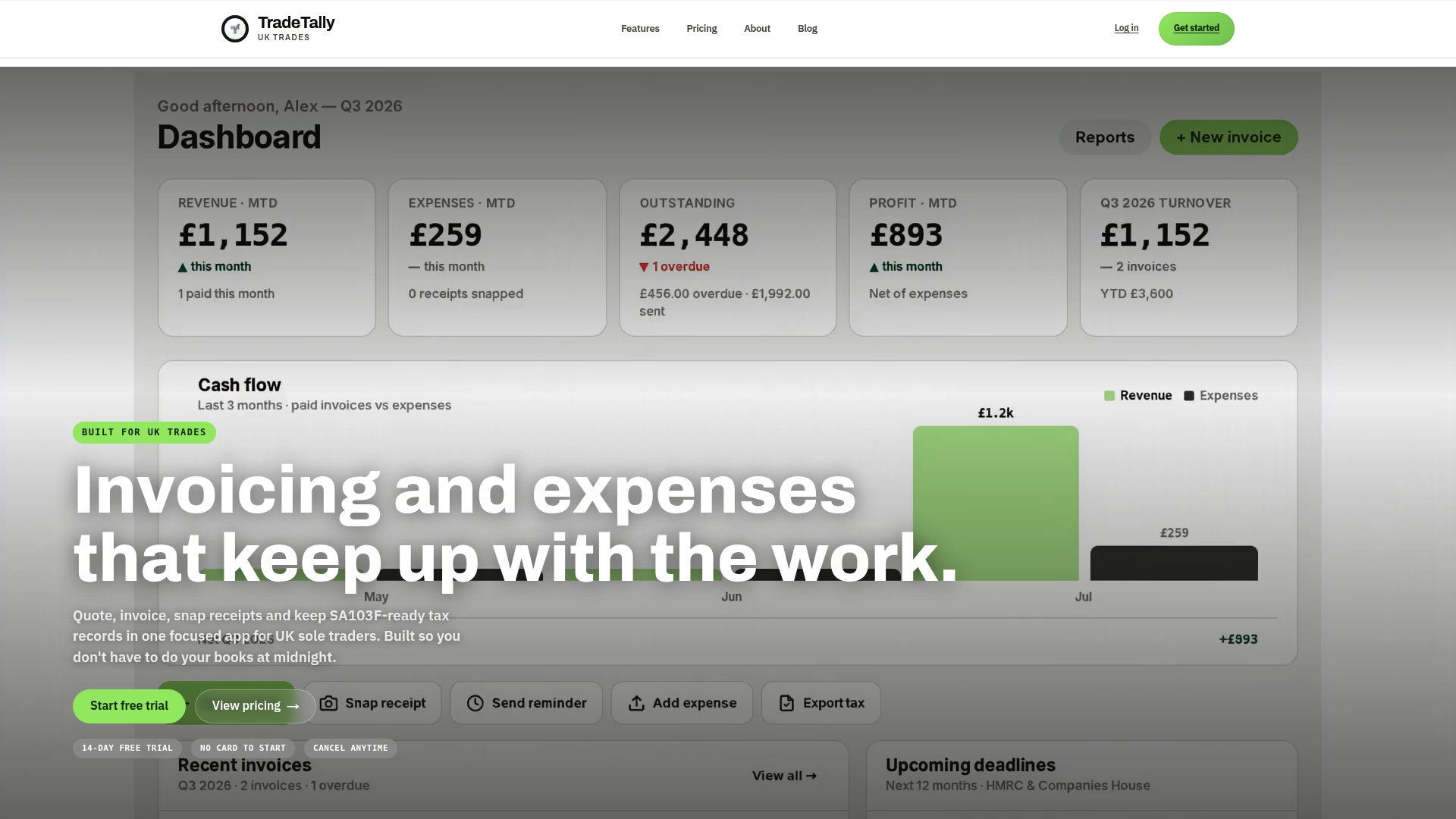
The Starter plan is free, at £0 per month, with limited invoicing. The Professional plan costs £12 per month, or £120 per year, and gives you unlimited invoices, receipts and tax exports. You can start on the Starter plan and see the full details on the pricing page.
FAQ
How soon should I follow up after sending a quote?
Check that it arrived within two working days. Make your main follow-up around day 5 to 7, sooner for small jobs and a little later for large ones. If the customer told you when they would decide, follow up on that date instead.
How many times should I chase a quote?
Three or four contacts across the life of the quote is enough: an arrival check, a main follow-up with something new, and a final message before expiry. After that, close the quote. If the customer replies later, you can reopen it at current prices.
Should I call, text or email?
Match the channel the customer used first. Text or WhatsApp suits homeowners and smaller jobs, a phone call suits larger jobs and customers who have gone quiet, and email suits landlords, agents and commercial clients. A call is the best way to hear hesitation about the price.
What should I write if the customer still does not reply?
Send a short close message that gives the expiry date, says you are happy to go ahead, and makes it fine to say no. For example: “If you’ve gone another way, no problem at all.” Then mark the quote closed and free the diary slot.
Should I offer a discount to win the job?
Not as a first move. Offer a smaller scope, a phased start or a different material choice first, so the price you quoted stays credible. If you want to check how much room your margin leaves, work it out from your costs before you reply.
Sources
Recommended
Related articles

Self-Billing Agreements UK: What Tradespeople Need to Know
A plain guide to self-billing agreements in the UK: who can use one, what it must contain, how the VAT works and what records you keep as a tradesperson.

Chasing Overdue Invoices in the UK: A Step-by-Step Guide for Tradespeople
How to chase overdue invoices in the UK: when an invoice is late, what to say, when to add interest and £40–£100 compensation, and when to go to court.

Invoice reminders for builders that get paid
Invoice reminders for builders that help you chase late payments without awkward calls, protect cash flow, and get paid faster on every job.

Do Quotes Need Terms Included?
Do quotes need terms included? For UK sole traders, clear quote terms help avoid disputes, late payment and scope creep before work starts.