Class 2 National Insurance for Sole Traders in 2026/27

If you are a sole trader with profits of £7,105 or more in 2026/27, you do not pay Class 2 National Insurance. HMRC treats it as paid, and your year still counts towards your State Pension. Below £7,105 you pay nothing compulsory, but you can choose to pay voluntary Class 2 at £3.65 a week to avoid a gap in your record. What you do pay once profits pass £12,570 is Class 4, and that comes out of the same Self Assessment return. Getting your profit figure right is therefore the one job that matters, and that is an records problem more than a tax problem.
TL;DR
- Class 2 stopped being a compulsory charge from 6 April 2024. At profits of £7,105 or more (2026/27) it is treated as paid, so you pay nothing and the year still counts.
- Class 4 is the one that costs money: 6% on profits between £12,570 and £50,270, then 2% above that, collected through Self Assessment.
- Below £7,105 you can pay voluntary Class 2 at £3.65 a week (2026/27) to protect your State Pension record. It is worth checking before you decide.
- Your profit figure drives all of this, so clean income and expense records are what keep the bill right.
Table of Contents
- What Class 2 National Insurance is, and what changed
- What you pay at each level of profit
- Class 2 versus Class 4: what each one does
- Do you need to pay voluntary Class 2?
- How Class 4 gets paid
- Why self-employed people pay differently from employees
- Where records make the difference
- Our view
- FAQ
- Sources
What Class 2 National Insurance is, and what changed
National Insurance is split into classes. Employees pay Class 1 through payroll. Self-employed people pay Class 2 and Class 4, and they work differently: Class 2 was a flat weekly amount that built up your entitlement to benefits, while Class 4 is a percentage of your profits and builds no entitlement of its own.

The flat weekly charge is gone. HMRC’s own guidance confirms that from 6 April 2024 there is no liability to pay Class 2. The same change cut the main Class 4 rate by one percentage point, from 9% to 8%, according to HMRC’s tax information note. A further cut followed, and the published rates for 2024/25 onwards put the main Class 4 rate at 6%.
The threshold that decides everything is the Small Profits Threshold. It is a profit level, not a turnover level, and it moves with the tax year:
| Tax year | Small Profits Threshold | Voluntary Class 2 weekly rate |
|---|---|---|
| 2023/24 | £6,725 | £3.45 |
| 2024/25 | £6,725 | £3.45 |
| 2025/26 | £6,845 | £3.50 |
| 2026/27 | £7,105 | £3.65 |
Those figures come from HMRC’s rates and allowances page, which is updated each April. Check it for the current year rather than relying on a figure you remember from an older article, because many of the pages still ranking for this topic describe the old compulsory system.
What you pay at each level of profit
The GOV.UK self-employed rates page and the National Insurance classes page set out three bands for 2026/27.
| Your annual profit | Class 2 | Class 4 |
|---|---|---|
| Under £7,105 | Nothing compulsory. Voluntary option at £3.65 a week | Nothing |
| £7,105 to £12,570 | Treated as paid, nothing to pay | Nothing |
| £12,570 to £50,270 | Treated as paid | 6% on the slice above £12,570 |
| Over £50,270 | Treated as paid | 6% up to £50,270, then 2% above it |
Two things catch tradespeople out here. First, the figures apply to profit, meaning income minus allowable expenses, not to what you invoice. Second, the Class 4 percentage applies only to the slice of profit above £12,570, not to the whole amount.
Worked example: an electrician on £30,000 profit
An electrician invoices £44,000 in the year and has £14,000 of allowable costs: materials, van running costs, tools, insurance and so on. Profit is £30,000.
- Class 2: treated as paid. Nothing to pay.
- Class 4: (£30,000 minus £12,570) × 6% = £1,045.80.
If that electrician had missed £3,000 of receipts, profit would show as £33,000 and Class 4 would rise by £180 on top of the extra income tax. Missing receipts cost real money twice over.
Worked example: a part-time carpenter on £6,000 profit
A carpenter works another job and makes £6,000 profit from weekend work. That is under £7,105, so there is no compulsory Class 2 and no Class 4. If they want that year to count towards their State Pension record and have no other contributions covering it, a full year of voluntary Class 2 would be 52 × £3.65 = £189.80 at the 2026/27 rate. Whether they need it depends on their other contributions, which is why the next section matters.
Class 2 versus Class 4: what each one does
The quickest way to keep them apart:
- Class 2 was the flat, weekly, benefit-linked contribution. It now exists mainly as something HMRC treats you as having paid, or something you can choose to pay.
- Class 4 is the profit-based charge. It is the one that leaves your bank account.
The point to remember is that Class 4 is a tax-like charge on profit. It does not by itself build a State Pension year. Your qualifying year comes from Class 2 being treated as paid (profits at £7,105 or more) or from voluntary contributions below that line. The GOV.UK classes page states that below £7,105 nothing is compulsory but voluntary Class 2 can be paid to avoid gaps.
Also worth knowing: being paid under CIS does not change which classes apply to you. If you are a subcontractor who is genuinely self-employed, the same profit-based rules above apply, and the CIS deductions taken by contractors are simply credited against your bill. Our piece on why CIS does not prove self-employment covers the status question, and how to reclaim CIS deductions you have suffered covers what happens when deductions exceed your bill.
Do you need to pay voluntary Class 2?
Most sole traders with profits above £7,105 never need to think about it. The decision applies if your profits are below the threshold, or if you have a gap year you want to fill.
For the full new State Pension you generally need 35 qualifying years, and at least 10 to get any. Those numbers are stated in the Ross Martin report on HMRC’s recent letters. That report also says HMRC has been writing to up to 800,000 self-employed people whose records may have gaps, mainly those who registered as self-employed between 2015 and early 2024 without a CWF1 form. The letters are not payment demands, and the gaps can be filled back to 2015/16, beyond the usual six-year limit. If you receive one, read it, check your record and decide, rather than ignoring it or paying in a panic.
Voluntary Class 2 can make sense when:
- your profit is below £7,105 and you have no other work, benefit or credit covering the year
- you have a gap in your record and are short of the years you want
- you work or live abroad and hold a certificate of coverage (see below)
How to check your record first
Before paying anything, look at what is already there. You can see your National Insurance record in your Personal Tax Account on GOV.UK or the HMRC app, or by calling the National Insurance helpline, as one accountancy guide explains. Years with enough contributions or credits count, and years without show as gaps. Some benefits, such as Carer’s Allowance, Maternity Allowance or incapacity benefits, can give you a credit even when you have not paid, according to HMRC’s manual. For personal pension forecasts and whether paying is worth it, the National Insurance helpline or HMRC is the right place to ask, as they hold your record.
How to pay voluntary Class 2
The GOV.UK voluntary Class 2 guide sets out the process:
- If you do not pay through Self Assessment, register with HMRC. You can register at any time.
- You can usually pay for the past 6 tax years.
- HMRC sends a payment request between September and the end of October, with an 18-digit reference number.
- Pay by online or telephone banking (Faster Payments or CHAPS arrive the same or next day), Bacs (allow 3 days), at a bank or building society, or by Direct Debit (allow 21 working days to set up).
If you are already in Self Assessment, you can usually deal with it there. The GOV.UK rates page says that when you pay for the previous tax year you pay that year’s original rate, and for earlier years you pay the 2026/27 rate. That is a reason to act sooner rather than later on any gap.
Working or living abroad
This changed recently. GOV.UK states that from 6 April 2026, people without a certificate of coverage can no longer pay Class 2 for time spent working or living abroad. If you do have one and your profits are below £7,105, you can still pay voluntary Class 2, with accounts sent to HMRC by 31 January following the tax year. HMRC’s March 2026 note confirms the change. If this applies to you, speak to HMRC before the deadline.
How Class 4 gets paid
Class 4 is calculated on your Self Assessment return, from the same profit figure used for income tax. It is not a separate bill. You pay it with your income tax, so a lower profit figure means a lower Class 4 charge, and a wrong one means a wrong one.
That has three practical consequences for a tradesperson:
- Know your profit during the year, not after it. If you only find out in January, you cannot plan for the bill. Our sole trader tax deadlines guide lists the dates for 2025/26 and 2026/27.
- Claim what you are entitled to. Mileage, use of home and tools all reduce profit. See the mileage rates for 2026 and the use of home rules.
- Keep the evidence. Missing receipts are the commonest reason profit is overstated. Our records checklist sets out what to hold and for how long.
For a fuller walk-through, we also have a guide to National Insurance for sole traders.
Why self-employed people pay differently from employees
Employees and employers pay Class 1 through payroll on each pay period. A sole trader is both the worker and the business, so there is no employer to split the bill and no payroll to collect it. Instead the charge is worked out once a year on profit and paid through Self Assessment. That is why your National Insurance depends on what you keep after costs, not on what you are paid week to week.
Where records make the difference
Nothing in this article needs an accountant’s training, but all of it depends on one number being right. Every pound of income you forget to record and every receipt you lose moves your profit, your income tax and your Class 4 in the wrong direction.
The usual failure is not complexity. It is the receipt in the footwell, the invoice sent from a phone and never logged, and the mileage you meant to write down on Friday. By January those are guesses.

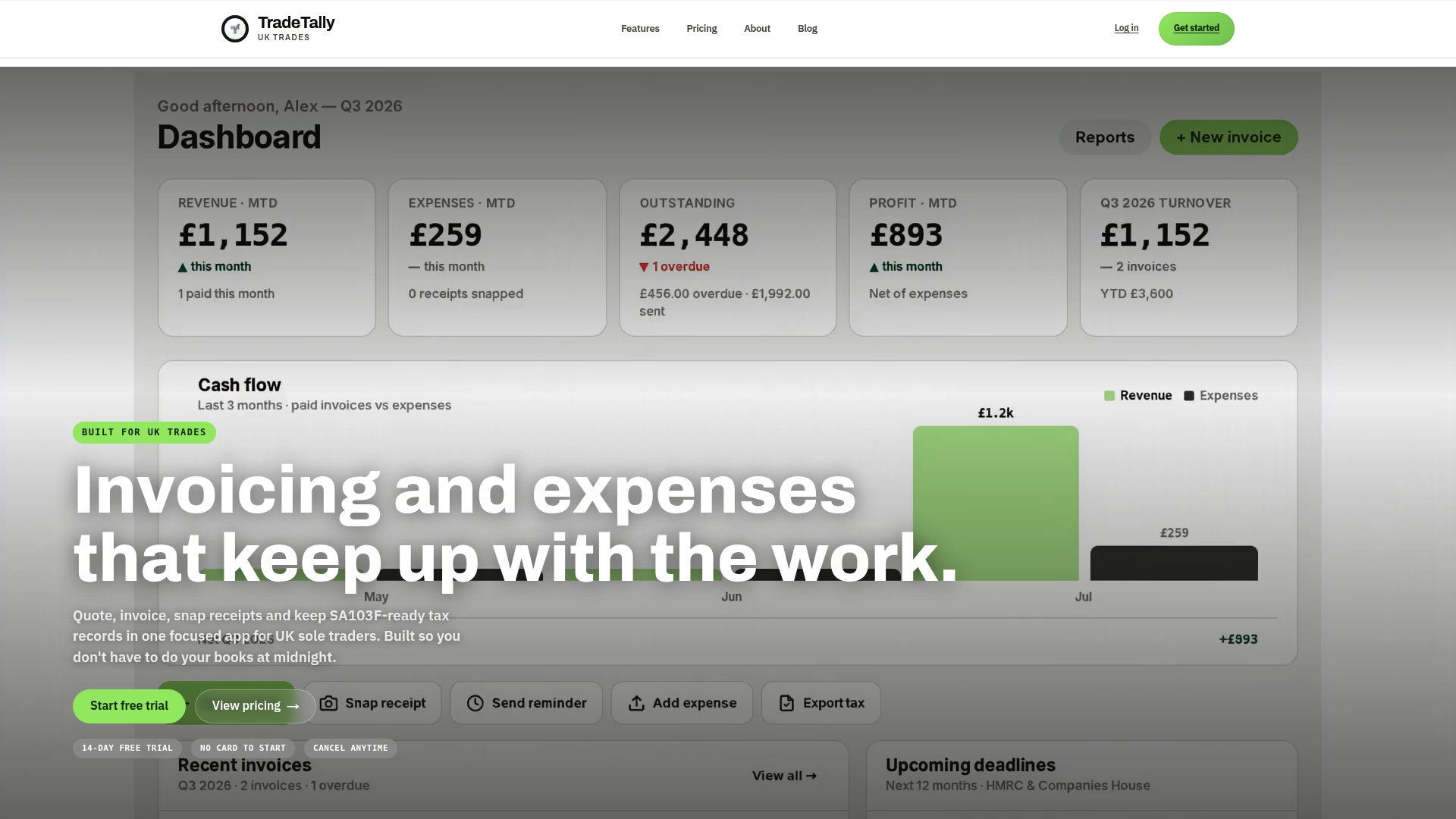
TradeTally is built for that problem. It is a UK web and mobile app for sole tradespeople that handles branded invoicing, quotes, expense and receipt tracking, mileage and time tracking and CIS deductions, with a live profit dashboard so you can see your running profit per job. It also produces tax-ready records, including an SA103F export for Self Assessment, and MTD-ready record-keeping with straightforward exports for you or your accountant.
The Starter plan is £0 per month with limited invoicing. Professional is £12 per month or £120 per year for unlimited invoices, receipts and tax exports. You can see both on the pricing page. If CIS is part of your income, the CIS deduction calculator shows what is being taken off your payments.
If you want to catch errors before they reach your return, the Self Assessment mistakes guide is a good checklist to run through on your phone.
Our view
Class 2 used to be the thing tradespeople worried about, a flat weekly charge you either paid or forgot. Now it mostly takes care of itself, and the real money question has moved to profit.
I built TradeTally because the admin after a day on site is where the numbers go wrong. Nobody gets home at six and wants to rebuild the month from a pile of receipts. So we made invoicing and receipt capture work from the van, and we keep a live profit figure for every job, so your Class 4 and income tax are no surprise.
My advice is simple. Record each invoice the day you send it. Photograph each receipt the day you buy it. Then, once a year, your Self Assessment is a check of figures you already trust, and your National Insurance follows from them.
Simon
FAQ
Is Class 2 National Insurance still compulsory?
No. Mandatory Class 2 ended on 6 April 2024. If your profits are £7,105 or more in 2026/27, HMRC treats you as having paid it, so there is nothing to pay and the year still counts. Below that, you can choose to pay it voluntarily.
How much is voluntary Class 2 in 2026/27?
It is £3.65 a week, which is £189.80 for a full 52 weeks. The rate is set each April, so check the voluntary rates page for the year you are paying for, as earlier years can be charged at a different rate.
What is the difference between Class 2 and Class 4?
Class 2 was a flat weekly contribution linked to benefits and your State Pension record. Class 4 is a percentage of profit: 6% between £12,570 and £50,270 and 2% above, for 2026/27. You pay Class 4 only when your profits exceed £12,570.
Do I pay National Insurance if I am a CIS subcontractor?
Yes, if you are self-employed, the same profit-based rules apply. CIS deductions are a payment on account of your tax, and they are credited when you file your return. Your Class 4 is still worked out on your profit.
Sources
- HMRC National Insurance Manual NIM70550
- Changes to National Insurance contributions from 6 January 2024
- Rates and allowances: National Insurance contributions
- Self-employed National Insurance rates
- National Insurance classes
- Pay voluntary Class 2 National Insurance contributions
- Voluntary National Insurance rates
- Voluntary Class 2 if you work or live abroad
- Voluntary National Insurance contributions for periods abroad from 6 April 2026
- HMRC writes to self-employed taxpayers about National Insurance gaps
- Check and pay National Insurance gaps
Recommended
Related articles

Subcontractor vs Sole Trader: CIS Explained
See how HMRC tests self employment for UK trades, why CIS registration does not prove status, and how to report deductions through Self Assessment.
Payments on Account: Avoid the January Shock
UK sole traders: learn how HMRC calculates payments on account, avoid the 150% January cash flow shock, and use monthly set aside plans and TradeTally to...

Sole Trader Profit and Loss for SA103F
For UK tradespeople: turn van invoices, receipts and mileage into profit and loss ready for SA103F. Monthly checklist and mobile automation to avoid...

SA103F vs SA103S: Which Self-Employment Pages Do You Need?
SA103S or SA103F? See the £90,000 turnover test, what each form asks for, part-year rules and what to do if you file the wrong one. For UK sole traders.