CIS Suffered: How to Reclaim Your Deductions in the UK

“CIS suffered” is the tax your contractors have already deducted from your pay under the Construction Industry Scheme. If those deductions come to more than you owe, you get the difference back. Sole traders do it through their Self Assessment return after the tax year ends. Limited companies do it through their payroll reporting, then claim any leftover as a refund. Either way, the claim is only as good as your records.
TL;DR
- CIS deductions are advance payments towards your tax. If they exceed your final bill, HMRC repays the difference.
- Sole traders enter gross pay and the deductions on the Self Assessment return (SA103F box 81 for the deductions). Limited companies report them on an EPS and claim any surplus after the year ends.
- You generally have four years from the end of the tax year to claim, and you cannot rely on HMRC to reissue lost statements.
- Check every monthly payment and deduction statement as it arrives. Most delayed refunds trace back to a mismatch or a missing statement.
- Track repayments in your HMRC online account before you chase anyone.
Table of Contents
- What “CIS suffered” means
- Who can reclaim, and how
- Reclaiming CIS as a sole trader
- Reclaiming CIS through a limited company
- Records that make or break the claim
- How far back can you claim?
- How long does a CIS refund take?
- Common mistakes that delay or shrink a refund
- Our perspective
- Keep the records as you work
- FAQ
- Sources
What “CIS suffered” means
When a contractor pays you under CIS, they take a slice off your pay and send it to HMRC. GOV.UK describes these deductions as advance payments towards your tax, and you must tell HMRC about them when you report your taxes. “Suffered” is simply the accounting word for tax taken from you at source.
The standard rates are 20% for registered subcontractors, 30% if you are not registered and 0% with gross payment status. If you want the rates explained in full, our guides on the three CIS deduction rates and 0%, 20% and 30% for contractors cover them.

Why you often end up overpaying
The deduction is a flat percentage on each payment. It does not take account of your personal allowance, your allowable expenses, quiet weeks or a low-earning month. As one umbrella provider explains, your real liability is worked out once, at year end, through Self Assessment. The gap between what was deducted and what you actually owe is your refund.
A simple example: you are paid £30,000 across the year and contractors deduct 20%, so £6,000 has gone to HMRC. After expenses such as tools, van costs, insurance and mileage, and your personal allowance, your real tax and National Insurance might be well below £6,000. The rest comes back to you. That is a worked illustration only, not a forecast of your own figures.

Who can reclaim, and how
The route depends on how you trade.
| Sole trader or partner | Limited company | |
|---|---|---|
| Where you report it | Self Assessment return | EPS sent with your FPS, then a refund claim |
| When you can claim | After the tax year ends | After the tax year ends (limited exceptions) |
| What offsets first | Your tax and NI bill | Your PAYE, NI and other payroll liabilities |
| Leftover | Repaid to you | Repaid after year end on a claim |
If you are unsure which category you fall into, our piece on subcontractor versus sole trader status explains why being paid under CIS does not by itself make you self-employed. It also explains why CIS differs from PAYE for cash flow.
Reclaiming CIS as a sole trader
You do not get money back as you go. The tax year runs from 6 April to 5 April, and you tell HMRC what you earned, what you spent and what has already been deducted once it has ended. Harrisons Accountants makes the same point: the end of the tax year is the main window.
Step by step
- Gather your statements. You need every monthly payment and deduction statement from every contractor for the year.
- Total your gross pay. GOV.UK says to record your total pay before deductions as income, and the contractor deductions as “CIS deductions” on your return.
- Add up your allowable expenses. Receipts, mileage, tools, insurance and the rest reduce your taxable profit.
- Enter the deductions in the right box. The 2026 SA103F notes say box 81 is for total CIS deductions taken from your payments. For 2025/26 that means deductions made between 6 April 2025 and 5 April 2026. The notes also say not to send the statements with your return, so keep them safe.
- Submit the return. HMRC works out your tax and takes off the deductions. If you are owed money, HMRC pays it back. If you still owe tax, GOV.UK says to pay it by 31 January after the tax year ends.
- Record any refund correctly. The SA103F notes say that even if you have already claimed a CIS repayment, you must still include the deductions in box 81. A refund you have received goes in box 1, “Tax refunded or set off”, on page TR 6.
Pro tip: file early. If you submit online shortly after 5 April, Harrisons reports you can often see the money within two to four weeks. Wait until the January rush and it can take longer.
Our Self Assessment walkthrough for tradespeople goes through the return box by box.
Paper and online deadlines
For 2025/26, Finistry sets out a paper deadline of 31 October 2026 and an online deadline of 31 January 2027, with any tax owed also due by 31 January 2027. In later years the same pattern applies: paper deadline at the end of October, online and payment deadlines at the end of January. Check GOV.UK for the dates that apply to the year you are filing.
Reclaiming CIS through a limited company
The route is different, and HMRC does not let you shortcut it.
- Send your FPS as usual, and an EPS at the same time. GOV.UK says the EPS should show the total CIS deductions for the year to date.
- Let HMRC offset them. The deductions come off what the company owes HMRC. Any amount left after that can be carried forward within the same tax year.
- Claim what is left after year end. Deductions still unused once the tax year ends can be claimed as a refund.
- Keep CIS out of your Corporation Tax return. GOV.UK warns against using it to pay tax with CIS deductions.
HMRC’s internal manual confirms there is no company equivalent of the Self Assessment in-year repayment. It says HMRC will not repay a company subcontractor until the tax year has ended and the company has paid all its liabilities as an employer or contractor.
There are two narrow exceptions. GOV.UK says a company can claim before the year ends only if the business has stopped trading or deductions were taken after it moved to gross payment status. The claim must include copies of all payment and deduction statements and the bank statements for that tax year.
Carry-forward and the year-end lock
HMRC’s debt management manual explains that at the end of the tax year, normally between 2 and 5 May, any CIS deductions suffered claimed on an EPS are locked so the excess credit does not roll into the next year’s charges. That is why you claim the surplus as a refund rather than waiting for it to drift across.
Why company refunds stall
Barton Accountancy reports that HMRC will not release a limited company refund until three things reconcile: the deductions on your monthly EPS, the deductions your contractors reported on their CIS300 returns, and the statements you hold from each contractor. A single contractor who filed late or wrongly can hold up the lot.
Records that make or break the claim
Your contractor must give you a written payment and deduction statement within 14 days of the end of each tax month. AccountingWEB notes that a contractor can face penalties for late or incorrect statements.
Check each statement when it lands:
- Your name, UTR and the contractor’s details are correct.
- The gross amount matches what you invoiced (before materials, if materials are shown separately).
- The deduction rate is the one you expect.
- The total deducted matches what you can see missing from your bank payment.
Our guide on what to verify on CIS statements walks through disputes in more detail. If a number is wrong, query it with the contractor straight away, while the paperwork is fresh.
If a statement goes missing
Do not count on HMRC to sort it out. ICAEW reports that from 1 July 2024 HMRC only accepts requests for missing statements in writing, and aims to reply within 15 working days. AccountingWEB adds that HMRC will deal with just one such request per customer, so you should keep your own records rather than lean on HMRC.
If you take card payments or deposits, keep those records tidy too. Matching your bank receipts to each statement is far easier when payments come through a single, well-organised route, such as payment processing for electricians, rather than a mix of cash, transfers and screenshots.
How far back can you claim?
For sole traders, the commonly cited limit is four tax years. One provider’s guide gives the example that in 2026-27 you can claim back to 2022-23, after which the right to a refund expires. File late returns for any missed years as soon as you can.
For limited companies, GOV.UK says you can claim for a tax year once it has ended. For the past six tax years you can claim online or by post, and earlier years must go by post.
How long does a CIS refund take?
Timings vary by route, and most published figures are rules of thumb rather than promises.
| Route | Typical wait | Source |
|---|---|---|
| Sole trader, online return | Around two to four weeks | Harrisons Accountants, and the umbrella guide above |
| Sole trader, clean refund service standard | Around two weeks, though security checks can extend it | Finistry |
| Limited company claim | GOV.UK says it usually responds within 8 weeks | GOV.UK |
| Limited company with mismatches | Months, not weeks | Barton Accountancy |
Sole trader refunds go to the bank account linked to your Self Assessment, so make sure those details are current before you file.
Checking where your refund is
Log in to your HMRC online account, confirm the return has been processed, then go to “Payments and repayments” and “Repayments issued” to see the date and amount, as Tax2u describes. Before you phone HMRC, use its “check when you can expect a reply” tool. The Low Incomes Tax Reform Group advises not to chase progress until the date the tool gives has passed.
Common mistakes that delay or shrink a refund
- Entering net pay as income. Income goes in before deductions, otherwise the deductions are double counted against you.
- Missing expenses. Every unclaimed receipt means a smaller refund. Photograph receipts on the day.
- Lost statements. A monthly statement you cannot find costs you time, and HMRC will not keep reissuing them.
- Forgetting the refund itself. Record a refund received in the right box, as the SA103F notes instruct.
- Leaving it late. Waiting until the January deadline slows everything down and risks the four-year cut-off on older years.
- Mixing personal and business spending. It makes the expense total hard to defend.
Our perspective
We built TradeTally because the CIS refund is rarely hard in itself. What makes it painful is the pile: statements in a glovebox, receipts in a jacket pocket, invoices half remembered. By April, you are rebuilding a year from memory.
Our approach is to capture the admin as it happens. Send a branded invoice from your phone, record the CIS deduction on it, snap the receipt in the van and log mileage as you go. By the time the tax year ends, your gross income, your CIS suffered and your expenses are already sitting together, with an SA103F-formatted export ready for you or your accountant.
We would rather you spent ten minutes a week keeping the records tidy than a weekend in March guessing at them. That is the discipline behind a clean claim, and it is what we designed the app around.
Simon
Keep the records as you work
TradeTally is a UK web and mobile app for sole tradespeople. It handles branded invoicing, CIS deductions, receipts, mileage and time tracking, and tax-ready records with an SA103F export, plus MTD-ready record-keeping. The Starter plan is £0 per month for limited invoicing. Professional is £12 per month or £120 per year for the full set.
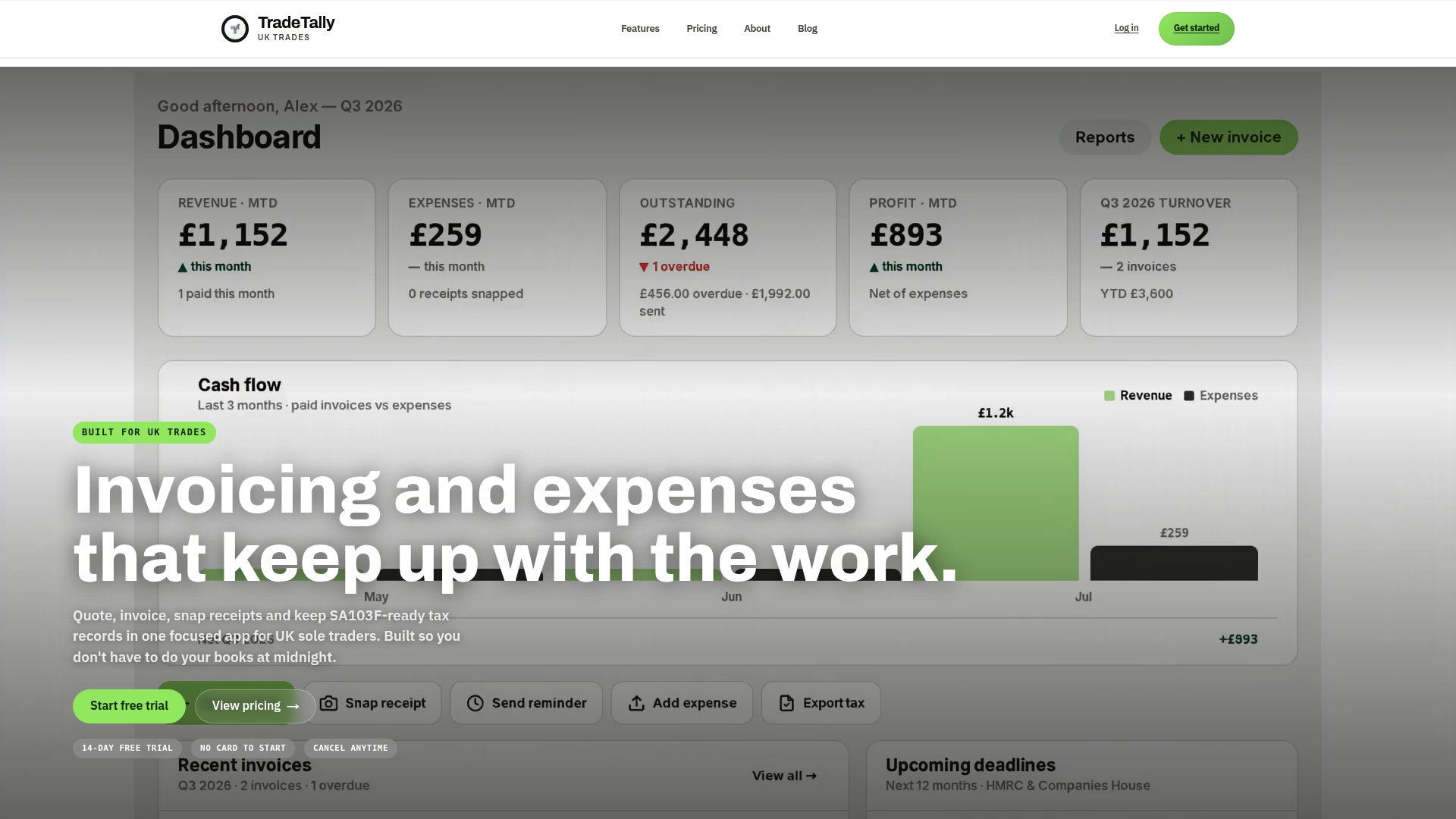
You can see the plans on our pricing page, try the CIS deduction calculator or read about CIS invoice software for UK contractors. If you want a quick self-check first, the free sole trader tax and CIS checklist is a good place to start.
FAQ
How do I reclaim CIS tax suffered?
If you are a sole trader, put your gross pay and your total CIS deductions on your Self Assessment return once the tax year has ended. HMRC works out your tax and repays any overpayment. If you run a limited company, report deductions on your EPS and claim any surplus as a refund after the year end.
What does “CIS suffered” mean?
It is the total CIS tax your contractors have deducted from your payments. It counts as tax you have already paid in advance. You report it so HMRC can set it against your final bill.
How long does a CIS refund take?
For sole traders filing online, published guidance suggests roughly two to four weeks, longer around the January deadline. GOV.UK says it usually responds to a limited company claim within 8 weeks. Mismatched records can add months.
How can I check the status of my CIS refund?
Sign in to your HMRC online account and look under “Payments and repayments” then “Repayments issued”. If nothing appears, use HMRC’s tool for expected reply times before you contact them.
Sources
- GOV.UK: What you must do as a CIS subcontractor, pay tax and claim back deductions
- GOV.UK: Claim a refund of CIS deductions if you’re a limited company
- HMRC: Self-employment (full) notes SA103F (2026)
- HMRC manual CISR76020
- HMRC manual DMBM524050
- ICAEW: CIS payment and deduction statements must be requested by post
- AccountingWEB: HMRC changes to requests for CIS payment and deduction statements
- LITRG: Contacting HMRC, chasing progress
- Harrisons Accountants: How to reclaim CIS deductions
- Barton Accountancy: CIS refund for a limited company
- Finistry: Claiming back CIS deductions through Self Assessment
- DASA Umbrella: How to claim back overpaid CIS tax
- Tax2u: How to track your CIS refund online
- Payment processing for electricians
Recommended
Related articles
CIS Statements: What Subcontractors Must Check
Checklist for UK subcontractors to verify CIS payment and deduction statements. Match UTR, gross, materials and deductions; photograph and store records...
CIS Deductions: The Three Rates Explained
A practical UK trades guide to CIS deductions: the three rates, step-by-step calculations, verification duties and a compact compliance checklist.

Contractor vs Subcontractor under CIS: What Each Must Do
Contractor or subcontractor under CIS? See who is which, what each must do, how the 20%, 30% and 0% deductions work, and when you can be both.

Subcontractor vs Sole Trader: CIS Explained
See how HMRC tests self employment for UK trades, why CIS registration does not prove status, and how to report deductions through Self Assessment.