Avoid the 150% January Shock: Payments on Account for UK Tradespeople
If your Self Assessment tax bill was above the threshold and less than most of it was collected at source, HMRC will make you pay in advance towards next year’s tax. These payments on account are due in two equal instalments, on 31 January and 31 July, each typically representing about half of last year’s Income Tax and Class 4 National Insurance combined.
TL;DR:
- Payments on account are calculated as 50% of the previous year’s Income Tax and Class 4 National Insurance, due in two installments on January 31 and July 31.
- These payments apply automatically if last year’s tax bill exceeded a set threshold and less than most of it was collected at source, with no opt-out option.
- The first installment often causes significant cash flow pressure, especially for first-year sole traders, as it can amount to about 150% of the previous year’s actual tax owed.
- Underestimating income to reduce payments can lead to interest charges back to the original due date, making cautious overpayment often more cost-effective.
- Regular monthly reconciliation and proactive cash flow management are key to avoiding surprises and managing payments on account efficiently.
Table of Contents
- How is payment on account calculated?
- Who needs to make payments on account?
- When are payments on account due?
- How do you reduce payments on account?
- Why does the first year hit cash flow so hard?
- What happens if you miss or underpay?
- Managing payments on account without the guesswork
- How do you check your payments on account with HMRC?
- A note on habits that actually prevent surprises
- Manage payments on account without the January scramble
- Sources
- FAQ
How is payment on account calculated?
The formula is simpler than most tradespeople expect. HMRC takes your total Income Tax and Class 4 National Insurance liability for the previous tax year and splits it in half. Each half becomes one instalment. Capital Gains Tax and Class 2 NI don’t count towards the calculation, so if you’ve sold an asset or paid voluntary contributions, strip those out before you try to check HMRC’s maths yourself.
Here’s a worked example using round numbers:
- Your Income Tax and Class 4 NI for 2025/26 comes to £6,000.
- HMRC calculates two payments on account for 2026/27, each set at £3,000 (50% of £6,000).
- The first instalment is due 31 January 2027, alongside your balancing payment for 2025/26.
- The second instalment is due 31 July 2027.
- Once your 2026/27 return is filed, HMRC works out your actual bill and adjusts for any difference, either as a balancing payment or a refund.
HMRC does this automatically once your return is processed under section 59A of the Taxes Management Act 1970. You won’t see a separate letter explaining the sum. It simply appears on your Self Assessment statement, so it’s worth checking the figures against your own calculation rather than trusting the total blindly.
Who needs to make payments on account?
Two conditions have to be true at the same time. Miss either one, and payments on account don’t apply to you.
- Your Self Assessment tax bill for the previous year exceeded a certain threshold.
- Less than most of that tax was collected at source, for example through PAYE.
Some situations catch people out. A plumber running a side business while employed under PAYE might still trigger payments on account if the self-employed portion of their tax bill clears the £1,000 threshold. Landlords with rental income taxed outside PAYE face the same rule, as do company directors whose dividend tax isn’t deducted automatically.
HMRC applies these thresholds automatically once your return is submitted, under the rules set out for payments on account. There’s no separate opt-in. If your figures meet both tests, the instalments appear on your account whether you expected them or not.
When are payments on account due?
Payments on account follow a fixed pattern every year: 31 January, then 31 July.
- 31 January: you pay your balancing payment for the previous tax year, plus your first payment on account for the current year.
- 31 July: you pay your second payment on account.
- If either date falls on a weekend or bank holiday, HMRC still expects the payment to clear by midnight on the stated date, not the next working day.
- Faster Payments usually clears the same or next day, making it the safest choice close to a deadline. Direct Debit, Bacs, and card payments can take three to five working days, so pay your Self Assessment tax bill early enough to allow for that.
- CHAPS payments typically clear same day but carry a bank fee, worth it only if you’re cutting it fine.
How do you reduce payments on account?
If you genuinely expect to earn less this year, a claim to reduce payments on account can ease the pressure. This only makes sense with solid evidence: fewer contracts on the books, a slower quarter, or a client who’s gone under.
- File the claim through your online Self Assessment account or by submitting form SA303.
- The deadline is the end of January following the end of the relevant tax year.
- State your grounds for the claim clearly. HMRC’s internal guidance confirms claims must set out the reasoning, and can be revised later if your circumstances change again.
- Underestimate your income and HMRC will charge interest back to the original due date, not the date you eventually pay.
Pro Tip: If you’re not certain your income will drop, pay the instalment as calculated and claim a refund later. Reducing your payment and getting it wrong is often more expensive than overpaying and waiting.
Why does the first year hit cash flow so hard?
New sole traders rarely see this coming, and it’s the single biggest complaint about the payments on account system.
- Your first Self Assessment return covers your first trading year, say £6,000 in tax owed.
- That £6,000 is due in full on 31 January, as a balancing payment.
- On the same date, HMRC also collects your first payment on account for the following year, another £3,000.
- Total due on 31 January: £9,000, roughly 150% of what you actually owed for the previous year.
This “150% shock” catches out even experienced tradespeople who’ve simply never faced it before, and it’s a recognised pattern across first-year sole traders. The fix is boring but effective: set aside a fixed percentage of every invoice from day one, and treat that money as already spent.
What happens if you miss or underpay?
Miss a deadline and HMRC doesn’t wait to act.
- Interest starts accruing the day after the due date, calculated daily until you pay.
- Late payment penalties attach to the balancing payment at set intervals (30 days, 6 months, and 12 months overdue), but a late payment on account by itself only attracts interest, not a fixed penalty.
- If you can’t pay in full, contact HMRC before the deadline to arrange a Time to Pay agreement.
- Overpaid instalments are usually refunded or offset against your next bill once your return confirms the correct figure.
Reducing your payments on account without solid evidence rarely saves money. HMRC calculates interest back to the original due date, so an optimistic reduction often costs more than simply paying the instalment and reclaiming any excess afterwards.
Managing payments on account without the guesswork
The tradespeople who avoid January panic all do the same thing: they treat tax as a monthly outgoing, not an annual surprise, and often use tools to compare life insurance & annuity quotes as part of their broader personal finance planning to manage cash flow effectively (Compare life insurance & annuity quotes | East Two West).
- Set aside roughly one twelfth of your estimated annual Income Tax and Class 4 NI every month, in a separate account you don’t touch.
- Keep receipts and invoices logged as you go rather than reconstructing months of work in December.
- Reconcile your figures monthly against your actual estimated liability using a tax calculator built for sole traders.
An app that shows your live profit position and exports records in SA103F format removes most of the estimation risk that leads to reduction claims going wrong. If your app captures every receipt and invoice as it happens, your year-end figure stops being a guess.
Pro Tip: Reconcile your bank feed against your invoices once a month, not once a year. Thirty minutes on a Sunday saves an entire weekend in January.
How do you check your payments on account with HMRC?
Log into your Self Assessment online account to see every payslip, payment, and adjustment HMRC has recorded.
- Check your account statement to confirm whether HMRC has reduced or amended your instalments after a claim.
- Payment history shows exactly what’s been received and when, which is the fastest way to spot a missed or misapplied payment.
- If you’re paying by cheque or need a paying-in slip for a bank branch, HMRC’s payment guidance explains how to request one.
A note on habits that actually prevent surprises
The single habit that separates calm tax seasons from chaotic ones is monthly reconciliation, not annual heroics. Check your figures against your bank position every month, and payments on account stop being frightening. If you’re unsure whether the rules apply to you, ask an accountant early rather than guessing in January.
— Simon
Manage payments on account without the January scramble
Some financial management apps are designed to help tradespeople estimate their tax bill accurately so that payments on account never come as a surprise. Such apps can provide a live profit dashboard that updates with each invoice or receipt captured.
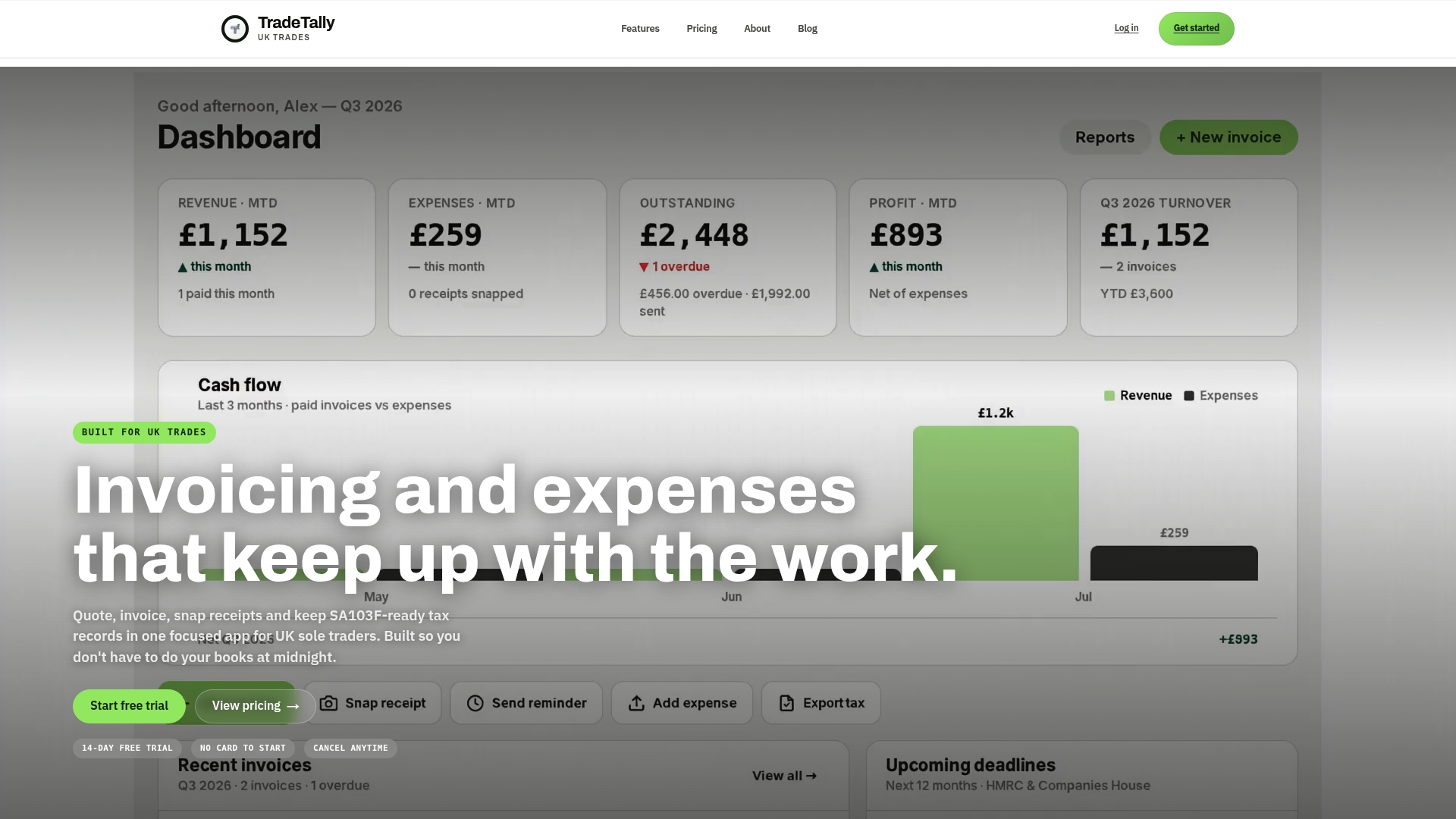
Branded invoicing gets paid faster, receipt scanning keeps your expense records tax-ready throughout the year, and automatic SA103F export means your accountant handoff takes minutes rather than a weekend. CIS deduction handling and mileage tracking cover the details that usually get missed until it’s too late to fix them. If you’re a roofer, tiler, carpenter, or run any other trade covered by Tradetally’s specialist pages, start with the Self Assessment tax calculator to see what your monthly set-aside should actually look like this year.
FAQ
What does payment on account mean in HMRC terms?
It means an advance instalment towards next year’s Income Tax and Class 4 NI, calculated as 50% of your previous year’s bill and paid on 31 January and 31 July.
Can I opt out of payment on account with HMRC?
You can’t opt out entirely, but you can file a claim to reduce the amount using form SA303 or the online service if you genuinely expect to earn less, by 31 January after the tax year ends.
Is payment on account compulsory?
Yes, if your last tax bill exceeded £1,000 and less than 80% of it was collected at source, HMRC applies the payments automatically under section 59A.
Recommended
Ready to sort your trade admin?
TradeTally gives UK sole traders invoicing, expenses, and SA103F-ready tax exports in one mobile-first app.
Start 14-day free trial →