5 Year Rule for UK Trades: Capture Self Assessment Records On Site
Keep every invoice, receipt, bank statement, P60, P45 and CIS statement that supports the figures on your tax return. If you’re self-employed or a landlord, the standard rule is five years from the 31 January deadline after the tax year; most other filers only need 22 months. From April 2026, Making Tax Digital adds digital record-keeping duties for qualifying sole traders and landlords.
TL;DR:
- HMRC requires retaining digital or paper records for five years after the January deadline if you are self-employed or a landlord, and 22 months for others who file on time.
- Keeping detailed and categorized records of sales, expenses, employment, property, and other incomes ensures you have evidence to verify every figure on your tax return.
- From April 2026, digital record-keeping and quarterly updates via compatible software become mandatory for qualifying sole traders and landlords, with thresholds phased in from 50,000 down to 20,000 pounds.
- Using a mobile workflow to photograph receipts, categorize expenses, and reconcile weekly reduces end-of-year stress and improves accuracy in records.
- In case of lost or damaged records, HMRC allows provisional estimates if you can demonstrate reasonable efforts to reconstruct the information.
Table of Contents
- Which records to keep for each type of income
- How long to keep Self Assessment records
- Digital record-keeping and Making Tax Digital from April 2026
- Cash basis versus traditional accounting: how each affects your records
- If records are lost or destroyed
- A mobile-first record-keeping workflow for tradespeople
- How to view or obtain your Self Assessment information from HMRC
- Organising and categorising records to speed up Self Assessment
- Common mistakes that lead to penalties or delays
- Records for rental income, dividends and foreign income
- Why a simple digital habit matters more than a perfect system
- TradeTally: built around the record-keeping this article describes
- Sources
- FAQ
Which records to keep for each type of income
HMRC doesn’t expect a filing cabinet full of paper, but it does expect evidence for every figure on your return. What you keep depends on where your income comes from.
For self-employed trading income, the required business records cover sales and expenses in full, plus anything relating to staff or subcontractors. If you’re a sole trader working on domestic jobs, this is the bulk of your admin.
- Sales and income evidence: invoices, till rolls, bank paying-in slips and contract notes for every job you’ve billed.
- Expenses evidence: purchase receipts, supplier invoices, insurance documents, repair bills, tool purchases and mileage logs.
- Employment and pensions: P60, P45, P11D forms, payslips and any PAYE records if you also employ staff.
- Property income: tenancy agreements, rent statements and letting-agent correspondence.
- CIS income: contractor deduction statements and records of payments received under the scheme.
- Other income: dividend vouchers, savings interest certificates, capital gains disposal paperwork and pension contribution records.
If you employ an apprentice or a labourer, your PAYE records sit alongside your own trading records. And if you take CIS deductions as a subcontractor, those contractor statements are non-negotiable. HMRC will ask for them, directly if your return is ever queried, and without them you’re relying on memory to explain deductions that were made months earlier.
A quick gut check: if a figure appears on your Self Assessment, there should be a document behind it. No document, no defence.
How long to keep Self Assessment records
The retention period depends on your filing status and whether anything went wrong along the way.
- Self-employed and landlords: keep records for five years after the 31 January deadline for the relevant tax year. For the 2025 to 2026 tax year, the filing deadline is 31 January 2027, so records need to be kept until 31 January 2032.
- Everyone else who files on time: keep records for at least 22 months after the end of the tax year, which usually means around 22 months from 5 April.
- Late filing or an amended return: your five-year clock effectively runs longer, since it’s measured from the deadline that applied once the correction or late submission was made, not the original one.
- An open HMRC enquiry: keep everything until the enquiry is formally closed, however long that takes.
- Digital backups: scan or photograph paper originals as you go, and keep at least one cloud copy in case the physical version fades or gets lost on site.
Digital record-keeping and Making Tax Digital from April 2026
Making Tax Digital for Income Tax changes how records are kept, not just how returns are filed. From 6 April 2026, qualifying sole traders and landlords must keep digital records and send quarterly updates through compatible software rather than relying on a shoebox of receipts at year end.
The qualifying-income thresholds are being phased in gradually, according to GOV.UK’s MTD guidance: £50,000 from April 2026, dropping to £30,000 from April 2027 and £20,000 from April 2028. This matters because a tradesperson just under this year’s threshold may well be caught next year.
A digital record doesn’t have to mean expensive software. HMRC accepts:
- Spreadsheets, provided they’re kept up to date and formatted clearly.
- MTD-compatible accounting software that logs income and expenses automatically.
- Scanned or photographed receipts, as long as the text stays readable.
The practical workflow is quarterly updates plus one final declaration each year, all through MTD-compatible software. If you’re unsure whether you’re in scope, HMRC writes to taxpayers it considers qualifying, but it’s worth checking the thresholds yourself rather than waiting for a letter.
Cash basis versus traditional accounting: how each affects your records
Most sole traders now use the cash basis by default, which means income is recorded when it’s actually received and expenses when they’re actually paid, not when the invoice was raised. Under traditional accruals accounting, you record income and expenses when they’re incurred, regardless of when money changes hands.
Say you invoice a customer on 28 March but get paid on 10 April. Under cash basis, that income falls in the tax year containing 10 April. Under accruals, it falls in the earlier year, matched against the invoice date.
Cash basis suits most trades businesses because it’s simpler and mirrors how money actually moves. Larger or more complex businesses sometimes opt out, often because they need accruals accounting to match costs to specific contracts. Whichever method you use, date every invoice and receipt clearly and reconcile them against your bank statements monthly, so the timing is never in doubt if HMRC asks.
If records are lost or destroyed
Fires, floods, stolen vans and dead hard drives happen. HMRC’s Self Assessment manual allows provisional or estimated figures when records genuinely can’t be recreated, but you must declare this in the “Any other information” box on your return.
Before reaching for an estimate, try to reconstruct what you can:
- Request duplicate bank and card statements covering the missing period.
- Ask suppliers and customers for copies of invoices they hold on file.
- Check email for order confirmations, delivery notes or digital receipts.
- Photograph any surviving paperwork immediately, since faded thermal receipts only get worse with time.
Keep a note of what you tried and when, since that record of effort helps demonstrate reasonable care if HMRC ever asks questions. If the loss is substantial or you’re unsure how to declare it, it’s worth talking to an accountant before you submit.
A mobile-first record-keeping workflow for tradespeople
Paperwork rarely gets done at a desk when you’re on site by 8am and quoting the next job by lunchtime. A workflow that fits around the working day beats one that assumes you’ll catch up in the evening.
- Daily: raise the invoice on site, photograph every receipt before it goes in your pocket, and tag each transaction to a category as you go.
- Weekly: match receipts against your bank statement and code expenses to the categories used on the SA103F form, so nothing needs re-sorting later.
- Quarterly: prepare your MTD update and reconcile any CIS deduction statements against payments received.
Pro Tip: Photograph thermal receipts the day you get them. The print fades within weeks, but a photo doesn’t.
Storing everything in a synced cloud folder means a lost phone or a soaked jacket pocket doesn’t cost you a quarter’s evidence. This is the exact rhythm TradeTally is built around: capture on site, sort weekly, export quarterly, with no evening admin session required.
How to view or obtain your Self Assessment information from HMRC
Your Personal Tax Account is the quickest route to past returns, payments and HMRC correspondence, and it’s worth checking there before assuming a document is lost. If you need copies HMRC holds directly, such as old submissions or payment confirmations, requests can take a few weeks to process, so build in time before a deadline.
If an accountant handles your filing, setting up agent authorisation gives them access to the same records without you having to forward everything manually. Lost login credentials are usually solved by resetting through GOV.UK’s identity verification, though it can take a day or two if you need a new Government Gateway ID.
Organising and categorising records to speed up Self Assessment
The businesses that breeze through January are the ones that sort as they go, not the ones that sort in January. A simple structure beats a clever one.
Start with folders, digital or physical, by tax year and then by category: sales, expenses, bank statements, and CIS if it applies. Within expenses, break things down the way SA103F does, into categories like materials, tools, vehicle costs and insurance, so your figures map straight onto the form when you file.
Reconcile weekly rather than annually. A weekly ten-minute check against your bank statement catches a missing receipt while you can still remember the job it belongs to, rather than in January when the memory’s gone. Name files consistently, something like the date followed by the supplier and amount, so a search actually finds what you need.
Keep personal and business transactions in separate accounts wherever possible. Mixing them doesn’t just make your own life harder, it makes an HMRC check take longer, since every transaction needs explaining rather than a clean set of business-only records speaking for itself.
Digital tools remove most of the manual sorting, since a receipt photographed at the point of purchase can be tagged and categorised in seconds rather than sorted into a shoebox for later.

Common mistakes that lead to penalties or delays
Most record-keeping problems aren’t dishonesty, they’re drift. A receipt goes in a pocket instead of a folder, and six months later nobody remembers what it was for.
Mixing personal and business bank accounts is the most common issue, since it turns every check into a longer one and makes genuine business expenses harder to prove. Losing paper receipts to fading or damage is a close second, particularly thermal till receipts that turn blank within weeks.
Under-recording cash income is a mistake that HMRC specifically watches for in cash-heavy trades. Compliance checks look for systems that reconcile receipts against bank statements, not just a pile of paperwork, so a business that can’t show that reconciliation is more exposed even if every figure happens to be correct.
Leaving everything until January is the mistake that causes the others. Rushed record-keeping means missing receipts, guessed figures and mismatched dates, any of which can trigger a query. And assuming record-keeping duties end when a business closes is a mistake too, since retention obligations continue for the standard period after your final filing deadline, not the day you stop trading.
Records for rental income, dividends and foreign income
Self-employed trading records get most of the attention, but other income types need their own paper trail.
For rental income, keep tenancy agreements, rent statements and any letting-agent invoices, alongside receipts for allowable expenses like repairs, insurance and letting fees. The timing rules mirror trading income: keep evidence for the same five-year period if the property income is reported alongside self-employment, or 22 months if it’s your only Self Assessment income.
Dividend income needs the dividend vouchers issued by the company, showing the amount paid and the date. Savings interest needs the certificate or statement from your bank or building society confirming the interest paid in the tax year.
Foreign income is the one that catches people out, since it often needs supporting evidence from an overseas source, translated where necessary, plus proof of any foreign tax already paid if you’re claiming relief to avoid being taxed twice. Keep the original documents, not just a summary, since HMRC may ask for the underlying paperwork rather than your own calculation of it.
None of these income types are exotic for a tradesperson with a rental property or a savings account, but they’re easy to forget when your main record-keeping habit is built around invoices and job receipts.

Why a simple digital habit matters more than a perfect system
Tradespeople lose more time hunting for a missing receipt than they’d ever spend photographing it on the day. A five-second habit on site beats an evening of guesswork in January. Build the digital habit now, ahead of your Making Tax Digital deadline, and get proper advice from a qualified adviser if your situation is unusual.
— Simon
TradeTally: built around the record-keeping this article describes
TradeTally is built for the tradesperson doing this admin between jobs, not at a desk. It lets you raise a branded invoice, photograph a receipt and export SA103F-ready records straight from your vehicle, which matters when your working day doesn’t include a fixed lunch break for paperwork.
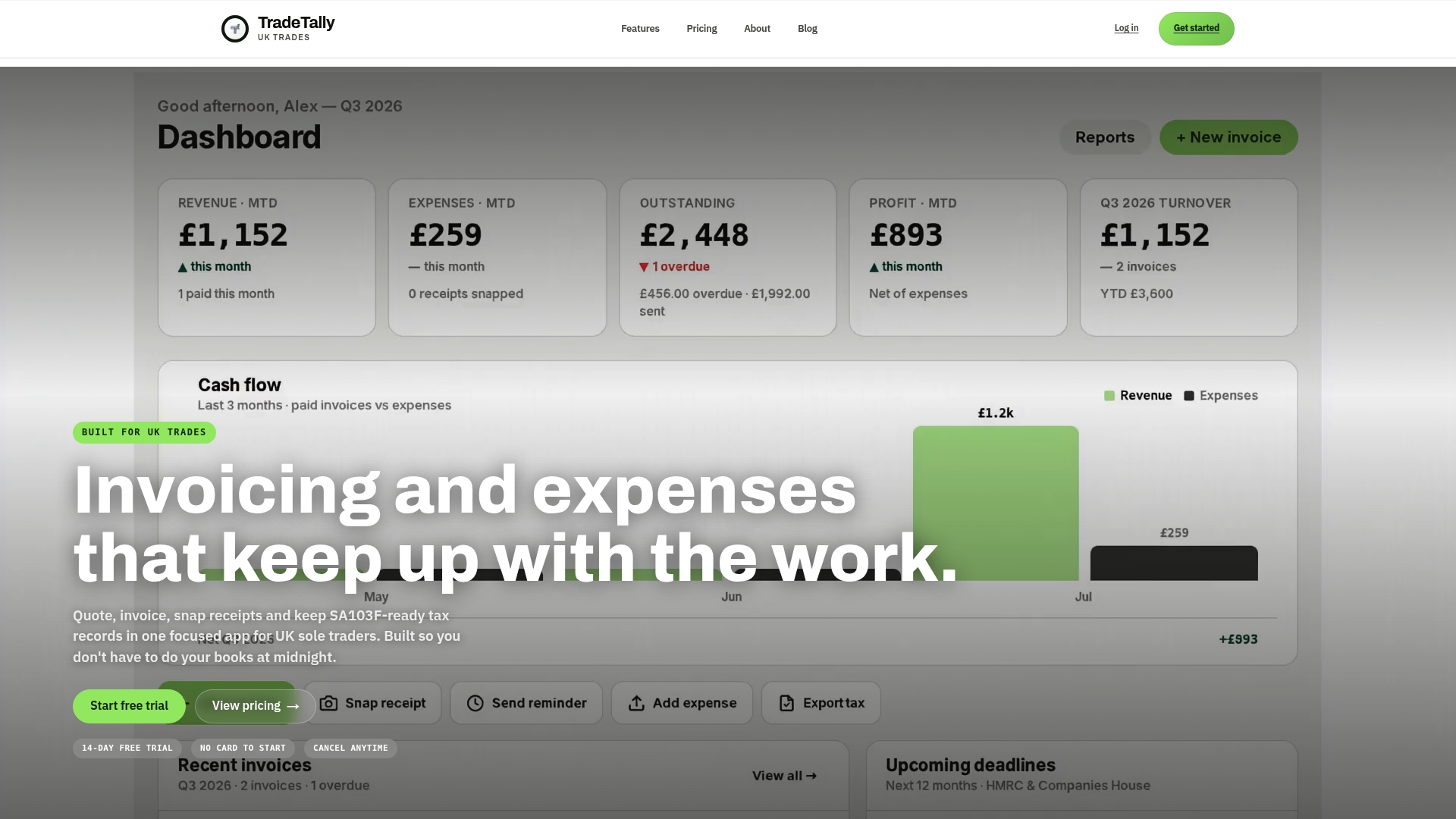
It’s aimed squarely at UK sole trader tradespeople: plumbers, electricians, carpenters and similar trades who need their invoicing, receipts and CIS records in one place rather than scattered across apps and shoeboxes. Confirm your own Making Tax Digital and record-keeping obligations first, then see whether the Starter tier fits, or compare it against the Professional plan if you need unlimited invoices and full tax exports.
FAQ
How can I view my past Self Assessment tax returns?
You can view previous returns, payments and HMRC correspondence through your Personal Tax Account on GOV.UK. If your accountant files on your behalf, they can access the same records once you’ve set up agent authorisation.
How long should I keep Self Assessment records in the UK?
If you’re self-employed or a landlord, keep records for five years after the 31 January deadline for the relevant tax year. Most other filers only need to keep records for around 22 months after the end of the tax year, provided they filed on time.
How can I view my Self Assessment information with HMRC?
Your Personal Tax Account shows your filing history, payments made and any letters HMRC has sent you. If you need something HMRC holds that isn’t visible online, you can request it directly, though processing can take a few weeks.
How do I get my HMRC records if I’ve lost my login details?
You can reset your Government Gateway credentials through GOV.UK’s identity verification process, which usually takes a day or two. If you’re still locked out, HMRC’s helpline can verify your identity another way and restore access.
What happens if I can’t find a receipt for a business expense?
You can use a provisional or estimated figure, but you must declare this in the Self Assessment return using the “Any other information” box. Try to reconstruct the figure first from bank statements or supplier copies, and keep a note of what you attempted in case HMRC asks later.
Recommended
Ready to sort your trade admin?
TradeTally gives UK sole traders invoicing, expenses, and SA103F-ready tax exports in one mobile-first app.
Start 14-day Pro trial →No card required