Lose £800 Upfront on a £4,000 Job? CIS vs PAYE for UK Subcontractors
CIS applies to genuine self-employed subcontractors; PAYE applies to employees. HMRC decides which one fits by looking at how you actually work, not what your contract calls you. Run the Check Employment Status for Tax tool for each engagement, confirm whether gross payment status applies to you, and keep evidence of the working relationship before you invoice anyone.
TL;DR:
- Most tradespeople should verify their work status with HMRC’s control, substitution, and mutuality tests before invoicing to avoid misclassification risks.
- CIS deductions are only for labour at rates of 20%, 30%, or none for gross payment status, while materials are not taxed under CIS, unlike PAYE wages.
- Subcontractors with gross payment status benefit from no initial deductions but must maintain strong compliance and accurate Self Assessment filings.
- Holding both PAYE and CIS statuses in the same tax year is possible but requires clear separation of each engagement and independent assessment for each job.
- Effective record-keeping, including running CEST tests and saving evidence, is crucial to substantiate working relationship classifications and avoid penalties.
Table of Contents
- PAYE explained: what it means for workers and employers
- What CIS is and how the deductions actually work
- CIS vs PAYE: the practical differences that affect your pay
- How to work out which one applies to you
- What happens next: filing, penalties and gross payment status
- Can you be both PAYE and CIS in the same tax year?
- What tradespeople should prioritise above everything else
- Where Tradetally fits into your CIS admin
- Official guidance and further reading
- FAQ
PAYE explained: what it means for workers and employers
PAYE stands for Pay As You Earn, and it’s the system contractors use to pay employees through payroll rather than through invoices. Each pay period, your employer reports your earnings to HMRC via Real Time Information (RTI), deducting income tax and Class 1 National Insurance before the money hits your account. Your employer also pays employer NIC on top, which is why some firms prefer subcontractors over staff.
Being on PAYE brings rights that CIS subcontractors don’t get automatically.
- Statutory holiday pay and sick pay
- Automatic pension enrolment once you meet the earnings threshold
- Protection against unfair dismissal after two years’ service
- A fixed wage regardless of whether the job runs over or under time
If your employer tells you what hours to work, provides your tools, and expects you personally to turn up (no sending a mate instead), those are strong signs you’re an employee under PAYE, whatever the paperwork says.
What CIS is and how the deductions actually work
The Construction Industry Scheme is HMRC’s way of collecting tax from subcontractors at source, treating the deduction as an advance payment rather than a final tax bill. Contractors verify each subcontractor with HMRC before the first payment and then apply one of three rates depending on status.
- 20% deducted from labour payments for subcontractors registered and verified under CIS
- 30% deducted for subcontractors who haven’t registered or can’t be verified
- 0% for subcontractors holding gross payment status, who receive the full amount and settle tax later
Crucially, deductions apply to labour only. Materials, VAT, and certain other costs on an invoice are excluded from the deduction base. Contractors file monthly CIS returns; subcontractors report income and reclaim deductions through Self Assessment.
CIS vs PAYE: the practical differences that affect your pay
The theory matters less than what lands in your account and what happens if the job goes wrong. Here’s the side-by-side that most tradespeople actually want.
| Factor | PAYE (employee) | CIS (subcontractor) |
|---|---|---|
| Who it applies to | Someone under an employer’s control | Genuine self-employed subcontractor |
| Tax and NIC collection | Deducted by employer via payroll (RTI) | 20%, 30%, or 0% deducted from labour, reconciled at Self Assessment |
| Materials treatment | Not applicable | Excluded from the deduction; only labour is taxed |
| Employment rights | Holiday pay, sick pay, pension, dismissal protection | None of the above; you carry your own risk |
| Admin burden | Employer handles almost everything | Subcontractor files Self Assessment; contractor files monthly CIS returns |
| Cashflow | Predictable, fixed wage each period | Deductions upfront, refunds often follow at year end |
A worked example on a £4,000 labour-only job. Under CIS with standard registration, the contractor deducts 20%, so you receive £3,200 with £800 held back as an advance against your Self Assessment bill. Under PAYE, that same £4,000 gross wage attracts income tax and 8% Class 1 employee NIC (on earnings within the standard band), while the employer separately pays 15% employer NIC on top of your wage, a real cost that many contractors try to avoid by using CIS instead.
Many subcontractors end up overpaying through the year because CIS deductions are only advances, and legitimate business expenses claimed later at Self Assessment often produce a refund. That’s a strong reason to keep receipts even when the deduction feels painful at the time.

CIS suits workers who run their own business, provide their own tools, and take on financial risk for the job. PAYE suits those who want certainty of pay and statutory protections, even if the take home is lower some weeks.
How to work out which one applies to you
Don’t guess. Status is decided on a set of legal tests HMRC has used for decades, and it doesn’t matter what label sits on your invoice.
- Control. Does the contractor dictate how, when, and where you work, or do you decide your own methods?
- Substitution. Could you send someone else to do the job in your place, or must it be you personally?
- Mutuality of obligation. Is the contractor obliged to offer you further work, and are you obliged to accept it?
- Integration and financial risk. Are you part of the client’s team with no financial exposure, or do you price jobs, buy materials upfront, and risk a loss if it overruns?
Run CEST separately for each engagement, because status is decided contract by contract, not once and for all, and save the result as evidence. Build a simple evidence file too: signed subcontractor agreements, invoices in your own business name, public liability insurance, proof you own your tools, and any substitution clause in your contract.
Pro Tip: Screenshot or PDF every CEST result the day you run it, with the date and the specific job attached. If HMRC ever queries your status two years later, that saved result is worth far more than your memory of the conversation.
If a contract is large, long-running, or borderline on control and substitution, get an accountant to review it before you sign. The cost of advice is far smaller than a backdated PAYE bill.
What happens next: filing, penalties and gross payment status
Once status is settled, the paperwork trail differs sharply between the two schemes. Subcontractors report their income through Self Assessment and claim CIS deductions as a credit against their final tax bill, often triggering a refund once allowable expenses are factored in.
Contractors carry heavier obligations. They file monthly CIS returns, and from 6 April 2026, mainstream contractors are expected to report through HMRC online services or commercial CIS software, with penalties for late filing.
- Misclassifying an employee as a CIS subcontractor can leave the engager liable for unpaid PAYE and employer NICgov.uk/employment-status-and-rights), plus interest and penalties.
- CIS registration alone doesn’t prove self-employment; HMRC looks at the actual working relationship and can reclassify it
- Gross payment status removes deductions at source, improving cashflow, but HMRC has tightened compliance checks and can revoke it for fraud links, with serious consequences
Gross payment status suits established subcontractors with strong compliance records, since the cashflow benefit only holds if you stay on top of your Self Assessment obligations.
Can you be both PAYE and CIS in the same tax year?
Yes, you can hold both statuses in one tax year, just not for the same piece of work. A site manager on PAYE five days a week could take on a one-off weekend fit-out job as a genuinely self-employed subcontractor, provided that second job meets the self-employment tests independently.
- Keep the two roles clearly separate on paper: different contracts, different invoicing, different working arrangements
- Never let your employer pay you CIS for tasks that are really an extension of your PAYE job
- Mixed workforces are common in construction but increase compliance risk, so review each arrangement regularly rather than assuming last year’s answer still holds
The most common trigger for an HMRC enquiry is a subcontractor who looks, on paper, identical to the firm’s PAYE staff, same site, same hours, same tools, just invoicing instead of payslipping.
What tradespeople should prioritise above everything else
Status follows how you actually work, not what your invoice template says or what your mate down the road does. Document the reality of each job, save your CEST result the day you run it, and revisit that decision every time the terms of an engagement change.
Most disputes with HMRC come down to missing paperwork rather than a genuinely wrong call. A tool like Tradetally can help you keep CIS deductions, invoices, and evidence organised in one place, so you’re not reconstructing a year’s work from memory when your accountant asks for it.
— Simon
Where Tradetally fits into your CIS admin
If you’re juggling CIS deductions, invoice records, and a shoebox of receipts every January, certain apps exist to help manage that workload effectively. Some tools are designed specifically to handle CIS requirements with appropriate features.
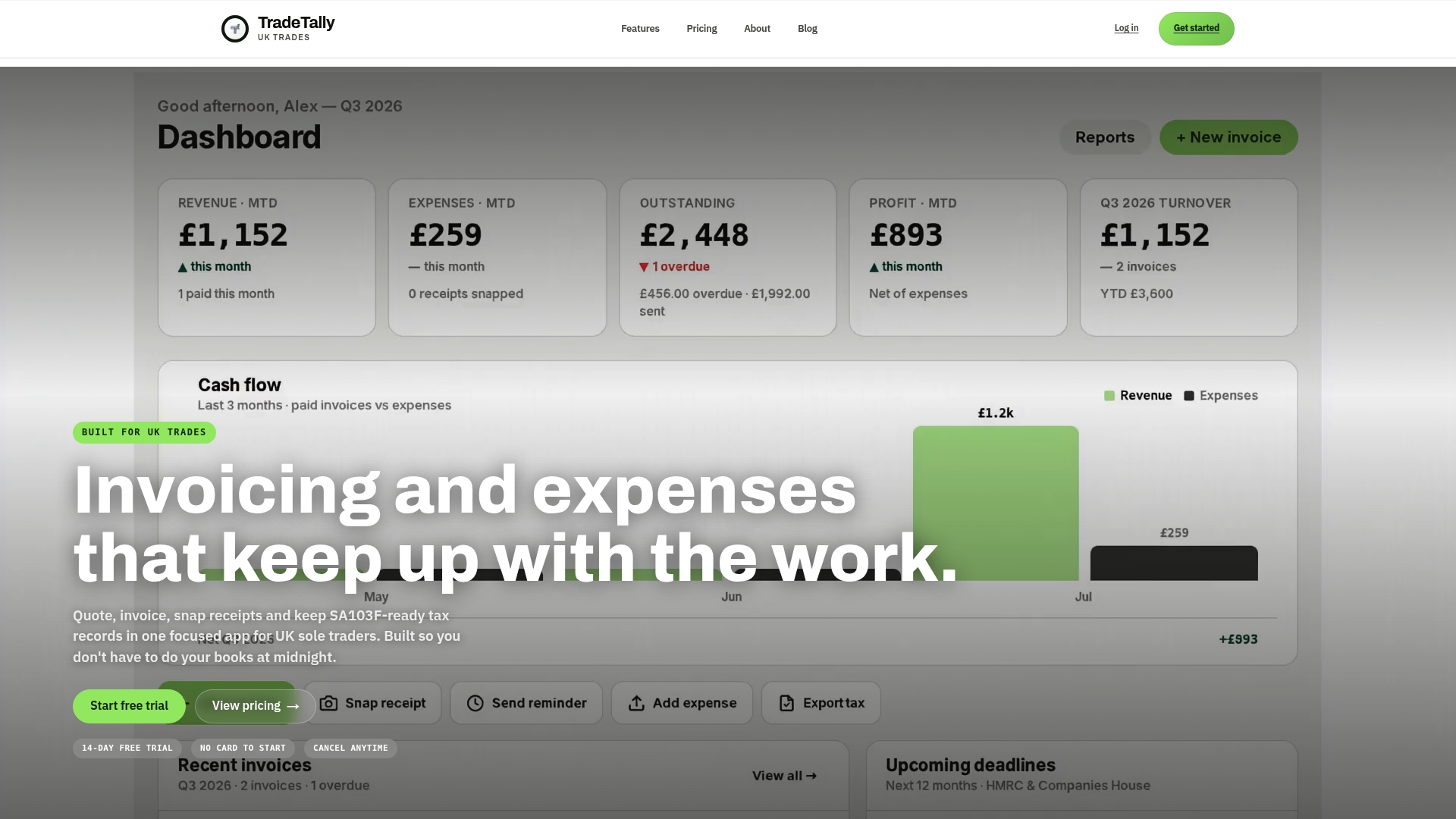
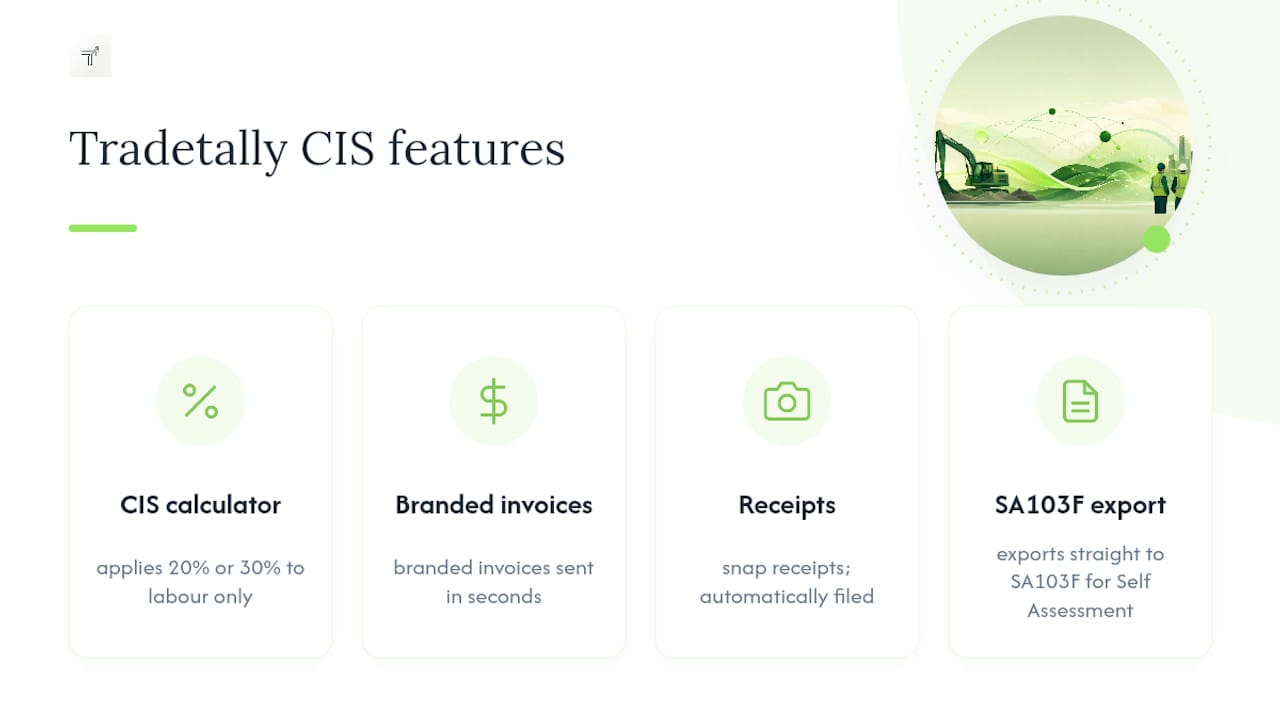
You get a built-in CIS deduction calculator that applies the correct 20% or 30% rate to labour only, so materials and VAT don’t get caught up in the maths by mistake. Branded invoices go out in seconds, receipts get snapped and filed automatically, and everything exports straight into SA103F format when Self Assessment rolls around. That means fewer errors on your deduction statements and no scramble to find six months of paperwork before the January deadline.
If you want to see exactly what you’d take home after CIS deductions on your next job, run the numbers through the Self Assessment tax calculator and see how quickly Tradetally could take the admin off your plate this tax year.
Official guidance and further reading
For the latest detail beyond this guide, HMRC’s own pages are the definitive source: employment status and rights, the CIS overview, CIS 340, and gross payment status.
This article is general information, not a substitute for advice from a qualified financial advisor. Consult a qualified financial professional about your own circumstances before acting on anything here.
FAQ
Is it better to be CIS or PAYE?
Neither is universally better. CIS suits genuinely self-employed subcontractors who want control and can handle their own tax and risk, while PAYE suits those who value guaranteed pay and statutory rights like holiday and sick pay.
Can I be PAYE and CIS at the same time?
Yes, you can hold both statuses within the same tax year, but never for the same piece of work with the same engager. Each engagement must independently meet the tests for employment or self-employment.
Is CIS tax always 20%?
No. Registered and verified subcontractors are deducted at 20%, unregistered subcontractors at 30%, and subcontractors with gross payment status have nothing deducted at source.
What is CIS tax in the UK?
CIS is a scheme where contractors deduct tax in advance from subcontractors’ labour payments and pass it to HMRC, with the subcontractor reconciling the actual bill through Self Assessment.
Recommended
Ready to sort your trade admin?
TradeTally gives UK sole traders invoicing, expenses, and SA103F-ready tax exports in one mobile-first app.
Start 14-day free trial →