Self Assessment for tradespeople: the 2025/26 walkthrough
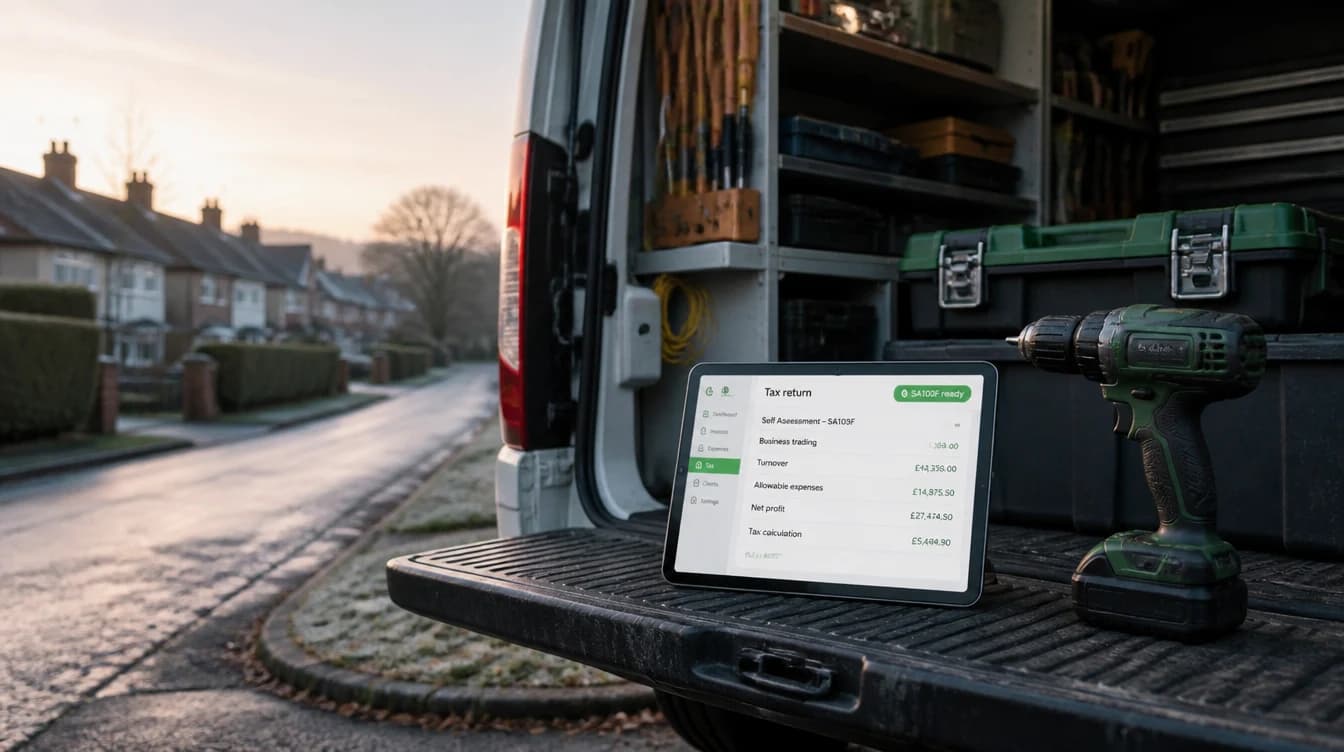
If you work for yourself in the trades, you must register for Self Assessment by 5 October after your first tax year, and file by 31 January. Miss the filing deadline and HMRC charges £100 on the spot, with more piling on after three months. This post walks through the 2025/26 return for a sole trader tradesperson: the deadlines, the SA103F boxes that actually matter, and a worked example with real numbers.
It is written for people who invoice their own customers: plasterers, electricians, plumbers, builders, decorators. If you only ever work as a subcontractor having CIS deducted, skip to the CIS section.
What are the Self Assessment deadlines for 2025/26?
Three dates matter, all from HMRC's deadlines page:
- 5 October 2026: register if 2025/26 is your first year trading.
- 31 January 2027: file your online return and pay the balancing payment for 2025/26.
- 31 July 2027: second payment on account, if HMRC's system puts you on it.
The £100 late-filing penalty lands the day after 31 January, even if you owe no tax. Three months late adds £10 a day, capped at £900. Six months late adds the greater of £300 or 5% of the tax due. File early and the pain is hypothetical.
Which form do tradespeople actually fill in?
Two boxes of the return matter for a sole trader: the main return (SA100) and the self-employment supplement. If your turnover is under £85,000, you can use the short version, SA103S. Over that, or if you want the proper expense breakdown, it is the full SA103F. The official publication is on GOV.UK's SA103F page.
The expense boxes that catch tradespeople out, using the 2025/26 numbering:
- Box 17: materials. Everything you buy that ends up in the job. Board, plaster, cable, fixings, paint.
- Box 18: payments to subcontractors. If you pay other trades to help on a job, here.
- Box 20: van and travel. Either the actual van costs or simplified mileage: 55p a mile for the first 10,000 business miles, 25p after (HMRC rates). For most tradespeople doing 12,000 to 18,000 miles a year, simplified mileage wins and keeps the records light.
- Box 21: insurance and premises costs. Public liability, tool insurance, any unit or yard rent.
- Box 22: repairs and renewals of tools and equipment. The replacement grinder, the re-tipped saws.
- Box 23: phone and admin. The business share of your mobile, stationery, website costs.
- Box 28: accountancy and professional fees. Your accountant, or bookkeeping software subscriptions like ours.
Two traps: business entertainment is not allowable (Box 25 exists so you can add it back), and the van's daily commute does not count as business miles if you have a permanent yard or base you travel to daily.
How does CIS fit in?
If contractors deduct CIS from your pay, those deductions are tax you have already paid. They go in the return (SA103F box 38 for the self-employment pages), and they come off your balancing payment. A plasterer with £3,000 deducted at 20% through the year and a final bill of £4,700 only pays the £1,700 difference in January. If the deductions overshoot the bill, HMRC owes you a refund, which is why filing early after 6 April is worth doing.
A worked example with real numbers
Take a self-employed plasterer in 2025/26. Turnover £48,000. Costs:
- Materials: £9,600 (Box 17)
- Van, 14,000 business miles on simplified expenses: 10,000 x 55p plus 4,000 x 25p = £6,500 (Box 20)
- Tool repairs and replacements: £1,100 (Box 22)
- Phone: £360 (Box 23)
- Insurance: £620 (Box 21)
- Software subscription: £144 (Box 28)
Total expenses £18,324. Profit £29,676.
After the £12,570 personal allowance, taxable profit is £18,106. Income tax at the 20% basic rate: £3,621.20. Class 4 National Insurance at 6% on profits between £12,570 and £30,676: £1,086.36. Total bill roughly £4,707, before any payments on account or CIS deductions already made.
None of those numbers needs a shoebox of receipts to reach. They need the expenses logged as the year goes.
Does Making Tax Digital change this?
Yes, from 6 April 2026, if your combined sole trader and rental income is over £50,000 you move onto MTD for Income Tax: quarterly digital updates plus a final declaration, replacing the single January filing. The £30,000 threshold follows from April 2027. The plasterer in the example above stays on annual Self Assessment for now. Someone billing £60,000 does not.
The practical answer is the same either way: expenses categorised as you go, quarterly figures you can already see, January as a formality.
What to do next
If your records live in three places, pull them into one before 31 January. In TradeTally, log your expenses against the SA103F categories as they happen, snap the receipt with the built-in OCR, and use the mileage calculator at /tools/mileage-calculator to sense-check your van claim. If you have CIS deducted, track it per job with the CIS calculator at /tools/cis-calculator so the January number is never a surprise. The SA103F export gives your accountant the box-ready figures in one file. If you are over £50,000, the MTD switch is coming either way; read what the November MTD milestone actually changes.
Self Assessment is not hard. It is only miserable when the records are missing.
Ready to sort your trade admin?
TradeTally gives UK sole traders invoicing, expenses, and SA103F-ready tax exports in one mobile-first app.
Start 14-day Pro trial →No card required