UK Tradespeople: Two Tests for Overheads vs. Direct Costs

Direct costs are expenses you can tie to one job; overheads are the running costs that keep the business operating. Get the split wrong and you underprice work, because overheads only get paid for if your job margins recover them. Bodies such as HMRC and ICAEW both treat the distinction as basic financial hygiene.
TL;DR:
- Classify a cost as direct only when it can be traced to one job and would disappear if the job stopped; mixed cases are shared costs.
- Allocate shared costs by the factor that best reflects use, such as distance for fuel or floorspace for workshop heating, and document the rule.
- Calculate an overhead rate by dividing total overheads by direct labor hours or direct costs, then apply it consistently to each job.
- Review margins monthly and recalculate the overhead rate when major costs, such as insurance or premises, change; otherwise, quotes can miss rising expenses.
- Keep job costing separate from tax treatment: a direct job cost may be only partly tax deductible when it includes private use.
Table of Contents
- What counts as a direct cost on a job?
- What are overheads, and how do fixed, variable and semi-variable types differ?
- How do you classify costs that sit between direct and overhead?
- How do you work out an overhead rate and allocate overheads?
- Why does the difference affect pricing and profitability?
- How do you keep direct costs and overheads accurate day to day?
- What does working with trades businesses teach you about overheads?
- Could a bookkeeping app make this easier?
- FAQ
- Sources
What counts as a direct cost on a job?
A direct cost is any expense you can attribute to completing one specific job. If the job had never happened, you would never have spent the money.
Typical examples for tradespeople:
- Raw materials bought for that job, such as pipe, cable, timber or plasterboard.
- Site disposables like sealant, screws and dust sheets used up on the job.
- Hire equipment taken out for one client’s work.
- Subcontractor invoices for work you passed on.
- Fuel for a single client visit, where you can trace the trip.
Direct costs are the foundation of job costing. Add them up, subtract them from the price you charged, and you get the contribution the job made towards everything else. A job’s contribution is its price minus its direct costs. That contribution has to pay for the business itself before any of it counts as profit.
If you want trade-specific examples, our guide on what expenses a plumber can claim maps common items to the right category.
What are overheads, and how do fixed, variable and semi-variable types differ?
Overheads are indirect costs that support the business as a whole. You cannot trace them to a single job, yet you pay them whether you are busy or quiet.
They come in three flavours:
- Fixed: the same each month regardless of workload. Rent, public liability insurance and a salaried admin wage are classic cases.
- Variable: they move with activity, but not job by job. Utilities and some general consumables fit here.
- Semi-variable: a fixed base plus a usage element. Phone contracts with call charges and van running costs both behave this way. Our piece on vehicle expenses for sole traders shows how to untangle them.
Overheads do not shrink because one month is slow. Your margins on jobs have to cover them across the year, or the business drifts into a loss even while individual jobs look healthy.
How do you classify costs that sit between direct and overhead?
Some costs refuse to sit neatly in either bucket. Two quick tests settle most of them:
- Traceability: can you point to the one job this cost belongs to?
- Disappearance: if the job stopped tomorrow, would the cost stop too?
Two yeses mean direct. Two noes mean overhead. Mixed answers point to a middle category, often called direct support or shared costs. Supervisor time shared across live sites and heating a workshop used for several jobs are examples.
Shared costs get split using a sensible basis:
- Time spent on each job.
- Headcount involved.
- Floorspace used.
- Distance travelled.
Pick the basis that best reflects how the cost is actually consumed. Fuel suits distance; workshop heating suits floorspace or time.
Pro Tip: Write down the apportionment rule you choose and apply it the same way every month. A documented, consistent method is easy to defend to an accountant and sits well with HMRC’s expectations.
Mileage is a common sticking point, so see our guide to HMRC mileage claims for how it fits in.
How do you work out an overhead rate and allocate overheads?
The simplest method is an overhead rate:
Overhead rate = total overheads ÷ allocation base
The base is usually total direct labour hours, though total direct costs also works. Choose one and stick with it.
Here is an illustrative worked example, not market data. Divide your overheads by your chosen allocation base, such as chargeable hours, to calculate an overhead rate. Apply that rate to the hours spent on a job, then subtract both direct costs and allocated overheads from the quote to see what remains.

A job can appear profitable before overheads are recovered, but leave much less once they are included.
Some firms move to activity-based costing, which assigns overheads using several cost drivers instead of one. It is more accurate, but it needs more record-keeping, so it suits larger operations. There is no single correct method, so choose the one you will actually maintain. Our guide to quoting small jobs properly shows how to carry the rate into your prices.
Why does the difference affect pricing and profitability?
Misclassifying costs makes jobs look better than they are. If you ignore overheads when quoting, each job seems profitable while the business as a whole quietly loses money.
Contribution margin is the practical tool here: price minus direct costs. Your total contribution across all jobs has to exceed your overheads before any profit appears. That point is your break-even.
Simple checks that catch under-recovery:
- Review margins monthly, not just at year end.
- Compare the margin billed across the month with your total running costs.
- Watch for jobs that repeatedly come in at a thin contribution.
- Re-run your overhead rate whenever a big contract changes, such as insurance or premises.
For more pricing examples, see how we approach quoting plumbing jobs properly, where overhead recovery changes the final figure.
How do you keep direct costs and overheads accurate day to day?
Good records beat clever formulas. A few habits keep everything honest:
- Tag each expense to a job or category at the point of purchase, using tracking categories in your accounting software.
- Review fixed subscriptions and contracts quarterly. Insurance and software are the usual candidates for renegotiation. ICAEW notes that overheads can form a large share of total spend and do not scale with revenue, so they deserve regular attention.
- Keep management classification and tax classification separate. For tax, the test is whether the cost was incurred “wholly and exclusively” for the trade, and dual-purpose costs only allow the business proportion.
- Use the right boxes when filing: the SA103F notes show where materials, travel and premises costs go.
Pro Tip: A cost can be direct for job costing yet only partly allowable for tax if there is private use. Track both views and do not let one overwrite the other.
Keeping private spending out of the picture helps too, as explained in splitting personal and business expenses. If you are a limited company, this overview of expenses HMRC allows is a useful companion.
What does working with trades businesses teach you about overheads?
The pattern I see most is the busy, well-liked tradesperson who is quietly underpriced. The work is there; the margin is not. It is rarely about one dramatic mistake. It is usually overheads that nobody tagged, so nobody noticed them eating the profit.
You do not need to fix everything at once. Start with one small change, such as tagging every receipt to a job when you buy it, and add a short monthly margin check. Small, repeated habits are what move the numbers.
— Simon
Could a bookkeeping app make this easier?
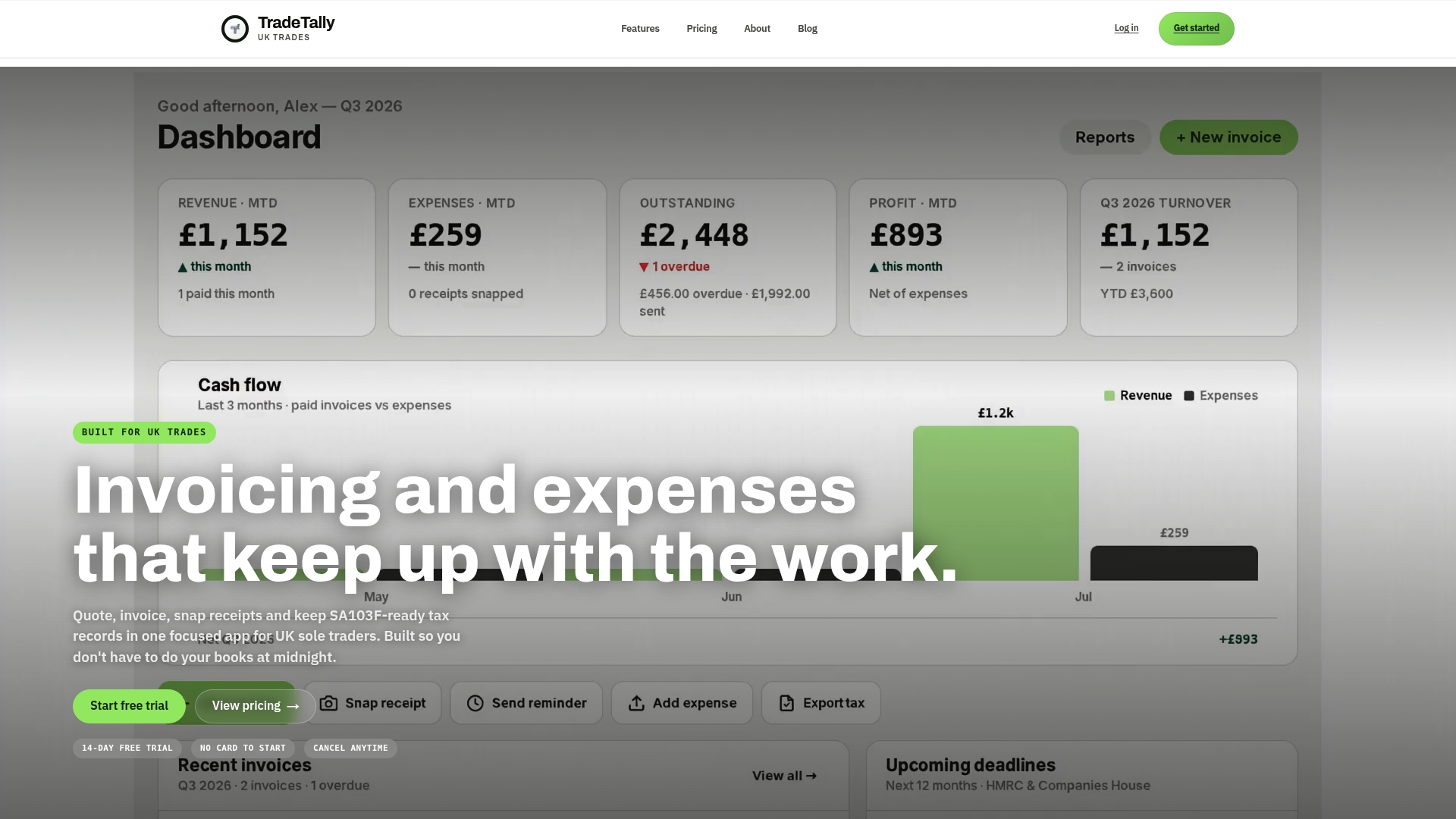
If you would rather not do this by hand, a mobile-first app can take most of the effort out of it. We built TradeTally for sole traders who handle the paperwork from the van, and it covers the habits described above:
- Snap receipts as you buy.
- Keep records tax-ready, with SA103F export for Self Assessment.
- Raise branded invoices without a late-night session at the kitchen table.
You can start on our free Starter tier or look at the pricing page to see whether the Professional plan at £12 per month suits how you work.
This article is general information, not a substitute for advice from a qualified financial advisor. Consult a qualified financial professional about your own circumstances before acting on anything here.
FAQ
Are overheads direct expenses?
No. Overheads are indirect expenses that support the whole business, so they cannot be traced to one job. Direct expenses are the ones tied to a specific job or product.
Is overhead included in direct cost?
No, the two are kept separate. Direct costs cover materials, subcontractors and job-specific labour, while overheads are recovered afterwards through your margins or an overhead rate.
What are examples of overhead costs?
Common overheads include rent, insurance, utilities, phone bills, software subscriptions and admin wages. HMRC lists typical business expenses for self-employed people, which helps when sorting items into categories.
What is the difference between cost and overhead?
Cost is the broad term for any money spent. An overhead is one type of cost: the indirect kind that keeps the business running rather than serving a single job.
Sources
Recommended
Ready to sort your trade admin?
TradeTally gives UK sole traders invoicing, expenses, and SA103F-ready tax exports in one mobile-first app.
Start 14-day Pro trial →No card required