UK Tradespeople: Keep Client Approvals and Log £150 Changes On Site
Capture the client’s acceptance at the point of agreement and keep a dated record of it, whether that’s a signed quote, a photo of the signed page, an SMS or email confirmation, or an e-signature. This single habit preserves the terms you agreed, backs up your invoices, and gives you something solid to point to if a client disputes the work or the price later.
TL;DR:
- For every approval, record the client’s name and job address, quote reference, agreed scope, price and VAT status, supply date, and dated acceptance.
- Treat each change during a job as a separately numbered variation linked to the original quote, and obtain fresh approval before carrying out extra work.
- Send confirmation naming the quote number and price, then attach it to an invoice with a unique reference, scope, supply date, and amount.
- Keep business records for at least five years from January 31 after the relevant tax year; VAT records often require six years.
Table of Contents
- Short on-site checklist: what to capture for every approval
- Practical methods to capture sign-off on site
- How approvals fit with HMRC rules and consumer law
- Copyable fields for quotes and simple customer approval scripts
- Repeatable 4-step workflow to implement today
- Why this habit pays off for tradespeople
- How TradeTally helps keep approvals
- FAQ
- Sources
Short on-site checklist: what to capture for every approval
A good approval record doesn’t need to be complicated. It needs to be consistent. Every time a client accepts a quote, you should capture the same core details so nothing is missing when you need it most.
- Client’s full name and job address
- Your quote reference number
- A clear description of the work agreed
- The price and whether VAT applies
- The date the work or supply took place
- A signature or timestamp confirming acceptance
- A working phone number or email for the client
When a job changes mid-way, don’t just scribble a note on the original quote. Give the variation its own reference, link it back to the original quote number, and get it approved the same way you got the first one approved. This matters more than it sounds: a £150 extra for moving a socket can become a real argument if there’s no record of who asked for it and who agreed to pay.
File the evidence the moment you have it. Photograph a signed paper quote and upload it to a cloud folder or attach it directly to the client’s record in your invoicing app before you leave the drive. If you’re running a paper system, number your receipts and file them in date order so nothing gets lost in the glovebox. HMRC guidance for sole traders sets out how long you need to keep these records, which we cover in more detail below.
Pro Tip: Keep a simple folder structure by year and quote number, for example “2026/Q104-Smith”, so you can find any approval in seconds when a query comes in.
Practical methods to capture sign-off on site
You don’t need expensive software to get a reliable approval. You need a method that’s quick enough to use on every job, because the methods you skip are the ones that come back to bite you.
- Paper plus photo. Get the client to sign the printed or written quote, then photograph the signed page clearly, including the date and your reference number in the shot. Save the photo with a file name that matches the quote reference, so “Q104-Smith-signed.jpg” is easy to find later.
- Email or SMS confirmation. Ask the client to reply with a short phrase such as “I confirm I accept quote Q104 for £850 plus VAT” rather than a simple “yes”. That one line does far more work than a thumbs-up emoji if you ever need to show what was agreed.
- E-signature. For bigger jobs, a basic e-signature tool captures a timestamp, the device used and the quote reference in one go. You don’t need anything elaborate: a low-cost app that logs these details is enough for most trade work.
- Photos of the finished job. Pair before-and-after photos with the original approval. This links what was agreed to what was delivered, which is useful if a client later claims the work wasn’t what they expected.
Attach whichever evidence you collect to the final invoice. An invoice needs a unique reference, a clear description of the work, the supply date and the amount charged, and having the approval sitting alongside it turns a plain bill into a document that explains itself.
Pro Tip: Combining a signed photo with a follow-up email confirmation gives you two independent records pointing to the same agreement, which is far harder for anyone to dispute than either one alone.

How approvals fit with HMRC rules and consumer law
Keeping approvals isn’t just good practice for avoiding arguments. It’s part of what HMRC and consumer law expect from you as a sole trader.
Under the Consumer Rights Act 2015, information you give a client about the work or the price can become a term of the contract, which means a verbal promise made while quoting can be just as binding as something written down. A dated, recorded approval protects you by showing exactly what was said and agreed, rather than leaving it to memory months later.
On the tax side, HMRC’s own position is clear:
- Keep business records, including invoices, receipts and contracts, for at least five years from 31 January after the tax year the return relates to.
- VAT records often need to be kept for six years.
- These rules apply whether you store paper files or digital copies, as set out in HMRC’s record-keeping guidance.
A verbal acceptance can form a binding contract in its own right, but a written or recorded approval is strongly advised because it proves what was actually agreed if a dispute ever lands on your doorstep.
On data protection, keep only what you genuinely need for the job and the tax record, not every scrap of personal information a client hands over. Publish a short privacy notice explaining what you hold and for how long, and delete records once the retention period has passed rather than letting old files pile up indefinitely, as recommended by TK Marketing.
If a client disputes the scope or the payment, pull the quote reference, the approval record and the invoice together before you respond. Nine times out of ten, the paper trail settles the argument before it escalates.
Copyable fields for quotes and simple customer approval scripts
A quote or invoice that’s missing basic details causes more disputes than almost anything else. Keep a short list of mandatory fields and you’ll rarely be caught out.
- Unique quote or invoice reference number
- Date the quote was issued and the date work was supplied
- A clear, specific description of the work, not just “plumbing job”
- The price, broken down with VAT shown separately where it applies
- Your contact details and the client’s name and address
For the approval itself, a plain signature line works well: “I accept this quote and the price stated above. Signed: ___ Date: ___.” If you’re relying on email or text, ask for a reply such as “I confirm acceptance of quote [reference] at [price]”, which gives you a record you can quote back word for word if needed.
When a job changes, treat the variation as its own mini-approval with its own reference number, linked back to the original. Our quote terms and conditions guide has wording you can copy straight into your own quotes, and our free invoice template already includes the fields GOV.UK expects on every invoice.
Repeatable 4-step workflow to implement today
Most disputes happen because one step in the chain gets skipped under time pressure. Build the habit into four steps and it stops being optional.
- Create the quote with a unique reference, whether that’s typed on your phone before you leave the drive or printed on the spot.
- Get the client’s acceptance and capture it in at least one durable format: a signed paper copy photographed on the day, an email or SMS reply, or an e-signature with a timestamp attached.
- Issue the invoice referencing the original quote number and attach the approval evidence to the same record, so anyone looking at the invoice can see exactly what was agreed and when.
- File everything under the quote reference and set a reminder to review and delete records once they pass the retention period required for tax purposes.
Our sole trader invoicing guide walks through each of these steps in more depth if you want to tighten up your process further.
Why this habit pays off for tradespeople
Every late payment chase I’ve seen traces back to a missing approval, not a missing invoice. Capturing acceptance at the point of agreement, on your phone, from the van, before you’ve even left the drive, saves arguments later and makes tax time far less stressful.
— Simon
How TradeTally helps keep approvals
We built TradeTally around the admin that follows a day on site, so capturing a client’s acceptance takes seconds rather than becoming another evening task. Receipts and signed quotes can be photographed and attached directly to the job record, invoices reference the original quote number automatically, and everything exports in a format ready for Self Assessment.
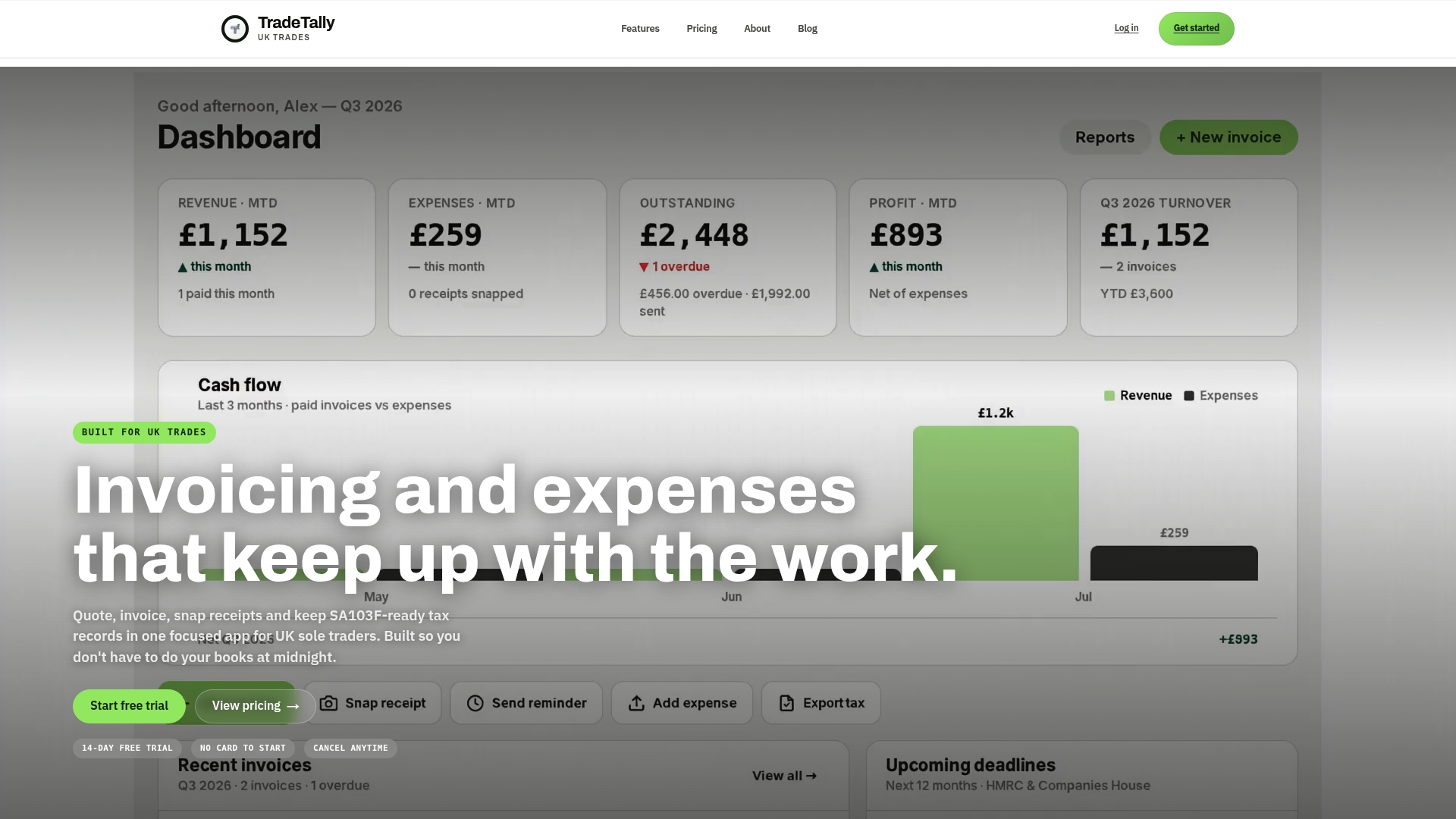
- Create and send branded quotes and invoices from your phone between jobs
- Attach photo evidence of approvals and finished work straight to the client record
- Export tax-ready records formatted for SA103F when it’s time to file
Our Starter plan is free for limited invoicing, and Professional costs £12 per month or £120 per year for unlimited invoices, receipts and tax exports. Have a look at the pricing page and see which fits the way you work.
FAQ
What counts as a valid client approval?
A valid approval is any dated record showing the client agreed to the quote, price and scope, such as a signed paper quote, a photo of that signature, or a written email or text confirmation. A verbal yes can form a contract, but a recorded approval is strongly recommended because it proves exactly what was agreed if a dispute arises.
How long should I keep client approval records?
Keep approval records alongside your invoices and receipts for at least five years from 31 January after the tax year they relate to, as set out in HMRC’s guidance for sole traders. VAT-related records often need to be kept for six years, so check which rule applies to your situation.
Does an email confirmation count as proof of approval?
Yes, a clear written reply such as “I confirm acceptance of quote Q104” counts as useful evidence of agreement, especially when it references the quote number and price. Pairing it with a signed or photographed quote gives you stronger proof than either one alone.
What must I include on an invoice to support an approval?
Every invoice needs a unique reference number, a clear description of the work, the supply date, and the amount charged, with VAT shown separately if it applies, as required by GOV.UK’s invoicing rules. Attaching the matching approval evidence to that invoice gives you a complete audit trail.
Can TradeTally store my client approvals for me?
TradeTally lets you attach photo evidence and confirmations to a job record alongside the quote and invoice, keeping everything under one reference. Plans range from a free Starter tier to Professional at £12 per month or £120 per year, depending on how much invoicing and record-keeping you need.
Sources
For the legal and tax detail behind this guide, GOV.UK sets out invoicing and record-keeping rules, legislation.gov.uk holds the Consumer Rights Act 2015, and Construction Legal Services covers the risks of relying on verbal agreements alone.
- Gov
- Legislation
- Verbal agreements: can they put your construction business at risk? — Construction Legal Services
Recommended
Ready to sort your trade admin?
TradeTally gives UK sole traders invoicing, expenses, and SA103F-ready tax exports in one mobile-first app.
Start 14-day Pro trial →No card required