Stop Quote Disputes: Copyable quote terms for UK tradespeople

A written quote that a customer accepts is normally a binding contract in the UK, provided the terms are clear and not unfair under consumer law. Get the core terms on the page, price, scope, validity period and payment terms, and record how the customer accepted it. That single habit prevents most of the disputes tradespeople face.
TL;DR:
- Fixed-price quotes must clearly state the scope, total price, validity period, payment terms, and cancellation policies directly on the document to be enforceable.
- Acceptance methods include signed copies, explicit email approval, or conduct such as beginning work, with written confirmation strongly recommended for legal proof.
- Including a variations clause, specifying site access requirements, and stating VAT details upfront help prevent disputes and clarify responsibilities.
- Terms must be fair and transparent under consumer law; hidden or unfair clauses risk being declared void and unenforceable in court.
- Recording acceptance promptly and maintaining version control of quotes prevent misunderstandings, especially if terms change before acceptance or disputes arise.
Table of Contents
- 1. What a quote is, and how it differs from an estimate
- 2. Standard terms to include on a quote
- 3. Consumer law limits: fairness and transparency under the Consumer Rights Act 2015
- 4. Payment, VAT and late-payment protections you can include on quotes
- 5. How to present terms and obtain clear acceptance
- 6. Validity periods, variations and handling on-site changes
- 7. Templates, worked examples and a one-page checklist you can use
- 8. How TradeTally helps with quoting, proof of acceptance and tax-ready records
- 9. Legal implications of including disclaimers and liability limits in quote terms
- 10. Data protection and privacy considerations when providing quotes
- 11. Impact of contract formation timing linked to quote acceptance
- Practical habits that save time and avoid disputes
- TradeTally: a practical way to put these terms into every quote
- Sources
- FAQ
1. What a quote is, and how it differs from an estimate
A quote is a fixed price for a defined piece of work. Once a customer accepts it, you have a contract, and you cannot usually charge more unless extra work is agreed or there was an obvious mistake in your figures, as Citizens Advice explains. An estimate is different. It is your best guess at cost, not a promise, and it leaves room to adjust the final bill once you know more about the job.
That distinction matters more than most tradespeople realise. If you send something called an “estimate” but write it like a quote, with a fixed figure and no caveats, a customer can reasonably treat it as binding. The label on the document counts for less than what it actually says.
Acceptance can happen in several ways:
- A signed copy of the quote returned to you.
- An email reply saying “yes, go ahead” or similar.
- A verbal agreement followed by you starting the work, which courts can treat as acceptance by conduct.
Fixed-price jobs are the easiest to get right: state the total, list what’s included, and you’re both working from the same number. Day-rate jobs are riskier because the final cost depends on hours worked, so be explicit about your day rate, minimum call-out charges and how you’ll handle a job that runs long.
The phrase “standard terms apply” is a common trap. If your full terms sit in a document the customer never saw or a link they never clicked, a court may decide those terms never became part of the contract. Put the terms that matter most, price, validity and cancellation, on the face of the quote itself, not buried in a footer reference.
2. Standard terms to include on a quote
A quote earns its enforceability from what it actually says, not from how long it is. Use these clause headings as a working checklist:
- Scope of work: exactly what you’ll do, the materials you’ll use, and what’s excluded (for example, “excludes making good to plasterwork” or “excludes disposal of old units”).
- Price: the total figure, whether it’s fixed or subject to variation, and how VAT is treated.
- Validity period: how long the price stands, typically 30 days.
- Payment terms: deposit amount, staged payment dates, final balance due date, and accepted payment methods.
- Variations clause: how extra work gets priced and agreed before it starts.
- Access and site conditions: what you need from the customer (parking, power, clear access) to do the job on schedule.
- Cancellation and refunds: notice period and any charges for late cancellation.
- Dispute resolution and governing law: how disagreements get resolved, and confirmation that English law (or Scots law, where relevant) applies.
On price, state plainly whether the figure includes or excludes VAT. “£2,400 plus VAT” and “£2,400 including VAT” describe very different jobs, and ambiguity here is one of the most common sources of argument once the invoice lands.
Validity periods protect you from rising material costs and protect the customer from a stale quote. A simple line does the job: “This quote is valid for 30 days from the date shown above. After this period, prices may be revised to reflect current material costs.” Without a stated period, courts may treat a quote as open for a “reasonable time”, which is vague and unhelpful to both sides.
Payment terms deserve their own clarity. Specify whether you need a deposit before starting, whether payments are staged against milestones (first fix, second fix, completion), and when the final balance falls due. Vague terms like “payment due promptly” invite disagreement about what “promptly” actually means.
Pro Tip: Put your payment terms in bold on the quote itself, not just in a linked document. Customers are far more likely to query a payment date before they sign than after.
A variations clause is worth writing out in full rather than assuming common sense will cover it. Something like: “Any changes to the scope of work must be agreed in writing before proceeding. Additional costs arising from variations will be quoted separately and require your approval before work continues.” That single clause does more to prevent scope creep than almost anything else on the page.
Access and site conditions matter more than they seem to at first glance. If a job depends on parking being available, power being live, or a room being cleared, say so, and note what happens to your schedule and price if those conditions aren’t met.
Cancellation terms protect your time. A line stating that cancellations within 48 hours of a booked start date incur a call-out charge, for instance, gives you a fair remedy for wasted time without being punitive.
3. Consumer law limits: fairness and transparency under the Consumer Rights Act 2015
Writing strong terms only works if the terms are actually enforceable. The Consumer Rights Act 2015, backed by Gov, requires that terms offered to consumers be fair and written in plain, intelligible language. A term that is unfair is simply not binding, however clearly you thought you’d written it.
Fairness generally comes down to two questions: does the term create an imbalance that unfairly favours you over the customer, and would a customer reasonably have expected it? Transparency asks whether the term was presented clearly enough that a customer could actually notice and understand it before agreeing.
Clauses that commonly run into trouble include:
- Terms that try to exclude a customer’s statutory rights entirely (sometimes called “magic shield” wording).
- Clauses letting you change the price after acceptance with no clear reason or limit.
- Cancellation penalties that are disproportionate to any loss you’d actually suffer.
- Small print that contradicts a bigger, bolder claim made elsewhere on the same document.
One of the clearest signals courts and enforcers look for is prominence. GOV.UK guidance recommends separating out the handful of terms that matter most to a customer, total price, validity period, deposit amount, cancellation rights, into an upfront summary on the face of the quote, with full terms available for anyone who wants the detail. A term hidden in dense paragraph nine of a document nobody read carries far less weight than the same term set out clearly near the price.
If you’re taking on a job with an unusual risk, asbestos-era properties, structural alterations, or anything with real potential for dispute, it’s worth having a solicitor check your wording rather than relying on a template. The cost of an hour’s legal advice is small next to the cost of a term that turns out to be unenforceable when you need it most.
4. Payment, VAT and late-payment protections you can include on quotes
If you’re VAT-registered, your invoices need to meet specific requirements or they risk being invalid for VAT purposes. HMRC’s rules require your VAT number, an itemised quantity and unit price for each item, the VAT rate applied, and both the VAT-inclusive and VAT-exclusive totals. Getting this right on your quote as well as your invoice avoids a scramble later.
Payment windows should be reasonable and stated plainly. For consumer work, seven to fourteen days after completion is common. For trade-to-trade contracts, payment windows around a month are common, though you can agree shorter terms if cashflow demands it.

Late payment costs you more than time, and the law gives you a remedy. Under the Late Payment of Commercial Debts (Interest) Act 1998, suppliers in business-to-business contracts can claim statutory interest at the Bank of England base rate plus 8%, along with fixed compensation of £40 for debts under £1,000, £70 for debts between £1,000 and £9,999.99, and £100 for debts of £10,000 or more. This applies to commercial debts, not to consumer contracts, but it’s a genuinely useful tool when a fellow business sits on your invoice.
Chasing overdue payment works best as a staged process:
- A friendly reminder a few days after the due date, assuming an oversight.
- A firmer follow-up referencing the original payment terms and any late-payment charges that now apply.
- A formal letter citing the statutory interest and compensation you’re entitled to claim.
- Escalation to a solicitor or the small claims process if the debt remains unpaid after that.
The Office of the Small Business Commissioner advises putting payment terms in writing from the outset precisely because vague terms are what make late payment hard to chase. A late payment letter template that references the statutory interest and compensation bands gives your chasing letters the weight of law behind them rather than just a polite request.
5. How to present terms and obtain clear acceptance
Where you put your terms matters almost as much as what they say. Put the price, validity period and payment terms directly on the quote document itself, not solely in a covering email that might get separated from the quote later. A highlighted “key terms” box near the top of the document, before the detailed scope, gives customers the information they’re most likely to check before they sign.
To get and keep evidence of acceptance:
- Send the quote as a PDF with a clear version number and date in the header.
- Ask for acceptance in writing, an email reply, a signed copy returned, or a click-to-accept confirmation if you’re using quoting software.
- Save the exact version of the quote the customer saw, alongside their acceptance message, in the job file.
- If acceptance was verbal, follow up immediately with a written summary: “Confirming you’ve accepted the quote dated [date] for £[amount], as discussed on the phone today.”
- Keep a simple log of quote number, date sent, date accepted and method of acceptance for every job.
An emailed “I accept” that references the quote number and date is solid evidence of a contract. A verbal “yes, go on then” is harder to prove later, which is exactly why the written follow-up step matters.
Pro Tip: Number every version of a quote you send. If terms change after a conversation, issue “Quote 104-v2” rather than editing the original file, so there’s never any argument about which version was agreed.
6. Validity periods, variations and handling on-site changes
A validity period gives both sides certainty. Thirty days is a sensible default for most trade work, long enough for a customer to decide without forcing you to hold a price against rising material costs indefinitely. Word it simply: “This quote is valid for 30 days from [date].” For jobs quoting volatile materials, timber or copper piping, for instance, a shorter window of 14 days can protect your margin.
Variations are where most disputes actually start, usually because extra work gets agreed on-site with a nod rather than in writing. A short workflow keeps this manageable:
- Spot the change (a hidden pipe run, rotten timber behind a fitted unit, and so on).
- Stop and quote the extra work separately before continuing.
- Get written agreement, even a text message confirming the price, before proceeding.
- Note the variation against the original quote number so the job file stays linked.
Genuine mistakes in your original figures, a miscalculated material cost or a missed line item, can usually be corrected if you spot them quickly and before the customer has relied on the original price. Citizens Advice confirms that a trader generally can’t charge more than a quoted price except where extra work is agreed or there was an obvious mistake, so the earlier you catch and correct an error, the stronger your position.
Deposits and staged payments are a fair way to manage cashflow on longer jobs, provided they’re proportionate to work already done or materials already bought. A retention, holding back a small percentage until snagging is complete, works well on larger contracts but is worth stating explicitly rather than assuming the customer will expect it.
7. Templates, worked examples and a one-page checklist you can use
A workable quote template needs only a handful of sections, each doing one job:
- Header: your business name, contact details, quote number, date and validity period.
- Scope of work: what’s included, in plain language, with materials specified.
- Price: the total, VAT treatment, and any assumptions the price depends on.
- Payment terms: deposit, staged payments, final balance and accepted methods.
- Key terms box: a short highlighted summary of price, validity and cancellation, sitting near the top.
- Full terms: variations, access requirements, dispute resolution and governing law.
Two quick examples show how this plays out in practice. For a fixed-price bathroom refit: “Total price £4,800 including VAT, valid for 30 days, 25% deposit on acceptance, balance due on completion. Estimated 3 days; any additional days will be agreed with you before work continues.”
The must-have terms for every quote fit onto a single page:
| Clause | What it must state |
|---|---|
| Scope | What’s included and explicitly excluded |
| Price | Total figure and VAT treatment |
| Validity | How many days the price stands |
| Payment | Deposit, staged dates, final balance, accepted methods |
| Variations | How extra work is priced and agreed |
| Cancellation | Notice period and any charges |
A free invoice template gives you a starting point for the VAT and totals layout described in section five, and a guide on whether quotes need terms included walks through tailoring a template to your trade. For plumbing-specific phrasing on scope and exclusions, this guide to quoting plumbing jobs is worth a look before you send your next quote.
8. How TradeTally helps with quoting, proof of acceptance and tax-ready records
Writing strong terms is only half the job. Keeping proof that a customer saw and accepted them, and turning that quote into a paid, tax-ready invoice, is the part that actually saves you from disputes and late-night admin.
TradeTally lets you build a branded quote on your phone, from your van if that’s where the job took you, with your standard terms attached every time rather than retyped from memory. Send it with a link to your terms, and the customer’s acceptance is recorded against that job automatically, so you’re not hunting through email threads months later trying to prove what was agreed.
Once a quote is accepted, the same details flow straight into an invoice, with VAT calculated correctly and shown the way HMRC expects. The built-in VAT calculator handles the inclusive and exclusive totals for you, and receipts snapped on-site get filed against the job for when your Self Assessment is due. At tax time, that record exports directly to the SA103F format, so the paperwork you built while quoting the job does double duty as your tax return.
The workflow is simple: create the quote, send it with your terms attached, record acceptance, then invoice and track payment, all from the same job record.
9. Legal implications of including disclaimers and liability limits in quote terms
A disclaimer can limit your exposure, but it cannot remove a customer’s core statutory rights. Under the Consumer Rights Act 2015, terms that try to exclude liability for work not carried out with reasonable care and skill are likely to be treated as unfair and simply won’t hold up, however firmly worded, as GOV.UK’s guidance on unfair terms makes clear.
What a disclaimer can reasonably do is set boundaries around things genuinely outside your control: pre-existing damage you didn’t cause, the condition of materials supplied by the customer, or delays caused by third parties. A line such as “we are not responsible for pre-existing faults not identified at the time of quoting” is fair because it describes a real limit on your knowledge, not an attempt to dodge responsibility for your own work.
Liability caps, limiting your total exposure to the value of the contract, for example, are more common on larger commercial jobs than domestic ones, and are far more likely to be upheld between two businesses than against a consumer. If you’re taking on a job where the potential liability is genuinely large, a solicitor’s input on this specific clause is worth the cost.
10. Data protection and privacy considerations when providing quotes
Quoting inevitably involves collecting personal details: names, addresses, phone numbers and sometimes photographs of a customer’s property. Under UK data protection law, you need a legitimate reason to hold that information and should only keep it for as long as you actually need it, typically for the length of the job plus your statutory record-keeping period.
Store quote and job details securely, whether that’s an encrypted app, a password-protected system or a locked filing cabinet if you’re still on paper. Avoid sharing customer photographs or addresses beyond what’s needed to complete the job, and be clear with customers about why you’re asking for their details if it isn’t obvious from context, particularly if you photograph their property for quoting or insurance purposes.
11. Impact of contract formation timing linked to quote acceptance
The moment a contract forms matters more than tradespeople often assume. A contract exists the instant the customer accepts your quote, not when you start work and not when the first invoice is sent. That timing decides which version of your terms actually applies.
If you change your pricing or terms after sending a quote but before the customer accepts it, the new terms are what counts, provided the customer sees them before saying yes. Once accepted, though, the terms are fixed. Sending an updated set of terms afterwards and expecting them to apply retroactively simply doesn’t work; you’d need the customer’s fresh agreement for any change to bind them.
This is precisely why validity periods and version numbers matter so much. They mark the exact point in time your terms became binding, so if a dispute ever surfaces months later, you can point to the specific document, and the specific date, both sides agreed to.
Practical habits that save time and avoid disputes
Most disputes I’ve seen tradespeople get dragged into come down to the same root cause: a term that existed somewhere, but not somewhere the customer actually saw it before saying yes. The fix isn’t more paperwork, it’s making the few terms that matter impossible to miss.
If you take one habit from this article, make it this: never send a quote without a stated validity period and a clear request for written acceptance. It takes thirty seconds to add and it closes off the single biggest argument a customer can raise later, that they never really agreed to what you’re now invoicing for.
— Simon
TradeTally: a practical way to put these terms into every quote
Writing the right clauses is one job. Making sure they go out on every quote, get accepted on record, and turn into a correctly VATed invoice without you re-typing anything at 11pm is another. That second job is what TradeTally is built for.
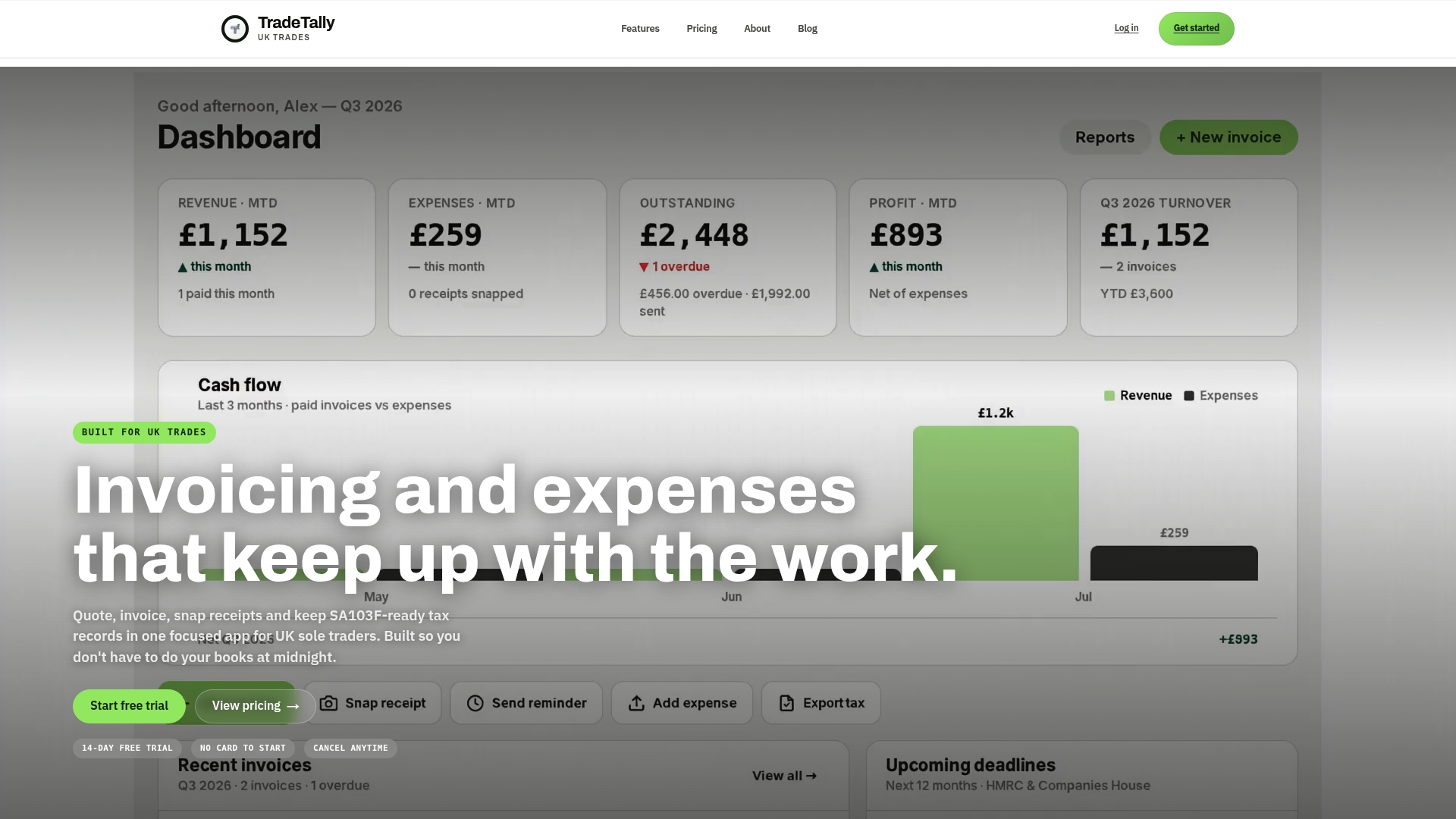
Some apps let you create quotes with standard terms attached from your phone, log acceptance against jobs, calculate VAT, and export records in SA103F format for Self Assessment.
The Starter plan is free for limited invoicing if you want to try the workflow first. The Professional plan costs £12 per month, or £120 per year, and unlocks unlimited quotes, invoices and tax exports. Whichever template you use, tailor it to the specific job in front of you, and get a solicitor to look over anything with an unusual liability risk before you send it.
Sources
For the specifics behind this guidance, these are the primary sources worth bookmarking:
- Late Payment of Commercial Debts (Interest) Act 1998
- Gov
- Before you get building work done - Citizens Advice
For anything unusual, an unfamiliar liability risk, a large commercial contract, or a dispute that’s already escalated, get advice from a solicitor rather than relying on a template alone.
FAQ
What are the standard terms and conditions for a quote?
A standard UK quote should state the scope of work, a fixed price with VAT treatment made clear, a validity period, payment terms including any deposit, a variations clause, and cancellation terms. Keeping these on the face of the document, rather than in linked small print, gives them the best chance of being enforceable.
Are quotes legally binding in the UK?
Yes, a written quote accepted by a customer is normally a binding contract, and Citizens Advice confirms a trader generally cannot charge more than the quoted price unless extra work is agreed or there was an obvious mistake. Terms within that quote must still meet the fairness requirements of the Consumer Rights Act 2015 to be enforceable.
What are the legal requirements for terms and conditions?
Terms offered to consumers must be fair and written in plain, intelligible language, as set out in GOV.UK guidance on unfair contract terms. Important terms, such as price, validity and cancellation rights, should be presented prominently rather than hidden in dense small print.
Are you legally bound if you accept a quote?
Yes, accepting a quote, whether by signature, email confirmation or by letting work start after agreeing verbally, generally creates a binding contract at the price stated. The trader can only charge more later if you agree to extra work or there was a genuine, obvious error in the original figures.
Recommended
Ready to sort your trade admin?
TradeTally gives UK sole traders invoicing, expenses, and SA103F-ready tax exports in one mobile-first app.
Start 14-day Pro trial →No card required