CIS Gross Payment Status: Who Qualifies and How to Apply

Gross payment status means your contractor pays you in full, with no 20% CIS deduction taken off each invoice. You then report the income and pay your tax and National Insurance yourself through Self Assessment. To get it you must pass three HMRC tests (turnover, business and compliance), apply for it, and then stay on time with your tax to keep it. What decides the outcome is your records: clean turnover figures and a clear tax history.
TL;DR
- Gross payment status is 0% deduction instead of 20% (30% if you are not registered for CIS at all). You pay your own tax instead.
- As a sole trader you need at least £30,000 of net construction turnover in the last 12 months, a business bank account and a record of paying tax and National Insurance on time.
- Everyone starts on net status. HMRC confirms gross only once you pass the tests, and a false statement can cost a penalty of up to £3,000.
- HMRC reviews gross status every year. Late returns or payments can lose it, and you wait a year before you can reapply.
- Gross status does not move with you if you change from sole trader to limited company. You register and apply again.
Table of Contents
- What gross payment status actually changes
- Who qualifies: the three tests
- How to apply for gross payment status
- Evidence that makes the application easy
- What you still pay with gross status
- Keeping gross payment status
- Changing from sole trader to limited company
- Our perspective
- Start with records that are ready for HMRC
- FAQ
- Sources
What gross payment status actually changes
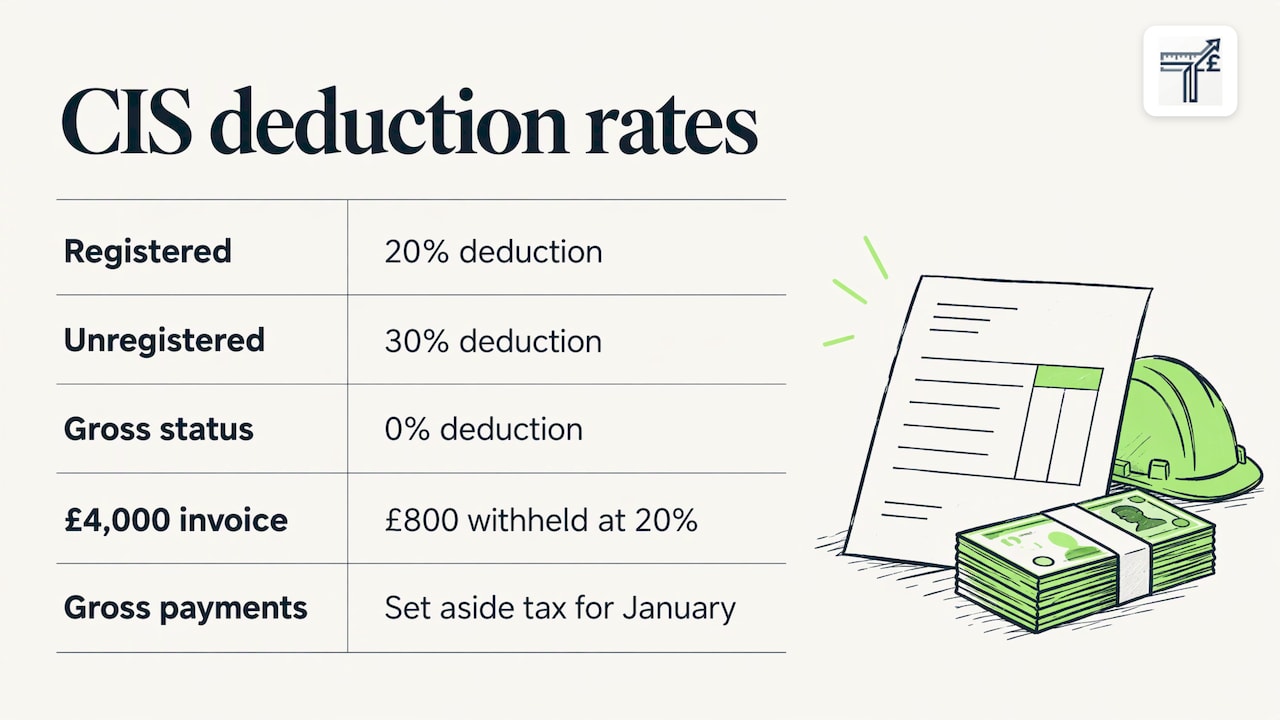
Under the Construction Industry Scheme (CIS), a contractor holds back money from your invoice and pays it to HMRC as an advance towards your tax and National Insurance bill. GOV.UK sets the rates at 20% for registered subcontractors, 30% for unregistered ones and 0% for those with gross payment status, as set out in its guidance on making deductions.
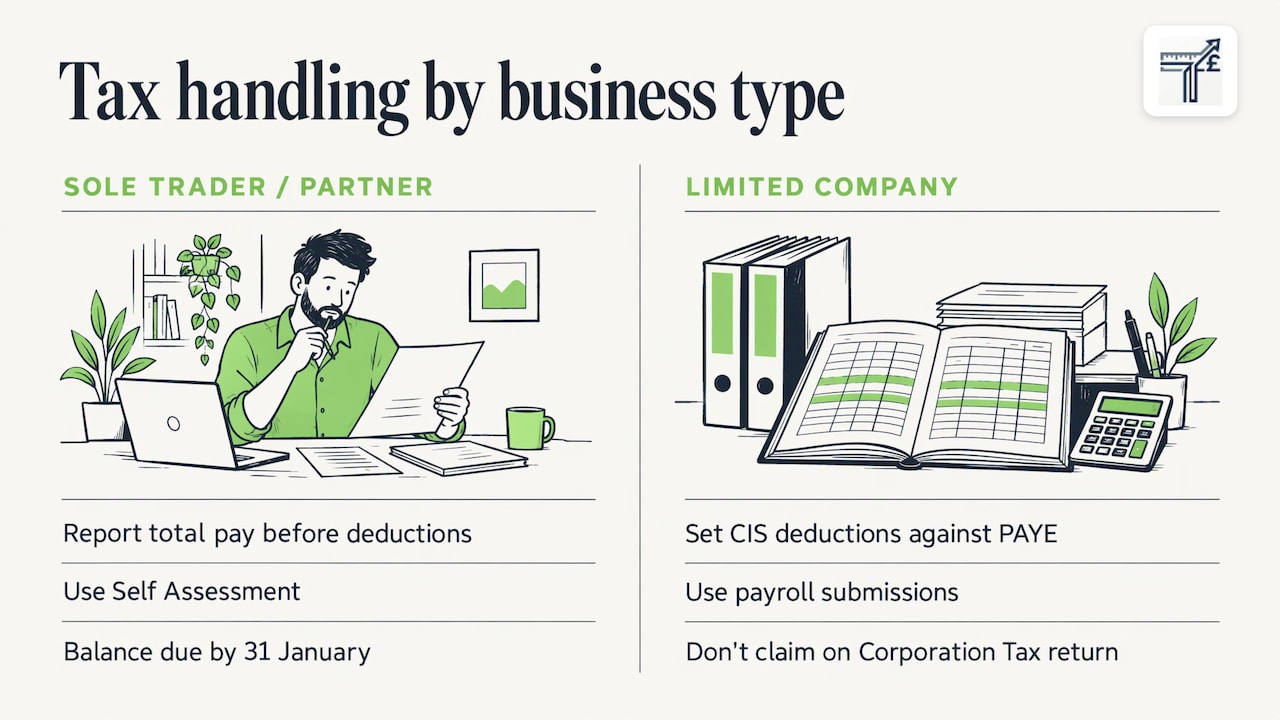
With gross status, the contractor pays you in full and you are responsible for reporting your income and paying tax as normal. Sole traders and partners do that through Self Assessment. Limited company owners do it through company accounts and tax returns.
The practical gain is cash flow. On a £4,000 labour invoice, a 20% deduction takes £800 before the money reaches you. You get it back later through your tax return, but in the meantime it is not in your account for materials, van costs or your own wages. If you want the rate side explained in more detail, our guide to the three CIS deduction rates walks through each one.
The other side of the coin is discipline. With no deductions being taken for you, nobody is setting tax aside on your behalf. If you take gross payments, you need to put money away for your January bill and your payments on account.
Who qualifies: the three tests
HMRC sets three tests for gross payment status. Per GOV.UK’s gross payment page, your business must have paid tax and National Insurance on time in the past, carry out construction work (or provide labour for it) in the UK, and be run through a bank account. HMRC’s internal manual groups these as the turnover, business and compliance tests.
The turnover test
Over the last 12 months, your turnover must reach the following, according to GOV.UK:
| Business type | Minimum turnover (last 12 months) |
|---|---|
| Sole trader | £30,000 |
| Partnership | £30,000 per partner, or £100,000 for the whole partnership |
| Limited company | £30,000 per director, or £100,000 for the company |
A company controlled by five people or fewer needs £30,000 for each of them. The details of how HMRC counts the people are in its manual on the turnover thresholds.
The figure that counts is net construction turnover. HMRC’s CIS302 guidance notes define it as your income from construction work excluding VAT and excluding the cost of materials. Their worked example: £37,000 of payments less £5,000 of materials leaves £32,000, which passes the £30,000 test.
That means a plumber who invoices £34,000 including £6,000 of materials has £28,000 net turnover and falls short. Know your net figure before you apply, not just your headline sales.
The compliance test
This is where most refusals and cancellations come from. The CIS302 notes list what HMRC looks at over the 12 months before you apply:
- Self Assessment returns filed on time
- Your own National Insurance paid on time
- If you are a contractor too, your monthly CIS returns and deductions paid on time
- If you are VAT registered, VAT returns and payments on time
- If you employ people, PAYE and National Insurance on time
- Any information HMRC asks for supplied
HMRC’s compliance test manual gives the specific failure points. They include any return still outstanding at the time you apply, any return more than 28 days late, four or more monthly or VAT returns that are late by under 28 days, any late National Insurance payment, and PAYE, VAT or CIS payments of £100 or more that are over 14 days overdue.
Pro tip: before you apply, check your Self Assessment, VAT and any other HMRC accounts for anything outstanding or recently late. A single missed return is enough to fail.
Is the work genuinely self-employed?
Gross status does not by itself prove you are self-employed. HMRC’s guidance says the contractor must establish employment status for each job, and a contractor who skips that check can end up liable for deductions. Applicants must also declare their employment circumstances for the past 12 months. Our piece on why CIS does not prove self-employment covers this in more depth.
How to apply for gross payment status
Every applicant starts on net status, which is the 20% rate. HMRC grants gross only once you have passed the tests. The form depends on how you trade, as listed in HMRC’s registration manual:
- CIS301: sole traders registering for net payment only
- CIS302: sole traders applying for gross payment
- CIS304: partnerships and trusts
- CIS305: companies and unincorporated bodies
Here is the routine for a sole trader.
1. Work out your net construction turnover
Add up everything you invoiced for construction work in the last 12 months, then take off VAT and the cost of materials. Use your invoices and receipts, not memory. If the figure is under £30,000, applying now will not succeed.
2. Check your tax record
Confirm that every return was filed and every payment made on time in the same 12-month window. If something is outstanding, sort it first.
3. Gather your details
For a partnership, HMRC’s CIS304 guidance asks for the partnership’s Unique Taxpayer Reference (UTR, the 10-digit number HMRC gives your business), 12 months’ turnover with evidence, bank account details, and each partner’s name, address, UTR and National Insurance number. As a sole trader you will need your own UTR, National Insurance number and bank details to hand.
4. Complete the form and declare honestly
HMRC’s notes are clear that false information means the status will not be granted and a penalty of up to £3,000 can be charged. Do not round turnover up. If a figure is estimated, work it out properly from your invoices first.
5. Wait for HMRC’s decision
HMRC confirms the outcome. Until then you stay on net status and contractors keep deducting 20%. Check your CIS status with your contractor once it changes, because they must verify you with HMRC before paying you gross.
If you are a partnership or company, expect to use the CIS304 or CIS305 route. Companies wholly owned by companies that already hold gross status can skip the turnover test, according to HMRC’s CIS305 notes.
Evidence that makes the application easy
The test is only as good as the records behind it. Turnover figures that take an hour of digging through bank statements are the ones that go wrong. Three habits make the difference:
- Invoice every job as it finishes, with labour and materials shown separately. That split is what gives you the net construction turnover figure HMRC wants.
- Log receipts the day you buy, so materials costs are documented and your net figure is accurate.
- Keep your CIS deduction statements and check them against your own records. Our guide to what to verify on CIS statements shows the common mismatches.
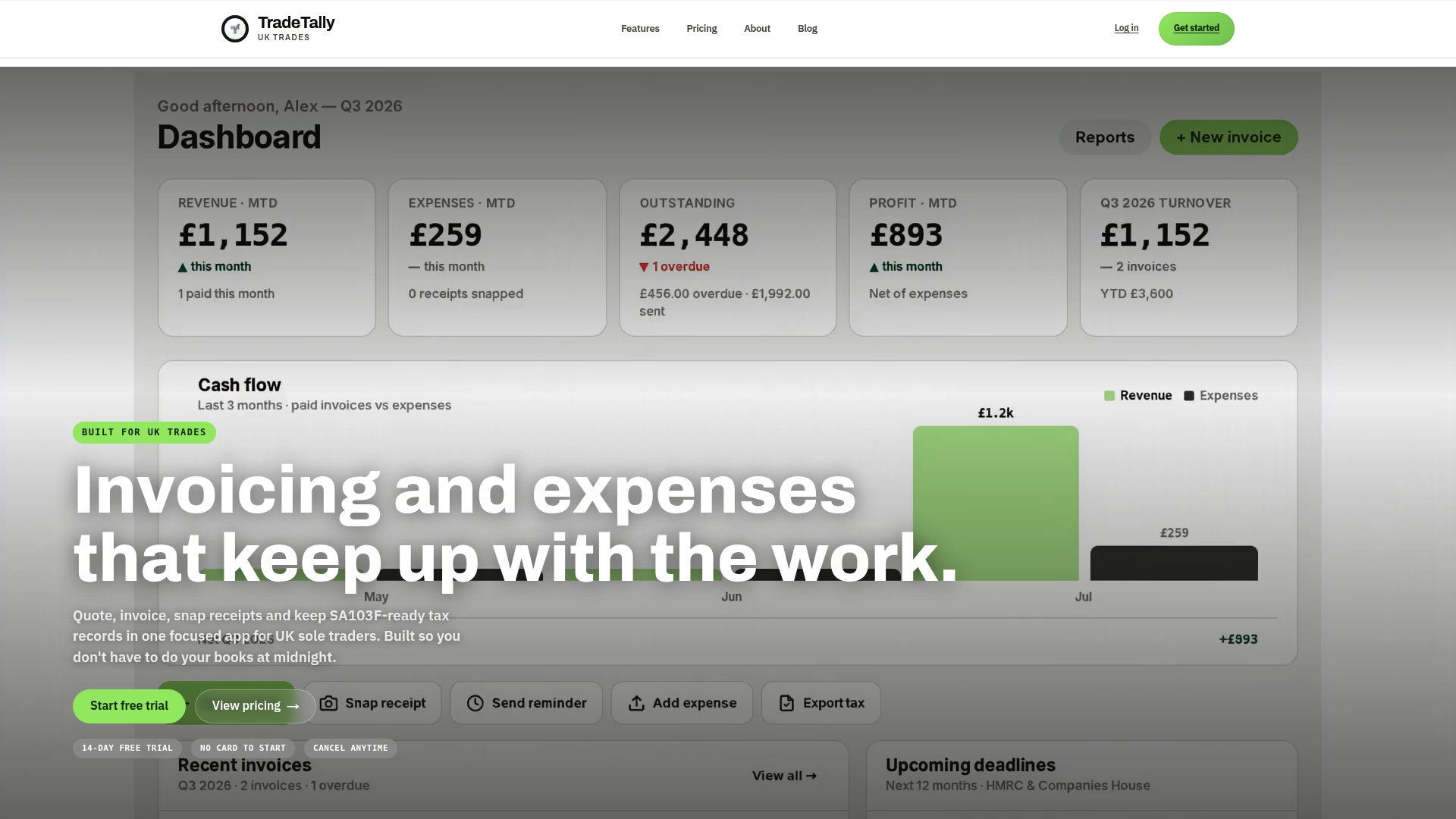
TradeTally is built for this. You can raise branded invoices, capture receipts from your phone and keep expenses in one place, and the records export in a format aligned to the SA103F self-employment pages for Self Assessment. With CIS deduction handling built in, your turnover and tax figures are ready when HMRC, or your accountant, asks for them.
What you still pay with gross status
Gross does not mean tax-free. As a sole trader or partner you record your total pay before deductions as income on your Self Assessment return, and any balance is due by 31 January, as GOV.UK’s guidance on paying tax explains. If you run a limited company, CIS deductions are set against PAYE through your payroll submissions, and you must not claim them on the Corporation Tax return or you may get a penalty.
A sensible habit is to move a fixed share of every payment into a separate savings account as soon as it lands. What share depends on your profit and your tax band, so ask your accountant for a figure that suits you.
Worth knowing for later: lenders treat CIS income differently depending on how it is evidenced. If you plan to buy a home, this overview of CIS income for mortgages explains how deduction vouchers and SA302 tax calculations are used, which is another reason to keep tidy records.
Keeping gross payment status
HMRC reviews gross status every year. GOV.UK says you must be on time with tax returns and payments to keep it. If you fail the review, HMRC gives you its reasons and you can write back. If it does not accept your explanation, the status is withdrawn after 90 days. You have 30 days from the letter to appeal, and you must wait a year from cancellation before you can reapply.
Two points help. If HMRC agrees more time to pay, that does not affect your gross status. And a limited company is reviewed as the company, not each director or shareholder individually.
HMRC also tightened its enforcement. Its policy paper on tackling CIS fraud noted measures due to take effect from 6 April 2026 and legislation in April 2024 to strengthen the gross payment tests. For an honest subcontractor with tidy records the takeaway is simple: keep paying on time and keep your paperwork accurate.
Changing from sole trader to limited company
Gross status belongs to the business HMRC approved, not to you personally. GOV.UK says you cannot transfer a CIS registration from your old structure, so you register again and, if you had gross status, apply again.
If a sole trader incorporates, HMRC’s manual on businesses taken over says the new company may be able to use the “inherited receipts” test, which counts the previous business’s turnover, provided the same people are running the same type of business. Plan the timing so your new company is registered and approved before you rely on being paid gross, otherwise contractors will deduct from your invoices.
Our perspective
We built TradeTally because the admin after a day on site is where tradespeople lose money and sleep. Gross payment status is a good example. Nobody fails it because they are bad at their trade. They fail because a return was filed late, or because they could not say what their net turnover was without a weekend of digging.
That is why we think the answer is the records, not the form. If every invoice goes out the day the job ends, every receipt is captured from the van, and your CIS deductions are tracked as they happen, then your turnover figure, your tax-ready SA103F export and your accountant handoff are all there when you need them.
Gross status rewards the sole traders who run their paperwork like a business. We designed TradeTally so that is the easy way to work.
Simon
Start with records that are ready for HMRC
The Starter plan is free for limited invoicing, and Professional costs £12 per month or £120 per year with unlimited invoices, receipts and tax exports. It includes CIS deduction handling, mileage and time tracking, and MTD-ready record-keeping. See the plans on our pricing page and start with the invoices you raise this week.
If you invoice contractors under CIS, our CIS invoice software page shows how deductions appear on your invoices, and our CIS explainer for subcontractors covers the scheme from the start.
FAQ
Can I apply for gross payment status straight away when I register for CIS?
No. Everyone is first registered on net status, and gross is only confirmed once HMRC is satisfied that you pass the turnover, business and compliance tests. In practice you register for CIS, then apply for gross when your last 12 months of figures support it.
How much turnover do I need as a sole trader?
At least £30,000 of net construction turnover in the last 12 months. Net means income from construction work excluding VAT and materials, so a £37,000 total with £5,000 of materials counts as £32,000.
What happens if I lose gross payment status?
HMRC writes with its reasons and you can reply. If it does not accept your explanation, the status is withdrawn after 90 days. You have 30 days to appeal, and you must wait a year from cancellation before you can reapply. Contractors then deduct 20% from your payments again.
Does my gross payment status carry over if I set up a limited company?
No. The new company must register for CIS and apply for gross payment status itself. It may be able to count your previous business’s turnover if the same people are doing the same kind of work.
Sources
- GOV.UK: Gross payment status for CIS subcontractors
- GOV.UK: Make deductions and pay subcontractors
- HMRC CISR11050: making scheme payments
- HMRC CISR43010: registering and gross payment tests
- HMRC CISR44100: turnover thresholds
- HMRC CIS302 notes: individual registration for gross payment
- HMRC CISR46060: compliance test
- GOV.UK: Register a partnership or apply for gross payment status
- HMRC CIS305 notes for companies
- GOV.UK: Pay tax and claim back deductions
- GOV.UK: Annual review of gross payment status
- GOV.UK: Tackling Construction Industry Scheme fraud
- GOV.UK: Changes you need to report
- HMRC CISR43210: business changes and gross payment
- Prosper Home Loans: CIS income proof for mortgages
Recommended
Related articles

Contractor vs Subcontractor under CIS: What Each Must Do
Contractor or subcontractor under CIS? See who is which, what each must do, how the 20%, 30% and 0% deductions work, and when you can be both.
CIS Deduction Rates: 0%, 20% or 30%?
Practical guide to CIS deduction rates (0%, 20%, 30%) for UK contractors: verification, step-by-step calculations, gross status tests and tools to avoid...
CIS Deductions: The Three Rates Explained
A practical UK trades guide to CIS deductions: the three rates, step-by-step calculations, verification duties and a compact compliance checklist.

Subcontractor vs Sole Trader: CIS Explained
See how HMRC tests self employment for UK trades, why CIS registration does not prove status, and how to report deductions through Self Assessment.