Bookkeeper vs Accountant: Which Does a UK Tradesperson Need?

A bookkeeper records your money in and out. An accountant takes those records and turns them into accounts, tax returns and advice. For most sole traders, the first job is simply getting the daily records right: invoices sent, receipts kept, expenses sorted. Once that is in place, an accountant has clean figures to work from, and you often need less of anyone’s time.
This guide explains the difference in plain terms, shows when each is worth paying for, and sets out how to keep your own records in shape on the days you are on site, not at a desk.
TL;DR
- A bookkeeper records and organises transactions. An accountant interprets them, prepares accounts and tax work, and advises.
- The roles overlap, so check what an individual is qualified and set up to do rather than going by the job title.
- Whoever you hire, the records start with you: invoices, receipts, mileage and CIS deductions captured as the work happens.
- Bring in an accountant for tax returns, planning and filing responsibility. Add a bookkeeper when the volume of paperwork outgrows your evenings.
- Tidy daily records make the accountant’s job quicker, which is usually where you save money.
Table of Contents
- The difference in one table
- What a bookkeeper actually does
- What an accountant does
- Where the two overlap
- Do you need a bookkeeper?
- When to hire a bookkeeper, and when an accountant
- How a bookkeeper and an accountant work together
- Keeping the daily records yourself
- Doing the daily bookkeeping with TradeTally
- Our view: fix the records before you pay for help
- FAQ
- Sources
The difference in one table
| Bookkeeper | Accountant | |
|---|---|---|
| Main job | Records and sorts transactions into the right parts of the accounts | Analyses and interprets those records, prepares accounts and tax work |
| Typical tasks | Day-to-day transactions, reconciling bank accounts, chasing invoices, VAT returns | Year-end reports, tax returns, financial statements, forecasting, advice |
| Time frame | Weekly or monthly, ongoing | Often once a year, plus planning conversations |
| Best for | Keeping the paperwork current | Getting the tax and the bigger decisions right |
The split above follows how the Institute of Certified Bookkeepers describes the two roles: a bookkeeper primarily records and organises financial transactions, while an accountant analyses them and may offer broader financial advice. The same source is clear that the roles overlap, and that qualifications and the services each person offers matter more than the label.
What a bookkeeper actually does
Bookkeeping is the record-keeping layer. In practice that means writing down what came in, what went out, and what each item was for, so that every figure ends up in the right place.
According to the ICB, core bookkeeping tasks include recording transactions, balancing the books, reconciling bank accounts, preparing VAT returns and producing monthly reports on your financial position. AAT describes it in similar terms: tracking money coming in and going out, supporting day-to-day cash flow and preparing records for year-end tax returns.
HMRC’s own guidance for businesses it supervises sets out what primary records look like. The HMRC Economic Crime Supervision Handbook lists amounts received and paid, cash records where relevant, and sales and purchase ledgers where required.
For a plumber or electrician, that translates into a few unglamorous habits:
- Every job gets an invoice, with the date and the amount.
- Every material purchase has a receipt attached to it.
- Every payment received is matched to the invoice it settles.
- Mileage and CIS deductions are noted when they happen, not reconstructed in January.
None of this needs a qualification. It needs consistency, which is why it is the part most tradespeople fall behind on.
What an accountant does
An accountant works one step further along. AAT says accountants analyse the information bookkeepers produce and may prepare financial statements, carry out audits and forecast what a business will need next.
For a sole trader, the work you are most likely to pay for is:
- Preparing and filing your Self Assessment return
- Working out what you owe and what you can legitimately claim
- Advising on whether to stay a sole trader or consider other structures
- Registering for VAT or PAYE when your business reaches that point
- Budgeting, pricing and cash flow planning
The last two are worth noting. AAT’s guidance on finding an accountant says a good accountant can help with business plans, VAT or PAYE registration, budgeting, forecasting, cash flow, pricing and credit control. ICAEW adds that accounting includes responsibility for meeting filing deadlines and requirements, which is a large part of what you are paying for when someone else files on your behalf.
Where the two overlap
The line is blurrier than most explainers admit. Some bookkeepers are qualified to go well beyond record-keeping. The ICB says its bookkeepers may be qualified to provide payroll, Corporation Tax, Self Assessment and financial statements for Companies House. AAT says its licensed bookkeepers can offer up to five service types, including sole-trader and partnership accounts preparation, VAT and payroll.
Some firms also bundle bookkeeping, accountancy, tax and advice under one roof, as ICAEW notes. So when you are comparing quotes, ask what is included, not just what the person is called.
Do you need a bookkeeper?
You need bookkeeping. Whether you need a bookkeeper is a separate question.
Business.gov.uk advises setting aside time every week for bookkeeping, so you know what you have, what you owe and what you are owed. It also says good records help you understand income and spending, plan and budget, pay the right amount of tax and show lenders or investors that the business is healthy.
So the real question is whether you can keep that weekly routine going. A few signs you cannot:
- Receipts live in a glovebox, a jacket pocket or a camera roll
- You are not sure which invoices have been paid
- You find out what a job really made only when the year ends
- Sunday evenings are spent on paperwork
- You are dreading a tax return because you cannot see the year clearly
If several of those sound familiar, the problem is the system, not you. Fix the system first. A bookkeeper then costs less because there is less mess to untangle.
Cash basis or traditional accounting
One choice affects how your records are kept. Sole traders and partnerships can pick between two methods, according to Business.gov.uk. Cash basis records income and expenses when the money actually moves. Traditional accounting records them when they are earned or owed, often when invoices are sent or received. Limited companies, LLPs and partnerships with a corporate partner must use the traditional method.
If you are unsure which suits your work, that is a sensible first question for an accountant.
When to hire a bookkeeper, and when an accountant
ICAEW frames the choice as a division of labour. Keep routine records yourself or hire a bookkeeper, then use an accountant for analysis, advice and filing, depending on your budget and how much record-keeping you can handle. It also notes that some businesses use both.
Here is how that plays out for a typical sole trader.
Hire an accountant when:
- It is your first Self Assessment return and you want it filed correctly
- You are weighing up VAT registration or a change of business structure
- You want advice on pricing, cash flow or planning for tax
- You would rather someone else carried responsibility for deadlines
Hire a bookkeeper when:
- You are issuing a lot of invoices and chasing a lot of payments
- You have staff or subcontractors, and the records are multiplying
- You are VAT registered and returns are eating your time
- You have the money but not the hours
Do the day-to-day yourself, with the right tool, when:
- You are a sole trader with a manageable number of jobs
- You would like to see how each job performed as it happens
- You want to hand your accountant a clean set of records once a year
The third path is where many one-person trades land, and it is the one this article spends the rest of its time on.
How a bookkeeper and an accountant work together
The two are not rivals. The ICB reports that 64% of the bookkeepers it surveyed were in touch with an accountant often or very often, and fewer than 2% said they never worked with one.
The handover is straightforward. A bookkeeper monitors daily transactions, digitises receipts, chases invoices and keeps the accounts reconciled. The accountant then uses those records to make adjustments and prepare tax returns, financial statements and year-end reports.

HMRC makes the same point from a different angle. Its handbook says up-to-date bookkeeping lets a business monitor cash flow and spot problems quickly, and that the records form the basis of the accounts and tax computations. In other words, bookkeeping is not just a tax-season chore. It is how you see trouble coming.
That has a practical consequence for tradespeople. The better the records arrive, the less time an accountant spends sorting, and the more they spend advising. If you are chasing late payers as well, our partner-free advice is the same as the professionals’: get invoices out promptly and keep an eye on tracking unpaid invoices as a routine, not an emergency.
What to hand over, and when
Whoever does the next stage, they will want the same things:
- A list of invoices raised and the payments received against them
- Receipts for every business expense
- Mileage and time records
- CIS deduction statements, if you work as a subcontractor (our guide to CIS for subcontractors explains how the deductions work)
- Bank statements covering the period
Have these in one place all year and the handover takes minutes. Hunt for them in January and it takes days. Our Self Assessment records checklist goes through what to keep and for how long.
Keeping the daily records yourself
For many sole traders, the choice is not really bookkeeper or accountant. It is whether the daily admin can be made light enough to do between jobs. That is a question of tools and routine.
A workable routine looks like this:
- Invoice the same day. The longer you wait, the longer you wait to be paid, and the more likely details are to slip.
- Photograph every receipt when you buy. Not at the weekend. At the counter or in the van.
- Log mileage and time as you go. Reconstructed mileage is guesswork.
- Record CIS deductions on the invoice they belong to. Misplaced deductions are a common cause of tax-time confusion.
- Check profit job by job. Revenue is not profit. Knowing what each job really made tells you whether your pricing works. Our guide to pricing your trade services helps with that.
- Set tax money aside. Our piece on sole trader cash flow and a tax pot covers a simple way to do it.
If you want a wider comparison of hiring help against using software, our article on a bookkeeper or an admin app for sole traders sets out the trade-offs for a one-person business.
Doing the daily bookkeeping with TradeTally
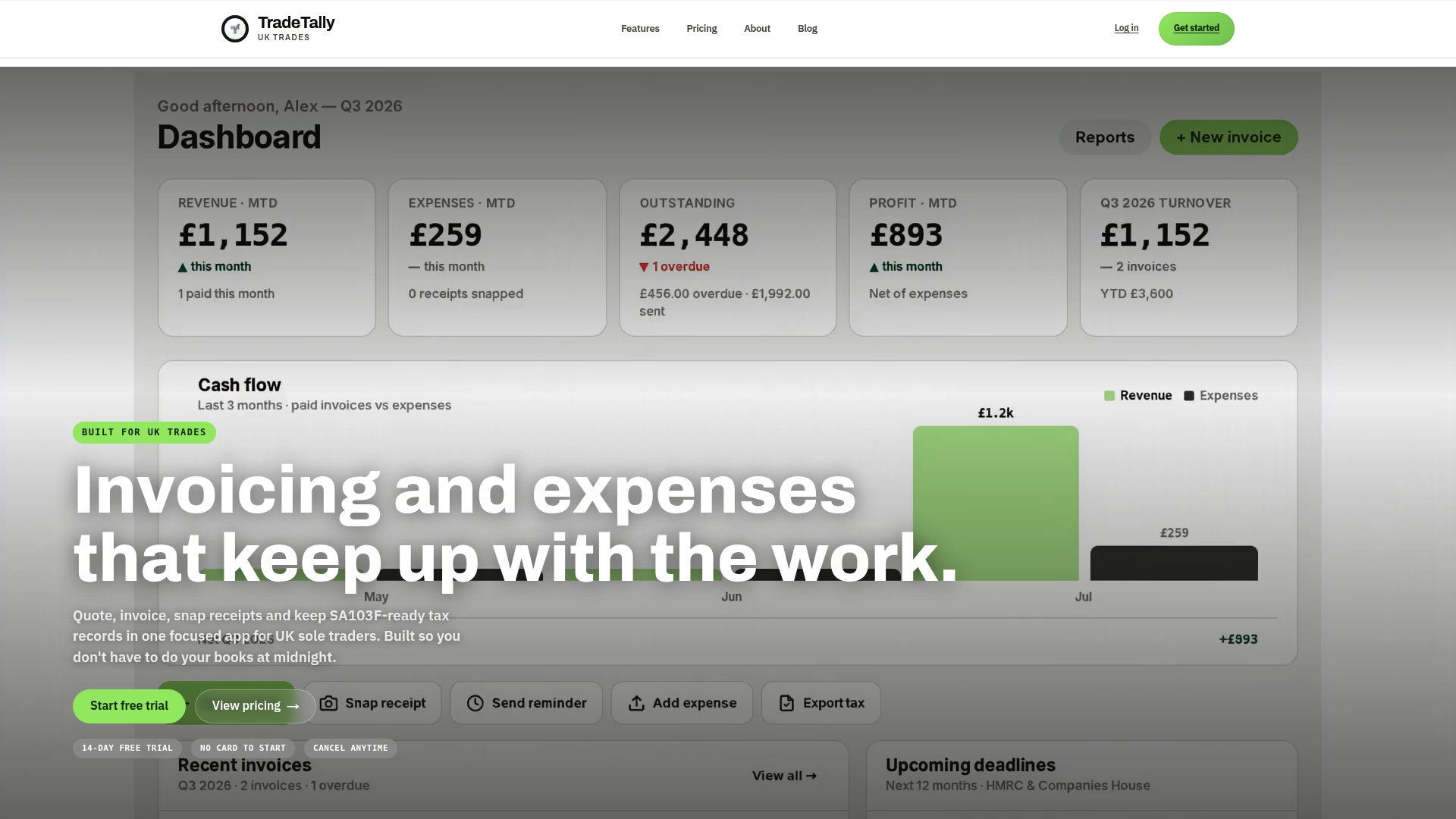
TradeTally is a UK web and mobile app for sole tradespeople, built by a working tradesperson for the admin that follows a day on site. It brings branded invoicing, quotes, expense and receipt tracking, mileage and time tracking and CIS deduction handling into one place, with a live profit dashboard showing how each job is doing.
When the year ends, it produces tax-ready records with an SA103F export (the self-employment page of the Self Assessment return), and it keeps MTD-ready records with straightforward exports for Self Assessment and for handing to an accountant. That is the clean set of records an accountant wants, built up as you work rather than rebuilt afterwards.
The Starter plan is £0 per month, with limited invoicing. The Professional plan is £12 per month or £120 per year, for unlimited invoices, receipts and tax exports. You can see both on the TradeTally pricing page.
Our view: fix the records before you pay for help
Most of the tradespeople we talk to do not have an accountancy problem. They have a paperwork-in-the-van problem. The receipts are somewhere, the invoices are mostly sent, and the picture only comes together in January.
We built TradeTally because the admin that follows a day on site should not need an accountant’s patience to survive. If an invoice goes out the same day, a receipt is photographed at the counter and a CIS deduction is logged where it belongs, the books are largely done before you have thought about them.
That does not make an accountant less useful. It makes them more useful. When your records arrive in order, with an SA103F-ready export, the conversation moves from sorting to advice: pricing, tax planning, what to do about growth. That is where their time is best spent, and where yours is too.
So our advice is simple. Get the daily habits working first. Then pick the professional who fits the next stage of your business.
Simon
FAQ
Is bookkeeping better than accounting?
Neither is better, because they do different jobs. Bookkeeping keeps the record of what came in and went out, and accounting interprets that record and prepares the tax and year-end work. Most businesses need both done, whether by two people, one person or by yourself with good software for the daily part.
Can a bookkeeper do my Self Assessment?
Sometimes. The ICB says its bookkeepers may be qualified to provide Self Assessment, and AAT says licensed bookkeepers can prepare sole-trader accounts. Check the qualifications and services of the individual, since the title alone does not tell you.
Do I need a bookkeeper if I am a sole trader?
You need up-to-date records, but not necessarily a bookkeeper. Business.gov.uk recommends setting aside time each week for bookkeeping. If you can keep that routine, perhaps with an app that captures invoices and receipts, you may not need one until your volume grows.
What should I give my accountant at year end?
Give them your invoices and payments received, receipts for expenses, mileage, any CIS deduction statements and your bank statements. Organised records let them spend their time on tax and advice rather than sorting.
Sources
- Bookkeepers vs accountants, Institute of Certified Bookkeepers
- Accounting or bookkeeping?, AAT
- How to find an accountant or bookkeeper, AAT
- Hiring an accountant: a small business guide, ICAEW
- ECSH52675 Bookkeeping, HMRC Economic Crime Supervision Handbook
- Setting up business accounting and finance, Business.gov.uk
- How to track unpaid invoices
Recommended
Related articles

Builder Bookkeeping: What to Record, Keep and Claim
Builder bookkeeping explained for UK sole traders: the records to keep for each job, CIS and invoice basics, how long to store them, and a simple weekly routine.

Mobile Bookkeeping for Trades: A Practical UK Guide
How UK sole traders can keep invoices, receipts, mileage and Self Assessment records up to date from the van, with a simple routine and a checklist.
Bookkeeper or Admin App for Sole Traders?
Bookkeeper or admin app - which is better for sole traders? See the real trade-offs on invoicing, expenses, cash flow and tax prep.

Accountant Handoff Checklist for UK Sole Traders
A practical accountant handoff checklist for UK sole traders: what to gather, what to ask for, and how to avoid gaps when you switch or start with an accountant.