HMRC Simplified Expenses for Sole Traders: Rates and Rules

Simplified expenses let a sole trader claim flat rates for vehicle costs, working from home and living at business premises, instead of adding up every receipt. For most tradespeople the one that matters is mileage: for 2026-27 it is 55p a mile for the first 10,000 business miles in a car or van. The rates are easy. The part that catches people out is the record you need to keep behind them, and that is where a tool built for the job earns its place, because a mileage figure you cannot back up is just a guess.
TL;DR
- Simplified expenses are optional flat rates for three things only: vehicles, working from home and living at business premises. Everything else is claimed at actual cost.
- For 2026-27, cars and vans get 55p a mile for the first 10,000 business miles and 25p after that. Motorcycles get 24p.
- Working from home is £10, £18 or £26 a month depending on your business hours, and only from 25 hours a month.
- Once you use the mileage rate for a vehicle, you stay on it for as long as that vehicle is in the business.
- Keep a log of every business journey as you go. The flat rate is applied at the end of the tax year.
Table of Contents
- What simplified expenses are, and who can use them
- Mileage rates for 2026-27
- What the mileage rate covers
- Working from home flat rates
- Living at your business premises
- Flat rate or actual costs?
- Records you need to keep
- Where TradeTally fits in
- Our perspective
- FAQ
- Sources
What simplified expenses are, and who can use them
GOV.UK describes simplified expenses as a way of working out some business costs using flat rates instead of actual costs, and says they are optional. Sole traders and partnerships with no company as a partner can use them. Limited companies cannot.
HMRC’s own manual confirms the scheme has run since April 2013, has no business income limit and works whether you use traditional accounting or the cash basis. You can pick it for one vehicle and not another, and for one category and not another.
Three categories have flat rates:
- Business costs for some vehicles
- Working from home
- Living at your business premises
Everything else, such as tools, materials, insurance, phone and software, stays at actual cost. The flat rate replaces the sums, not the receipts for everything else, so you still need a tidy record of those. Our guide to allowable expenses for tradespeople covers the full list.
Mileage rates for 2026-27
The GOV.UK vehicles page sets these rates for 2026-27:
| Vehicle | First 10,000 business miles | After 10,000 miles |
|---|---|---|
| Cars and goods vehicles (vans) | 55p | 25p |
| Motorcycles | 24p | 24p |
Before 6 April 2026 the first-10,000-miles rate was 45p. The Low Incomes Tax Reform Group notes the new rate applies to the whole of the 2026-27 tax year, not just the months after the change. HMRC also publishes approved mileage rates including 20p a mile for bicycles. Rates can change in future years, so check that page when you file.
A worked example
Say you drive 11,000 business miles in your van in 2026-27. GOV.UK’s own example gives the sum:
- 10,000 miles × 55p = £5,500
- 1,000 miles × 25p = £250
- Total claim: £5,750
That is a deduction from your taxable profit, not money paid back to you. The Tax Confident guidance for self-employed drivers makes the same point.
What the mileage rate covers
HMRC’s manual says the rate covers buying, running and maintaining the vehicle: fuel, oil, servicing, repairs, insurance, vehicle excise duty, MOT and depreciation. So if you claim mileage, you do not also claim fuel, van insurance or repairs for that vehicle.

It does not cover tolls, congestion charges or parking. Those stay claimable separately when incurred solely for business.
Rules that lock you in
- You cannot use the rate for a vehicle you have already claimed capital allowances on, or whose costs you have already put through your profit calculation.
- Once you use flat rates for a vehicle, you must keep using them for as long as it is in the business.
- Under the cash basis, a deduction for buying a van or motorcycle (but not a car) means you cannot use the mileage rate for it. You then claim the business share of running costs instead.
- Cars designed for commercial use, such as black cabs, are excluded.
Because of the lock-in, decide before the first claim on a new van, not at the end of the year. Our guide to fuel versus mileage claims walks through that choice.
Which journeys count
HMRC says the rate is only for journeys wholly and exclusively for business. Driving from home to a fixed place of work is private. A trip to a customer’s site, a supplier or a merchant counts. A mixed-purpose trip does not.
You must also keep a contemporaneous record, meaning one made at the time rather than rebuilt from memory.
Working from home flat rates
If you do paperwork, quotes and ordering from home, the flat rate depends on the hours a month you spend on business there. GOV.UK sets them at:
| Business hours a month | Flat rate per month |
|---|---|
| 25 to 50 | £10 |
| 51 to 100 | £18 |
| 101 or more | £26 |
Below 25 hours a month you get nothing for that month. Accountants point out the rates are applied month by month, not averaged across the year. GOV.UK’s example: 10 months at 40 hours (£100) plus 2 months at 60 hours (£36) gives £136.
The flat rate does not include phone or internet. You can claim the business proportion of those at actual cost on top. A Tax Network guide also explains that fixed costs such as council tax, insurance, mortgage interest or rent may be claimable separately where part of the home is identifiably used for business, such as a room used only for work. Where that applies, the claim can be larger than the flat rate alone, which is why it pays to run both sums.

Living at your business premises
This one suits a few trades, such as someone living above a shop or workshop. You claim all the premises costs, then deduct a flat amount for personal use. GOV.UK’s figures are £350 a month for one person, £500 for two and £650 for three or more. The Low Incomes Tax Reform Group adds that the deduction only applies to the months each person lives there, and mortgage interest, council tax and business rates are adjusted separately.
Flat rate or actual costs?
Simplified expenses are optional, so the sensible approach is to price both. GOV.UK points to its simplified expenses checker for comparing the two methods.
Some rules of thumb:
- Vans doing high mileage on a fairly new, efficient vehicle: the flat rate is often generous and saves a lot of paperwork.
- Home working: the flat rate is modest. In one worked 2026-27 example, the flat rate plus fixed costs and broadband came to £867.71 against £875.71 on actual costs, a gap of £8. The real value was in remembering the fixed costs.
- Cash flow: claiming business costs properly lowers the profit your tax is based on, which helps when you plan for the bill. This cash flow plan for paying tax on time shows how to set money aside.
Pro tip: do the comparison once a year, before you commit a new vehicle to either method. For vehicles the choice is hard to undo.
Records you need to keep
GOV.UK says to keep records of business miles, hours worked at home and the number of people living at your premises, apply the flat rates at the end of the tax year, and include the amounts in the total expenses on your Self Assessment return.
For mileage, a good log has:
- The date of each journey
- Where you went and why (the customer or job)
- The miles driven
- A running total for the tax year, so you know where the 10,000-mile line falls
The Tax Confident page suggests a phone, notebook or app. Parking fines, speeding tickets and everyday lunches are not allowable. Our mileage log template and HMRC rules and guide to mileage claims go through what a log should show.
If you fall under Making Tax Digital for income tax, the Low Incomes Tax Reform Group notes some self-employed people must keep digital records with software and send quarterly updates. Records built up day by day make that far less painful.
Where TradeTally fits in
The weak point in simplified expenses is rarely the maths. It is the log, kept on the back of a receipt or in a notes app, and found missing in January. TradeTally is a UK web and mobile app for sole tradespeople that covers mileage and time tracking, expense and receipt tracking, branded invoicing and quotes, a live profit dashboard and tax-ready records, including an SA103F export for Self Assessment and handoff to an accountant. It is also MTD-ready for record-keeping.
The Starter plan is free at £0 a month with limited invoicing. Professional is £12 a month or £120 a year, with unlimited invoices, receipts and tax exports. You can see both on the pricing page.
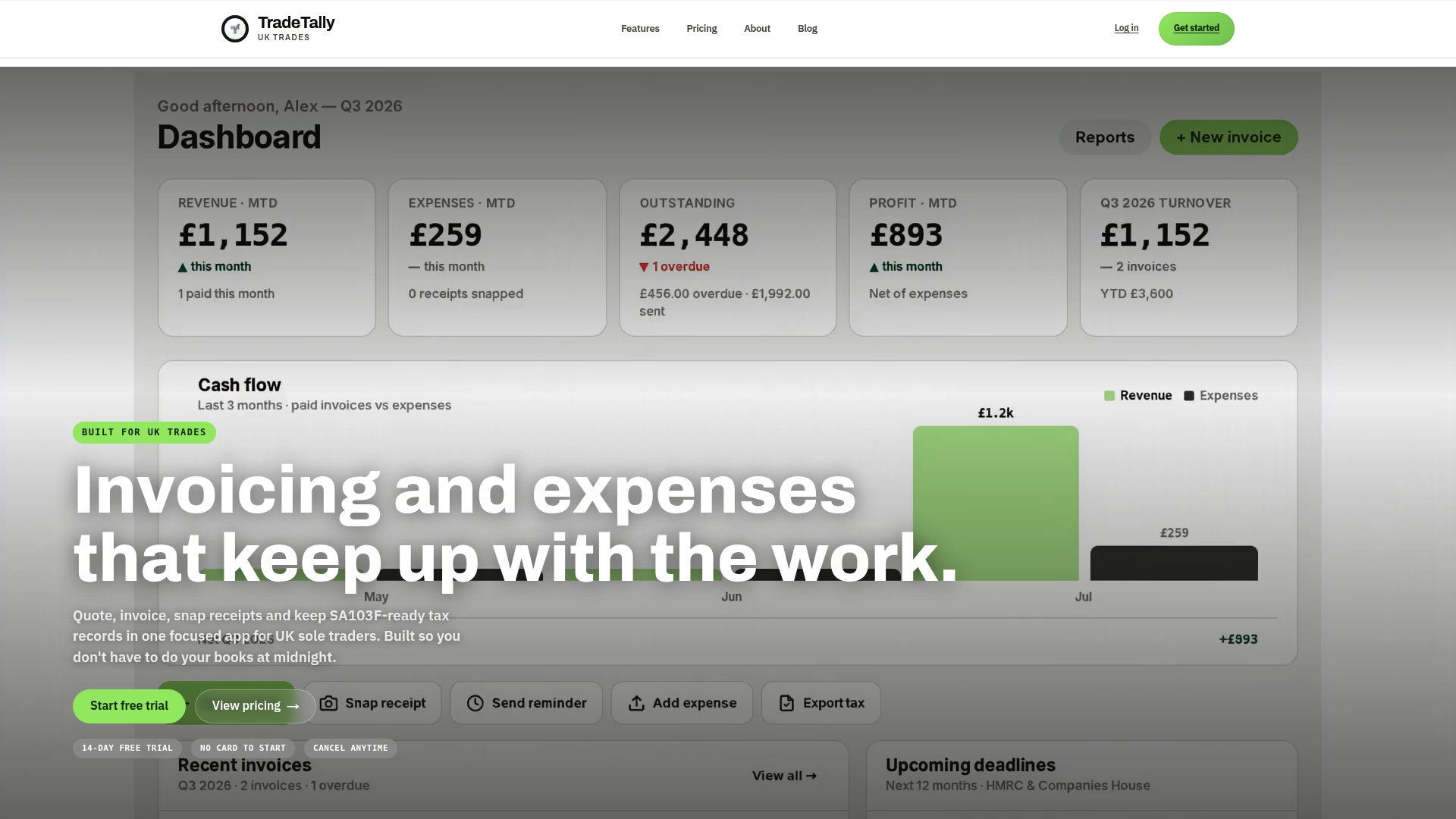
If you want to see how your mileage and receipts sit in one place, start with the TradeTally plans.
Our perspective
We built TradeTally around a working tradesperson’s day, and the same mistake comes up with simplified expenses: people treat the flat rate as the easy bit and the record as an afterthought.
The rate only works if the log stands behind it. A mileage figure that is rounded up in April from memory is weaker than a journey list you added to from the van, and the same goes for receipts for everything the flat rates do not cover.
That is why the app is mobile-first. You log the journey, snap the receipt and send the invoice from the vehicle, and the records end up in a format you can use for the SA103F or pass to your accountant. Less admin after a long day, and less to worry about at filing time.
Simon
FAQ
Can I claim simplified expenses and actual costs for the same van?
No. The mileage rate is instead of actual running costs for that vehicle, and you must stick with your chosen method for as long as you use it in the business. Tolls, congestion charges and parking can still be claimed separately.
Do limited company directors get simplified expenses?
No. Simplified expenses are for sole traders and partnerships without a company as a partner. If you are a sole trader, the scheme applies to you whether you use the cash basis or accruals accounting.
Is the home-working rate worth claiming?
It is simple, and it starts at £10 a month once you work 25 hours a month from home. Remember you can still claim the business share of phone and internet separately. See our guide to tracking business expenses as a sole trader for keeping those bills together.
When do I apply the flat rates?
You keep records through the year and apply the rates at the end of the tax year. The result goes into your total expenses on your Self Assessment return.
Sources
- Simplified expenses if you’re self-employed: Overview (GOV.UK)
- Simplified expenses: Vehicles (GOV.UK)
- Simplified expenses: Working from home (GOV.UK)
- Simplified expenses: Living at your business premises (GOV.UK)
- BIM75001 Simplified expenses: introduction (HMRC)
- BIM75005 Simplified expenses: motor vehicles (HMRC)
- Travel mileage and fuel rates and allowances (GOV.UK)
- How Tax Works for Self-Employed Drivers (Tax Confident)
- Business expenses: allowable for tax (Low Incomes Tax Reform Group)
- Self-employment guide AST5600 (Low Incomes Tax Reform Group)
- Self-employed home working: flat rate or actual costs? (Tax Network)
- Working From Home Tax Relief in 2026/27 (IAK Accountants)
Recommended
Related articles

Fuel vs Mileage Claims: Which Is Better for Sole Traders?
Fuel receipts or the 55p mileage rate? See what UK sole traders can claim, why you can't do both on one vehicle, and how to choose with a worked example.

Vehicle Expenses for Sole Traders
UK tradespeople who are sole traders: learn when 55p per mile or actual costs pays off, how VAT and capital allowances work, and how to keep tax-ready...
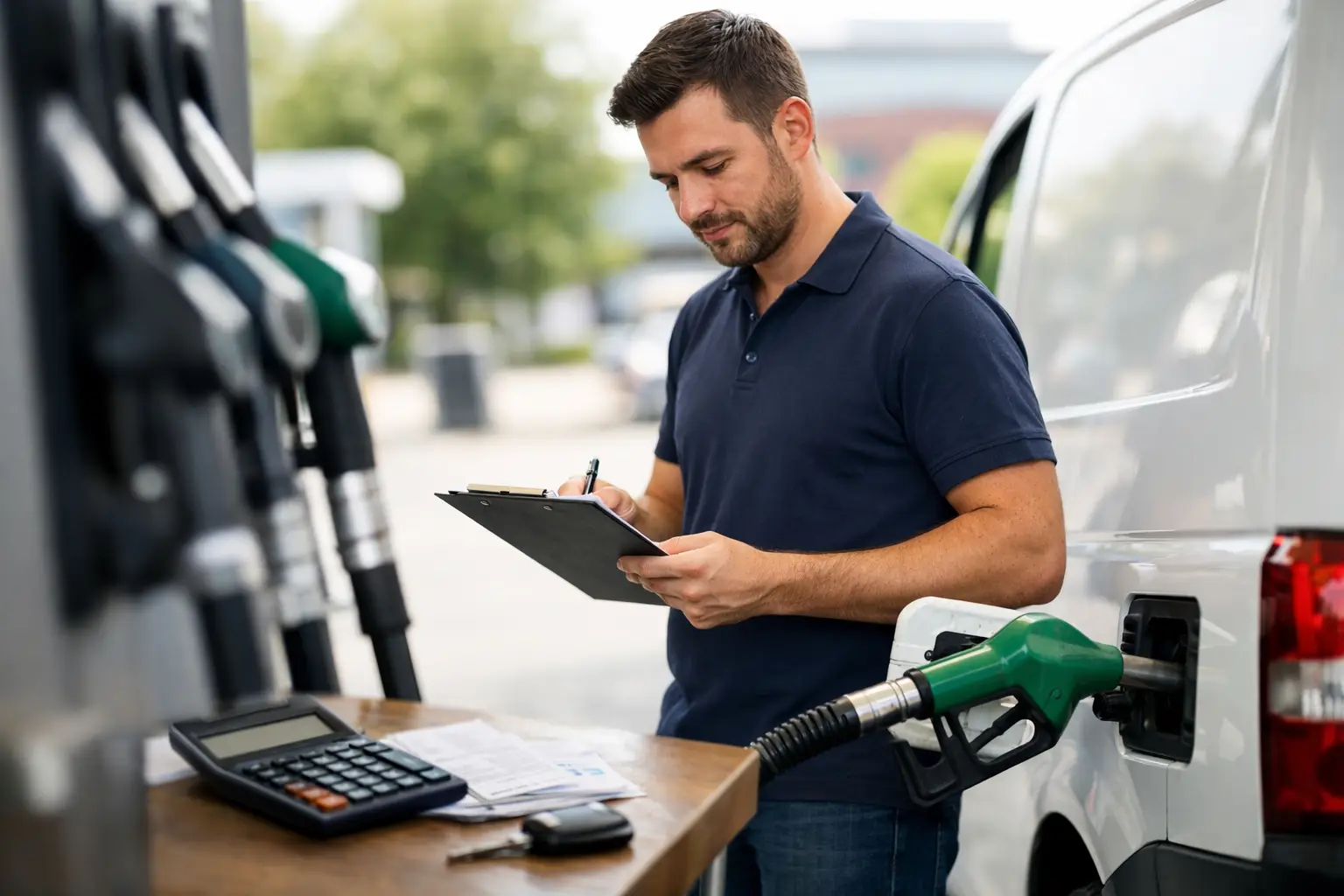
Can Sole Traders Claim Fuel Costs?
Can sole traders claim fuel costs? Yes, but only for business use. Learn HMRC rules, mileage options and what records you need to keep.

Mileage Log Template: 55p per Mile Rules
HMRC checklist and ready to use log template for UK sole traders to keep contemporaneous mileage records, use 55p AMAP and keep logs five years.