Markup vs Margin: How to Price Jobs Without Losing Profit

Markup is the percentage you add on top of your cost to get a price. Margin is the share of the price you actually keep as profit. Same pounds, different base: markup divides profit by cost, margin divides profit by the selling price. That is why a 20% markup is only a 16.7% margin, and why tradespeople who mix the two up quote jobs with less profit than they meant to. If you track each job’s price, costs and profit in one place, the gap shows up before the invoice goes out, not at the end of the tax year.
TL;DR
- Markup = profit ÷ cost. Use it to build a price from your costs.
- Margin = profit ÷ selling price. Use it to check what a job really earned.
- Margin is always smaller than markup. A 25% markup is a 20% margin; a 20% margin needs a 25% markup.
- Work both out on figures before VAT. VAT you charge belongs to HMRC, not to you.
- Cost the job fully (labour, materials, waste, overheads) before you apply either percentage.
Table of Contents
- Markup and margin: the difference in plain terms
- Which one should you use?
- Converting markup to margin (and back)
- A trade example from quote to profit
- What belongs in the cost before you add anything
- What margin should a trade job earn?
- Is 100% markup the same as 50% margin?
- Five habits that keep your pricing honest
- Where a job’s margin gets eroded
- Keep markup and margin in one place
- FAQ
- Sources
Markup and margin: the difference in plain terms
Both figures start from the same two numbers: what the job cost you and what you charged. The only difference is what you divide by.
- Markup = (price − cost) ÷ cost
- Margin = (price − cost) ÷ price
HMRC uses the same split in its own Enquiry Manual. It describes a gross profit rate as profit measured against sales, and a rate of mark-up as profit measured against cost. Inspectors use these to test whether a business’s reported figures look plausible, so it pays to know which one you are quoting.
Here is the simplest example. A bag of materials costs you £1,000 and you charge £1,200.
- Profit: £200
- Markup: £200 ÷ £1,000 = 20%
- Margin: £200 ÷ £1,200 = 16.7%
Nothing changed except the denominator. Because the price is always bigger than the cost, margin is always the smaller number. Margin can never reach 100%, while markup can go well past it: sell something at three times your cost and that is a 200% markup but a 66.7% margin.
Which one should you use?
They do different jobs, so most tradespeople need both.
Markup is the pricing tool. You know your cost, you decide what to add. It suits materials in particular: a markup on supplies pays for ordering, collecting, storing, delivering and replacing faulty items, as BookaBuilderUK points out. Typical UK material markups are listed by ProPlaybooks as 10 to 15% on bulk materials, 15 to 20% on plumbing and electrical supplies, 15 to 25% on finishing materials and 20 to 30% on specialist or hard-to-source items.
Margin is the checking tool. Once the job is done, your gross profit as a percentage of what you charged tells you whether the work was worth doing, and it is the figure your accounts and any benchmark use. Recording the final profit and margin on every job lets you base future prices on evidence rather than memory.
A practical rule: set your price with markup or a target margin, then judge the job by margin.

Converting markup to margin (and back)
The two conversions are short enough to keep in your phone:
- Margin = markup ÷ (1 + markup)
- Markup = margin ÷ (1 − margin)
Worked through: a 25% markup gives 0.25 ÷ 1.25 = 20% margin. A 25% margin needs 0.25 ÷ 0.75 = 33.3% markup.
The table below is rounded to one decimal place.
| Markup on cost | Margin on price | Target margin | Markup you need |
|---|---|---|---|
| 10% | 9.1% | 20% | 25% |
| 15% | 13.0% | 25% | 33.3% |
| 20% | 16.7% | 30% | 42.9% |
| 25% | 20.0% | 40% | 66.7% |
| 30% | 23.1% | 50% | 100% |
| 40% | 28.6% | 60% | 150% |
| 50% | 33.3% | 70% | 233.3% |
Two lines worth remembering. A 30% markup is only a 23% margin, so if you want a 30% margin you need roughly a 43% markup. And a 50% margin means doubling your cost, a 100% markup. A window-trade accountant put it the same way in Window News: a 30% markup on £1,000 of direct costs yields only a 23% gross margin.
Pricing from a target margin
If you decide you want a 25% margin on a job that costs you £360, do not multiply by 1.25. Divide the cost by (1 − margin):
£360 ÷ 0.75 = £480
Multiplying £360 by 1.25 gives £450. That is a 25% markup, but the profit is £90 on £450, a 20% margin. On a job you quote at several thousand pounds, the missing 5 points is real money.

A trade example from quote to profit
Take a flooring job. Materials are £4,500 and labour is £3,500, so direct cost is £8,000 before VAT.
- Apply a 25% markup: £8,000 × 1.25 = £10,000.
- Profit is £2,000. Margin is £2,000 ÷ £10,000 = 20%.
- Add 20% VAT last: the customer sees £12,000.
Now the common slip. Some people work the margin from the VAT-inclusive total: £2,000 ÷ £12,000 looks like 16.7%, or if they subtract the VAT as if it were cost they muddle it further. The safe habit is simple: keep cost, price, markup and margin on ex-VAT figures throughout, and add VAT only on the customer-facing quote. VAT you charge is collected for HMRC, so leaving it in makes your margin look different from what you earn.
If you are VAT-registered and reclaim VAT on materials, your cost is the net figure. If you are not VAT-registered, the VAT you pay on materials is a real cost, so use the gross cost instead.
A second example comes from a bathroom refit job-costing worked example. It starts with a full cost of £6,564.48, including 15% overheads and 5% contingency. Pricing that at £8,205.60 before VAT gives a 20% margin, which is a 25% markup on full cost, and the customer is quoted £9,846.72 including 20% VAT. The lesson is the order of operations: cost it fully first, then add profit, then add VAT.
What belongs in the cost before you add anything
A markup or margin is only as honest as the cost underneath it. Where tradespeople lose money is rarely the percentage; it is the cost base.
- Labour at a fully loaded rate. TradeCoach warns that counting only the hourly wage underprices work. A plumber paid £18 an hour who is productive on billable work for 32 of 40 hours costs far more than £18 per billable hour. Their list of direct costs includes holiday pay, employers’ NI, pension, van, fuel, consumables, small tools, training time and an allowance for unproductive hours. If you work alone, the same logic applies to your own day: travel, quoting and ordering time are not billed unless you price them in.
- Materials and waste. Include offcuts, breakages and delivery charges.
- Plant and sundries. Hired kit, skips, fixings and consumables.
- Direct costs versus overheads. Costs that belong to one job go in the job cost; costs that exist whether or not you work (insurance, phone, software) are overheads. Our guide on two tests for overheads versus direct costs shows how to tell them apart.
If you price bespoke or made-to-order items, the same discipline applies to supplier quotes. A guide on costing a made-to-order job shows how specification and size changes feed through to the final invoice, which is exactly the kind of cost you need to capture before you add your percentage.
To keep the receipts that feed these numbers, see how to track job expenses as a UK sole trader.
What margin should a trade job earn?
There is no single right number, because it depends on how much of the job is labour and how much is materials. TradeCoach’s UK bands for gross margin are:
| Type of work | Healthy gross margin |
|---|---|
| Reactive plumbing, small works | 60 to 70% |
| Electrical callouts and small works | 55 to 65% |
| Boiler swaps and bathroom refits | 45 to 55% |
| Full rewires, first and second fix | 45 to 55% |
| Hard landscaping installs | 45 to 55% |
| Garden maintenance, soft landscaping | 55 to 65% |
The pattern is that the more labour-dominant the work, the higher the margin; the more materials and kit, the lower it falls. TrainAR’s benchmarks show the same shape for plumbing and electrical work. With overheads typically running at 20 to 30% of sales and a 10 to 15% net profit target, TradeCoach says a gross margin below 45% leaves little room for error on domestic work.
To see why that matters, the same source quotes a porcelain patio priced at £9,600 against £5,800 of direct costs. That is a 39.6% gross margin, light for an install. Raising the price to £11,200 with costs unchanged lifts it to 48.2%. Same job, same hours, and the only change was the price.
Now translate the target. If you want a 50% margin on a bathroom refit, your markup on full cost must be 100%, not 50%. As TradeCoach’s Daren Henderson puts it, confusing the two is how you end up selling at a 33% margin when you meant 50.
Is 100% markup the same as 50% margin?
Yes. Selling at double your cost is a 100% markup, and profit is half the price, so it is a 50% margin. The reverse mistake is the costly one: thinking a 50% markup earns you a 50% margin. It earns 33.3%.
Five habits that keep your pricing honest
- Say which one you mean. Write “25% markup” or “20% margin” on your own costing, never just “25%”.
- Work ex-VAT, always. Add VAT as the last line on the quote.
- Put the conversion in your template once. Pick your target margin, work out the markup it needs, and reuse it, rather than doing the sums on a customer’s driveway.
- Price risk in. Add a contingency for scope creep, fixed-price jobs and hard-to-source items, as the bathroom example above does at 5%.
- Record the result. After each job, note quoted price, actual materials and labour, subcontractor costs, variations and discounts, then the final gross profit and margin.
On point 3, our free quote template for sole traders gives you a layout to build your costings into, and the profit margin calculator for trades does the arithmetic for a quick check.
Where a job’s margin gets eroded
Even when the quote is right, the margin can slip during the job. The usual causes are extra materials that never get charged, variations agreed verbally, and hours that overrun the estimate. Logging time against each job helps: our piece on HMRC-ready time tracking for trades covers how to capture it. The aim is that the margin you quoted is the margin you can see on the job, not a guess at year end.
What we think at TradeTally
Most pricing mistakes we hear about from tradespeople are not about bad maths. They happen because the quote is built with one percentage in mind and the accounts judge the job by another. Markup builds the price, margin tells you what you kept, and the two only line up if you convert them on purpose.
That is why we built TradeTally around the admin that follows a day on site. Quote, invoice, receipts and profit for each job belong in one place, so the margin on a job is something you can read off a live profit view rather than rebuild from a shoebox of receipts at the end of the tax year. Do the costing properly, price it, then let the numbers tell you whether the job was worth taking.
Our advice is simple: decide your target margin per type of work, convert it to the markup you need, and keep every figure before VAT.
Simon
Keep markup and margin in one place
TradeTally is a UK web and mobile app for sole tradespeople. It covers branded quotes and invoices, expense and receipt tracking, a live profit dashboard per job, mileage and time tracking, CIS deduction handling and SA103F-ready records for Self Assessment. The Starter plan is free at £0 per month with limited invoicing. The Professional plan is £12 per month or £120 per year, with unlimited invoices, receipts and tax exports. You can see both on the pricing page.
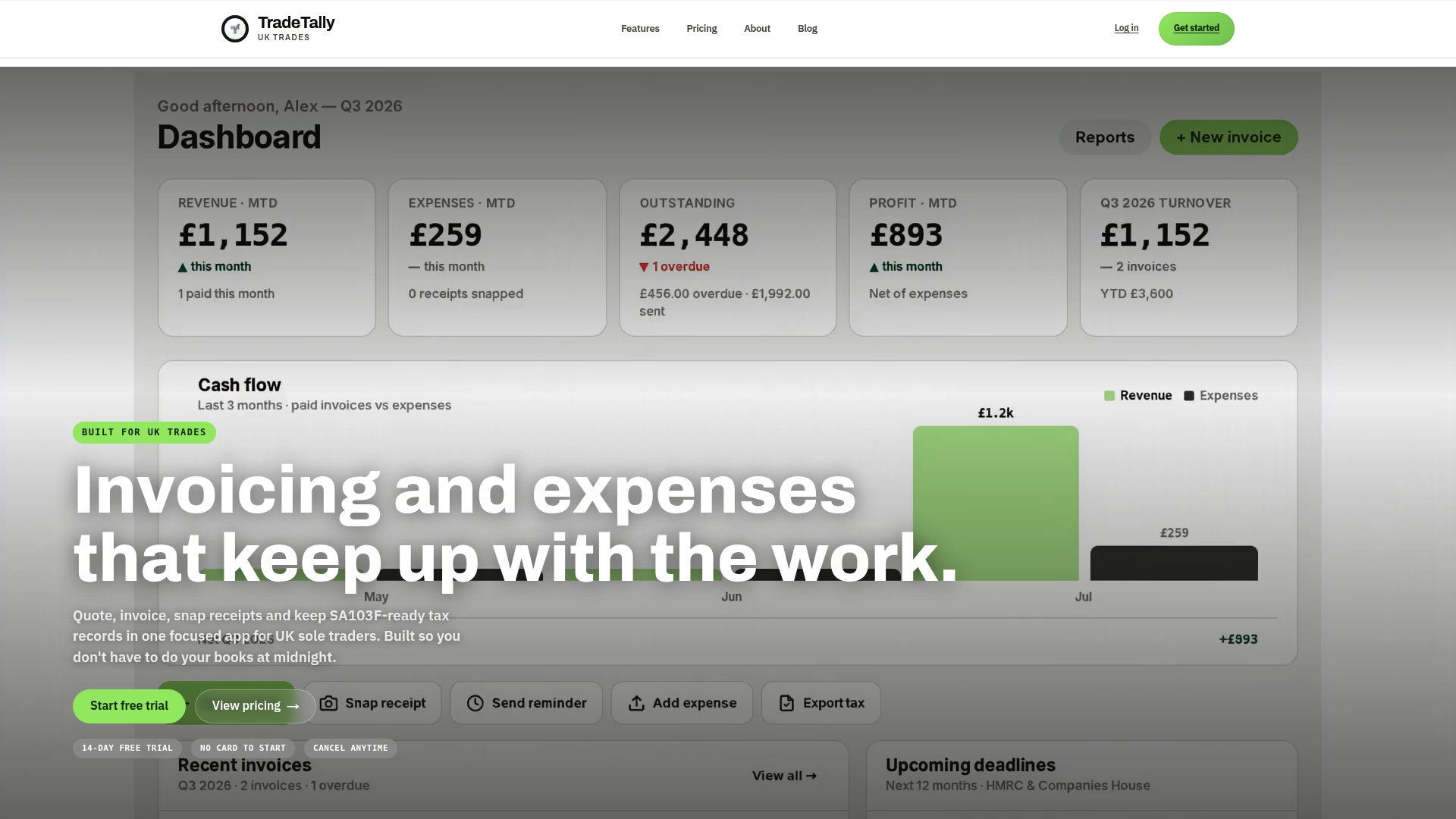
If you want to see what each job really earned, start with TradeTally and put your next quote and its costs in one place.
FAQ
What is the difference between a 30% margin and a 30% markup?
A 30% markup on a £1,000 cost gives a price of £1,300 and £300 profit, which is a 23.1% margin. A 30% margin needs a price of £1,000 ÷ 0.70 = £1,429, which is a 42.9% markup. The 30% margin is the bigger profit share.
What margin is a 20% markup?
A 20% markup is a 16.7% margin. On £1,000 of cost, the price is £1,200 and the profit £200, and £200 is 16.7% of £1,200. To earn a true 20% margin you need a 25% markup, so a price of £1,250.
Should I use markup or margin when I quote?
Use whichever you can apply consistently, but know both. Markup is quick for building a price from costs, especially materials. Margin is what you check afterwards, because it shows the share of the price you kept. Convert between them with the table above so your target and your quote match.
Do I include VAT in markup and margin?
No. Work both on figures before VAT. VAT you charge is collected for HMRC, so leaving it in makes the margin look larger than it is. Add VAT as the last line on the customer’s quote. If you are not VAT-registered, the VAT you pay on materials is a genuine cost and goes into your cost figure.
Sources
- HMRC Enquiry Manual EM3504: Recalculating profits, business models
- Window News: Do you know your gross margins?
- Trustmark Trades: Free job costing calculator
- TradeCoach: What is a healthy gross margin?
- TrainAR: Benchmarking your trades business
- ProPlaybooks: How to price building work in the UK
- BookaBuilderUK: How to calculate whether a job is actually profitable
Recommended
Related articles

Project Profitability for Trades: How to Know What a Job Really Earned
Work out what each job really earns. Costs to include, margin versus mark-up, a worked example and a simple routine for UK sole traders.

CIS safe time and materials invoicing for UK trades
Make time and materials invoicing CIS safe for UK trades: itemise labour and materials, secure signed timesheets, keep VAT records, and produce...

Carpenter Day Rate Calculator Explained
Use a carpenter day rate calculator to price jobs properly, cover overheads, and protect profit without guessing what your time is worth.

UK Tradespeople: Two Tests for Overheads vs. Direct Costs
UK tradespeople can separate job costs from overheads, classify shared expenses with two tests, allocate overhead, and price work while keeping tax records.